
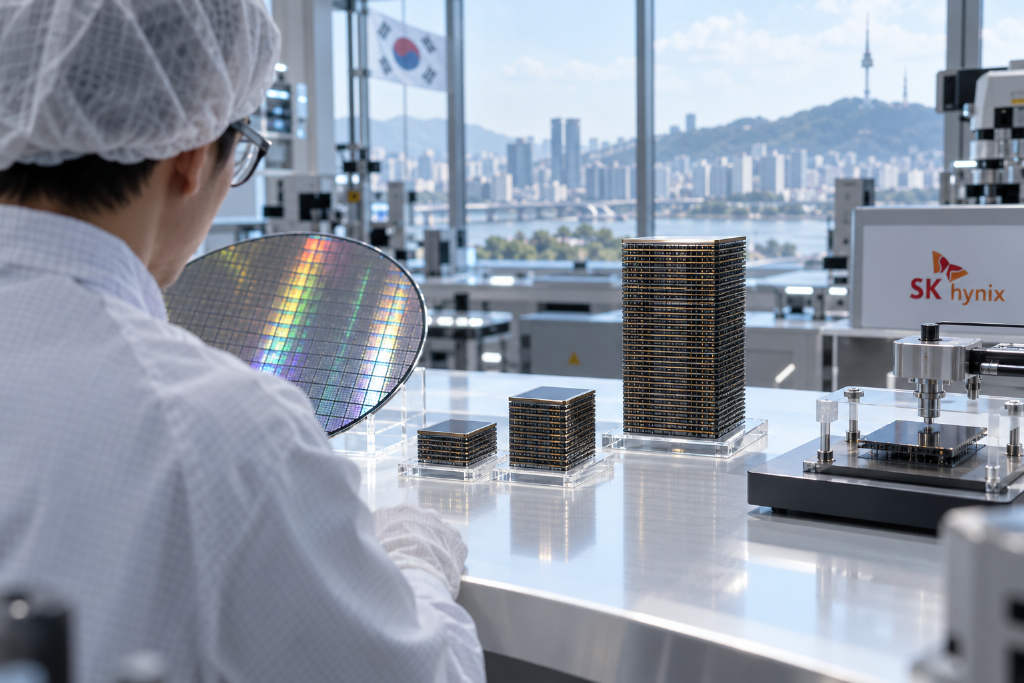
SemiAnalysis said memory suppliers are beginning to acknowledge the "de-spec" argument around high bandwidth memory, or HBM, and the firm is maintaining its bearish stance on D2W hybrid bonding, or die-to-wafer hybrid bonding, in that market.
The core of its case is that hybrid bonding matters in HBM mainly because it helps address total package height in very tall memory stacks. If the market moves toward 4-hi and 8-hi configurations, that constraint becomes far less important.
SK hynix points to 16-hi difficulty as bandwidth takes priority
SemiAnalysis said SK hynix has publicly stated that 16-hi HBM is difficult to manufacture. At the same time, market priorities are shifting, with bandwidth becoming more important than capacity. The research firm said that supports its earlier call that HBM is moving toward de-spec.
In this context, de-spec means HBM is no longer pushing only toward ever-higher stack counts and larger per-package capacity, but is instead giving ground on stack height. SemiAnalysis also made a distinction here: SK hynix has not publicly announced that it is adopting a de-spec roadmap. It has only said that 16-hi is difficult.
The rationale for D2W hybrid bonding weakens at lower stack counts
In HBM, hybrid bonding is mainly sold on the idea of direct copper-to-copper bonding without bumps, which helps solve height limits once many layers are stacked together. SemiAnalysis said that in 4-hi and 8-hi designs, height is not really the issue, so the need to introduce hybrid bonding is much weaker.
In the firm’s words, D2W hybrid bonding for HBM has shifted from a question of "when it will happen" to "whether it will happen at all."
SemiAnalysis also addressed recent market talk that Samsung is using W2W hybrid bonding, or wafer-to-wafer hybrid bonding, to build its first sub-10nm-class DRAM node. The firm said that should not be treated as a positive signal for D2W.
According to SemiAnalysis, that process belongs to the device-layer manufacturing flow, uses a different equipment set, and is still roughly two years away from commercialization. It is unrelated to D2W and is not a thesis for hybrid bonding equipment supplier BESI, the firm said.
Industry views remain split on lower-stack HBM
There is no clear consensus across the market. Jukan, a researcher at Citrini, cited Daishin Securities in South Korea as saying that discussions around mass production of lower-stack HBM, including 4-high and 6-high products, have effectively been canceled. Plans to shift from 12-high to 8-high have also been scaled back, according to that view.
That stands apart from the de-spec argument put forward by SemiAnalysis and suggests the supply chain has not broadly moved toward lower-stack products. The market is still divided on a basic question: how many layers HBM should ultimately use. Some analysts think de-spec will become the trend. Others think customers will still prefer relatively higher stacks, with 12-hi remaining the main configuration.
Bank of America sees 8-hi HBM4 as a possible growth catalyst
Bank of America approached the issue from a different angle. In its report, the bank said some chipmakers could supply 8-hi HBM4 for Rubin GPUs next year. That would mean 8 DRAM dies at 3 GB each, or 24 GB in total, replacing the current mainstream 12-hi setup at 36 GB.
If Rubin typically carries eight HBM stacks, total HBM capacity per card would fall from 288 GB to 192 GB, a reduction of one-third.
Even so, BofA does not see that as a sign of weaker demand. The bank said 8-hi de-spec could become another growth catalyst for memory, and gave three reasons:
- HBM shortages could push suppliers to use fewer layers so they can ship more GPUs.
- More GPUs would need additional memory components, including SOCAMM using LPDDR5, as well as eSSD for key value cache, alongside processors such as Vera CPU.
- Large technology companies could, in theory, pay a premium for 8-hi products.
Still, BofA said it has not yet seen any meaningful wafer input for 8-hi HBM4. It expects shipment volumes for 8-hi HBM4 to remain small through the first half of 2027, and possibly until the third quarter.
SemiAnalysis reiterates its bearish D2W view
From SemiAnalysis’ perspective, de-spec is a clear negative for hybrid bonding equipment tied to HBM because the memory standard would no longer require extremely tall stacks. For memory makers, though, the balance between lower capacity, pricing and volume changes, and extra orders for adjacent products still needs to be tested against actual shipment data.
SemiAnalysis said it will remain bearish on D2W until logic chip stacking reaches real volume and Wall Street forecasts fully remove HBM hybrid bonding from their models.