
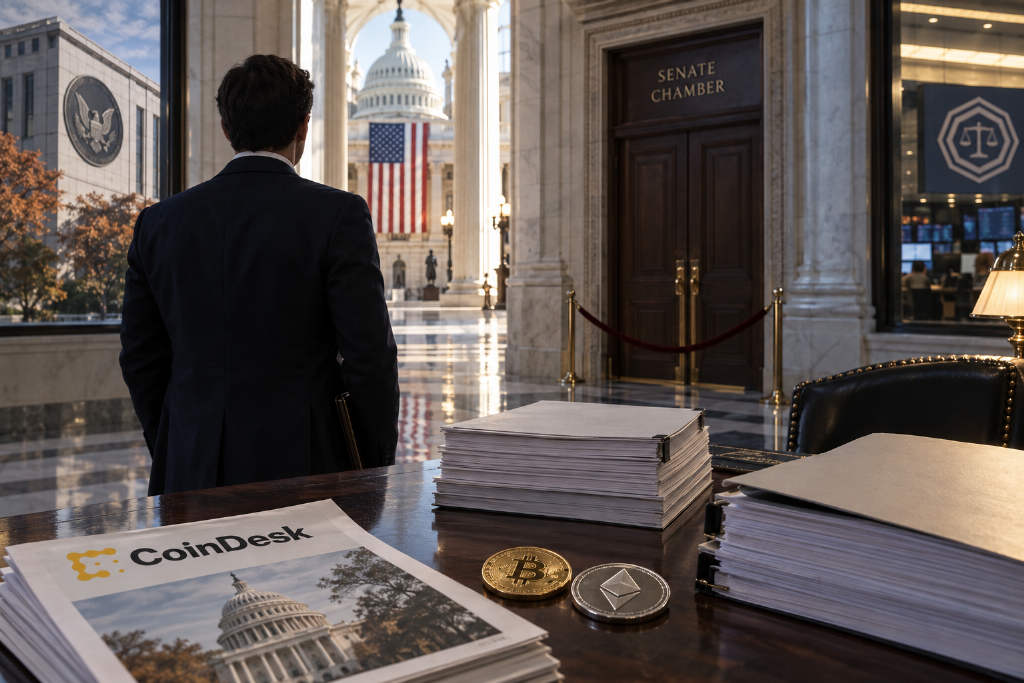
The U.S. Senate recently failed to advance the Digital Asset Market Clarity Act, and with the midterms approaching, there is no realistic path to revive the bill before the end of the year, according to a CoinDesk opinion column published on Oct. 3.
The piece, written by Ryan Chan-Wei, a research fellow at the Cato Institute’s Center for Monetary and Financial Alternatives, says crypto’s long push for regulatory clarity has once again stalled. The bill ran 635 pages and, in the author’s telling, represented the closest Congress has come to establishing a full market structure framework for the sector.
What the Clarity Act was meant to do
As described in the article, the Clarity Act sought to build the rulebook for crypto market structure. That included sorting tokens into legal categories, licensing firms that trade them, and determining how supervisory authority should be split between the Securities and Exchange Commission, or SEC, and the Commodity Futures Trading Commission, or CFTC.
Chan-Wei writes that, if enacted, the legislation could have unlocked what he called crypto’s considerable potential, including broader financial inclusion and lower cross-border payment costs. But he also argues that technical innovation alone is not enough to deliver those outcomes at scale. Regulated institutions, he says, are reluctant to commit capital while the rules remain unwritten, and ordinary Americans have little reason to trust a market that no one fully oversees.
Years of legislative work, still no framework
The column says Congress has long recognized the need for a comprehensive regulatory framework for digital assets. Legislative efforts date back to the Token Taxonomy Act of 2018, and attempts spanning four Congresses have all fallen short. Even so, Chan-Wei says none came as close as the Clarity Act.
He argues that progress will effectively reset when the next Congress is sworn in because key senators who helped drive the bill will no longer be on the ballot.
Retirements could erase the bill’s momentum
The article names two senators in particular: Cynthia Lummis and Thom Tillis.
Lummis, a Republican from Wyoming who chairs the Senate Banking Subcommittee on Digital Assets, is retiring. Tillis, a Republican from North Carolina, is also retiring. According to the column, Tillis helped broker the bipartisan compromise on stablecoin rewards that cleared the Clarity Act’s path out of committee.
In Chan-Wei’s view, that means the groundwork built around the bill may not carry forward in any meaningful way once the new Congress takes office.
Author says ethics concerns, not market structure, stopped the bill
What makes the defeat especially frustrating, the article argues, is that the hardest part had largely already been done. The core questions around market structure had mostly been resolved, which, in the author’s account, explains why the bill drew support from an unusually broad coalition.
The column notes that Wall Street and the crypto industry are not natural allies, yet firms including Goldman Sachs and BlackRock also backed the Clarity Act.
Chan-Wei writes that legislation of this size rarely achieves full agreement on every detail, and some loose ends were always going to remain. But what ultimately held the bill up, he says, was ethics — specifically the risk of conflicts of interest at the highest levels of government. The U.S., he argues, gains little from a crypto sector widely seen as rife with corruption and self-dealing, and preserving public trust matters.
Even so, he says it was a mistake to sacrifice the Clarity Act over those ethics concerns because other legislative routes to address them would still have remained open even if the bill had passed.
Crypto still lacks a statutory regulatory perimeter
The article frames the issue as one of fairness as well. Nearly every other part of American finance operates within a defined regulatory perimeter, Chan-Wei writes, where firms know which rules apply and which regulator enforces them.
Crypto, by contrast, has no such perimeter written into law. The column points to other developed economies, including the European Union, the United Kingdom, Japan and Singapore, saying they have already established one. International precedent should not dictate U.S. policy, the author says, but it is still instructive that so many jurisdictions have already settled the matter.
Call for the next Congress to finish the job
Chan-Wei closes by arguing that the next Congress must finish what its predecessors did not. For nearly a decade, he writes, crypto regulation has been pushed uphill only to roll back down again.
The column uses the myth of Sisyphus as its central comparison, saying Sisyphus had earned his punishment because he betrayed the gods and cheated death twice. Whatever crypto’s faults may be, the author argues, it does not deserve the same sentence.
CoinDesk notes at the end of the piece that the views expressed are those of the author and do not necessarily reflect the views of CoinDesk, Inc. or its owners and affiliates.