
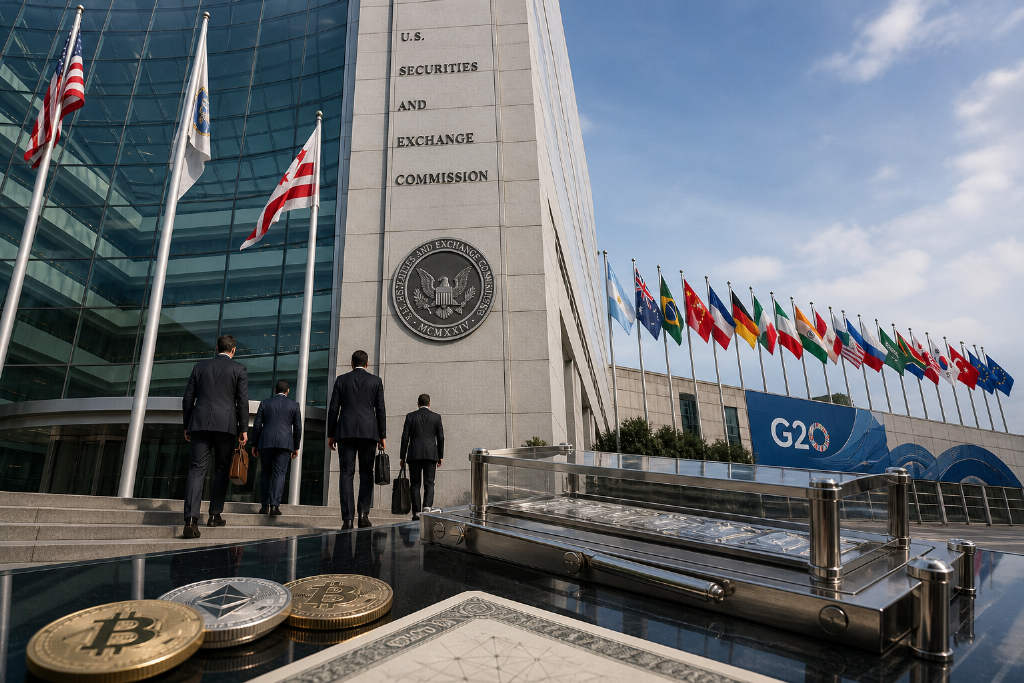
Crypto, policy, payments, exchange listings, ETF flows and AI-related developments all landed at once between Sept. 1 and Sept. 2. The U.S. Securities and Exchange Commission moved to revise transfer-agent rules for the blockchain era, the G20 formally acknowledged the growth potential of digital assets, 21 financial institutions outlined a stablecoin joint venture, and fresh data pointed to stronger August inflows into U.S.-listed Bitcoin ETFs.
Macro policy signals and regulatory updates
Japanese Prime Minister Sanae Takaichi commented Tuesday after the country’s long-term bond yield moved above 3% for the first time in 30 years. She said economic and fiscal management should, in her words, be judged “appropriately and in a timely manner based on assessment and analysis of various economic conditions, including interest-rate trends.” On the direction of rates, she said she would not comment because a specific remark could have an unintended effect.
Takaichi said interest rates are determined by the market under the influence of many factors, including policy developments in other countries. Asked how Japan would maintain market confidence, she said the government would respond properly to necessary fiscal demand while balancing a strong economy with fiscal sustainability. She also said budget reform would proceed in line with the Basic Policy on Economic and Fiscal Management and Reform adopted in July, adding that recurring policy measures should be incorporated into the initial budget rather than rely on large supplementary budgets.
According to Jin10, U.S. Treasury Secretary Scott Bessent said the United States would introduce a “comprehensive” fiscal package and argued that global imbalances caused by some countries were weakening growth elsewhere. Bessent said G20 ministers want stronger growth, though it remains unclear whether countries will take the steps needed. He also said the U.S. has been discussing G20 imbalances, expects countries to work with Washington on Iran-related issues, and believes Japan is taking the right economic measures.
In a separate G20 chair statement released by Bessent, finance ministers and central bank governors explicitly recognized the potential for digital assets to support economic growth and pledged to create a clear path for “responsible innovation.” The statement also called for improvements in cross-border payments, including longer operating hours for bank and central-bank systems used for large-value or time-sensitive payments, broader use of the ISO 20022 global messaging standard, and simpler cross-border data transfers for financial services. The G20 is also awaiting an assessment from the Financial Stability Board on the cross-border impact of global stablecoins.
The SEC, meanwhile, proposed changes to the rules governing registered transfer agents, a framework that has not seen major revisions since the late 1970s. Transfer agents keep ownership records for securities, process corporate actions such as mergers and dividend distributions, and play a central part in clearing and settlement. The SEC chair said the proposal would “streamline and modernize” the rules to reflect the use of electronic communications and blockchain technology in securities issuance and share transfers.
The agency said transfer agents are increasingly interacting with tokenized securities and artificial intelligence, while some market participants are exploring blockchain-based systems for securities ownership records. Transfer agents dealing with tokenized securities and smart contracts must manage risks tied to blockchain data integrity, tokenized-security safety and distributed-ledger operating models. Injective recently became an SEC-registered transfer agent, while Securitize and tZERO have also registered. The comment period will run for 60 days.
The SEC also released the agenda for its Sept. 17 roundtable on “24-hour trading,” where participants will discuss operational readiness and expected market effects. Representatives from Robinhood, the New York Stock Exchange, Nasdaq and BlackRock are scheduled to join panel discussions.
Stablecoins, remittances and payment rails
Twenty-one large international financial institutions said they plan to establish a new global company in the second half of 2026 to issue fully bank-reserve-backed stablecoins. The first product is planned as a U.S. dollar stablecoin, with later expansion prioritized for G7 currencies including the euro. The company said it aims to serve wholesale, institutional and retail use cases, including cross-border payments and digital-asset settlement, while seeking compliance with the GENIUS Act and MiCA. The target market launch is the first half of 2027.
The participating institutions include Bank of America, Citi, Goldman Sachs, Wells Fargo, Fidelity Investments and WisdomTree from the United States; Deutsche Bank, UBS, Banco Santander and BBVA from Europe; and MUFG Bank, Standard Bank and Sirius International Holding, among others.
Stablecoin remittance startup Felix Pago said it completed a $200 million Series B round made up of $87 million in equity financing and a $113 million credit facility. Andreessen Horowitz, or a16z, participated in the equity portion, while the credit line came from General Catalyst’s Customer Value Fund.
Felix Pago was described as one of Latin America’s better-known stablecoin remittance networks. It uses WhatsApp as its front-end channel and relies on USDC and blockchain-based settlement infrastructure to cut the cost and delivery time of cross-border remittances from the United States to Mexico.
Ethena Labs launched a test version of Ethena Pay, a self-custodial payments app built on Avalanche and available across 48 countries. Users can receive funds through an IBAN or a crypto wallet, with balances denominated in USDe and withdrawals to external bank accounts available in local fiat currency.
Ethena Pay offers Standard, Pro and VIP tiers that require users either to lock $0, $2,000 or $10,000 worth of ENA, or invite 0, 10 or 50 people. Standard users can earn 5% annualized on USDe balances up to $5,000. Pro and VIP users can earn 6%, with limits of $15,000 and $50,000, respectively. Cashback on the payment card is paid in AVAX, at 4% for Standard, 4.5% for Pro and 5% for VIP, rising to as much as 10% at selected merchants including Uber, Spotify and Claude. The United States and the European Union are not part of the first test batch.
Bitcoin valuation arguments and ETF flows
Bitcoin analyst Willy Woo said in response to investor Gary Cardone that gold’s market capitalization is currently around $32 trillion and would be about $103 trillion if it were still serving as the global monetary anchor. Woo argued that the idea of gold as merely a “financial asset” is an “illusion” shaped by the U.S. government and Wall Street, and said gold had functioned as money for thousands of years.
Woo said Bitcoin is trying to become a form of global hard money similar to gold. On that basis, he said, Bitcoin could imply a price of roughly $5 million per coin. He also said the global fiat system has existed for only about 55 years and looks more like an “experiment” when set against the much longer history of hard money.
U.S.-listed Bitcoin ETFs took in about $3.5 billion in August, their largest monthly inflow since July 2025. Bitcoin rose 25% during the month, its best monthly performance since November 2024. Bitwise’s chief investment officer said investors had spent the past few months waiting for a reason to buy crypto assets again, and that while prices had dropped, fundamentals remained strong, with Treasury Secretary Bessent’s actions acting as a catalyst.
According to the report, Bessent announced increased long-end Treasury buybacks to push down yields, while Donald Trump met crypto executives and urged the Senate to pass a market-structure bill. Together those developments helped fuel the rally. Pantera Capital’s founder said Bitcoin and other hard assets should perform well as the U.S. government keeps printing money and debasing paper currency.
Citi strategists said Bitcoin had recovered to around the ETF investor weighted average entry price of roughly $80,000 to $83,000, and that flows were the key driver. Bitcoin, however, ran into resistance near $80,000 and at one point fell to $76,393 on Tuesday. A StoneX analyst said concerns about the U.S. fiscal position had lifted demand for alternative assets such as Bitcoin and precious metals, and that continued ETF buying would mark an important turn after an extended weak period.
Another analyst said about 2% to 3% of the inflows into BlackRock’s iShares Bitcoin Trust, or IBIT, came from investors moving Bitcoin out of self-custody and into the ETF. He said ETFs are becoming a more attractive holding vehicle than self-custody wallets for investors focused mainly on Bitcoin’s inflation-hedge and currency-debasement-hedge traits, while those who prioritize censorship resistance remain less likely to accept ETF ownership. Balchunas said that share of self-custody migration could keep rising as overall subscriptions into IBIT expand.
Tokenized products, exchange support and onchain trading
Bitfinex Securities listed five tokenized note products backed by shares in publicly listed “Bitcoin treasury” companies: Strategy Note (CMSTR), backed by 100 common shares of Strategy Inc. per note; Strategy STRC Note (STRCst), linked to one share of Strategy Inc.’s floating-rate perpetual preferred stock and passing through dividend rights; Metaplanet Note (CMPTL), backed by 100 common shares of Metaplanet Inc.; H100 Note (CH100), backed by 100 common shares of H100 Group AB; and Capital B Note (CALCPB), backed by 100 common shares of Capital B.
The products are issued by Luxembourg-based ORO (II) Fund through STOKR. The underlying shares are held with a regulated custodian, the notes can be traded fractionally, and markets are available against U.S. dollars, Tether (USDt) and Bitcoin. The instruments are regulated by El Salvador’s CNAD and issued on Liquid Network. Participating wallets must pass Bitfinex Securities KYC and AML checks.
Silhouette, Hyperliquid’s block-trading layer, launched its request-for-quote system on mainnet with initial support for xStocks under Payward’s tokenized-equities framework. The setup lets traders request quotes on any supported xStock, after which market makers compete and completed orders settle onchain without time limits or single-trade size caps.
Under the RFQ model, xStocks can trade without requiring a standalone order book. Tokens that reach sufficient trading activity may later migrate to a dedicated HyperCore market. Since launching in June 2025, xStocks has served more than 200,000 holders and generated over $40 billion in cumulative volume, with nearly $20 billion settled onchain. It currently represents about $620 million of the roughly $2.53 billion tokenized-equities market, making it the third-largest issuer.
Binance Wallet said the third round of the Binance Alpha SOON airdrop has started. Users with at least 250 Binance Alpha Points can claim 166 SOON on a first-come, first-served basis. If the reward pool is not fully claimed, the threshold will drop by 5 points every five minutes. Claiming the airdrop costs 15 points, and users must confirm on the Alpha Events page within 24 hours or forfeit eligibility.
Coinbase said it will support Cluster Protocol (CP). Users can now generate CP deposit addresses on coinbase.com, the Coinbase App and Coinbase Exchange, although deposits can begin only after the asset issuer unlocks transfers.
Coinbase also said on X that cbHYPE and cbZEC are now live on Base. The two B20 tokens are custodied by Coinbase and pegged 1:1 to Hyperliquid (HYPE) and Zcash (ZEC), respectively.
Pump.fun said on X that limit orders are now live on Solana. Users can set take-profit and stop-loss orders in the Pumpfun app to protect gains and cap downside risk.
Fund movements and onchain transfers
One institution moved 109,806 ETH worth $266 million to centralized exchanges over three days at an average price of $2,430. The address still holds 58,048 ETH worth $140 million and plans to sell a total of 167,854 ETH valued at $406 million. Based on an accumulation cost of $1,700 from two years ago, a full sale would generate a profit of $122 million.
Multicoin Capital transferred 261,000 HYPE worth $21.7 million to Coinbase Prime over the past nine hours. Of the 1.97 million HYPE it unstaked at the end of July, 1.551 million worth about $114 million has been sent to Coinbase Prime over the past month at an average price of $73.
A TRUMP token team address transferred 11.01 million TRUMP worth $26.65 million yesterday. After multiple hops, 2 million tokens worth $4.78 million were sent to Binance six hours ago.
Security incidents and compliance disputes
The U.S. Department of Homeland Security signed a one-year, no-bid contract worth $95 million with crypto analytics firm TRM Labs in July for cryptocurrency-tracing software and data-analysis personnel. The work supports the White House campaign against crypto scams and cybercrime targeting Americans. Rival Chainalysis has sued the Trump administration over the award, calling the process “arbitrary, capricious, and unreasonable.” In its public explanation, the U.S. government said TRM was “the only vendor capable of providing the full suite of technical, data, and operational support services required.”
A report by The Block said Robinhood Wallet and the Fomo app allow users to buy meme coins with credit cards through Apple Pay or Google Pay without completing identity verification, appearing to bypass card-network rules on crypto transactions. Testing found that Visa and Mastercard meme-coin purchases were categorized under MCC 5815, “digital goods media,” a category typically used for products such as ebooks and digital movies rather than the MCC 6012 or 6051 codes normally associated with crypto transactions.
The transactions are supported by crypto infrastructure provider Crossmint, and users may still receive card points or cash-back rewards. Chase said one Visa transaction was not flagged as a cryptocurrency purchase and that the merchant category code appeared to be incorrect, meaning the purchase should not have qualified for rewards points. The bank said it had asked Visa to review the issue. The New York attorney general’s office is aware of the matter and reviewing it. Crossmint defended the classification as reasonable and cited the SEC’s view that meme coins can be treated as “digital collectibles,” while payments experts said card-network rules are a separate issue. Fomo and Robinhood referred detailed questions to Crossmint.
Grok said many accounts are currently receiving unsolicited X password-reset emails, with attackers using public usernames to trigger password-reset forms in bulk. There is no confirmed sign so far of a system breach or a large-scale account takeover. Grok advised users to enable Password Reset Protect under Settings and privacy > Security and account access > Security, turn on two-factor authentication and ignore related emails without clicking links.
On Sui, DeFi protocol Full Sail said on X that it will gradually shut down after being affected by a Switchboard oracle security incident. Virtue Money, one of the impacted protocols, reported about $455,000 in losses and said 45 users were liquidated. Switchboard has published a statement on the incident, but as of Sept. 1 had not provided the technical details requested by Full Sail or committed to compensation. Mysten Labs declined Full Sail’s request for financial support.
Full Sail said all remaining protocol-owned liquidity will be allocated to users first, and the team will cover any shortfall so community depositors are prioritized for repayment. New deposits and LP reward claims have been disabled, vaults remain paused, and standard pools will move into withdrawal-only mode after final safety checks. Withdrawal and claims guidance is expected in the coming days. Full Sail said users should trust only its official X account and website and that it will never ask for seed phrases or private keys. A full incident report will be released later.
Digital-asset treasury companies and decentralization research
The total market capitalization of digital asset treasury companies, or DATs, has risen 10% since mid-August and is hovering around $340 billion, though still well below the roughly $490 billion level seen when Bitcoin hit its $126,000 all-time high last October and November. Performance has varied sharply across names: Strategy is up 30% and Bitmine 27%, broadly in line with gains in Bitcoin and Ether, while Strategy has outperformed BTC by 10 percentage points since Aug. 17.
Newer altcoin-focused DATs have moved more aggressively. CYPH, which tracks Zcash, is up 142%, while PURR, which tracks Hyperliquid, is up 62%. Over the same period, ZEC rose 56% and HYPE 36%. Some DATs also build direct exposure into their business models through ETH staking, validator operations and mining activity.
ARK Invest and Glassnode jointly released a report titled “The Decentralization Spectrum,” comparing three blockchain networks across four design features — auditability, security, governance and ownership — and six measurable dimensions. On security, the report said Bitcoin and Ethereum each need only three entities to reach a critical control threshold, while Solana requires 19.
The report also said Bitcoin miners can exit roughly 1% of their position in about 30 seconds, while an equivalent share of staked Ether could take weeks to exit under stress. On geographic distribution, Bitcoin nodes were described as the most evenly spread, with 63% running through Tor. Ethereum depends more on cloud providers, with AWS hosting about 20% of nodes. Solana, by design, runs nearly all of its infrastructure in data centers. Across the six-dimensional scorecard, Bitcoin ranked highest in auditability, ownership distribution and geographic resilience; Ethereum sat in the middle; and Solana traded decentralization for performance and coordination speed.
AI power constraints and startup financing
Elon Musk said in a G20 speech that global AI growth has already run into a power bottleneck and that by 2027 there will be at least a 15-gigawatt shortfall in electricity tied to AI chips. He said AI chip production capacity is growing about 40% to 50% a year, while electricity supply outside China is growing only about 10% to 20%, creating what he described as the central constraint.
Musk said companies including Google and Anthropic have rented compute capacity from SpaceX because SpaceX can scale quickly with self-built power plants. He added that China has sufficient electricity but faces limits from GPU export controls, while other countries that build power at scale and host AI data centers could create a new source of tax revenue.
Startup Abliteration.ai launched a new model called abliterated-model-large-v2 based on GLM-5.3, which ranked third on Terminal-Bench 4.0. The company said the model’s cyber offense and exploitation capabilities are about twice as strong as the 5.2 version. It said the model was built by removing the “refusal” direction from activations at the weight level while preserving coding, cybersecurity and agentic abilities, allowing use in offensive cybersecurity, AI red teaming, agent testing, and trust-and-safety settings for full execution of authorized attack chains. The model is hosted in the United States, uses FP8 precision, supports a 1 million-token context window, and the company said it does not retain prompts or outputs. Access is available through an API.
Media reports citing people familiar with the matter said Nvidia is in deep talks to acquire AI startup Hugging Face in a deal that could be worth about $14 billion. One person said Nvidia could reach an agreement as early as this week to acquire the company for $12.9 billion, and that the package may include a $1 billion employee-retention plan. The sources said no final agreement has been reached and timing and terms could still change. If completed, the transaction would be Jensen Huang’s biggest move yet in expanding AI applications and broadening Nvidia’s customer base. A report on Aug. 27 had already said Nvidia agreed to buy the open-source AI platform Hugging Face for $12.9 billion.
Separate media reports said AI coding startup Cognition AI is close to completing a new funding round that would value the company at about $47 billion. The latest financing is said to be around $1 billion, and one person familiar with the talks said the final amount could exceed that because demand has come in far above expectations. The same source said Cognition has received nearly $10 billion of investment interest. Talks are still ongoing and details may change.
AI training-data startup AfterQuery completed a new round at a $3.2 billion valuation, just five months after raising a $30 million Series A in April at a $300 million valuation. Y Combinator partner Gustaf Alströmer said it is the fastest startup in YC history to go from founding to unicorn status. The founders are 22 and 23 years old and joined YC’s Winter 2025 batch 18 months ago. In April, the company said it had reached $100 million in annualized revenue, with clients including Nvidia, Legora and South Korean AI lab Motif Technologies. AfterQuery focuses on training models and agents to complete work like professionals rather than simply returning correct answers.
AI security startup AIR raised $50 million, with Sequoia Capital leading the first $10 million round and Greenoaks leading the second $40 million round. Swish, Netz and multiple angel investors also participated. The company was founded by former members of Israel’s Unit 8200, Yair Saban and Niv Hoffman, and offers a security platform for AI agents that can discover the agents operating inside an enterprise, continuously review the skills and tools they use, block interactions with non-compliant software or outside sources, and provide a marketplace of vetted agent plugins and skills.
In selected AI developments, Anthropic released Claude Fable 5.1 and the restricted Mythos 5.1 version for cybersecurity and life sciences. Anthropic said Fable 5.1 sets a new standard in coding and knowledge work, with a 1 million-token context window, 128,000-token maximum output, API pricing of $10 per million input tokens and $50 per million output tokens, and an overall cost reduction of about 25% versus Fable 5. For complex agent tasks, the reduction can reach 45%.
World Labs, founded by Fei-Fei Li, released Atlas on Sept. 1 and described it as an “omni world model” that can handle text, images, video and 3D data at the same time. The model supports 1440p resolution and up to one minute of fully camera-controlled video generation, using a multimodal autoregressive diffusion Transformer architecture for pixel-level spatial reconstruction.
OpenAI said Astra became the first model to reach the “critical” cybersecurity risk level under its Preparedness Framework and that public release has been postponed. The company said Astra can autonomously identify zero-day vulnerabilities and design and execute a full end-to-end cyberattack workflow. OpenAI said it has put in place isolated testing environments, full-lifecycle risk monitoring and coordinated third-party security testing.
Other company and market developments
Nubia’s NaviX Ultra, equipped with the Doubao mobile assistant, has received approval from China’s Ministry of Industry and Information Technology, completing the compliance path from large-model filing to terminal network access. The device is positioned as the world’s first mass-produced flagship AI agent smartphone and is scheduled to go on sale in September. As the second-generation “Doubao phone,” it comes in black, pink, white and blue, with some versions carrying an orange dedicated AI button. The camera module is supplied by Sunny Optical, and the underlying Doubao model has completed on-device generative AI filing with the Cyberspace Administration of China alongside Apple Intelligence, Huawei Xiaoyi, vivo Blue Heart and Xiaomi Pengpai.
Bubblemaps said on X that Pons, a token-launch platform on Robinhood Chain, generated $4.73 million in fees in a single day, more than the combined roughly $3.461 million posted by Hyperliquid, Polymarket and Fomo, and also above the roughly $4.65 million combined across Robinhood Chain, BSC and Solana. The figures came from DefiLlama and cover 24-hour fee revenue, with public-chain figures counting network fees rather than protocol-layer fees.
Market data showed Unitree Technology shares fell below 550 yuan, down by half from the 1,100-yuan intraday high reached on the first day of listing.
Unitree supplier United Imaging completed a new financing round worth several hundred million yuan, with participation from industrial capital, state-backed capital and market-oriented institutions. Named investors include Dunhong Asset, Hangzhou Embodied Intelligence Industry Fund, Fuyang Industrial Investment and Zhifang. The company supplies visual systems to humanoid robot and AI hardware makers including Unitree, Zhifang, Zibianliang and Rokid, and said revenue has reached the 2 billion yuan level. It said the new funding will support its strategy of building “visual infrastructure for the physical AI world,” linking optical design, visual modules, depth cameras, edge AI, data collection, the AI Base engineering toolchain and scaled manufacturing. It is also advancing a 1 billion-yuan intelligent-vision industrial project in Hangzhou.