
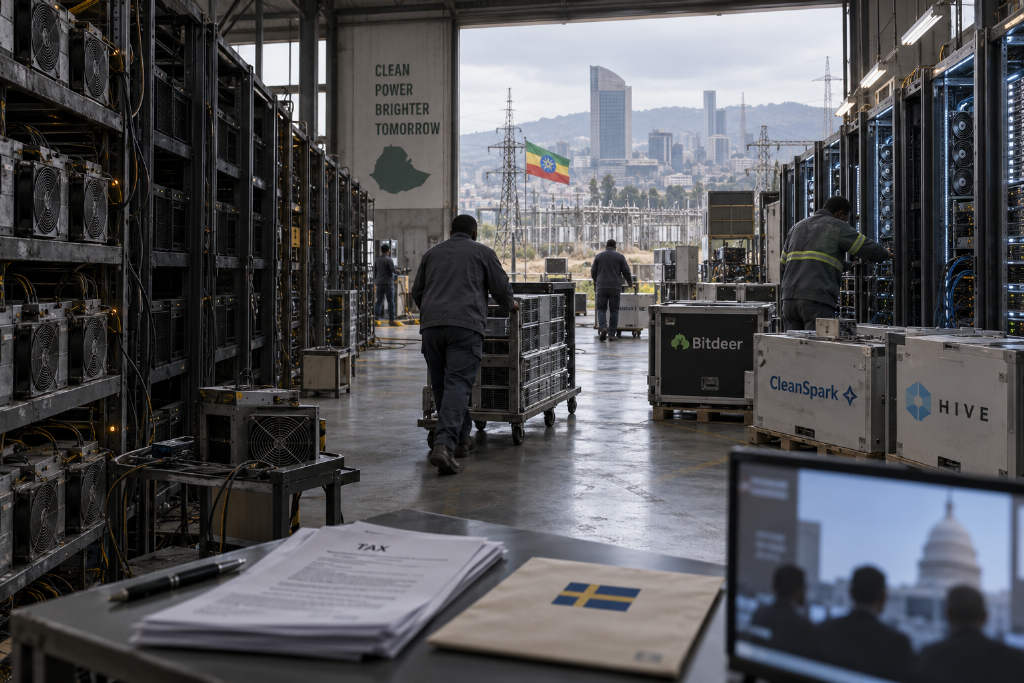
Bitcoin mining in September moved along a line that is now hard to miss: as mining margins stay under pressure and some jurisdictions tighten tax or power conditions, a growing share of listed miners is redirecting power, sites, and data center resources toward artificial intelligence and high-performance computing.
Public miners keep reallocating power and data center capacity
According to CoinShares’ Bitcoin Mining Report | Q2 2026, listed bitcoin miners continued to shift electricity and data center resources toward AI and HPC. The report estimated annualized profit at roughly $1.5 million per MW for AI compute, compared with about $500,000 per MW for bitcoin mining. Companies with signed AI/HPC capacity contracts were valued at an average EV/NTM Sales multiple of 12.9x, versus 3.7x for companies that remained focused on mining without such contracts.
The operating numbers already show that change. IREN’s AI Cloud revenue exceeded mining revenue for the first time. TeraWulf said HPC hosting revenue accounted for 71% of total revenue. Core Scientific paid $41.9 million to cancel orders for about 15 EH/s of next-generation Proto miners.
CoinShares also said the weighted average pre-tax cash mining cost for public bitcoin miners in Q2 2026 was about $75,500 per BTC, above BTC’s price of around $58,400 at quarter-end. June hash price fell to a record low of $27.7 per PH/s/day. The report said the industry is accelerating its shift toward AI/HPC data centers, with some miners canceling rig orders, scaling back, or leaving bitcoin mining altogether. In CoinShares’ view, valuations will increasingly depend on the value of power access and data center infrastructure rather than raw hash rate alone.
CryptoQuant pointed to the same split in the market. Bitcoin miners with AI exposure are up 21% this year, while miners without AI initiatives are down 8%. Core Scientific sold about 3,136 BTC this year, worth around $271 million, cutting its bitcoin reserves by more than 90%. MARA said it sold 23,093 BTC in the first half, worth about $1.63 billion.
Network data also shifted. Bitcoin’s realized hash rate fell from a peak of about 1,101 EH/s in November 2025 to 899 EH/s in early August this year, a decline of 18.3%, before recovering to about 934 EH/s. CryptoQuant said some miners are redirecting capital and infrastructure toward AI and HPC.
JPMorgan analysts said bitcoin briefly rose above their estimated production cost of about $85,000 this week, after spending 280 straight days below that level. If prices stay above production cost, they said, pressure on miner profitability could ease and the risk of forced BTC sales could decline. The analysts also described bitcoin production cost as a historical “soft floor” for price, saying long periods below that level can push higher-cost miners to sell more BTC, shut down machines, or exit.
At the same time, JPMorgan said miners are shifting part of their operations, power, and data center capacity to AI compute. Bitcoin network hash rate is down about 19% from its peak in October last year, and mining difficulty is down about 15%. The bank said that trend could help limit excessive hash rate expansion and slow growth in production costs outside the effect of the halving.
An analysis from TheEnergyMag said listed miners have cut roughly 23% of their actual bitcoin hash rate as some companies convert infrastructure to HPC hosting and AI cloud operations. Among companies pushing hardest into those businesses, HPC hosting and AI cloud revenue has already surpassed mining revenue. Even so, cumulative spending on those conversions is still about 15 times the revenue currently being generated. The report also said bitcoin’s rise in late August and lower network competition eased profit pressure for miners running efficient machines.
Ethiopia cuts miner power supply, Kazakhstan backs associated gas generation
Bloomberg reported that Ethiopia cut electricity supply to bitcoin miners by about three-quarters after lower inflows into hydropower stations tied to El Nino. Bitcoin mining companies had accounted for about 35% of Ethiopian Electric Power revenue in the previous fiscal year while consuming nearly one-third of the country’s roughly 9,730 MW of total generation.
Euronews reported that Kazakhstan is pushing crypto miners to use associated gas from oil fields to generate electricity for mining sites. The stated aim is to reduce gas flaring, ease pressure on the grid, and attract mining companies back. Miners would pay for the related infrastructure, while oil fields could earn revenue by selling gas that would otherwise be burned and relieve disposal bottlenecks that constrain crude output.
Kazakhstan’s Energy Ministry said about 40 to 60 oil fields are currently flaring associated gas. The ministry and the Ministry of AI and Digital Development are drafting the legal framework.
Sweden seeks tax repayments; the US prepares to review two crypto tax bills
SVT reported that Sweden’s tax agency, Skatteverket, decided to reclaim nearly SEK 540 million, or about $58 million, from six crypto companies operating in Boden. The agency said some companies under review obtained tax benefits they were not entitled to by describing cryptocurrency mining as other types of business.
From 2024 to 2026, Sweden imposed additional taxes on nine crypto companies totaling more than SEK 500 million. Several companies have appealed. Bikupan Datacenter, a HIVE Digital subsidiary, entered restructuring because it could not repay the related debt and has taken the dispute to Sweden’s Supreme Administrative Court. HIVE rejected the tax agency’s view, saying the company sold computing capacity and that actual crypto mining was carried out by independent external mining pools.
CoinPost reported that the US House Ways and Means Committee plans to review two cryptocurrency tax bills on Sept. 16. The first, introduced by Representative Mike Carey, the Mining and Staking Tax Certainty Act, would allow miners and stakers to defer taxation on newly created tokens until sale or other disposition, while the income would still be taxed as ordinary income. Republican lawmakers were reportedly considering removing the deferral provision, and another proposal would limit the deferral to five years.
A second bill from Representative Jodey Arrington, the bill to apply existing anti-abuse tax rules to digital assets, would extend stock-related wash-sale rules and constructive sale anti-avoidance rules to digital assets. Digital assets received through transaction validation activities such as mining and staking, as well as compliant dollar stablecoins, would be excluded. If both bills clear the committee, they would move to the full House for consideration.
Company filings and operating updates add detail to the transition
Bitdeer reported August 2026 operating data showing AI Cloud ARR of about $86 million. It had deployed 4,328 GPUs with 92% utilization, including 3,998 GPUs subscribed by external customers. In Malaysia, the 9.5 MW A102 project reached 100% contracted GPU capacity, with long-term contracts tied to expected revenue of more than $800 million.
The company also signed a 10-year data center services agreement for the A202 project in Johor, adding 65.1 MW and bringing total AI Cloud capacity in the park to 86.8 MW. It signed a non-binding memorandum of understanding with Gelephu Mindfulness City in Bhutan for an AI data center that would start at 30 MW and scale as high as 500 MW.
On the mining side, Bitdeer produced 1,310 BTC in August, up 249% year over year. Its self-mining hash rate rose to 79.9 EH/s, while jointly mined hash rate stood at 21.6 EH/s.
CleanSpark (Nasdaq: CLSK) said in unaudited operating results through Aug. 31, 2026, that it mined 593 BTC in August and 4,903 BTC year to date. Operating hash rate reached 50 EH/s. Peak fleet efficiency for deployed miners was 16.07 J/TH. Contracted power totaled 1.8 GW, of which 808 MW was in use.
Its treasury held 13,703 BTC at the end of August. During the month, the company sold 821 BTC through spot sales, call option exercise, and delta-neutral basis trades at an average realized price of $65,420. CleanSpark is also accelerating construction of a high-performance compute data center in Sandersville, Georgia, where it has signed a 20-year lease worth $6.6 billion with an investment-grade technology tenant.
MARA, in a filing, said it amended its acquisition agreement for a Texas data center campus and posted a $100 million deposit to the utility company tied to a planned 2,000 MW of power capacity for the site. Under the amended agreement, part of the payments depends on progress in project review, interconnection studies, and power approvals. If all conditions are met, the total acquisition price remains $600 million. MARA said it plans to use the campus for bitcoin mining or HPC, while actual available power and construction remain subject to approvals and development progress.
HIVE said it plans to gradually stop bitcoin mining at its Swedish facilities and is evaluating the reuse of that infrastructure for HPC and AI. The company said its Sweden mining business contributed less than 5% of global daily revenue in August. HIVE also said its global operations have produced about 12 BTC per day on average since Aug. 21. The announcement applies to Sweden only and does not say HIVE will stop bitcoin mining in other regions. The shutdown and conversion in Sweden are still at the planning stage.
The Energy Mag reported that Bitdeer (NASDAQ: BTDR) acquired about 200 acres in Milam County, Texas, for roughly $100 million in cash. The parcel sits next to its existing Rockdale facility and is intended for AI and HPC data center development while preserving the current bitcoin mining operation.
After the deal, Bitdeer will hold about 255 acres in Milam County, with about 563 MW of existing grid-connected power and planned total capacity rising to 742 MW. Including the project, Bitdeer’s global operating and development power pipeline is about 3.0 GW.
TheEnergyMag reported that Cango (NYSE: CANG) posted unaudited Q2 2026 results with revenue of $50.8 million, down about 50% quarter over quarter. Net loss from continuing operations was $81.6 million, narrower than the $261.1 million loss in Q1, mainly due to a $42.9 million mining machine impairment and an $8.5 million loss on equipment disposals. Adjusted EBITDA loss narrowed to $10.7 million.
Cango ended the quarter with 27.58 EH/s of operating hash rate, including 19.84 EH/s in self-mining and 7.74 EH/s in leased hash rate. It produced 656 BTC in the quarter, reduced average cash cost per BTC to $73,313, and held 1,056 BTC at the end of June. On AI infrastructure, its 3 MW Georgia site completed its retrofit in early July and is set to offer bare-metal GPU hosting and colocation. The first revenue is expected to be recognized in the third quarter. The company has also deployed test nodes in Texas and on the US West Coast.
Canaan, the bitcoin miner maker, reported Q2 2026 revenue of $31.9 million, down from $62.7 million in the first quarter, and a net loss of $97.6 million. Self-mining revenue was $17.7 million for the quarter, with 243 BTC mined. As of June 30, the company held 1,915.5 BTC, a quarter-end record.
BitFuFu said it mined 174 BTC in August, up about 55.4% from 112 BTC in July. Of that total, 88 BTC came from self-mining and 86 BTC was tied to cloud mining. By the end of August, managed hash rate rose from 14.2 EH/s to 20.6 EH/s, including 3.8 EH/s of owned hash rate. Managed power capacity increased from 255 MW to 344 MW, and average machine efficiency improved from 18.0 J/TH to 16.7 J/TH. The company said the growth mainly came from previously secured additional hash rate being brought online.
Canaan separately said it mined 44 BTC in August and sold all 3,952 ETH and 54 BTC at month-end at average prices of about $2,400 and $79,000, respectively. The sales generated about $13.9 million in cash, of which about $5.4 million was used to repurchase 13.6 million ADS. At the end of August, Canaan still held 1,868 BTC and said it would maintain a strategic digital asset reserve.
Soluna Holdings, the listed green data center developer and operator, amended an existing agreement with Bitdeer to increase Bitdeer’s bitcoin mining deployment at the Project Kati 1 wind-powered data center in Texas from about 28 MW to about 35 MW. Under the earlier agreement, Soluna provides the site, power, and operating services, while Bitdeer provides and owns the miners, with both sides sharing mining proceeds.
Zcash mining, financing, and a Nasdaq listing plan
TheEnergyMag reported that Zcash miner Fortitude Mining said parent company Digital Currency Group increased its existing credit line from $26 million to $50 million, adding a new $24 million commitment. Together with remaining prior availability, Fortitude now has about $31 million of borrowing capacity available and expects the funds to be disbursed entirely in ZEC.
Fortitude said it can sell the received ZEC in the market and use the proceeds to pay for 9,000 Zcash ASIC miners and for capital spending on new and acquired data centers and power infrastructure.
Grayscale said in research that strong token price performance has made Zcash mining highly profitable, encouraging more mining activity and strengthening network security. Grayscale estimated that a single Zcash miner earns roughly twice the daily mining reward of a bitcoin miner and about four times as much per MWh, though the machines are not interchangeable. Other sources cited in the report also indicated that Zcash mining currently generates more revenue per MWh than some AI/HPC cloud services. Measured by standard hash rate, total Zcash mining activity has risen by more than 2.5x this year.
The Miner Mag reported that Fortitude Mining, DCG’s Zcash-focused mining subsidiary, appointed former Hut 8 CEO Jaime Leverton as chief executive to speed up its plan to go public through a reverse merger with Nasdaq-listed medical technology company HeartSciences. Leverton is set to take the role on Sept. 21 and will lead the newly listed company after the merger closes. Current CEO Andrea Childs will become COO.
The all-stock transaction was announced in June. The combined company plans to rename itself Fortitude and trade on Nasdaq under the ticker TUDE. DCG is expected to own about 95% of the equity. Fortitude was spun out of Foundry’s proprietary mining arm in January 2025 and produced 72,696 ZEC in the first half of 2026.
Late-September network and miner holdings data
Digital Asset reported that as of Sept. 26, bitcoin’s 7-day average hash rate was about 915.8 million TH/s, down about 34.86 million TH/s from a week earlier and at its lowest level in about three weeks since Sept. 3. The data covered the period from Sept. 20 to Sept. 26.
Over the same stretch, CryptoQuant data showed bitcoin miner holdings at about 1.1928 million BTC, down 1,530 BTC on the week. Bitcoin’s Puell Multiple stood at 1.13, up 0.24 from a week earlier. The metric measures miner revenue relative to historical levels by dividing the daily value of BTC issuance by its 365-day moving average.
Heat reuse, corporate restructuring, and site-specific mining shutdowns
Canaan said its Avalon A1566HA water-cooled bitcoin miners are being used in an approximately 8 MW district heating project in Northern Europe. The machines produce hot water at about 80°C while operating, and the heat is fed into an existing heating network. Canaan said the project was supplying heat to about 2,800 households as of September. The company said the mining solution was selected by a local heating service provider to replace the previous heating setup.
Hyperscale Data (GPUS), a listed data center company, said it plans to establish a new subsidiary called Patriot BTC and transfer its Montana data center, bitcoin miners, and related mining infrastructure into that entity, separating the bitcoin mining business from its Michigan AI data center project. Management is evaluating a possible spinoff or another transaction that could make Patriot BTC a publicly traded entity. The new subsidiary has not yet been formally established, and no transaction structure has been approved.
In a separate announcement, Hyperscale Data said its facility in Dowagiac, Michigan shut down all bitcoin miners on Sept. 1 to free power, floor space, and personnel for deployment of AI data center infrastructure for customers. The move is tied to an earlier AI data center services agreement. The shutdown applies only to the Michigan site and does not mean the company has exited bitcoin mining entirely. Media reports said it continues mining in Montana.
PowerCompute said its subsidiary fully repaid and terminated a bitcoin-collateralized credit arrangement with Arch Lending on Sept. 24, paying down about $22.45 million of debt and recovering about 39.6 BTC. The company now has no bitcoin pledged as collateral. Secured debt fell from about $19.4 million at the end of June to about $1.25 million, a reduction of about 94%. PowerCompute also plans to expand its Mississippi mine and upgrade miners in Oklahoma, which it expects will increase active mining hash rate by about 25% to 964 PH/s.
An Ethereum Classic client incident and a lawsuit against Coinmint
According to an incident report from Classix, Ethereum Classic recently saw a social engineering incident tied to the Core-Geth client. An ethereumclassic/core-geth v1.13.0 release that had not been reviewed by the existing maintainers was published on Sept. 14 and promoted as a “security update” through @ETC_Network, CoinMarketCap community posts, and email, encouraging node operators to migrate.
Classix said a small number of mining pool nodes briefly switched to that version but later returned to the long-maintained etclabscore/core-geth v1.12.23. The incident caused no block loss, no chain reorganization, no fund loss, and no service interruption. Classix warned that the unreviewed version altered critical logic including chain selection and node discovery, creating a potential network split risk.
Protos reported that Coinmint shareholder Mintvest Capital alleged in an amended complaint that Coinmint CEO Ashton Soniat misrepresented miner deployment timing and transferred 448.7193 BTC produced by the mining site during the relevant “testing period” into a personal wallet. The complaint also alleges securities fraud and violations of RICO. Mintvest said Coinmint generated more than $570 million in cumulative profit, that it owns an 18.2% stake, and that it is seeking at least $104 million in undistributed profits plus $47.10 million in damages tied to the allegedly misappropriated BTC.
Illegal mining and power theft cases in Mexico, Paraguay, and Malaysia
Reuters reported that Mexican authorities uncovered a hidden cryptocurrency mining site in the mountains of Tlaola, in northern Puebla state, that is suspected of being used for illegal money laundering. Officers seized 300 GPU miners, 80 medium-voltage electrical terminals, and eight satellite antenna systems. Authorities are investigating whether the site stole power directly from a nearby hydroelectric plant. It was the fourth such underground mining site found in the area since early last year.
Blockchain intelligence firm Chainalysis said major Latin American drug trafficking groups are expanding from traditional smuggling into financial crime and on-chain assets, using nearly “zero-cost” stolen electricity in areas they control to mine cryptocurrency and move illicit proceeds.
CriptoNoticias reported that Paraguayan authorities recently raided two crypto mining facilities in Alto Parana and seized a total of 35 machines. In one operation on Sept. 17, a site was found drawing electricity illegally through an unmetered line, and 10 ASIC miners were confiscated. Associated charges and fines totaled about $30,000. In another operation on Sept. 12, authorities seized 25 mining machines. Paraguay’s Chamber of Deputies has passed a resolution asking the national power authority to report on electricity use, tariffs, and oversight in the crypto mining sector.
The Star reported that police in Perak, Malaysia found a site in Seri Iskandar suspected of carrying out bitcoin mining through illegal power connections and detained two local men to assist the investigation. In a joint operation with national utility TNB, police seized 30 bitcoin miners, one router, one network switch, and a roll of cable. The case is being investigated under Section 427 of the Penal Code and Section 37(1) of the Electricity Supply Act 1990. Police said crypto mining tied to electricity theft is not only illegal but can also cause major losses for utilities and raise fire risk.
A solo miner finds a block again
Bitcoin.com reported that an independent bitcoin miner using Braiins Solo successfully mined block 966,351 and received the full block subsidy and fees, totaling 3.147 BTC, worth about $244,900.
It was the first block found by a solo miner on the Bitcoin network in nearly 40 days. The previous one came on Aug. 2, when a Solo CKPool miner received 3.1569 BTC.