
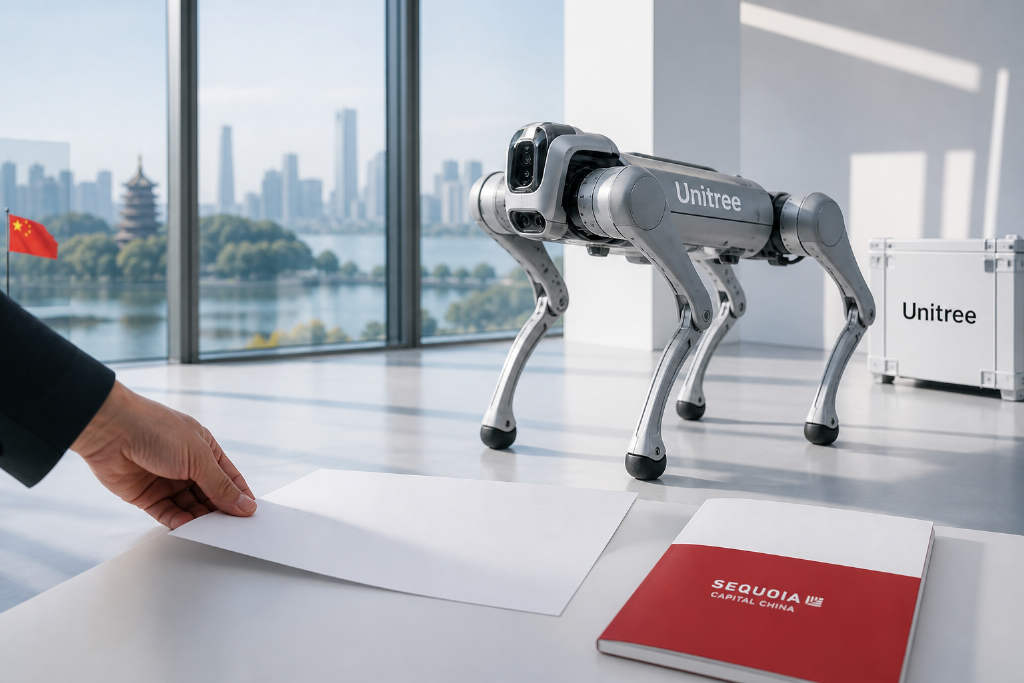
Sequoia-backed publication Hongshan Hui has published the internal investment memo from its first deal in Unitree Robotics, explaining why the firm chose to back founder Wang Xingxing in 2019 even as the company was short on cash and the quadruped robotics market remained highly uncertain.
In the article, Hongshan Hui said Wang appeared before Sequoia Seed’s investment committee in 2019 as a 29-year-old founder with no elite university pedigree and almost no formal work experience. He had spent 3 years building a robot dog, but its practical use case was still unclear. At the same time, an industrial investment fund that had planned to lead the round pulled out, leaving the company close to running out of money.
The one-page memo from July 2019
Hongshan Hui said it decided to disclose the “one-pager” used for Unitree’s Pre-A financing in July 2019. That document marked Sequoia’s first investment in the company and, in the firm’s words, captured its earliest impression of both Unitree and Wang.
The article said the investment was never a simple or obvious call. It was not a case of instant alignment or full certainty about the future. Instead, the decision came after repeated internal discussion and debate under an approach the firm described as “bold assumptions, careful verification.”
Wang scored 9 out of 10 on “outlier” and “vision”
In that memo, Sequoia described Wang as a “typical outlier” and called him an evangelist for quadruped robots in China. The firm gave him 9 out of 10 on both the “outlier” and “vision” dimensions.
The article also recalled Wang’s remarks at the investment committee meeting: 「我希望造一个很大的机器人,比奥特曼比山还大;造一个很小的机器人,到微米级进入到人的血管常驻,治疗各种疾病;我还希望用机器人来造机器人。」
Looking back, Hongshan Hui said those ideas sounded far-fetched at the time. Later, the firm came to see a consistent logic behind them: extremely large or extremely small robots both point to continued breakthroughs in materials, technology, and products, while “robots building robots” suggests the ability to scale both the machines and the company’s technical base.
Why Sequoia still chose to invest
The article said it was not easy to persuade most people to believe in Wang at the time. He had weak points that were hard to ignore: a non-elite academic background, very limited work experience, the withdrawal of the planned lead investor, and a robotics segment that was still considered niche. On top of that, there was no reliable way to estimate the market size for quadruped robots.
Sequoia said those were not the deciding factors. For very early-stage companies, it placed heavier weight on founder-project fit.
First, according to the article, Wang had been studying and building robots since high school. By the time he launched the company, he had already accumulated substantial product and technical experience. After evaluating the product, Sequoia concluded that Unitree’s robot dog was on par with Boston Dynamics and in some respects performed even better, while costing only a fraction of the latter.
Second, the firm said direct interaction and background checks showed Wang’s strong passion for technology, deep focus, confidence in the product, and serious interest in forward-looking robotics ideas. The article added that during Wang’s brief internship at DJI, the company’s then-CTO had a strong impression of him and spoke highly of his abilities.
Third, Sequoia said Wang had entered what it called “founder mode” early on. The article listed several examples: he handled financing terms personally to make sure the governance structure stayed effective and orderly; he drove frequent product and technology breakthroughs, with a new step forward roughly every 6 months; he kept a customer-first approach summarized as “whatever customers need is what we should build”; and he was able to hold together a core team while actively selecting employees who aligned more closely with the company’s culture. Hongshan Hui said no member of the core founding team had left in the company’s 10 years of entrepreneurship.
The central debate: how big could robotics become?
Even though Sequoia ultimately centered its decision on Wang himself, the article said Unitree’s strengths and weaknesses were both obvious at the time, which led to substantial discussion and disagreement inside the firm. The biggest issue was the size of the robotics market.
Hongshan Hui said there was no broad consensus around robotics then. Unitree was mainly making high-performance robot dogs, and many people saw that as a niche product for enthusiasts rather than a defined investment track.
The article said robot dogs were different from robots built for vertical sectors such as warehousing, delivery, cleaning, or special operations. At that point, they did not yet have an obvious demand-side use case. The team could only speculate that such products might one day be used in security, short-distance delivery, education and training, or home companionship.
Sequoia added that market size is always dynamic. Drones, it noted, were once considered a niche area for hobbyists but later became a large consumer market and produced a company like DJI. Even so, whether robotics would follow a similar path was still a major open question at the time.
That left the investment sitting in two very different frames. From a rational commercial perspective, the article said Unitree was controversial and could easily have been passed over. From the perspective of long-term expectations for technology, however, both Unitree and Wang represented enough possibility to justify taking the chance.
How Sequoia handled a non-consensus bet
According to the article, Sequoia Seed did not use exactly the same decision process for non-consensus opportunities that it would use at the venture or growth stage.
- First, when a business is still immature, the firm said it intentionally gives more weight to its judgment of the person.
- Second, it believes a founder’s strengths matter more in the early stage, so it focuses on whether those strengths can be pushed to the limit rather than on solving every weakness in the short term.
Sequoia said it completed the initial investment quickly, then internally led another round within 6 months. It later added capital again in the B and C rounds, becoming the independent private equity fund with the largest ownership stake among shareholders.
Sequoia says Unitree’s listing is a milestone, not the finish line
Hongshan Hui said robotics and embodied intelligence have entered a faster phase of development over the past 2 years and are now widely accepted themes in venture investing.
On one side, robot hardware and intelligence have made visible progress across technology, products, and application scenarios. The article compared the current moment to the early mobile phone market in the 1980s: devices still looked like bricks, but the room for imagination had already opened up. On the other side, the emergence of intelligence in AI models has strengthened market confidence in the future of embodied systems and brought in more capital and conviction.
The article said Unitree’s successful listing is an important milestone in the company’s growth, but only a starting point for embodied intelligence as a broader field. Sequoia said the sector is still at a relatively early stage, and major problems remain before it can scale into households at large or generalize across industries. In its view, companies like Unitree still need to keep pushing into “uncharted territory.”
The piece ended by saying that any world-changing creation depends not only on the intelligence and persistence of entrepreneurs, but also on broader social consensus, and it congratulated Unitree on its progress.