
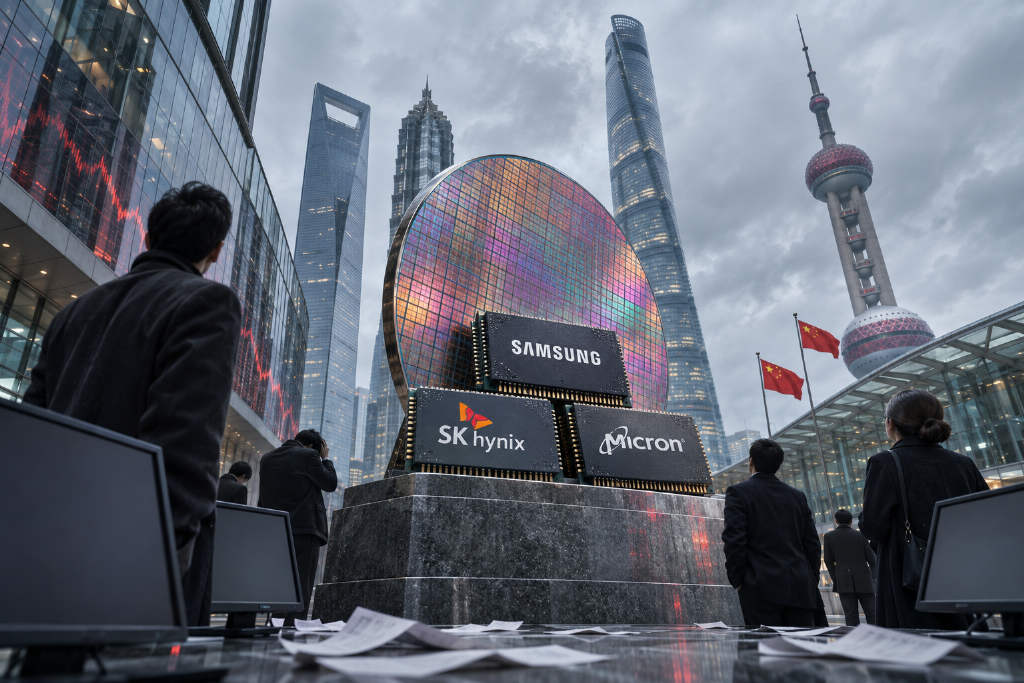
Citrini researcher Jukan said his recent field trip to Shanghai left him with a darker view of investor sentiment than he had expected. In his account, many investors holding China and Hong Kong AI stocks, along with South Korean memory shares, are deeply underwater after a long decline.
Shanghai meetings pointed to heavy pessimism
Jukan said A-shares have not staged a single rebound since July, unlike U.S. equities. China and Hong Kong AI names have been falling for an extended period, and South Korean memory stocks have also dropped sharply, leaving investors discouraged.
He said many investors now believe the AI trade is over. Others are questioning whether AI capital expenditure plans for 2027, not just 2028, will actually be executed on schedule. Jukan added that the bearish tone was strong enough to shake even his own bullish stance after several days of conversations.
He also said he viewed with caution the bearish argument that memory prices could start falling from the third quarter of 2027, adding that he could not directly refute it.
Jukan described the current market as the hardest he has ever traded. In earlier cycles, investors selling companies that were not making money was easy to understand. This time, he said, the market is still selling even when companies are profitable, report earnings above expectations, and say demand visibility extends into 2028 and 2029. That gap between fundamentals and share prices has become one of the most confusing features of the latest AI stock pullback.
The key question: what comes after AI coding?
Jukan said investor pessimism ultimately comes back to one issue: after AI coding, what is the next annual recurring revenue, or ARR, engine for Anthropic and OpenAI?
Several ideas have surfaced in discussions, including AI4S, short for AI for Science, and AI chip design. In his view, none of them has given the market a convincing answer.
On AI4S, he said there have been market rumors that Anthropic has made major breakthroughs in both AI4S and AI chip design. For investors, though, the real question is not whether those breakthroughs exist but when they can be monetized. He said some companies have already benefited on a short-term trading basis, including firms that sell laboratory animals or diagnostic reagents. The bigger issue is whether Anthropic can eventually make money by participating in new drug development, and how long that would take.
As for AI chip design, Jukan said the total addressable market, or TAM, is difficult to estimate in the first place. Even if it could be estimated, turning that opportunity into revenue would still be hard, which is why the market has struggled to embrace the theme.
Why he still prefers DRAM
Against that backdrop, Jukan said investors should buy memory first, with a preference for DRAM. He was explicit that this is not a call based on confidence in the DRAM cycle. He sees it instead as a relatively defensive choice inside the broader AI trade.
He gave two reasons.
- Low valuation: based on 2027 book value per share, memory stocks are trading close to 1x price-to-book. Jukan said memory shares have historically tended to see technical rebounds when they fall below 1x P/B.
- Strong capital support: even if the broader market drops further from current levels, he expects the three major DRAM makers — Samsung Electronics, SK Hynix, and Micron — to keep buying back their own shares. That, in his view, should provide some level of support.
Relative defense is not the same as guaranteed upside
Jukan said he does not have an answer on whether memory stocks can break above their previous highs. That depends on whether overall market sentiment improves.
His point is narrower: memory has a fairly high chance of outperforming other AI-related groups on a relative basis. That does not mean it cannot fall.
He also cautioned that memory stocks have historically behaved like cyclical names, and they can remain depressed for a long time even after P/B drops below 1x. The scale of buybacks will also depend on future earnings and cash flow. Investors using the defensive-memory framework, he said, still need to watch memory pricing, AI capex trends, and broader market sentiment closely.



