
Shenzhen-listed memory companies reported explosive earnings for the third quarter of 2026, with profit growth at several firms rising into the thousands of percent as higher DRAM and NAND prices lifted the sector.
Delongli released its quarterly results on Oct. 25, reporting net profit attributable to shareholders up 32,399.91% year on year to 8.75 billion yuan. On Oct. 28, Biwin Storage posted third-quarter results showing net profit attributable to shareholders up 28,728.12% to 8.77 billion yuan. On Oct. 29, Longsys filed its report and said net profit attributable to shareholders for the first three quarters reached 14.322 billion yuan, up 1909.68% from a year earlier.
The report links the earnings surge to still-strong demand for DRAM and NAND in the third quarter. Contract price gains narrowed from earlier levels, but prices were still rising at a meaningful pace.
Price gains in the third quarter drove a sharp jump in revenue and profit
According to the article, the storage market already showed structural divergence in the third quarter. Bernstein data put the increase in DRAM contract prices at about 20% for the quarter. By segment, quarter-on-quarter gains were 24% for PCs, 19% for servers, 11% for mobile and 34% for consumer products.
The NAND market was even more uneven. NAND wafer spot prices jumped in August and then pulled back in September, leaving third-quarter contract prices broadly flat. The article attributes that to weak consumer demand. At the same time, enterprise eSSD demand stayed strong, and contract prices for client and enterprise SSDs still rose 20% quarter on quarter in the third quarter.
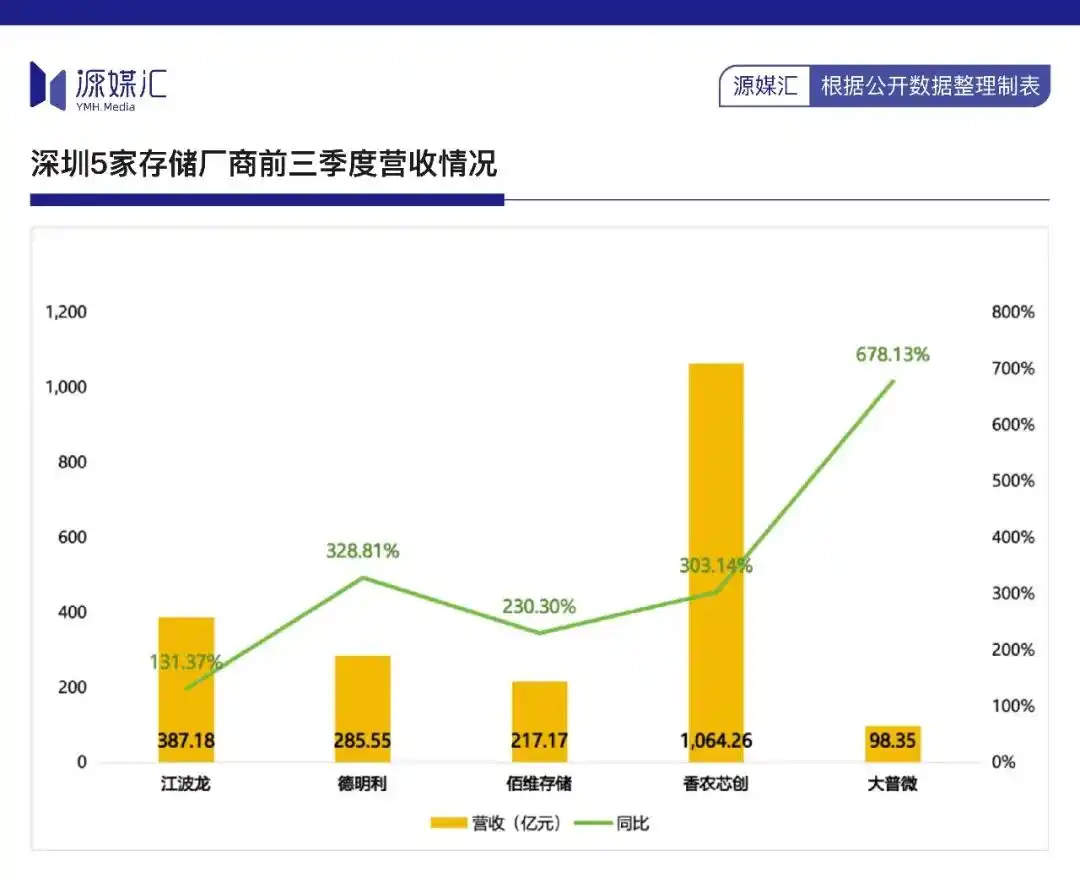
That pricing backdrop translated into outsized growth for Shenzhen suppliers tied to the Huaqiangbei electronics market. In the first three quarters of the year, revenue at Longsys, Delongli and Biwin Storage more than doubled. Longsys posted the smallest increase, up 131.4% to 38.7 billion yuan, while Delongli recorded the largest gain, up 328.8% to 28.56 billion yuan.
Two other Shenzhen memory companies mentioned in the report also posted stronger top-line growth. Dapu Micro rose 678% year on year to 9.84 billion yuan, and Shannon Core increased 303% to 106.43 billion yuan.
Companies gave broadly similar explanations for the jump in earnings, saying the storage industry had entered a high-prosperity cycle.
Delongli said that during the reporting period the storage industry remained strong, its supply chain stayed stable, and the company increased research and development spending, launched self-developed controllers, expanded its product matrix and improved product mix. It also said revenue and revenue share from enterprise storage continued to rise.
Biwin Storage said it mainly benefited from the surge in AI computing demand and the storage industry’s entry into a high-prosperity cycle, while its product and customer mix kept improving.
The comparison with a year earlier is stark. In the third quarter of last year, the report said Longsys and Shannon Core had net profit margins of only 4.54% and 1.31%, while Biwin Storage had just moved past break-even and the other two companies were still loss-making. This year’s price rally changed that picture.
Most of these firms sit in the middle of the supply chain
The article notes that these storage companies generally do not own wafer fabrication lines. Their main raw materials, DRAM and NAND, are purchased externally, often through long-term supply agreements with multiple upstream manufacturers. Their core businesses are concentrated in chip design, solutions, advanced packaging and testing, and testing equipment.
That places them in the module segment between rising upstream chip prices and downstream shortages. When prices are climbing, that position can amplify earnings. When the cycle turns, the same group is often hit first.

According to the report, average DRAM prices reached a high point in the third quarter and then began to cool in October. JPMorgan forecast fourth-quarter quarter-on-quarter price increases of 13% for DRAM and 18% for NAND, with gains set to narrow clearly.
TrendForce said the main reasons were that earlier cumulative price increases had become too large, downstream buyers were less able to absorb them, consumer demand pressure was rising, client SSD inventories were ample, and some server DRAM suppliers had signed long-term fixed-price agreements.
Once the marginal effect of rapid price increases starts to fade, the balance across the chain can weaken. For companies absorbing higher upstream costs while facing delayed downstream demand, inventory and funding pressure can become much more visible.
Quarterly reports point to strong paper gains but weaker cash generation
The article highlights two signals from the quarterly reports of Shenzhen’s so-called “storage five tigers.”
- First, the surge in profitability looks closer to paper wealth than to fully realized cash earnings.
- Second, higher upstream chip prices are being transmitted first to intermediaries in the chain rather than directly to the end market.
Based on the disclosed figures, rising memory prices increased the expected value of raw materials sitting in warehouses and on company books, which in turn boosted what the article described as asset-driven profit creation.
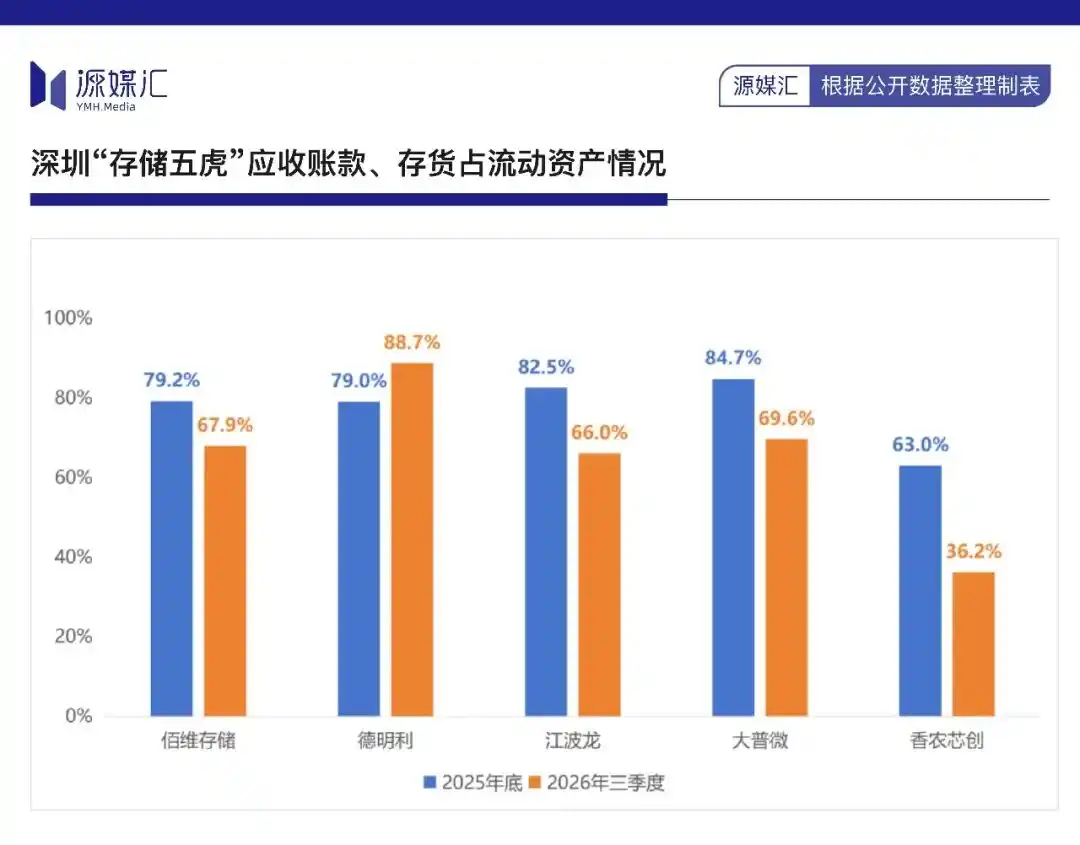
In the third quarter, accounts receivable and inventories made up an unusually large share of current assets at the five companies. Shannon Core was the exception at 36.17%, while the other four were all above 66%. The report said Shannon Core’s lower ratio reflected the fact that storage accounted for only about 10% of its total revenue.
That ratio suggests a large part of revenue growth came from a sharp increase in raw-material procurement and inventory scale. The article stresses that this kind of growth does not automatically translate into recurring cash inflows.
In the first three quarters of the year, four of the five companies posted negative net operating cash flow, and for three of them the deficit widened from a year earlier. The only company with net inflow was Shannon Core, which also had a relatively low share of storage business in total revenue.
Purchases, inventories and borrowing all expanded
The report gives two main reasons. One is that companies in modules, packaging and related middle segments directly bear the pressure of higher upstream chip prices and must pay more to secure supply. The other is that these firms have been stockpiling more aggressively.
It cites two sets of figures.
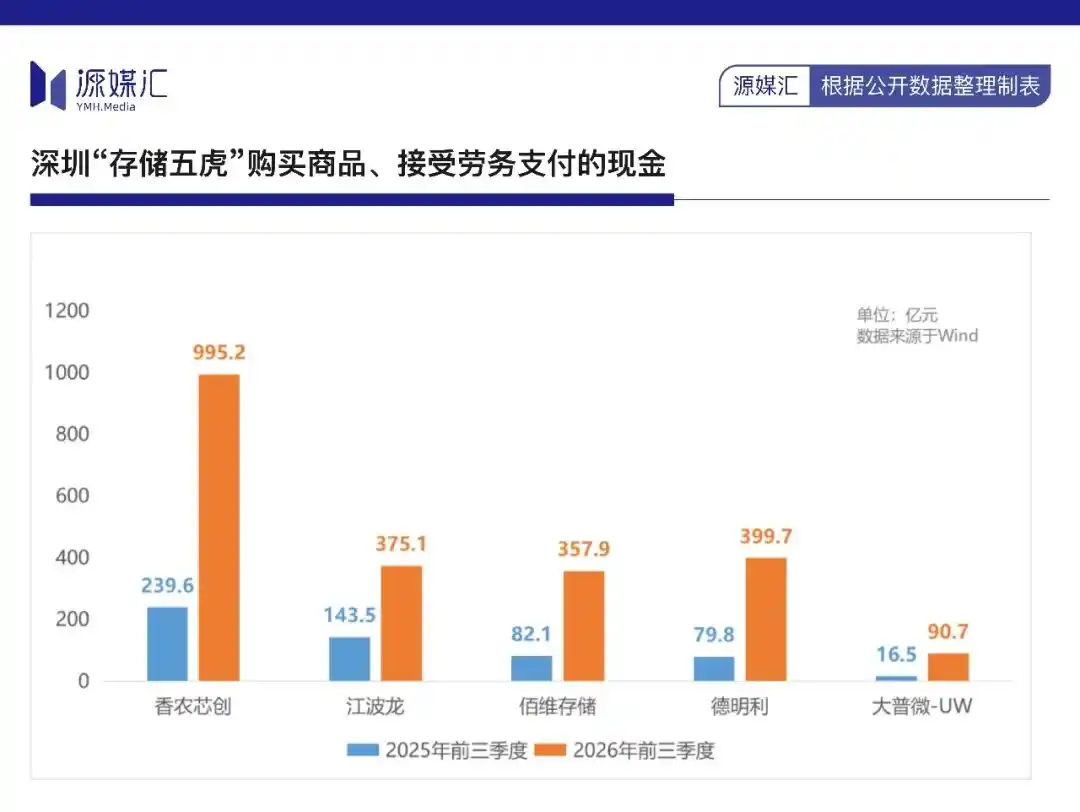
First, in the first three quarters of the year, spending on raw materials and services among the five storage companies rose by multiples across the board. Longsys posted the smallest increase at 2.61 times, while the other four ranged from 4.15 times to 5.5 times.
Second, after that procurement push, inventories also climbed by multiples. In the third quarter, inventory at the five companies was 2.4 times to 4.1 times the level at the end of 2025, with Delongli showing the most aggressive increase.
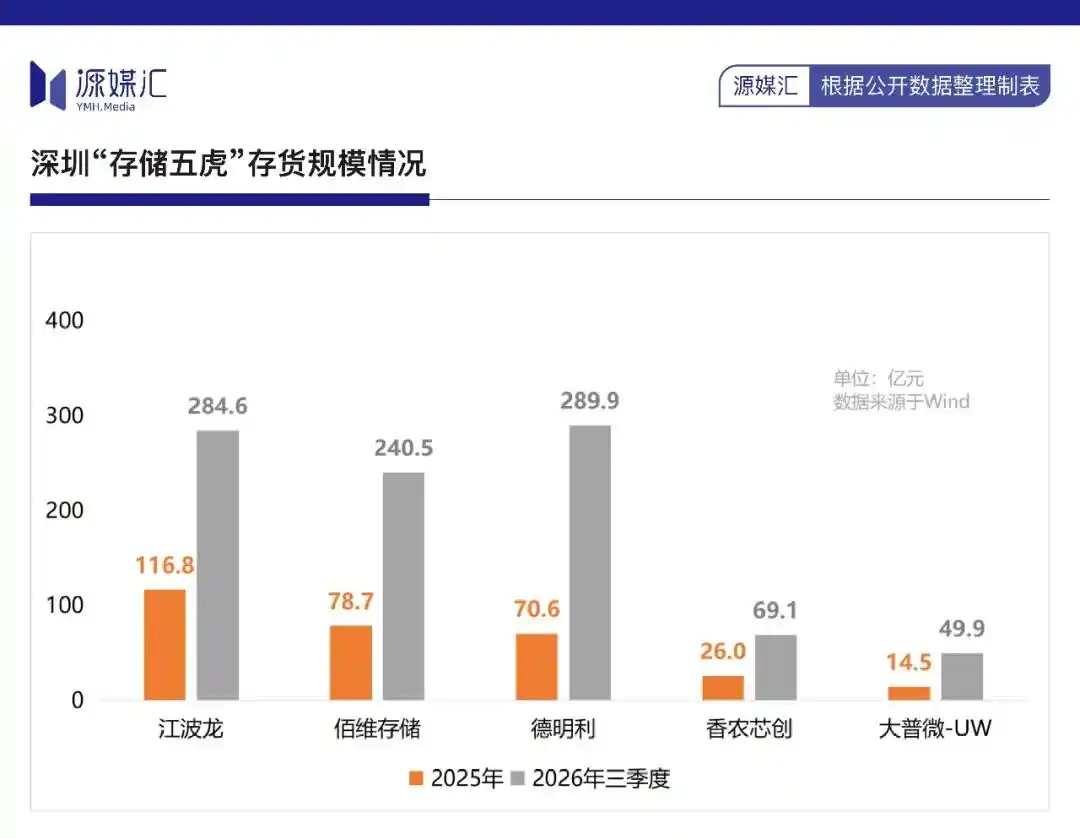
Combined inventory across the five companies reached 93.39 billion yuan, more than triple the level at the end of 2025.
The article then raises the funding question: where did the money for such large-scale stockpiling come from? Its answer is borrowing.
In the third quarter, cash received from borrowings at the five companies was 2.68 times to 4.09 times the level of the same period a year earlier. The three largest figures were Shannon Core, up 309% to 28.87 billion yuan; Biwin Storage, up 298.5% to 20.98 billion yuan; and Delongli, up 288.6% to 18.76 billion yuan.
Taken together, the quarterly reports show that Shenzhen’s “storage five tigers” have not stepped back during this high-cycle phase of the memory market. The companies already in the trade have instead increased procurement and inventory commitments.
The article notes that its material came from official reports and public information, that the views were for reference only, and that some images came from the internet. It also says the original piece was published by the WeChat account Yuanmeihui and written by Li Jin.




