
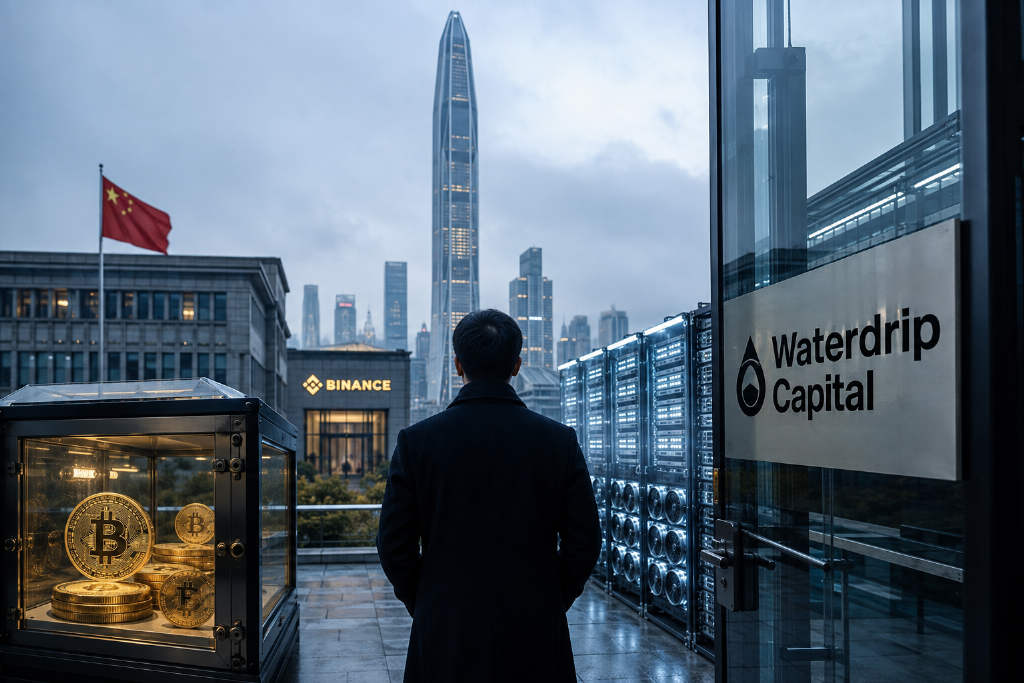
Dashan, CEO and co-founder of Shuidi Capital, said Bitcoin and artificial intelligence are the two defining asset classes and industries of the digital era, describing them as the period’s "gold and oil" in a live interview on Binance Square’s show Blockchain 100.
In the conversation, he traced his path from discovering Bitcoin as a student, to mining and buying BTC, to leaving Huawei HiSilicon in 2017 to enter crypto full time and build Shuidi Capital. He also discussed the firm’s cooperation with Taibao Asset Management, its 2024 push into BTC Layer 2, his preference for taking some projects public instead of issuing tokens, his move into AI data centers, and his views on RWA, U.S. elections, and tokenized Pre-IPO equity.
From early Bitcoin curiosity to mining during his PhD
Dashan said he first came across Bitcoin in 2011 and got more involved during his PhD years. At the time, he was doing circuit simulation work, with each simulation often taking 10, 20, or even 30 minutes to run. Those gaps gave him time to browse websites and magazines, which is how Bitcoin entered his field of view.
He was studying overseas then and said cross-border money transfers were a practical issue for international students. In that setting, Bitcoin looked useful to him as a way to move value across borders without relying entirely on channels such as Western Union.
He said mining on a standard personal computer had already become difficult, but the machines provided by his school were powerful because they were used for circuit simulation. He downloaded mining software and mined a small amount of Bitcoin, though he stopped because it interfered too much with normal use. Later, he shifted to buying mining rigs through friends in China and placing those rigs in hosted mining arrangements.
Dashan added that he had seen Bitcoin in 2012 but treated it mostly as a novelty. He only began buying seriously when BTC started rising in late 2012 and early 2013. As a result, the first batch of Bitcoin he held was not mined alone. Most of it, he said, was purchased.
Leaving Huawei HiSilicon was a gradual decision
Asked why he left Huawei HiSilicon and committed to crypto full time, Dashan said the process was anything but sudden. In his telling, it was not a case of seeing Bitcoin once and deciding to go all in.
He recalled that he first engaged with Bitcoin online, then later attended offline events and became more hesitant about entering the space outright. At the time, he was in Montreal, Canada, and said he was half an alumnus in common with Binance founder Changpeng Zhao. One night, while walking downtown, he saw a small place with a sign reading "Bitcoin Embassy." A security guard told him he needed a "Passport" to enter, meaning a Bitcoin wallet. It did not matter whether the wallet held much BTC. Having the wallet itself was the pass. He downloaded one on the spot, transferred in a small amount of Bitcoin, and was then allowed inside.
He described the place as dark, punk, and wild, with an atmosphere that felt far from his own temperament. Even during his PhD years, he said he was not truly inside the industry yet and was better described as an enthusiast. After returning to Shanghai, he saw some meetups taking shape, but the industry was still small, and many people in the space did not strike him as especially polished. He continued to see crypto as a niche interest.
The turning point came in late 2016. Another Bitcoin rally had lifted the value of the BTC he had mined and bought earlier, and he realized he might no longer need to rely entirely on a regular salaried job. Even then, he did not jump in at once. He said he spent time figuring out what role he should actually play.
By 2017, as the ICO boom accelerated, he saw firms such as Sequoia and IDG, along with many highly credentialed people from Tsinghua and Peking University, entering the sector. That was when he felt that if all those people were coming in, joining the industry himself was not necessarily a mistake. Only then did he move into it full time. Before that, he had spent several years around crypto on a part-time basis.
He also said he did not tell family members or his original social circle that he was working in blockchain until much later, when state-level attention to blockchain in China had become more visible. He framed the shift as a slow process of understanding and confirmation, not a dramatic leap.
Shuidi Capital’s start and the projects that generated realized 100x returns
Dashan said that before Shuidi Capital was formally established in 2017, the partners had already made a range of personal investments in projects including Ethereum, Cosmos, Polkadot, and VeChain.
He said two of the firm’s partners bought Ethereum at a very low price when the project first came to Shanghai for a roadshow. He also noted that the Chinese name for Ethereum was fixed during white paper translation and naming work involving another partner, Juxie.
As the ICO wave heated up in 2017 and new projects appeared every day, the team concluded that individual effort was no longer enough to compete. They formed a group, pooled their own money, and each took the same equity stake. Dashan said he became CEO in part because he was the youngest and the others believed the younger person should do more of the work. That was how what he called a very grassroots token fund was born.
He recalled that in early 2018, Mars Finance held a blockchain conference in Chongqing and named a Top 40 list of token funds that included Shuidi. There were so many teams at the time that the stage was almost too crowded. Dashan estimated that 200 to 300 similar funds may have emerged in 2017, but fewer than 10 are still alive today.
As for the first formal investment made after Shuidi was founded, he said he no longer remembers exactly which project received it. The reason, he said, is that the partners already held many projects before the firm was formally organized, and later allocations were sometimes topped up or shifted into the fund structure. That made it difficult to define which check came first.
He was specific about realized outcomes, though. Dashan said only three projects ultimately delivered 100x returns that were fully realized through exit: Ethereum, Cosmos, and Polkadot. He excluded Bitcoin from that list because BTC was a personal investment rather than a venture deal. He added that returns above 10x were not rare and paper gains of 100x or even 1,000x were also common on paper, but realized 100x outcomes after unlocks and full exits were very rare.
Why Shuidi moved to Hong Kong and what the four Taibao-linked funds invest in
Dashan said Shuidi’s cooperation with Taibao Asset Management began in 2022. From 2017 through 2021, the firm was largely based in Shanghai. In 2021, however, tighter regulation made it much harder to conduct crypto-related business, including investment activity, on the mainland. Shuidi then moved to Hong Kong and built what he described as a compliant LPF structure there.
According to Dashan, some Hong Kong firms, especially institutions with state-owned backgrounds, may have anticipated earlier than others that Hong Kong would introduce more supportive crypto policies. People from Taibao approached Shuidi about cooperating to enter the sector. Dashan said he was skeptical at first. They were a large institution with a state-owned background, while his team was small and scrappy. He doubted the interest was serious.
For their first meeting, he chose a casual street-side restaurant and showed up in slippers and loose shorts, while the Taibao side arrived in formal business attire and in large numbers. He said the contrast was memorable. Afterward, he realized they were serious. Once he attended 2049 and news spread that Hong Kong would support new crypto policies, he flew to Hong Kong immediately to advance the discussions and signed a letter of intent that same day. By 2023, the related funds were being established step by step.
He said there are four main funds in that cooperation:
- an early-stage VC fund that has already finished deploying capital into about 40 projects;
- a secondary-market fund focused mainly on altcoins, which has now been liquidated;
- a pure Bitcoin fund, which he said has performed the best and follows a cycle-based approach of buying BTC in bear markets and selling in bull markets, with no more than two trades a year;
- and an RWA fund focused on real-world asset opportunities.
Dashan said the team also tried to run a quantitative fund but stopped midway. Overall, the digital asset funds launched with Taibao stayed focused on crypto rather than expanding into other sectors.
He drew a distinction between those funds and Shuidi’s own proprietary capital. Over the past two years, the firm’s proprietary money has started looking outside crypto. By late 2024, he said, Shuidi had concluded that many altcoin narratives outside Bitcoin were struggling to attract liquidity if they lacked real execution. The team then wrote a report titled New Liquidity High Ground Beyond Crypto, centered on U.S. equities.
At that point, Shuidi still held many portfolio companies that had not exited. Dashan said the firm began advising some of them that if they already had revenue and profit, they did not need to insist on issuing a token and could consider listing instead. As a crypto-native institution, Shuidi still sees advantages in tokens, he said, but that does not mean every company has to choose that route. In an unregulated market, issuing a token effectively ties a founder’s long-term reputation to that token, so token issuance is not always the better choice.
Starting in late 2024, the firm also began paying attention to crypto-related stocks and captured what he called the later DAT opportunity. At the same time, it pushed some portfolio companies to pivot toward AI. He said at least two have shown good progress, with one currently moving toward a Nasdaq listing.
Why Shuidi leaned into BTC Layer 2 in 2024
Dashan said his view on X was clear at the time: he was very bullish on the Bitcoin ecosystem, but not nearly as bullish on inscriptions. In his view, early inscriptions resembled many meme coins in the current market. They lacked solid underlying value and depended mainly on attention and community energy. He said they could be interesting as a cultural phenomenon, but not something to treat as a serious investment destination.
Looking back, he said he still stands by that call. The Bitcoin ecosystem has kept developing, while far fewer inscriptions have lasted.
Dashan argued that Bitcoin remains the largest and most durable asset class in crypto, and the gap between BTC and other coins has continued to widen. Whether one looks at Ethereum or other tokens, most of them have underperformed Bitcoin on a relative basis over the long run. Every bull market produces a few exceptions, he said, but repeatedly catching them is difficult.
From an institutional perspective, he said, concentrating on the Bitcoin ecosystem was the right move. Many crypto VCs have had a hard time over the past few years, and a number of peers are no longer active or have disappeared. If Shuidi had simply chased the same themes as everyone else, it might have ended up in a far more difficult position. Instead, the Bitcoin ecosystem delivered comparatively solid returns.
He also said that while altcoins broadly performed poorly in bear markets, not every BTC ecosystem project did well either. Even so, when compared with narratives such as the metaverse, NFTs, ZK, and GameFi, the Bitcoin ecosystem held up better. He cited River, Lorenzo, Particle, Merlin, and Bsquare among Shuidi’s investments and said at least a dozen projects in that group are still developing well. Those names, he said, supported the net asset value of the firm’s latest fund and gave the team an answer for LPs.
That said, Dashan was careful not to elevate BTC Layer 2 into something untouchable. He said he does not think the sector is inherently great or irreplaceable. The context, in his account, was that Ethereum had gone through a phase in which highly homogeneous Layer 2 projects proliferated, potentially into the hundreds or even thousands, with only a small number surviving. By contrast, Bitcoin Layer 2 had only around a dozen to 20 projects. That, he said, has translated into a relatively higher survival rate. The real test still lies ahead. Those projects need to survive another bear phase and find capabilities that are hard to replicate in other ecosystems, including Ethereum Layer 2, as Bitcoin’s market cap grows.
"A truly strong project can choose to list"
Dashan addressed a line that has circulated widely from him: that truly strong projects should not issue a token and should go public directly. He said that statement was incomplete on its own. What he meant, he explained, was that truly strong projects can choose to list, while a project that can only issue a token is probably not strong enough.
Some businesses, he said, can do either. If the crypto market offers better liquidity, they can issue a token. If the stock market offers better liquidity, they can pursue a listing. That is a business choice. If there is little room to choose, then a regulated capital market is often the more compliant and safer route. But he stressed that this does not mean crypto lacks high-quality projects. He specifically named BNB and Uniswap as examples of strong businesses whose profitability and operating capability are not inferior to many public companies.
He said Shuidi has persuaded a meaningful number of projects to consider that route. In its portfolio, more than five companies are waiting in line to list. Excluding DAT-related companies, at least five are businesses trying to go public on the back of actual operations rather than a market narrative.
He gave Good Vision AI as an example. The company was originally small and had considered issuing a token. Because it had real revenue, Shuidi advised against forcing a token launch in an altcoin bear market. Instead, the firm invested more money, helped expand the company’s AI business line, and pushed revenue higher so the company could follow a listing path. Dashan said its revenue rose from $2 million to $3 million in 2024 to about $7 million in 2025, and to roughly $70 million this year. Under narratives tied to AI and compute infrastructure, he said, listing became the more sensible option while issuing a token could have created fresh regulatory complications.
Even so, he said token issuance and ICO regulation are still evolving. The U.S. is discussing a new ICO regulatory framework, with different requirements potentially tied to different fundraising sizes. If such rules are eventually adopted, ICOs or token issuance could see a new opening. In his view, tokens are a newer financial tool than stocks and are not automatically inferior. They may even prove to be more advanced in some settings. The deciding factor is the state of the market and the regulatory environment at the time.
Why he thinks fundraising should come with higher standards
When asked whether pushing projects toward listings raises the barrier to entrepreneurship, Dashan said that entrepreneurship should not be easy in the first place. In traditional industries, he said, starting a company is already a high-failure endeavor.
If founders use their own money, they risk their own savings or their family’s money. Once they raise outside capital, especially from unqualified investors or retail communities, the consequences spread to far more households. For that reason, he said, the threshold should be high whenever other people’s money is involved, including retail money.
He pointed back to the 2017 and 2018 ICO bubble. In his view, the earliest people who tried ICOs were genuine first movers, and many of those projects were decent and are still around today, or at least did not disappear with the money. But by late 2017 and early 2018, many others discovered they could raise capital simply by telling a story, and outright cash grabs followed. What looked like a lower barrier to entry ended up producing severe adverse selection and a market where bad money drove out good.
Issuing a token, he said, is effectively putting a founder’s reputation on-chain for life. Ten or twenty years later, people can still look back at a token a founder launched that later went to zero and use it to judge that person. He said token issuance is a serious responsibility and should come with standards or regulation that force founders to be more careful, unless what is being issued is explicitly an anonymous meme coin treated by everyone as entertainment or a game.
Advice to crypto founders who want to list
Dashan said crypto companies that want to pursue a public listing face a different path from token issuance, and in some ways a harder one than traditional internet firms. Ordinary internet companies need to think primarily about users, revenue, and operating data. Crypto businesses have those challenges plus compliance and regulation.
But if they succeed, he said, the competitive setup in public markets may actually be more favorable. A token launch faces competition from thousands or tens of thousands of other crypto projects. In the crypto segment of Nasdaq, there may only be a few dozen stocks. Strong companies are easier to spot there.
He offered two main suggestions. The first is to build a real business rather than just tell a story. Especially for Nasdaq, he said, there are requirements around revenue, company scale, and customer base. A company needs real customers and real business. The second is that founders who choose the listing route need to embrace traditional finance in earnest. They cannot rely only on communities, X posts, or meetups. They need to work with Wall Street funds, hedge funds, market makers, and regulators and become part of that mainstream system.
He added that this may mean attending business school, building ties with traditional fund managers, founders of listed companies, and entrepreneurs, and learning how those circles operate. His message was simple: if you want to play in a certain arena, you need to fully enter that arena.
Moving into AI data centers does not mean turning away from crypto
Dashan pushed back directly on the idea that becoming chairman of an AI data center company means he has lost faith in crypto after nine years as a crypto VC. He said the opposite is true. He remains more bullish on crypto, not less.
He repeated the theme he has used in recent talks: "Left hand crypto, right hand AI: the gold and oil of the digital age." In his view, crypto and AI are the two most important new assets and industries of the current era, and they are two sides of the same coin. They are also, he said, major opportunities for younger generations.
Every era has its own structural tailwinds. Real estate, oil, and automobiles were the advantages of the last one. In this era, he said, the opportunity set lies in crypto and AI. After spending more than a decade in crypto and making the first pool of capital there, he believes it is natural to engage with AI as the other major theme of the age.
But he also argued that entry into AI should be selective. People have asked whether he plans to trade storage, optical modules, or agent platforms. He said those may not be his team’s natural strengths. Their deepest accumulation from crypto lies in compute power, mining farms, and mining machines. Because Shuidi has invested in many mining farm and mining hardware projects, converting Bitcoin mining farms into AI data centers, or AIDC, felt like a direct extension. Control over power supply and physical sites gives them an advantage over teams entering from scratch.
He also said AIDC supports what he called a form of "dual mining." If Bitcoin prices rise back to very high levels, facilities can switch back to mining BTC. If AI enters a bubble, the assets do not necessarily go to zero. That flexibility is one reason they moved into AI and one reason he took the chairman role.
On Good Vision AI specifically, Dashan said the company initially focused on token routing and designing compute usage plans for enterprises and users. Because Shuidi invested heavily and owns a relatively high stake, he became chairman as a way of taking responsibility for the investment rather than acting as a passive venture holder with a 1% or 2% position. He described the role as transitional. Once the company becomes much larger, or once Shuidi exits, control should be handed back more fully to the founder.
He said the company now has exposure across the stack: underlying compute and compute centers, mid-layer compute services, and joint R&D around AI agents, including trading agents, drug discovery agents, and gaming agents. Those efforts can connect with Shuidi’s existing crypto footprint. He described this as the first time in his investing career that he has joined a startup team at a much deeper level. At present, he said, the company’s financing and listing process is moving quickly.
Dashan then turned back to Bitcoin. He said he has not become less bullish on crypto at all. In this cycle, he started buying Bitcoin from $80,000 and kept buying as it fell through $70,000 and $60,000, eventually buying near a relative low. He said his current personal BTC position is larger than in the previous cycle. He added that the title he likes most in his bio is still "Bitcoin evangelist," even ahead of founder of Shuidi Capital and chairman of Good Vision AI.
Miners moving to AI does not leave crypto infrastructure unattended
Asked whether crypto infrastructure will be left behind if many former miners move into AI data centers, Dashan said there is no reason for alarm. The movement of people and capital between sectors, he argued, is a sign of health rather than weakness.
If an industry only ever retains the same old participants and no one leaves, that can be a worse sign because new entrants may wonder why they should come in. If existing holders never rotate out, outside capital may also stay away. In his view, it is normal for crypto OGs to cash out some Bitcoin and improve their living standards by buying homes or cars. Investment should improve life, he said, and consumption supports other parts of the economy too.
As for miners, he said moving into AI does not mean abandoning crypto forever. In a bear market, if the same site and the same electricity generate more revenue by serving AI than by mining Bitcoin, the switch is rational. If Bitcoin returns to much higher prices, those operators can come back. He does not see this as damage to crypto. He sees it as a positive adjustment.
He also said new groups are quietly entering the market, including traditional companies, ETFs, institutions focused on risk control and market strategy, and some payment and internet companies that are gradually allocating to Bitcoin. Bear markets, he said, are often when large Western institutions position themselves.
One of the biggest opportunities in crypto today, in his view, is RWA, especially the tokenization of Pre-IPO private equity. He used Anthropic and OpenAI as examples of companies that are not yet public. If allocations in such firms could be split, tokenized, and traded on-chain, retail investors and high-net-worth individuals who are bullish on them but lack the capital or access to join private rounds could participate with smaller amounts in a market that runs 24/7 and remains liquid. That, he said, could draw more traditional users into crypto.
His broader point was that some people leaving and others entering is normal. Departing does not always mean losing confidence in the sector. It can just mean someone found a better-paying opportunity for a period. Once they make money there, they may still come back and buy Bitcoin again. In his framework, crypto and AI should not be framed against each other. They are two sides of the same digital economy. AI practitioners should understand blockchain, and crypto practitioners should recognize AI as one of blockchain’s important application directions.
His read on AI: no bubble now, but future excess is possible
Dashan prefaced his answer on AI by saying it was a personal view, not investment advice. His conclusion was that AI does not currently look like a bubble, but that does not mean a bubble cannot form later.
From what he sees at the front line of AI compute, the market is still a seller’s market. In the U.S. and Japan, he said, any compute coming online is likely to be sold out quickly, and capacity deliverable over the next six months to one year is often booked in advance. At the same time, large language models have become embedded in daily life, usage of tools such as DeepSeek and ChatGPT continues to grow, and hardware companies in chips and storage have posted strong earnings. To him, all of that points to real demand.
Still, he said real demand does not prevent financial markets from cracking before fundamentals visibly weaken. He is watching two risk factors. The first is whether expectations around large AI companies reverse after they go public. Even if financial results remain strong in the moment, institutions may exit six months or a year before the peak if they believe a bubble will emerge later. Stocks trade on expectations, he said, not on the present alone.
The second is a potential oversupply of compute after the autumn of 2028. He cited data suggesting that U.S. investment in AI infrastructure in 2025 was above $500 billion and could at least double to $1 trillion in 2026. Because AIDC projects typically take at least two years from construction to launch, much of that capacity could come online after the autumn of 2028. At that stage, compute supply could expand by more than 10x. The key question, he said, is whether applications such as AI agents can expand consumption by a similar magnitude.
If demand grows at the same pace, the sector can keep expanding. If demand lags and supply rises sharply, oversupply may follow. Dashan said that would not be unusual. Internet fiber, submarine cables, and highways all went through phases of aggressive buildout, oversupply, bursting bubbles, and eventual absorption. AI compute could follow a similar cycle.
U.S. midterms, Clarity Act, and election-stage caution
On whether U.S. midterm elections could hit crypto and push the sector back into a bear market, Dashan said he had attended the Bitcoin conference in Hong Kong and spoken with people close to Western governments. The current U.S. administration presents itself as crypto-friendly, he said, and Donald Trump is often described as a "crypto president." Since that camp has benefited from support from the crypto industry, Dashan argued, it needs to show voters progress before elections by advancing bills or at least delivering positive policy signals.
For that reason, he said he is not very worried about the market before the midterms. On the Clarity Act, he said the view he has heard is that the bill faces significant resistance and may not pass. Even so, the market is also watching other potential positive developments, such as whether the U.S. national treasury might buy Bitcoin on a large scale. If money on the order of tens of billions of dollars were to enter, he said, the impact on Bitcoin’s price would be clear.
His judgment is that the period before the election may still hold opportunities, but investors need to become more careful as the vote draws closer. If the election result is good, Trump may not feel the need to keep emphasizing crypto. If the result is poor, pressure could come from the other side’s approach to digital assets. Dashan said his own position is still relatively heavy, but he will be watching closely as the market moves into the more sensitive pre-election phase.
Over the longer term, he remains bullish. He does not think the two U.S. parties can be reduced to a simple supporter-versus-opponent split on crypto, because there are already many crypto asset holders in the country and neither side can ignore that constituency. On a four-year cycle, he said, short-term weakness remains possible, but Bitcoin should still have another bull market ahead. He again described this as a personal judgment, not a trading recommendation.
What retail investors should watch in Pre-IPO opportunities
Dashan said it is very common for Pre-IPO names to spike on their first trading day and then spend a long time below those highs. The old problems of traditional finance, including manipulation, conflicting interests, and information asymmetry, are no lighter there than in crypto. Retail investors start from a disadvantage.
He offered two suggestions. The first is to use time to create room. If an investor truly believes in an asset, long-term holding matters. He used Bitcoin as the example again, saying that someone who bought early and stayed in despite volatility may have ended up in a very different position. He added that altcoins require much more careful selection.
The second is to get access as close as possible to early-investor or institutional cost bases. Dashan said some projects are now trying to tokenize allocations from earlier private rounds and bring them on-chain. If retail investors can enter near the prices paid by institutions, rather than buying high after a listing pop, the risk-reward profile changes completely.
He said tokenized early equity in strong private companies could give retail investors a lower cost basis before a public listing, leaving them with more downside cushion and liquidity even if prices pull back later. More broadly, he said he is positive on the direction of tokenizing high-quality Pre-IPO private equity and moving it on-chain. In his view, that lowers the barrier and cost for retail investors to access better assets while improving flexibility.
By contrast, assets that institutions are unwilling to touch and that rely only on a story to pull in retail buyers are unlikely to be good assets. The ones worth studying, he said, are strong assets institutions already hold at a reasonable cost. For retail investors seeking excess returns, the key is to get as close as possible to institutional entry levels rather than buying at emotional highs.
He compared that logic with the early ICO period in 2017, when on-chain assets were scarce and participants sent funds directly to protocols. Institutions had the advantage of larger checks, but retail and institutions were relatively closer in terms of access to each single opportunity. In the future, if more on-chain protocols can offer fair and transparent access to early stakes in strong assets, retail investors may be able to narrow the gap again.
What separates long-term survivors from those who disappear
At the end of the interview, Dashan was asked what most fundamentally separates people who last in the industry from those who fade away mid-journey. He gave two answers.
The first was long-termism. If someone wants to stay in the market for a long time, he said, that person has to look farther ahead instead of focusing only on immediate returns. A narrow short-term view makes it easy to miss the holes in front of you.
The second was principle. In Dashan’s view, not every kind of money should be made. People need to know what they are good at, what they like, and what kind of money lets them feel both secure and at ease. Human energy is limited, he said.
Across the interview, the thread running through his account was consistent: from mining in 2013, to venture investing in 2017, to a concentrated BTC Layer 2 bet in 2024, and now to AI, he sees the real question as how to back the core productive infrastructure of the next digital world.