
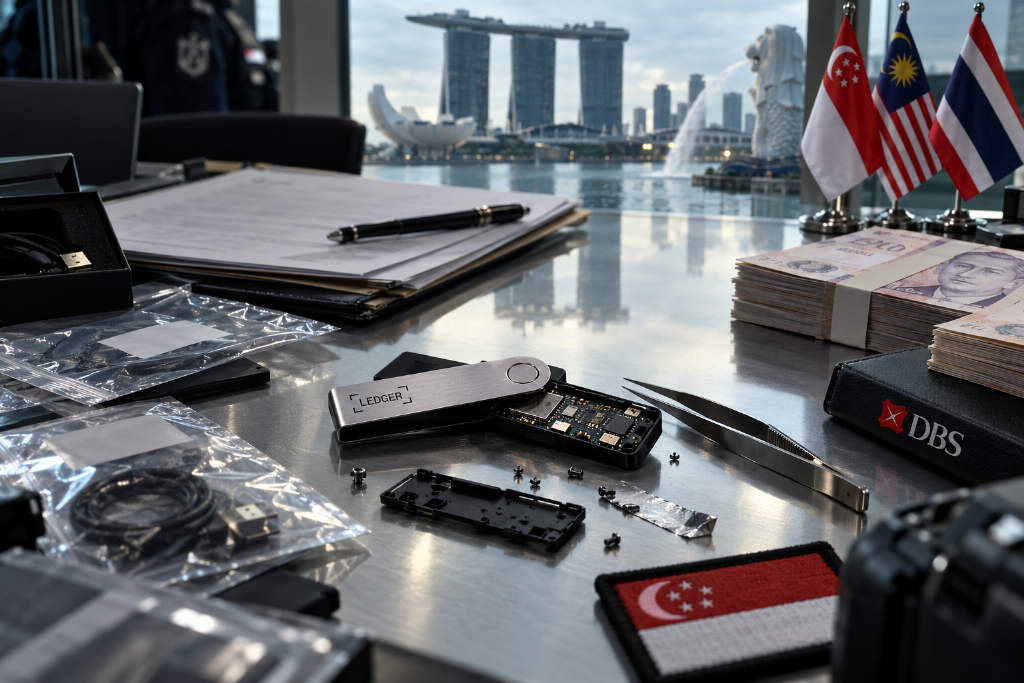
Singapore police say at least two cases involving tampered Ledger hardware wallets have been reported since Sept. 10, with combined losses of about 3.5 million Singapore dollars, or $2.7 million. That puts the first local report nearly a month before the incident became widely known.
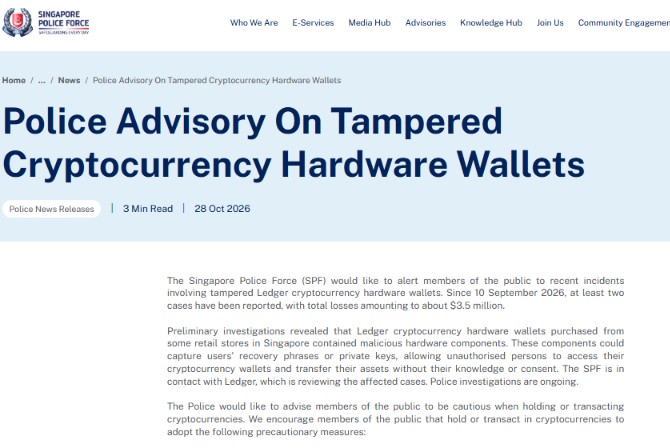
Singapore police detail tampered Ledger cases
A consumer alert issued by Singapore police on Oct. 28 said at least two cases were tied to tampered Ledger devices. The notice did not make clear whether the Sept. 10 case was reported to police at the time or filed retrospectively.
If the report was made promptly, that leaves open whether Ledger had been informed earlier and whether the Singapore Police Force could have issued a public warning sooner. The Oct. 28 advisory also indicated that the investigation was still in its preliminary stage.
Ledger issued a public alert on Oct. 9 saying tampered devices had been found in the CryptoBilis supply chain. Wallets containing spyware components were drained of almost $100 million.
On Oct. 13, Ledger said it had asked retailers in Indonesia, Singapore, Thailand, the Philippines, Vietnam, Malaysia and Hong Kong to suspend sales of Ledger devices while the investigation continued.
Singapore police issued their warning about tampered Ledgers roughly three weeks after the story had already broken.
Malaysia and Thailand join Singapore stablecoin project
Bank Negara Malaysia and the Bank of Thailand joined Singapore’s BLOOM initiative on Friday as policymaker members.
BLOOM, short for Borderless, Liquid, Open, Online, Multi-currency, is a public-private initiative designed to help financial institutions use stablecoins and tokenized deposits for cross-border payments. The project was launched by the Monetary Authority of Singapore in October last year. Members include Airwallex, Mastercard, Ripple, Visa and the World Bank Group.
DBS survey points to corporate demand for tokenized money
A survey by Singapore bank DBS found that almost 90% of 422 global businesses surveyed are either already adopting tokenized cash or interested in doing so to speed up payments.
South Korea may delay crypto tax for a fourth time
Government officials in South Korea are reportedly considering another delay to the country’s cryptocurrency tax policy, which is currently scheduled to take effect in January 2027.
According to a Monday report from South Korean outlet Newsis, the crypto income tax could be pushed back to 2029, partly because that is the earliest point at which officials would be able to share tax information related to digital asset exchanges with the United States.
The policy would impose a 22% tax on crypto gains for investors earning more than 2.5 million Korean won, or $1,883, a year.
Bithumb and two other firms disclose breaches
Bithumb said its in-house mobile system was hacked and personal information was leaked. Brokerage Daishin Securities reported that roughly 38,000 customer records were exposed, while asset manager Mirae Asset Global Investments also confirmed a hacking incident.
South Korea moves on stablecoin rules and transfer reporting
The South Korean government and the Bank of Korea intend to draft amendments to the Foreign Exchange Transactions Act within this year to regulate stablecoins used as payment instruments.
The central bank will also require crypto transfer service providers to submit monthly reports from Dec. 2 identifying who has been sending money out of the country. The reporting requirement will extend back to mid-2024.
Chainalysis tracks North Korean cash-outs through Garantex
Blockchain analytics firm Chainalysis mapped a long-running network of Russian intermediaries that helped North Korean IT workers cash out millions of dollars in cryptocurrency.
According to a Wednesday press release from the US Treasury Department’s Office of Foreign Assets Control, the agency sanctioned 10 individuals and one entity for supporting North Korean government-run IT worker schemes that it said funded the country’s weapons programs.
Those sanctioned included Russian nationals Ilya Aleksandrovich Boykov and Vitold Viktorovich Obertas.
Hong Kong adds Solana Company to strategic enterprise program
Hong Kong named Nasdaq-listed Solana Company, ticker HSDT, a strategic enterprise under a government program aimed at attracting businesses that support the city’s economic development.
Solana Company said on Thursday that it was part of the seventh batch selected by Hong Kong’s Office for Attracting Strategic Enterprises, or OASES, and the only blockchain infrastructure company brought in by the office in 2026.
Hong Kong’s government said last week that 18 enterprises were added to the program, bringing the total to 142.
Report says Beijing wants Hong Kong to help expand digital yuan use
The South China Morning Post reported that Beijing wants Hong Kong to help seed international use of the digital yuan.
RedotPay plans US IPO
Hong Kong crypto payments firm RedotPay plans to launch an initial public offering in the United States before the end of the year. It has also opened a pre-IPO funding round that values the company at $4 billion.
China sets 2030 target for national blockchain network
China has set a 2030 target for largely completing a national blockchain network under a five-year digital development plan published on Friday.
The plan also calls for stronger blockchain technical standards and broader use of the technology in data circulation and trading.
Mainland China bans cryptocurrency-related business activities, but continues to promote blockchain technology as a national priority. Critics say the blockchain-without-crypto approach has never worked before.
Thai Supreme Court recognizes Bitcoin as property
Thailand’s Supreme Court ruled that Bitcoin qualifies as property under criminal law, creating a precedent that may shape how Thai courts handle other cryptocurrencies.
The case upheld a 10-year prison sentence in a robbery case involving about $50,000 in Bitcoin.
Thailand launches tourist crypto wallet
Thailand has launched the WORPT digital wallet, allowing tourists to convert USDT or USDC into Thai baht and spend through PromptPay QR codes.
The program is part of the Tourist DigiPay sandbox.


