
Castle Labs says the gap between protocol performance and token performance comes down to a structural break: revenue may be growing, but that does not mean value is reaching token holders in a way the market will reward.
Its report notes that crypto protocols generated $7.42 billion in revenue in the first half of 2026. Even with that figure, many tokens across the sector still have not reflected the success of the underlying products. In Castle Labs’ view, investors are moving away from pure speculation and toward a more basic set of questions around business quality, distribution and token-level value capture.
The firm frames the exercise around four questions token holders usually want answered: how a protocol generates revenue and whether that revenue is sustainable; how revenue is distributed and whether holders receive any of it; how much token value is released through inflation, unlocks and incentives; and whether an equity structure gives another class of stakeholders better rights than existing token holders.
Those questions, the report argues, now carry more weight in token evaluation than they used to. Many projects still cannot answer them clearly. Token designs vary widely, some have no value-capture mechanism at all, and even direct revenue sharing may fail to translate into stronger token performance.
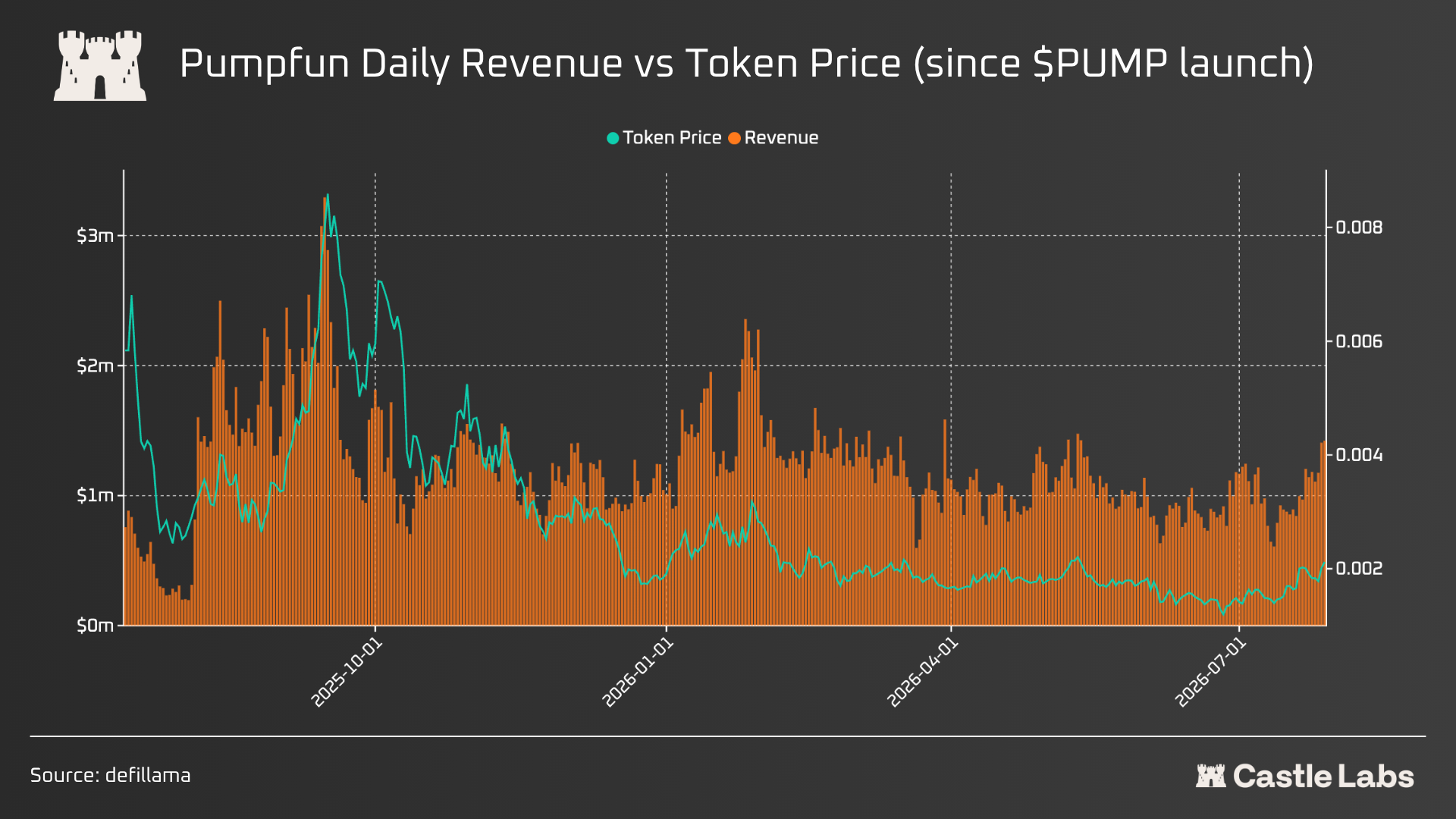
PumpFun is used as an example. Since its token launched, the protocol has generated about $450 million in revenue on a one-year timeframe, according to the report, yet the token has remained in a prolonged decline. Castle Labs attributes that in part to unlock speed and disappointed airdrop expectations.
Six protocols generated $726 million in H1
The detailed analysis focuses on six protocols: Aave, Aerodrome, Hyperliquid, Pump, Sky and Uniswap. Castle Labs says they produced a combined $726 million in revenue during the first half of 2026.
Revenue alone, though, is not enough for a clean comparison. The report argues that sustainability should be tested across multiple timeframes rather than through a single aggregate number. On that basis, it compares revenue in the first and second quarters of 2026 and finds that most of the group posted weaker numbers in Q2 as broader market conditions softened.
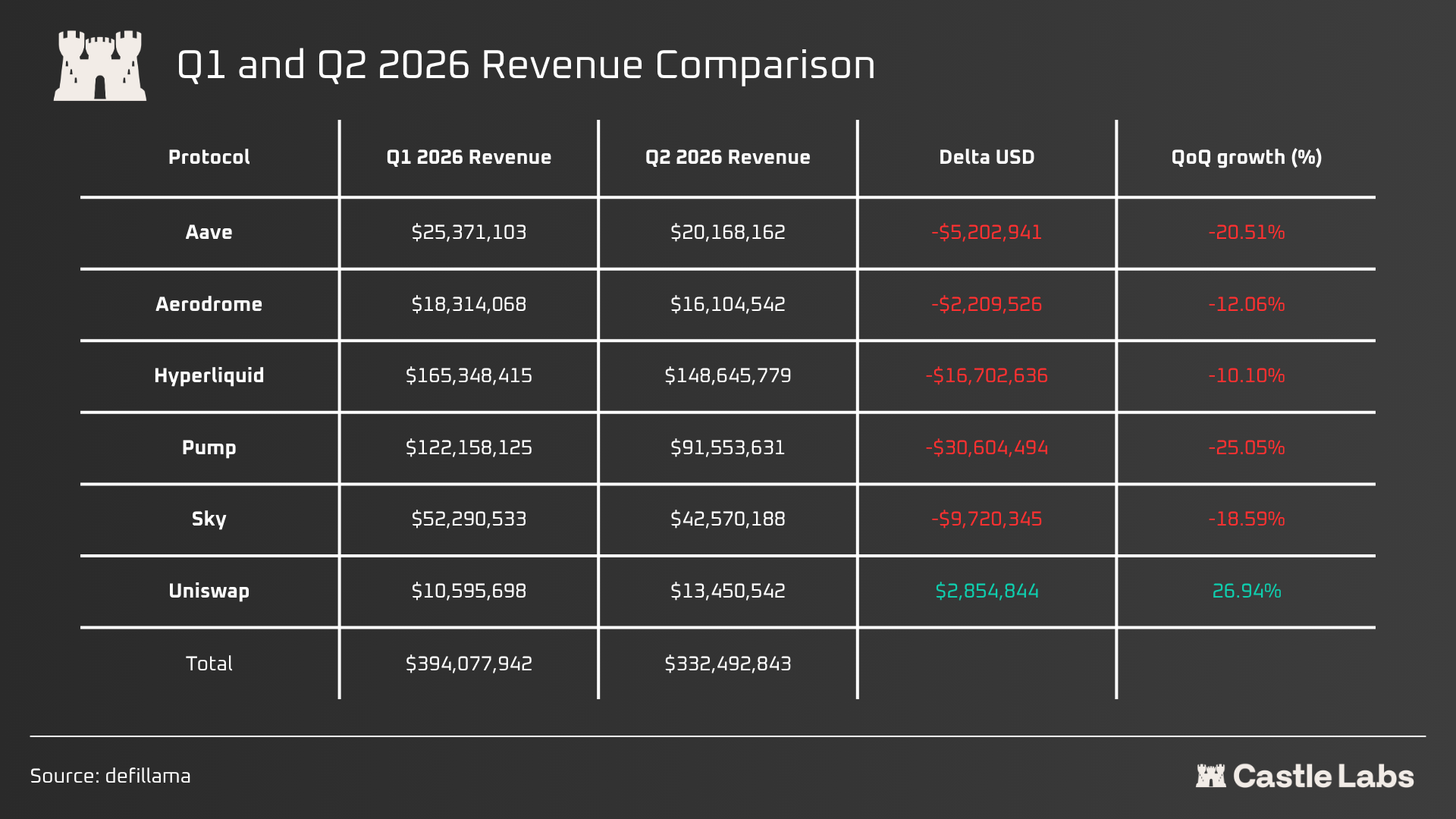
Across the six names, total revenue fell from $394 million in Q1 to $332 million in Q2. Uniswap was the only protocol in the set to record positive quarter-on-quarter growth, up 26.94%.
Where the revenue comes from
Castle Labs breaks the revenue mix down by protocol.
- Hyperliquid earns revenue from fees on its perpetuals exchange, including native and HIP-3 activity, along with spot markets, code auctions, priority fees and HyperEVM gas fees.
- Aerodrome, a decentralized exchange, generates revenue from trading fees and external voting incentives, or bribes.
- Uniswap collects fees on trading activity.
- Sky earns revenue from several products, including stability fees on collateralized DAI/USDS loans, liquidation penalties, fees from the Peg Stability Module, and interest from Direct Deposit Modules and real-world assets.
- Aave generates revenue from interest rate spreads paid by borrowers, flash loans, liquidation penalties and stability fees tied to its native GHO stablecoin.
- Pumpfun earns revenue from trading fees and graduation fees charged when newly created tokens hit a target market capitalization.
That mapping matters because the report is not only asking how much money a protocol makes. It is asking what happens after the money comes in, and how much token issuance is required to maintain current activity.
Revenue distribution and token release
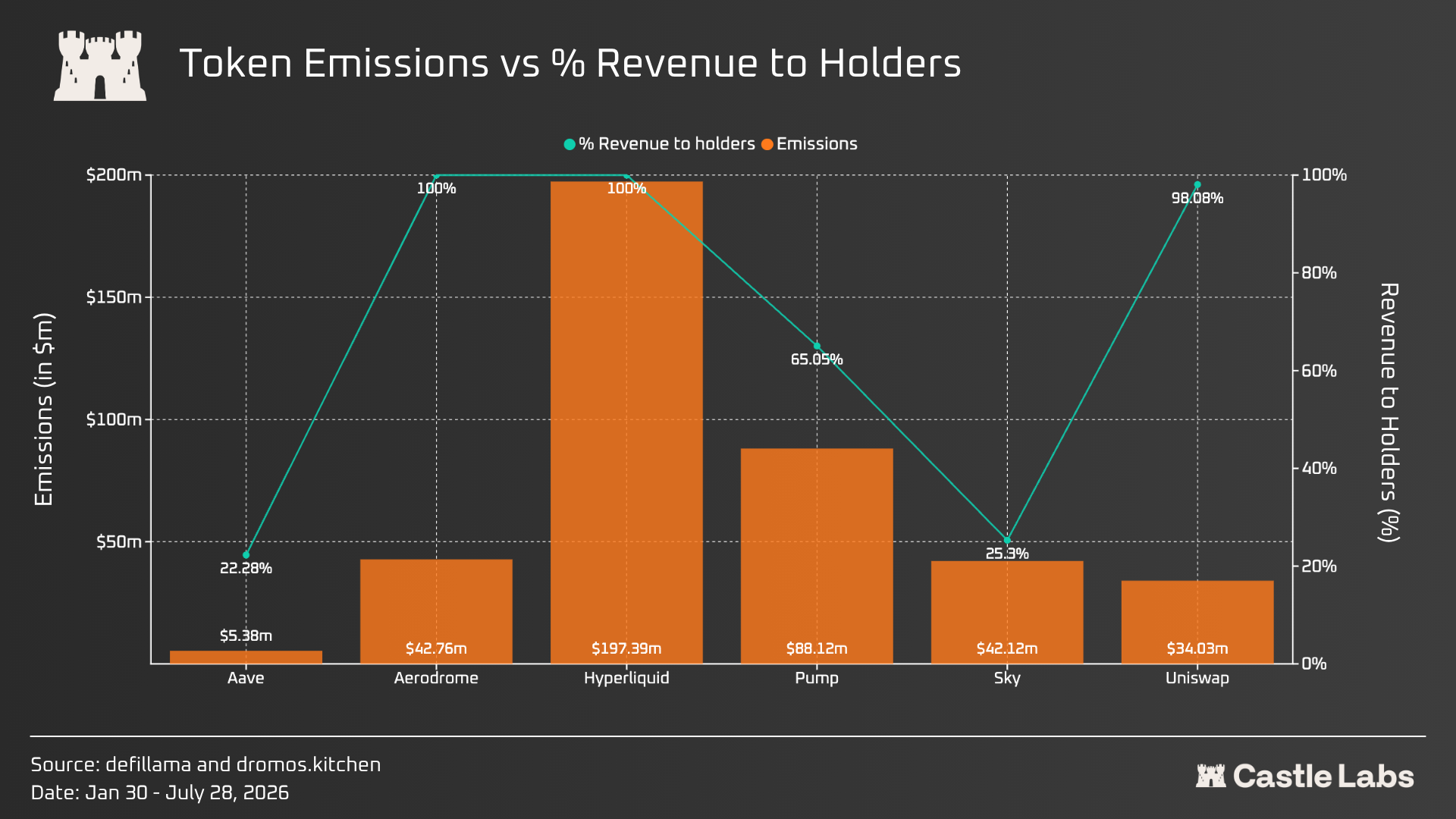
Most protocols split revenue between token holders and the treasury, with the exact path shaped by each protocol’s mechanics and governance process. To measure what holders actually keep, Castle Labs subtracts token release from holder income and uses that as a net token value flow metric.
The logic is straightforward. A protocol can show high holder income on paper, but if the token release side is even larger, the net effect for holders weakens sharply. The report gives a simple illustration: a protocol generating $100 million in revenue looks very different if it is also minting $200 million of tokens every year.
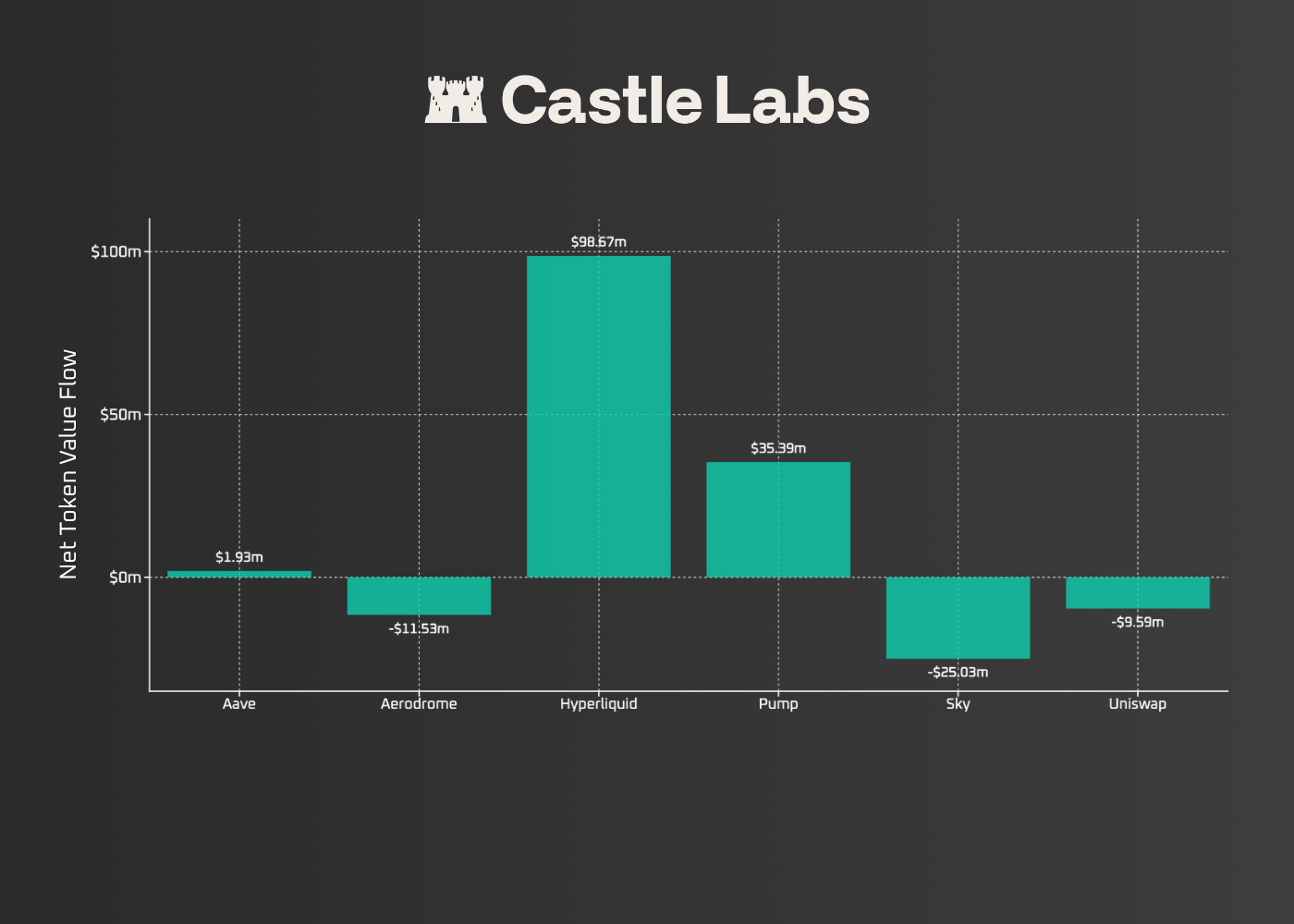
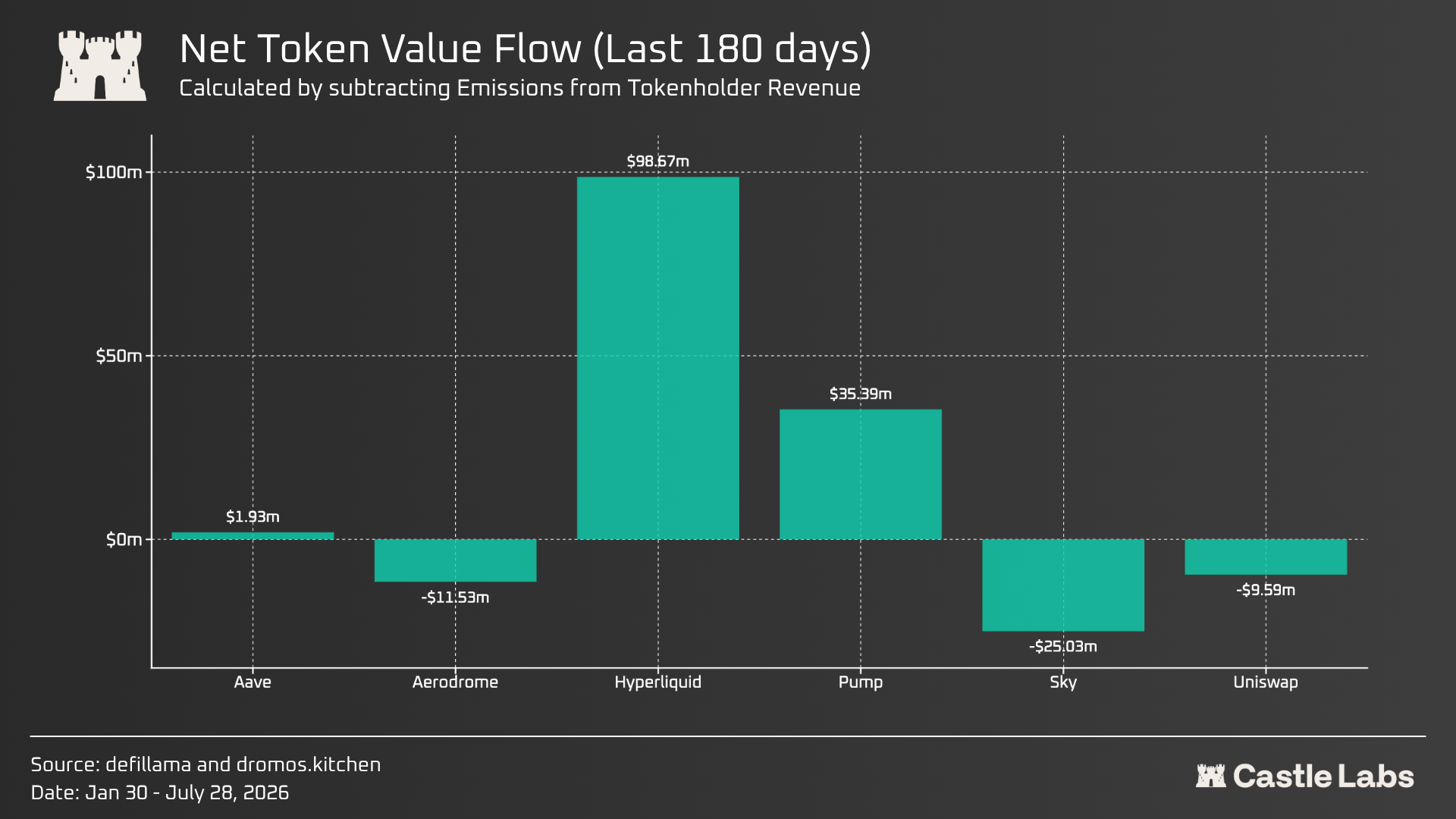
Release, in this framework, includes not only inflation but also unlocks for teams and investors, and incentives. For Aerodrome, Sky and Uniswap, net token value flow turns negative after release is deducted from holder income. In other words, even though holders receive some value, more token value is being emitted to sustain the current level of activity.
On a 180-day basis, Castle Labs says Hyperliquid recorded a net inflow of $98.67 million, while Sky posted a net outflow of $25.03 million.
Buybacks and burns remain the main route
The report says token holders mainly capture value through two channels today: buybacks and fee distribution.
Buybacks are one of the clearest mechanisms. A protocol uses revenue to purchase its own token, then either burns it or sends it back to the treasury for future incentives or staking rewards. Aave is cited as an example of the treasury route, with repurchased tokens moved into the treasury. Other protocols choose to burn the tokens in order to shrink supply.
Castle Labs points to Lighter, which has burned about 15.6 million LIT tokens acquired through revenue, equal to 6.6% of supply and worth $36 million. Hyperliquid runs programmatic buybacks and burns and has so far burned more than 47 million HYPE, or about 4.72% of supply. Uniswap burned 100 million UNI in December 2025 and has burned a cumulative 107 million UNI, roughly 11% of total supply, using fees from its activated fee model.
The report adds a caveat. Not every burn is economically meaningful. What matters is whether the burn reduces circulating supply or only non-circulating supply. It cites BNB’s historical quarterly burns as an example where users need to look closely at the details before assuming a market effect.
How buyback design differs across protocols
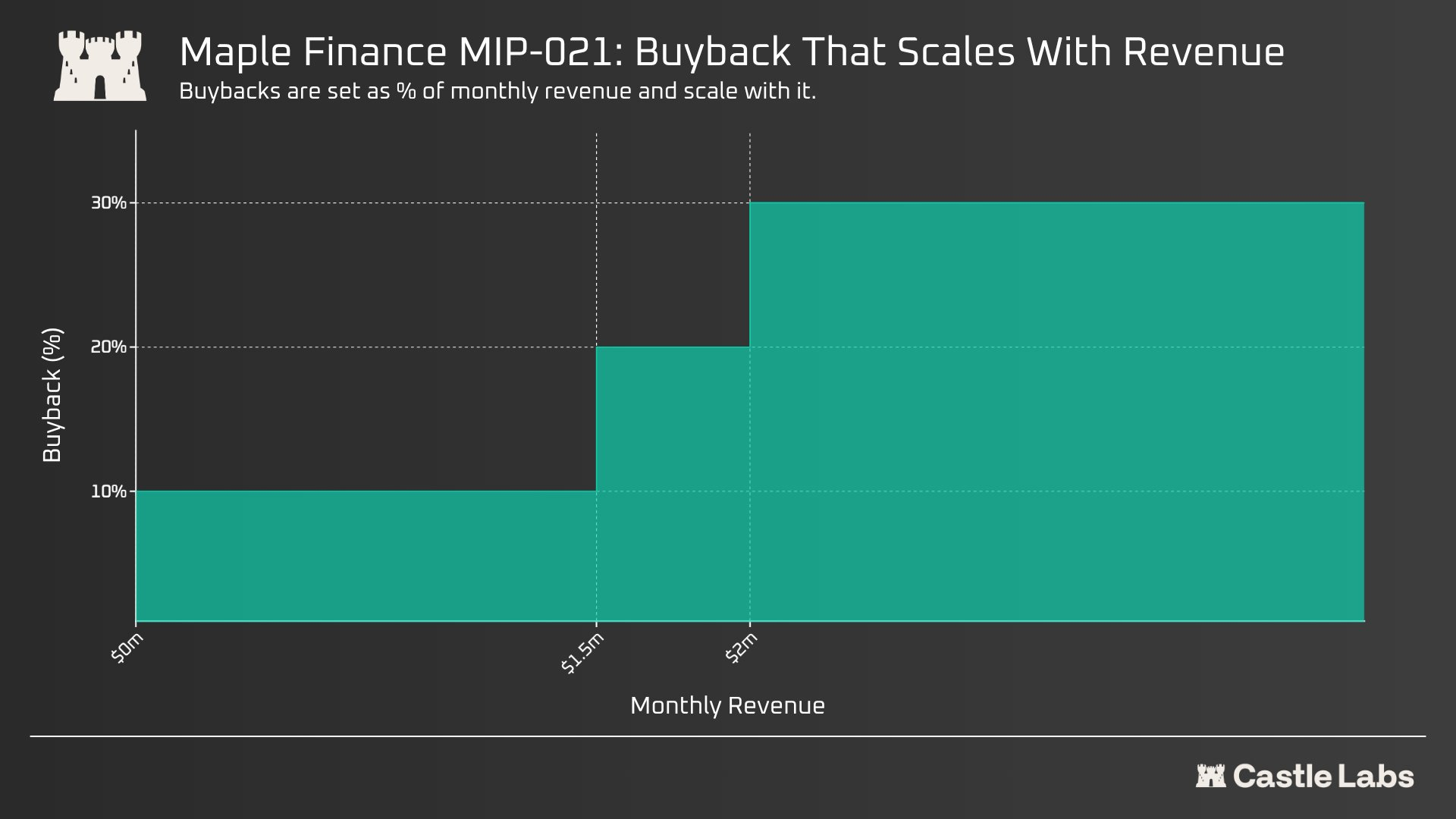
Maple Finance recently passed a token-holder vote on a buyback plan that scales with revenue. Castle Labs describes it as an update to MIP-019. The earlier proposal allocated 25% of revenue to buybacks; based on average H1 2026 revenue of $1.15 million, the revised structure would reduce that share to 10%. The report says that may not be ideal for holders, yet the proposal still passed with 99.97% support. Under the new ladder, the buyback allocation rises to 30% once monthly revenue exceeds $2 million.
Some protocols also route value to holders through staking. Following a recent tokenomics update, Lighter is targeting a 6% staking yield. At the current staked level of 125 million tokens, that would distribute 7.5 million LIT per year. Castle Labs also says more than 430 million HYPE is staked, earning yield from future release reserves at an estimated 2.1%.
Buybacks and burns, the report says, are not enough on their own to repair weak tokenomics or falling revenue. They need to be viewed inside the broader framework of supply, demand and incentives. Even so, these tools can support ecosystem growth, steer liquidity and reduce supply over time.
Fee sharing and the ve model
Other protocols choose direct fee distribution. Aerodrome and Curve Finance are the examples used here. They rely on ve tokenomics, where holders lock tokens and receive vote-escrowed assets such as veAERO or veCRV.
Castle Labs says this model creates economic value for holders in three ways.
- Protocol trading fees: 50% to 100% of fees can be distributed to ve-token holders.
- Yield enhancement: holding those assets can increase returns for liquidity providers in the exchange’s pools.
- Bribes: protocols pay cash incentives to ve holders in exchange for governance votes that direct future rewards to specific pools.
The report also says ve systems tend to be paired with strong emissions by design, which helps explain why fee distributions can grow quickly under inflationary token setups.
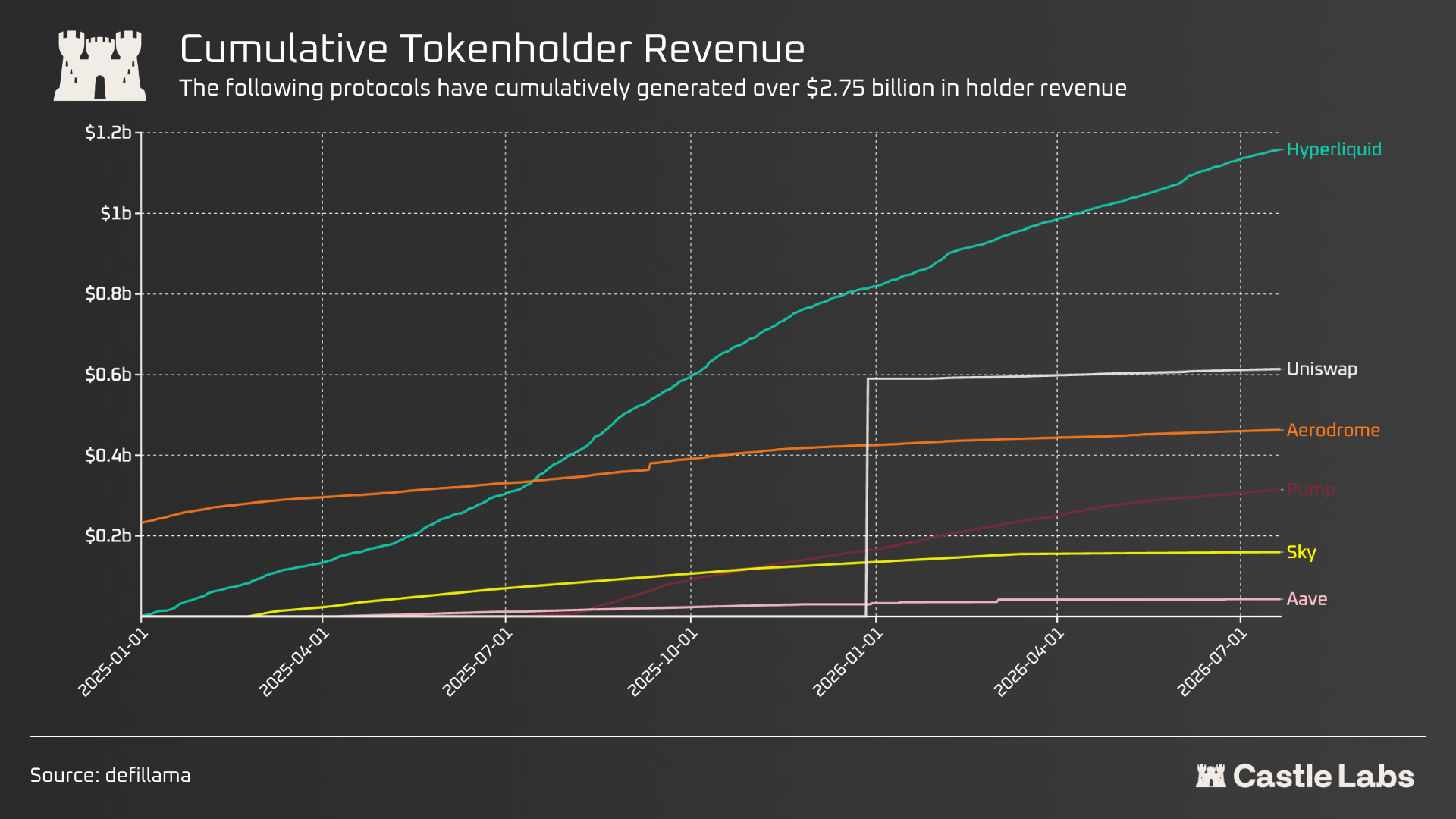
Using these methods, the six protocols have distributed more than $2.75 billion in holder income to date, according to Castle Labs, with Hyperliquid and Uniswap accounting for most of it. In Uniswap’s case, the 100 million UNI burn in December 2025 is part of that story.

Why strong revenue still does not guarantee token gains
Castle Labs describes this as the “beautiful trap” of tokens. Crypto products have matured and many now generate meaningful revenue, but stronger business performance does not automatically mean better token performance.
The report gives several reasons.
First, revenue may never reach the token. A protocol can produce substantial income while most of the value remains in the treasury rather than flowing to holders. Buybacks are discretionary, and a protocol can pause, alter or cancel them. Governance exists, but much of the voting power is often controlled by the project team.
Second, equity-token separation can leave token holders in a weaker position. Castle Labs says more companies are adopting dual structures that include both equity and tokens. XRP is cited as a textbook case. Ripple Labs stock has risen 105% since 2025, while XRP has fallen 45% over the same period. In that structure, token holders do not have a specific claim on company revenue, while equity holders do.
Third, faster unlock schedules increase expected sell pressure. Even if a protocol shares revenue, rapid supply release can weigh on price. The report also points to low-float, high-FDV token setups, where a large share of supply still needs to unlock and be absorbed by the market. That can make a token look cheap on headline ratios while future circulating supply expansion remains ahead. Among the six tokens in the study, HYPE has a circulating-to-FDV ratio of just 23.28%, while Sky stands at 99.63%.
PUMP, HYPE and AAVE show how different the outcomes can be
The report compares several tokens to show that revenue and token performance do not move in a straight line.
PUMP has fallen 60% since launch, even though the project has completed more than $315 million in buybacks. Castle Labs links that to weak team communication, the absence of an airdrop, rapid unlocks and token selling in the market.
HYPE, by contrast, has risen 1400% since launch and has returned $1.2 billion to shareholders through buybacks, according to the report. Both PUMP and HYPE have used buybacks, but the price outcomes are dramatically different.
AAVE is another case the report highlights. Castle Labs says the token has struggled since the start of the year. Since Aave launched its buyback program in April 2025, it has completed $45 million in buybacks, though the program is now paused because of the Kelp DAO incident. The report names several pressures: the departure of DAO service providers including BGD Labs and ACI, the impact of the Kelp DAO event on Aave, and stronger institutional competition from Morpho.
It also says Aave has lost more than $23 million while executing those buybacks as asset prices fell. The average purchase price for AAVE was $182, versus a current trading price of about $90. For Castle Labs, that is evidence that buybacks are not automatically the best path.
Buybacks versus dividends
Even so, the report still calls buybacks one of the most consistent ways for a token to accumulate value. They can be tracked on-chain, they require protocols to purchase assets in the market, and they create revenue-backed buying pressure. That gives holders a direct link between protocol growth and a more deflationary token structure.
Still, the Aave example shows the drawback. If the timing is poor, losses on repurchases can eat into the value created by the business itself.
Dividends look cleaner at first glance because users receive stablecoins tied to their token holdings and can use them however they want. But Castle Labs says dividends do not directly support the token price in the same way buybacks do. The choice between the two depends heavily on the protocol. A token that only distributes fees may even risk becoming economically redundant unless it has some other utility or source of value. The counterargument, as the report notes, is that a dividend stream can itself make the token more attractive to investors.
As of now, most projects still lean toward buybacks, which Castle Labs interprets as a sign that teams see more value in that route.
A simple conclusion: a good protocol is not always a good token
Castle Labs ends on a broader point. Many protocols are now generating meaningful revenue, but they are not all building value into the token in the same way. Even when they do, price may still fail to respond because sell pressure can come from unlocked insider holdings, negative news, incentive emissions, project sentiment and competition.
The report argues that investors need a wider framework. They should look at how revenue is generated, how it is distributed, and how those flows are balanced against release schedules and incentives. The first job for any protocol is to become a successful business and generate revenue. The next job is to make sure that value reaches token holders, whether through buybacks, dividends or automated fee sharing.
Hyperliquid is presented as the strongest example of alignment between protocol and token because value accrual was built into the design from the start and most revenue is distributed to holders. Aerodrome and Uniswap are described as other projects moving in that direction.
The report’s final takeaway is direct: a good protocol does not equal a good token. Revenue, distribution and release need to be examined together before token holders can judge whether they are actually sharing in the growth.