
SK hynix’s ADR and its underlying Korean shares split sharply in price after the U.S. listing, and Hyperliquid’s paired perpetual markets made that divergence visible in real time. TradeXYZ, a HIP-3 builder on Hyperliquid, had opened perpetual contracts for both SKHY, the Nasdaq-listed ADR, and SKHX, the underlying Korean line. The funding rates on those two contracts ended up showing what stock perps can already do, what they still lack, how they interact with spot markets, and where demand is strongest.

An ADR, or American Depositary Receipt, is issued by a U.S. bank and represents shares of a foreign company so investors can trade them in dollars on venues such as Nasdaq. In this case, SKHY is the ADR ticker for SK hynix, and each SKHY represents one-tenth of an underlying SKHX share. Once trading began, demand in the U.S., different liquidity conditions, and blocked arbitrage pushed the ADR and the underlying further apart.
SK hynix ADR premium jumped while arbitrage remained blocked
On July 9, SK hynix sold 177.9 million ADRs at $149 each and raised $26.5 billion. The report describes it as the largest ADR issuance ever by a foreign company, topping Alibaba’s $21.8 billion record set in 2014. The order book was oversubscribed by more than seven times, and the ADR opened at $170 on Nasdaq on July 10.
After that, the price gap between the ADR and the ordinary shares widened quickly.
- July 13: the ADR premium, which was about 3% relative to the issue price, widened to 25.6%, while the underlying shares fell 15.4%. The KOSPI index dropped more than 8% intraday and triggered a circuit breaker, yet the ADR was down only 9.3%.
- July 14: the ADR jumped 27% to close at $193.92, and the premium over the underlying stock surged to 51%.
- July 15: after the previous day’s rally, the ADR fell 9% to close at $176.46, while the underlying shares rebounded 8.8%. The premium narrowed from 51% to 30.7%.
The report says the premium was driven by a shut arbitrage channel. In a functioning market, institutions would buy the cheaper underlying shares, convert them into ADRs, then sell the ADRs to increase supply and compress the gap.
That route is not open yet. These ADRs were not created by depositing existing shares. Instead, they were created through the issuance of 17.79 million new shares to depositary bank Citibank. Those underlying shares are scheduled for additional listing on the Korea Exchange on July 29. According to the Korean securities depository cited in the report, conversion requests between the ordinary shares and ADRs will only become possible after that date.
Supply was tight for another reason as well. The issued ADRs account for less than 3% of SK hynix’s total shares outstanding. U.S. institutional demand met a supply pool that could not expand, and the premium widened.
HIP-3 funding rates pointed to a spread trade
Over the same period, TradeXYZ ran perpetual futures markets for both sides on Hyperliquid. SKHX, which tracks the underlying Korean shares, had already been live for some time. SKHY, which tracks the ADR, first launched as a pre-IPO contract one day before listing and then switched into a standard contract when Nasdaq trading began.
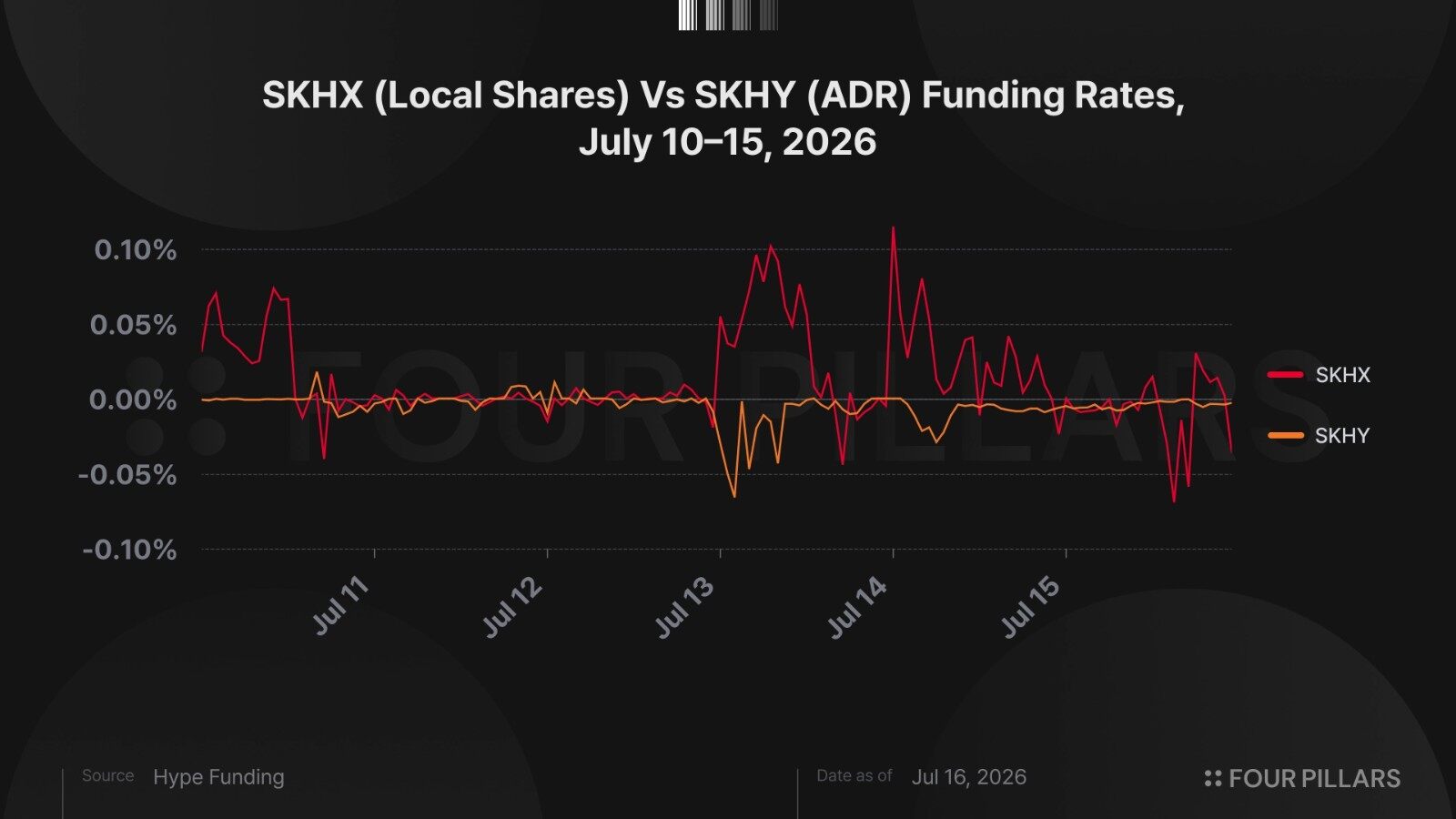
As the gap between the ADR and the underlying widened, funding rates on the two contracts split in opposite directions. On July 13, when the underlying stock was dropping sharply, SKHX funding jumped to +0.10% per hour, while SKHY fell to -0.065% per hour.
Positive funding means longs pay shorts. Negative funding means the reverse. Put together, those prints suggest long demand was piling into the underlying side while short demand was building in the ADR side. The report interprets that combination as a single position: a trade on Hyperliquid that bets the premium will narrow.
What stock perpetuals delivered in this case
The SK hynix episode is used in the report as a live test of several ideas about stock perps.
They let traders bypass spot-market frictions
A trader who wants to bet on premium compression would, in spot markets, need to buy the underlying Korean stock and short the ADR. That usually requires won funding, foreign investor account access, settlement infrastructure and ADR borrow.
In perpetuals, the trade is simpler. A user can post USDC as collateral and trade the two contracts on one platform.
They reflect the spread, but they do not close it
The report also argues that the two-legged perp position is not an ideal structure. Even if the premium stays in place, hourly funding accrues and chips away at collateral over time.
That differs from spot arbitrage. Once the underlying shares are converted into ADRs, the spread can be locked in as realized profit. Perpetuals have no such forced convergence. SKHX converges to the underlying-share index and SKHY converges to the ADR index, but neither contract narrows the distance between those two indices. The contracts mirror the spread in the underlying markets. They do not resolve it.
That matters because being directionally right is not enough. If convergence comes too late, the accumulated carry can eat into returns. In that sense, the structure bundles two exposures together: the view that the premium will narrow, and the cost of holding the trade while waiting.
The market still lacks a separate tool to trade funding itself
The report says those two pieces would need to be separated through a market that lets traders trade funding directly.
It points to Pendle’s Boros as an example. Boros tokenizes funding into YU, or Yield Unit, and splits it into fixed and floating components. A position such as a long in SKHX that pays funding could buy YU that receives floating funding on Boros to offset the cost. That would turn a variable cost into a fixed one. The cost would not disappear, but future outlays could be locked in at entry, which helps position sizing and risk control.
For now, that route is not available for HIP-3 stock perps. Boros currently supports only major crypto markets such as BTC and ETH, according to the report. So anyone trading this spread still has to absorb funding-cost volatility.
Perpetuals also acted as a leading signal
TradeXYZ’s pre-IPO SKHY market pointed to $164 three hours before the Nasdaq open, $169.80 one hour before the open, and $169.92 one minute before the open. The actual opening price was $170.
SKHX also trades at night and on weekends while the Korea Exchange is closed, and Korean traders use it as a leading signal for the next session’s open. In the report’s framing, perpetuals are no longer just derivatives that follow the underlying. When the original market is shut, they can become the first place where price is formed.
Value rises as access to the underlying gets harder
The report also draws a contrast between the two contracts tied to the same company. SKHY funding stayed near zero most of the time outside moments such as July 13, when the premium moved sharply wider.
The reason given is that Nasdaq already has a physical ADR market, and U.S. options began trading from July 14, giving arbitrageurs a way to collect basis. SKHX has no equivalent hedging tool, so funding becomes the only clearing mechanism. That is why SKHX became the single largest contract, accounting for 33% of total HIP-3 volume and 50% of stock-perpetual volume.
The report’s conclusion on that point is simple: listing a perp on a highly liquid U.S. large-cap stock means rebuilding something that already exists elsewhere. The more constrained market access is, the more useful the perpetual contract becomes.
July 29 is the next date to watch
The next key point in the timeline is July 29. On that date, the newly issued underlying shares are scheduled to list on the Korea Exchange, and requests to convert between the ordinary shares and ADRs may open. That would partially unblock the arbitrage channel.
Even then, the asymmetry remains. ADR redemption into ordinary shares has no restriction, but converting ordinary shares into ADRs is still capped by the issuance limit, and that is the side needed to compress the premium.
So whether the premium narrows sharply is still uncertain. Even so, the report says Hyperliquid remains the only venue where this spread can be traded directly.