
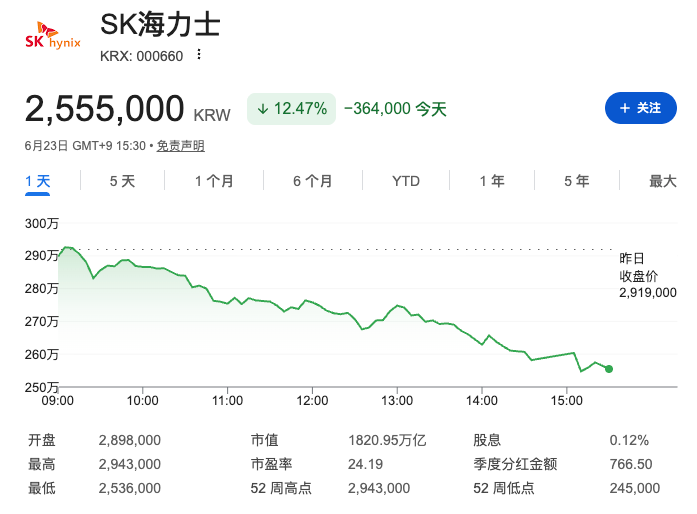
On June 23, the South Korean stock market experienced a dramatic shift from euphoria to panic. The day before, SK Hynix's intraday market cap reached approximately 1.35 trillion USD, surpassing Samsung Electronics for the first time in 26 years to become South Korea's most valuable company. However, just one trading day later, the KOSPI 200 futures plunged 5%, triggering a circuit breaker, with both Samsung and SK Hynix facing panic selling. According to TradingKey, direct triggers included AI competitiveness concerns following a Google executive change, and forced liquidations due to South Korean regulators' scrutiny on excessive concentration in semiconductor leveraged financial products.
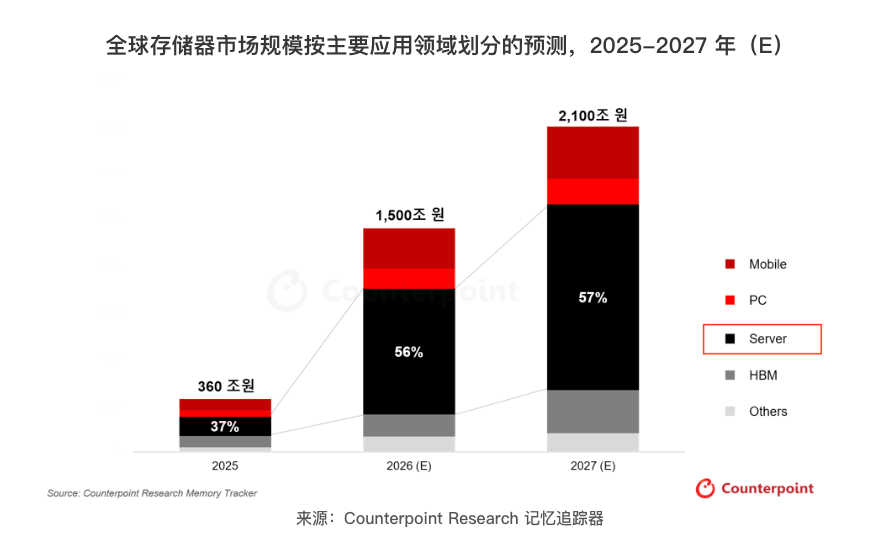
Coinciding with this volatility was an optimistic industry forecast. Counterpoint Research's Memory Tracker, released on June 23, indicated that the global memory market (DRAM+NAND) will continue expanding until the first half of 2027, exceeding 2,100 trillion Korean won (approximately 1.5 trillion USD), with server memory share rising from less than 50% in 2025 to 57%.
Fundamentals: Supply-Demand Gap at 15-Year High
Understanding current memory stock valuations requires examining the fundamentals. SK Hynix's Q1 2026 revenue reached $52.58 billion, up 198% year-on-year; operating profit was $37.61 billion, up 405% year-on-year; and operating margin reached 72%, surpassing NVIDIA's 65% in the same period, setting a historical record for semiconductor manufacturing. According to CNBC, Counterpoint Research analyst MS Hwang commented that Q1 earnings showed AI inference demand for memory far exceeded expectations, with companies scrambling for supply.
Goldman Sachs' April report estimated that the global DRAM supply-demand gap would widen from 3.3% to 4.9%, the most severe in 15 years. Samsung, SK Hynix, and Micron control over 95% of global DRAM capacity, but nearly all incremental output is absorbed by AI. TrendForce data shows DRAM contract prices surged 90% to 95% quarter-on-quarter in Q1 2026, with Q2 gains narrowing to 58% to 63%, while NAND flash contract prices accelerated to a 70% to 75% sequential increase.

HBM Core Driver and New Capacity Timeline
HBM (High Bandwidth Memory) is central to this price surge. Producing 1GB of HBM consumes approximately three times the wafer area of standard DDR5, but a single stacked unit sells for between $300 and $500, with margins three to five times higher than ordinary DRAM. SK Hynix holds about 57% to 62% of the global HBM market share and is NVIDIA's primary AI accelerator supplier. Goldman Sachs estimates SK Hynix has secured approximately two-thirds of orders for NVIDIA's next-generation Rubin platform HBM4.
Counterpoint explicitly warned that once new capacity comes online, the risk of sharp price declines cannot be ruled out. Key timelines include: Micron raising its FY2026 capex to $20 billion, with its Idaho wafer plant starting production in mid-2027; Samsung's Pyeongtaek P5 factory expected to operate in 2028; and SK Hynix's M15X facility launching in mid-2027, alongside a 19 trillion Korean won investment announcement for a new plant.
However, capacity expansion still lags far behind demand growth. Goldman Sachs estimates that from 2027 to 2028, U.S. data center-driven memory demand will increase by about 9% to 12%, while local capacity expansion will only be about 2% to 4%. Meanwhile, HBM4 increases DRAM die per stack from 12 to 16, boosting DRAM consumption per AI accelerator chip by 33%. TrendForce notes that while HBM3E remains the primary shipping product and HBM4 is beginning to contribute revenue, AI chip upgrade delays and inventory accumulation are slowing growth momentum, with a true price adjustment window likely appearing from H2 2027 to 2028.
Market Contradictions and Future Outlook
The June 22 record and June 23 circuit breaker encapsulate the core contradiction in the memory sector: fundamentals are still accelerating (SK Hynix's Q1 margin of 72%, the largest supply-demand gap in 15 years), but valuations have already priced in extremely optimistic expectations (SK Hynix up over 340% year-to-date), and excessive concentration of leveraged products amplifies volatility in either direction.
Both Samsung and SK Hynix have warned in earnings reports that memory shortages are expected to last at least until 2027. Samsung's memory head Kim Jaejune stated that the demand fulfillment rate has dropped to historic lows, with customers rushing to secure future supply. The Bank of Korea is leaning toward raising interest rates due to the semiconductor super cycle, causing South Korean government bonds to underperform globally. Currently, 38 analysts give SK Hynix a consensus rating of "Strong Buy," with a 12-month average target price of approximately 2.71 million Korean won; Hanwha Investment & Securities has just raised its target from 1.63 million to 4.30 million won.