Slop Cash is trying to turn AI-assisted open-source work into something that can be paid for in a structured way. The platform links project budgets, GitHub activity and onchain reward pools, with the idea that contributors can use AI tools to complete work and get paid if maintainers accept the result.
Its token sale is next. Slop Cash plans to issue SLOP through token launch platform Umia. According to the project’s schedule, the auction opens to eligible wallets at 1 a.m. Beijing time on Nov. 6, public bidding starts at 1 a.m. on Nov. 8, and the sale ends at 1 a.m. on Nov. 11.
How the platform is supposed to work
The core setup is straightforward. Open-source projects put up a budget. Contributors use AI tools to write or modify code, run tests and submit pull requests on GitHub. Project maintainers decide whether to accept the work. Once accepted, Slop Cash’s automated scoring tool, Slopbot, evaluates the size and value of the contribution and assigns a score, which maintainers can adjust. Useful code review can also earn points.
That does not remove the contributor’s upfront cost. AI may help produce code, but payment still depends on whether the submission solves a real problem for the project and gets merged or otherwise accepted. Time and tooling costs come first; compensation comes only if the work clears review and settlement.
Slop Cash was co-founded by Shaw Walters and Drew Pierson. Shaw, the creator of elizaOS, leads the technical side. Pierson is CEO and previously worked on projects including Arweave, Avalanche and Orderly Network.
Hyperliquid reverse engineering as a live example
One of the clearest examples on Slop Cash is a Hyperliquid node reverse-engineering effort started by Shaw. He had previously reverse engineered the Pump.fun contract, but later received a legal letter from Bracket Company, Pump.fun’s parent company, demanding that he stop and not publish the code.
That focus on high-profile targets such as Pump.fun and Hyperliquid also gives Slop Cash a way to attract developers: use the attention around reverse engineering to bring people in, then route them toward contribution tasks and reward mechanisms on the platform.
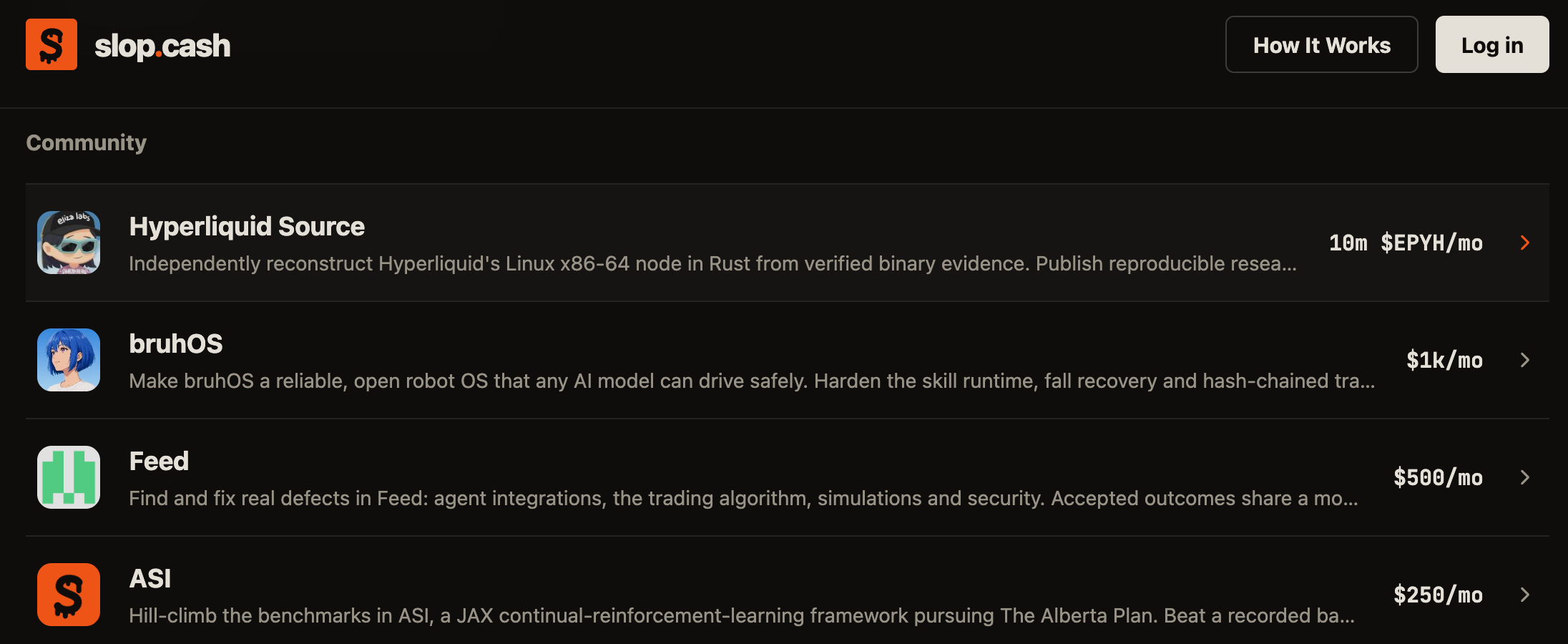
Slop Cash has listed Hyperliquid Source as a community project and is inviting contributors to analyze node software, rebuild code and verify results. The repository shows a monthly reward of 10 million EPYH. The same repository says the work is independent research and that it has not yet produced a runnable or functionally equivalent node. It also states that EPYH is not Hyperliquid’s HYPE token.
Payments have already been made, but the process changed
Slop Cash has disclosed one set of real payouts. In September, it sent 6,005 USDC across 72 transfers. Official records say those payments were sent directly by project creators and did not go through the full review and settlement flow described in the earlier design.
The funding structure has since shifted to a treasury-contract model. Under the current setup, project teams deposit funds, approve rewards, and then payments are recorded and executed. The review process changed as well. An earlier description referred to a 14-day public review period. The current repository documentation says that after the end of a month, the person in charge has 72 hours to adjust allocations and finalize the list, with no public review stage.
So while the platform can point to actual payouts, the mechanics around review, allocation and settlement are still being revised. How much contributors can really earn remains tied to project budgets, review standards and execution.
How users can participate, and what is known about airdrops
For individual users, the first step is to pick a project on the website, check what kinds of work are accepted, review the reward conditions and funding status, then use their own AI coding tools to complete the task and submit it through GitHub. Buying SLOP is not required to take part in these jobs.
Not every listing works the same way. Some projects show a monthly reward pool, while others only track points. Contributors need to confirm whether their work falls within the reward scope and whether funding is actually available before deciding how much time to spend. For first-time participants, a small bug with a clear scope and reproducible path is easier to take from fix to test to review submission.
Slop has also experimented with non-code contributions. Its official introduction page says that in October it offered reviewed rewards for tutorials, explainers, videos or support answers, with eligible content receiving 1 to 8 points.
On token distribution, the official allocation table includes 2 million SLOP for contributors, equal to 2% of total supply, unlocked at TGE.
Some lower-friction point tasks have already ended. The current rules say that since Oct. 24, users no longer receive points for registering or linking an X account. The platform also says points are non-transferable, cannot be redeemed, and do not grant payment rights or access rights. At this stage, the clearest path to participation is still to complete accepted project work and seek compensation under the relevant rules. Whether new contributors will receive SLOP is still not fully spelled out.
What SLOP offers buyers
In Slop Cash’s structure, open-source projects fund contributor rewards, while the platform raises money for its own development by selling SLOP. Tokenholders can take part in decisions on how platform funds are used and how fees are charged. But the decision to accept code, and the amount each contributor receives, stays with each project’s review process. Contributors do not need to buy SLOP before participating or getting paid.
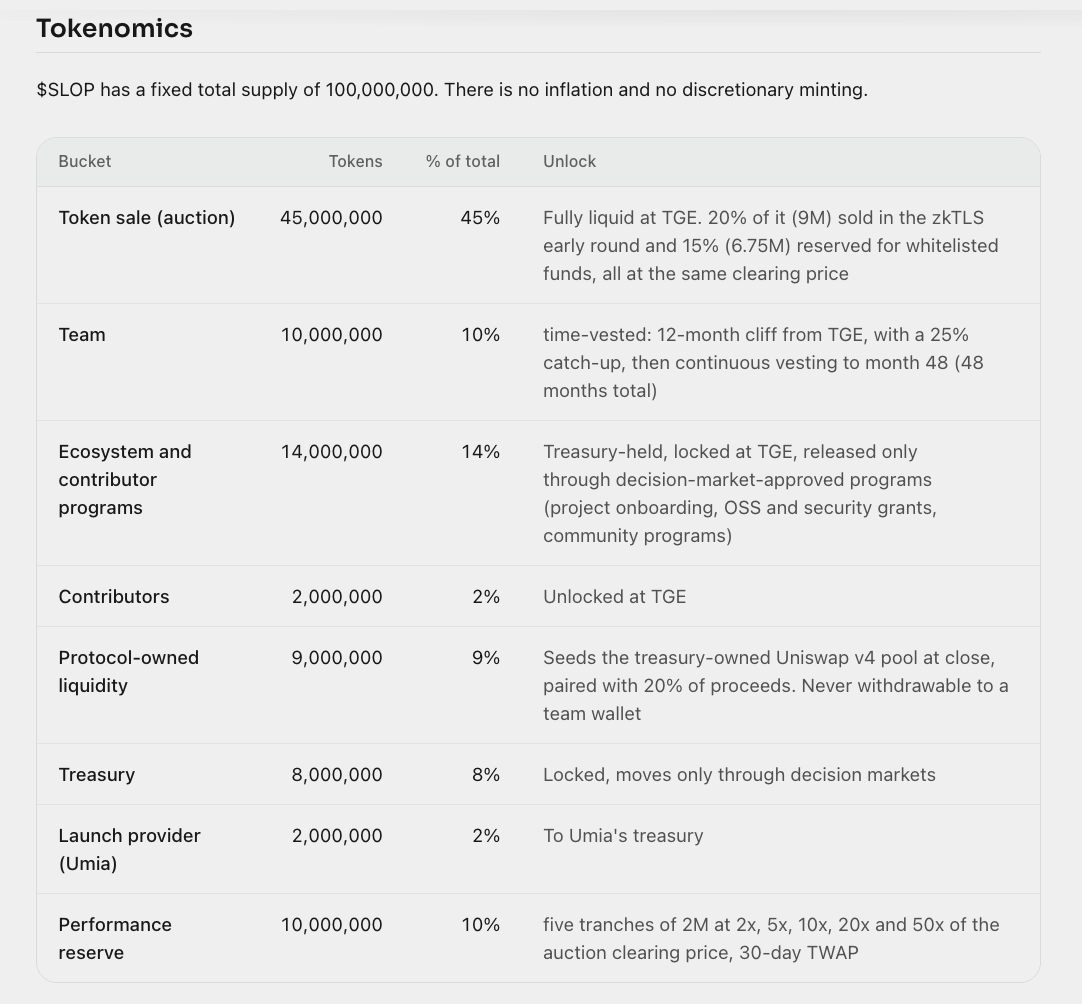
SLOP has a fixed total supply of 100 million tokens, with no inflation and no arbitrary minting. The allocation is 45% for the token auction, 14% for ecosystem and contributor programs, 10% for the team, 10% for a performance reserve, 9% for protocol-owned liquidity, 8% for treasury reserves, 2% for contributors and 2% for Umia.
All auctioned tokens unlock at TGE. Twenty percent of auction proceeds will be paired with the liquidity allocation to create a treasury-owned Uniswap v4 pool, while the rest goes to the project treasury.
The team’s 10% allocation is locked for one year. At that point, 25% of that allocation unlocks, with the remainder vesting through month 48 after TGE. Another 10% sits in a performance reserve split into five tranches of 2 million tokens each. Those tranches unlock if the token’s 30-day time-weighted average price reaches 2x, 5x, 10x, 20x and 50x the auction clearing price. That ties part of team incentives to token price performance, not directly to platform revenue or payout volume.
Revenue exists on paper, but tokenholder value is less clear
Beyond fundraising, Slop Cash plans to generate revenue through fees. The current repository lists a 2% reward fee. On a 100 USDC reward, for example, the contributor would receive 98 USDC. Withdrawing unused funds also carries a 2% fee. At that rate, processing $1 million in rewards would generate $20,000 in fee revenue before operating costs.
For SLOP buyers, the harder question is what that means in practice. Using the product does not require holding the token. User growth does not automatically create token demand. And the mechanism by which platform revenue would benefit tokenholders still needs to be defined more concretely.
Paying for open-source contributions is not a new idea by itself. Platforms such as Algora already let users place bounties on GitHub tasks and pay once code is merged. Slop Cash is trying to combine AI-assisted development, contribution scoring and onchain reward pools in one system. Whether that system can hold up will depend on which teams keep allocating budget, how much contributors actually receive, and how much revenue the platform itself can capture.