
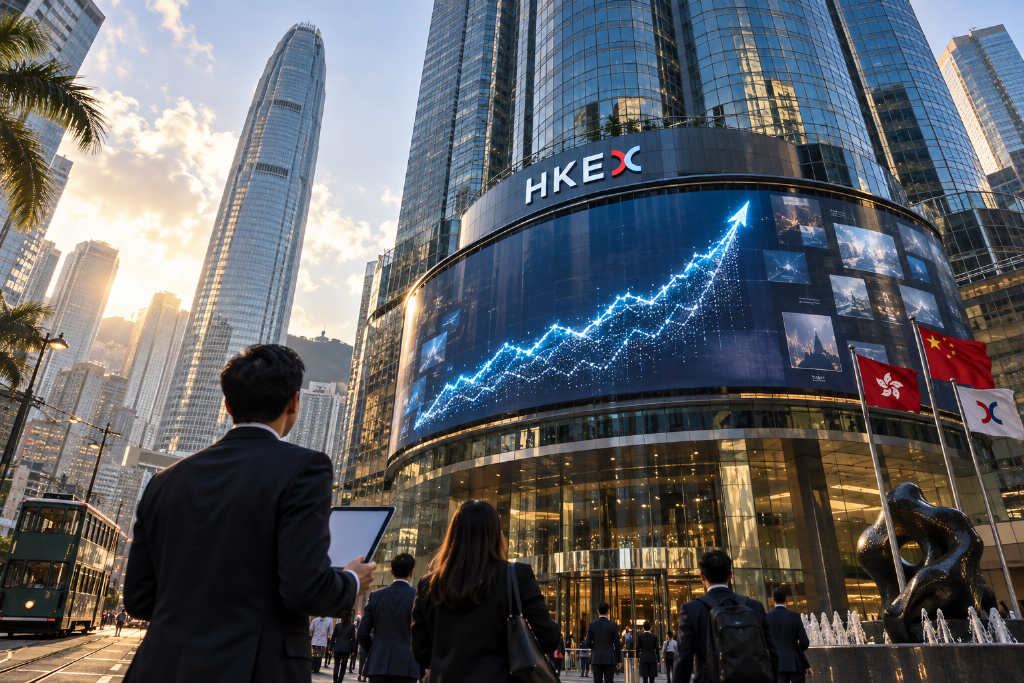
In August 2026, average daily volume in Hang Seng TECH Index futures on Hong Kong Exchanges and Clearing reached 154,986 contracts. Over the same period, all single-stock futures combined averaged 4,385 contracts. PANews uses that contrast to make a broader point: one thematic index can become a more active trading gateway than an entire menu of individual contracts.
For perpetual futures DEXs, and for smaller centralized exchanges, the article says the easiest trap is competing through ever-longer listings. Add more names, offer more leverage, subsidize turnover, and try to manufacture activity. That usually brings users in quickly and sends them out just as fast, because they are trading the same thing everywhere. Capital tends to move to the venue with lower costs and deeper books.
From discovering single names to defining a market
PANews argues that small caps do give protocols an early window. Companies not yet covered by large exchanges can become a starting point for research and trading. But exclusivity is hard to defend over time. Once a stock starts drawing attention, a larger platform can list it too, leaving the smaller venue to search for the next overlooked name. In that cycle, smaller exchanges and protocols do the discovery work, then hand mature flow to bigger rivals.
The article’s central proposal is to build small-cap index perpetuals, or basket perpetuals, rather than stop at single-stock contracts. These would not be existing ETFs, but protocol-built, ETF-like contract markets. The sequence is straightforward: use single names to attract the first wave of attention, then organize the risk and return of related companies into tradable sector exposure. Single names generate initial interest; the index turns that interest into a broader stream of trading demand. In PANews’ framing, that shifts a venue from finding stocks to defining a market.
Single names let users choose companies. An index lets them trade a view on an industry. The article notes that many traders have a view on a sector without having the ability to track every company inside it on an ongoing basis. Liking a theme is not the same as selecting the right stock. Research, comparison, and position management sit in between. A platform that offers only single names leaves all of that work to the user and shuts out some of the capital that might otherwise participate.
An index shortens that gap. Users do not need to identify the winner in advance to express a view on the broader sector. Industry growth, interest-rate changes, capital spending, and the relative performance of small caps against large caps can all become reasons to trade. Views that previously did not map cleanly onto any one stock gain an instrument that can actually be traded.
PANews says that expands the product’s audience. Orders can come not only from company-level researchers, but also from sector investors, macro traders, and portfolio managers. Individual constituents may be small, while the trading demand around the full basket can be much larger.
The framework borrows from the ETF model of turning a basket of assets into one trading entry point. An index perpetual provides portfolio price exposure without requiring the protocol to buy every underlying stock in advance and without requiring a fund to be issued first. Users trade contract price moves; the protocol organizes the market.
The article argues that small caps are especially suited to this structure. Research attention is scattered across different companies, and liquidity in small-cap names is often weak. Many of those names cannot support active markets on their own. An index gives them a shared industry label. That can pull users who originally followed only one company toward the wider sector, while also giving sector-focused traders a direct way in. Company-specific events can bring attention to the index, and the index can send users back toward its constituents.
To show that the model has real trading scale in mature markets, PANews cites CME data. Through the end of May 2024, E-mini Russell 2000 small-cap index futures averaged about 225,000 contracts a day, representing roughly $22.5 billion in notional turnover. Over the same period, Micro Russell 2000 futures averaged about 90,000 contracts a day, with notional turnover of about $880 million. The article’s conclusion is that small caps may be small one by one, but a basket of them can support meaningful risk trading at the aggregate level.
Can a basket improve liquidity in small-cap names?
The next step in the argument is that an index changes not just who trades, but how risk gets warehoused.
Small-cap order books are hard to make for two reasons in the article’s telling. One is information asymmetry. The other is shallow depth. The trader on the other side may know more than the market maker about a company’s orders, finances, or an unexpected event. To protect against that, market makers widen quotes and reduce the size they are willing to carry.
Once stocks are put into a basket, company-specific news has less influence on the overall product because its effect is diluted by weighting. Idiosyncratic risks can offset one another to some extent. A market maker can manage risk at the portfolio level, and investors become less dependent on information about any one company. Firms in the same sector may still face common shocks, but the success or failure of a single company matters less to the product as a whole.
PANews cites a 2012 study by Small, Wansley, and Hood comparing ETFs with matched samples of individual stocks. The study found lower adverse-selection costs for ETFs, while dollar quote depth was 35 times that of the matched stock sample. The paper also found higher quoted and effective spreads for ETFs. When spreads and depth were assessed together, however, ETFs showed stronger overall liquidity. PANews presents that historical sample as support for the view that baskets, whether indexes or portfolios, can improve a market’s ability to absorb risk relative to trading single names alone.
The article adds that this is what matters beyond raw volume: how much size the market can absorb when a larger order arrives, and how far price has to move to do it. Busy tape and easy entry and exit are not the same thing. Each needs to be tested on its own.
Why an index can form its own trading layer
Another point PANews highlights is that basket products can build an independent trading layer. An index trade does not require all of the underlying stocks to trade at the same time. Buyers and sellers can exchange the same basket exposure directly. A market maker that receives client orders in opposite directions can offset part of the inventory risk internally before dealing with the residual. In that setup, the underlying market only has to absorb the net pressure that needs to be passed through, not every unit of gross turnover generated in the basket product.
The article cites a BIS study published in March 2018, which said that most ETF trading takes place in the secondary market and that primary-market share creation and redemption is relatively infrequent. Investor turnover does not convert one-for-one into trades in the underlying securities.
PANews then points to IWM, the Russell 2000 ETF. As of Sept. 25, 2026, the fund held 1,986 assets and averaged about 22.4 million shares traded per day over the previous 30 days. The article says that volume reflects turnover in the full basket and does not require each trade to be broken into nearly 2,000 stock transactions.
Index perpetuals can work in a similar way at the contract layer. They do not require a protocol to buy stocks trade by trade. Their price-anchoring mechanism is different from an ETF because there is no creation-redemption pathway, but the market-structure advantage is related: the same basket risk can be transferred repeatedly inside one unified product. Market makers manage net inventory, traders exchange exposure, and the basket may develop liquidity of its own.
According to the article, underlying liquidity constrains the cost of transferring net risk and a market’s ability to absorb imbalances. It does not mechanically impose the same ceiling on daily turnover in the index product. If the outside market is thin, market makers need to manage exposure more carefully. PANews says that is not the same as saying each unit of index turnover consumes an equal amount of underlying stock liquidity.
The piece also argues that indexes do more than attract users. In a market with only single names, traders mainly build positions around whether one company rises or falls. Once an index exists, a new set of tradable relationships appears between the stock and its sector. Users can keep a company-specific view while adjusting industry exposure, or rotate between sector exposure and single-name exposure. Capital that might otherwise have exited the market to reduce risk has another way to stay engaged.
CME data is used again here. On the Russell index rebalancing date of June 27, 2025, E-mini Russell futures traded about 237,000 contracts, 37% above that week’s daily average. Micro contracts were up 16% as well. PANews links that jump to portfolio-adjustment demand, arguing that indexes are used not only to bet on direction but also to manage holdings.
The article’s broader point is that gains and losses generate trading, but so do sector divergence and position adjustments. That gives protocols a chance to rely less on the fleeting popularity of a single stock and more on products that can be used repeatedly.
Professional capital can enter through another route too. Indexes and constituent stocks take orders separately, so prices and funding costs can diverge. Trading those differences requires links between the index and the single names. Orders from sector-level users can create hedging demand, while positions in single-stock markets can generate index demand in return. PANews notes that spread trading carries execution and inventory risk, but it also broadens participation beyond directional speculation.
Those trading relationships around an index can grow on their own. CME materials, as cited in the article, show average daily volume in Russell 2000 basis-at-close trading rising from about 3,800 contracts in 2022 to more than 5,000 in 2023, an increase of about 31%. Traders use that tool to manage the relationship between futures and the index closing price. For perp DEXs and smaller exchanges, PANews says the lesson is to offer professional capital a set of trading relationships worth running continuously, not just a place to make directional bets.
The article sums up the value of portfolio and index products this way: they allow the same group of assets to generate more trading relationships.
A flywheel built around small caps
PANews then lays out a small-cap flywheel. It starts with a clearly defined theme. A protocol picks one industry worth following over time and places its single-stock market, index product, research content, and market-making resources on the same line. Stock selection should reflect industrial linkage and tradability. Index rules should be published in advance. The team should keep working around that asset group. At the start, the article says, the biggest mistake is chasing a new hot theme every week and scattering users and liquidity across unrelated books.
The first turn of the flywheel converts single-stock attention into index demand. A stock page links to the relevant index and shows weight and contribution to performance. The index page puts constituents, industry research, and trading in one place. Users who arrive through company news can move outward to the whole sector; users who arrive through sector research get a direct instrument for expressing that view. Each round of content distribution, PANews says, adds users to the same thematic market.
The second turn makes positions produce repeated trading demand. Users should be able to see a stock’s performance relative to the index, the portfolio’s sector concentration, and adjusted exposure in one place. Basket pricing and multi-leg order tools then convert those judgments into executable trades. Users may come in because of price action, but they can stay for rebalancing, hedging, and relative-value trades.
The third turn is handled by market makers and professional capital. Orders with different objectives and directions enter the same book, improving inventory turnover. Market makers and spread traders connect the index, single stocks, and outside markets while handling residual risk. PANews says launch budgets should prioritize continuous quoting and fillable depth, and that results should be measured through the spread and price impact that users actually bear. Rewarding cumulative volume alone can end up buying nothing more than repetitive churn.
That flywheel matters because better liquidity lowers the barrier for capital that previously could not participate due to execution costs. A broader trading base brings in more orders. Better matching and better risk management improve the market’s capacity to absorb flow. Lower price impact then allows larger portfolios and more strategies to use the product. Added demand raises the value of quoting continuously, giving professional capital a reason to stay involved. In the article’s telling, each loop lowers the participation cost for the next batch of users, allowing an index to grow from a market-access point into an asset traded again and again.
The moat is in the product and the relationships around it
The final section turns to the relationship between perp DEXs and larger exchanges.
If larger venues list the constituent stocks, single-name flow may be diverted. But the article says the added external depth can also give index traders a place to hedge. A protocol can keep its product and user demand centered on the index while professional traders complete part of their risk management in outside markets.
That is why, in PANews’ view, the product roadmap should not stop at listing one stock before a major exchange does. The stronger goal is to let an exchange’s single-stock liquidity become usable inside the protocol’s own index product. The protocol does not need to fight large venues head-on in every order book. It needs to organize a basket exposure worth trading and let external depth serve as supporting infrastructure for that trade.
Portfolio and index products also shift competition away from fees, depth, and brand alone and toward the product itself. Different constituent choices, weights, maturities, and rebalancing methods produce different exposures. Traders start comparing which product better matches their view, not just where the same contract is cheapest to trade. PANews puts it bluntly: that kind of edge cannot simply be copied away.
By that stage, the article says, an index is no longer just a standard instrument. Public rules can be copied, but market relationships built through continued use, along with rebalancing practices and trading routines, take time to form. Researchers cite it. Traders build strategies around it. Market makers learn its flow. External applications integrate it into their own interfaces. A protocol’s advantage gradually shifts to those relationships rather than sitting in an ordinary constituent list.
PANews argues that this is a better use of resources than endlessly adding more single-stock pairs. An index that is cited, traded, and integrated over time can become the center of a protocol’s product stack. Research develops around it. Single-name markets connect to it. External depth is used to manage its risk. Each useful link adds another layer of value to the original product.
The article closes by casting the breakout path for perp DEXs and smaller exchanges in these terms: turn small caps from a set of illiquid names waiting to be discovered into a market that can express sector views, manage portfolio risk, offer relatively stronger liquidity, and connect with outside liquidity. Single stocks bring in the opportunity. The index expands the ways that opportunity can be used. Users do not have to believe in the same company to trade in the same place.
What keeps capital on a platform over time, the piece says, is repeated need. Small-cap index perpetuals are worth building because they move that need away from the passing heat of one stock and toward ongoing trading around an industry. Large exchanges can keep competing for the hottest names. Perp DEXs, in PANews’ framing, should try to become the first market users think of when they want to trade the sector as a whole.