
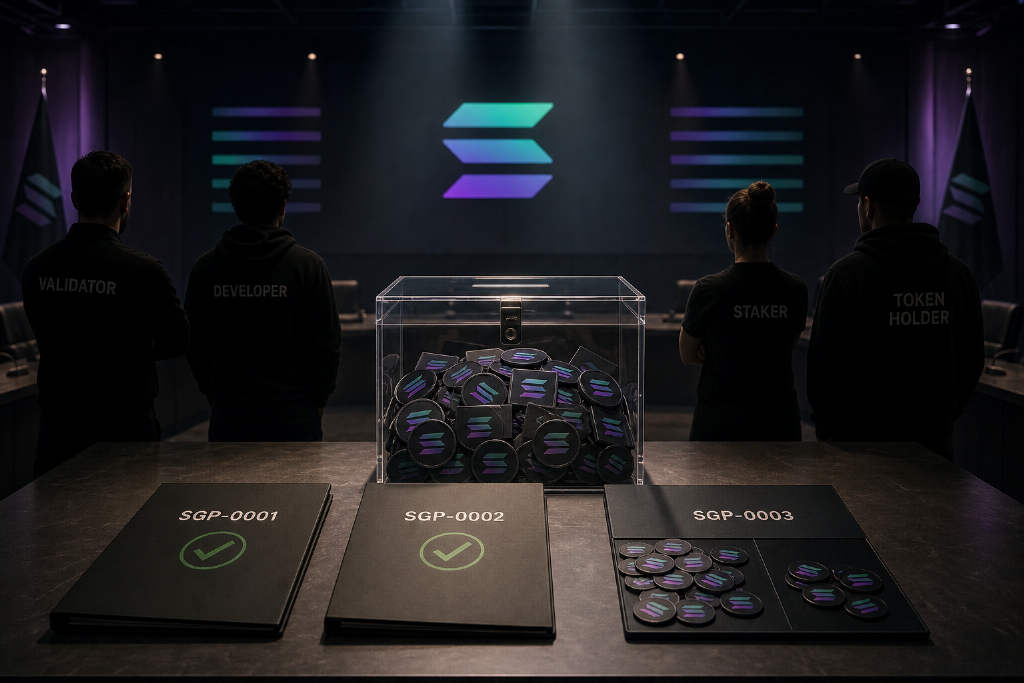
Solana’s first formal on-chain governance vote has ended, closing a milestone process that put three proposals — SGP-0001, SGP-0002 and SGP-0003 — before validators and stakers at the same time.
The vote opened on Aug. 23 and concluded at around 23:00. SGP-0001 and SGP-0002 both met the minimum thresholds: at least one-third participation from all valid staked SOL and at least two-thirds support among ballots cast. Both will now move into implementation. SGP-0003 did not pass. It drew 54.3% support, short of the 66.6% requirement. Projects listed among the opposing votes included Jupiter, Forward Industries, Anagram Staking and Solana Company.
The vote marked a shift in how major Solana decisions are handled. In the past, important network upgrades were largely coordinated by core developers and ecosystem organizations. This round moved part of that decision-making into a formal public process.
SGP-0001 sets up a formal governance structure
SGP-0001, described as the “Solana Constitution,” serves as the institutional base for the new governance system. Before this, Solana did not have a standardized on-chain governance procedure comparable to what is seen in Ethereum governance. Traditional SIMD processes were mainly about how to implement technical changes. The new SGP track is meant to answer whether Solana should move in a given direction at all.
Under SGP-0001, any proposal that secures support from at least 15% of active stake can advance to a formal on-chain vote. Voting power is weighted by the amount of staked SOL. Validators express votes by default, but stakers can override validator votes through their own staking accounts.
For a proposal to pass, at least one-third of network stake must participate, and at least two-thirds of participating stake must vote in favor. The practical importance of SGP-0001 is not a direct change to performance or tokenomics. It creates a formal procedure for handling future disputes.
SGP-0002 shortens the path to Solana’s terminal inflation rate
If SGP-0001 is about process, SGP-0002 and SGP-0003 go straight to SOL’s economic design.
SGP-0002, called “Double Disinflation,” would raise Solana’s annual rate of inflation decline from 15% to 30%, while keeping the terminal inflation floor unchanged at 1.5%.
The difference is in timing. Based on the proposal’s estimates, Solana would have taken about 5.7 years under the existing schedule to reach the 1.5% terminal inflation rate. The new plan cuts that to about 2.8 years and is expected to reduce new SOL issuance by roughly 18.9 million tokens over the next six years.
Backers argued that this would move SOL more quickly away from an early-stage network model built on high inflation and high staking subsidies, and toward a more mature asset profile. Forward Industries said lower issuance could reduce sell pressure tied to staking rewards and ease dilution for long-term holders. The firm estimated that 18.9 million SOL, at the then-current price, translated to about $1.795 billion in potential issuance avoided.
Opposition focused on validator and staker income. Inflation rewards are a major source of revenue for validators. The proposal does not create new network revenue; it reduces future issuance, which means lower SOL rewards for validators and stakers.
The debate also extends a controversy Solana had in 2025 around SIMD-0228. A similar inflation reform effort previously won more than 60% support but failed because it did not reach the supermajority threshold.
SGP-0003 targeted Solana’s fee structure and blockspace pricing
SGP-0003 proved more divisive because it aimed to change not only SOL issuance dynamics, but the way Solana prices blockspace across the network.
At present, Solana’s base transaction fee is largely a fixed charge based on the number of signatures. SGP-0003 proposed splitting that into two parts:
- a fixed 2,500-lamport base inclusion fee, paid entirely to the block producer;
- a Resource Fee calculated from the amount of resources requested by a transaction, with 100% of that portion burned.
The underlying principle was simple: transactions that consume more network resources should pay more.
According to the figures cited in the article, Solana currently burns about 648 SOL per day through base fees. Supporters of SGP-0003 argued that the new mechanism could lift that to the thousands, with some estimates ranging from 7,500 to 9,000 SOL per day — more than a tenfold increase in daily burn.
For SOL holders, that looked attractive on paper: lower new issuance on one side and higher token burn on the other, slowing supply growth. But the added fees would not come from nowhere. The cost would be carried by traders, applications and on-chain markets.
Mostly Data simulated the impact on different application types and found that ordinary transfers would see limited effect, while account creation, central limit order book market making and on-chain routing would face more meaningful cost increases. For trading protocols such as Jupiter, Titan and DFlow, the average fee per transaction could rise by about 0.000068 SOL, 0.00010 SOL and 0.00012 SOL, respectively.
The central dispute: rational pricing or a tax on applications
Supporters of SGP-0003 argued that Solana’s current fee model materially underprices the burden complex transactions place on network resources.
Cavey, the developer who proposed SGP-0003, openly described it as “an opinionated proposal.” His stated goal was not to keep Solana as a fully neutral general-purpose compute platform, but to push it toward becoming a blockchain more focused on financial markets. For that use case, he argued, fast confirmation, reliable execution, censorship resistance and predictable resource pricing matter more than making every type of application uniformly cheap.
Solana co-founder Anatoly Yakovenko backed the same direction. He argued that the current fixed signature fee causes transactions of very different sizes to bear almost the same base cost. In his view, pricing a transaction that consumes 5,000 CU and one that consumes 1.4 million CU under nearly the same model is not reasonable, and repricing by CU would address a real issue.
Application developers rejected that framing.
Ellipsis Labs CEO Eugene Chen was among the sharpest critics. He argued that SGP-0003 was, in substance, a highly subjective policy proposal packaged as a neutral resource-pricing mechanism. In his view, if an application platform’s core economic parameters can change suddenly through a governance vote, developers will struggle to build durable businesses on top of it.
He also said SGP-0003 was “a middle finger to every microstructure-sensitive app on Solana,” because it signaled to developers that a cost model accepted today could be rewritten tomorrow through governance.
Manifest also opposed the proposal. The project argued that Solana’s genuinely scarce resource is priority ordering inside a block, and that this is already priced through priority fees. By contrast, large amounts of available blockspace are not truly scarce, yet would face extra charges under SGP-0003.
Manifest added that excessively high resource fees could backfire. Developers trying to reduce CU costs might cut back on on-chain safety checks, raising security risk.
Voting records showed a clear split inside the ecosystem
On-chain voting records showed Jupiter, Drift, Forward Industries and Anagram Staking voting against proposal 0003. Figment, Staking Facilities, Kiln and P2P.org publicly supported it, while Everstake abstained.
That division turned the proposal into more than a technical debate. It became a direct clash over network costs, economic incentives and Solana’s long-term positioning.
Expansion in performance, but no agreement on pricing
The vote came as Solana continued to expand its technical capacity and financial use cases. In July, Solana raised the single-block compute cap from 60 million CU to 100 million CU. In August, mainnet slot time was reduced to 350 ms, with a plan to move toward 200 ms. Firedancer is already running on mainnet, and next-generation consensus upgrades such as Alpenglow are also in progress. At the same time, financial applications tied to RWA, stablecoin payments and tokenized stocks have kept growing as Solana tries to turn its performance edge into larger-scale real economic activity.
SOL has also seen a sharp rebound in price. In August, the token rose from around $75 to above $110 at one point. Against that backdrop of technical upgrades, ecosystem expansion and changing market expectations, Solana has started to regain a growth premium in the market.
Yet the first governance round exposed a separate fault line. Passage of SGP-0002 showed support for lowering SOL’s long-term inflation. Failure of SGP-0003 showed that application developers remain highly sensitive to sudden increases in operating costs and to the prospect of economic rules being redrawn through governance.
The result leaves Solana with a clearer boundary line. The network can no longer rely on technical progress alone to drive growth. From here, it must also work through the balance between developer interests, validator revenue, value for SOL holders and long-term sustainability of the network.