
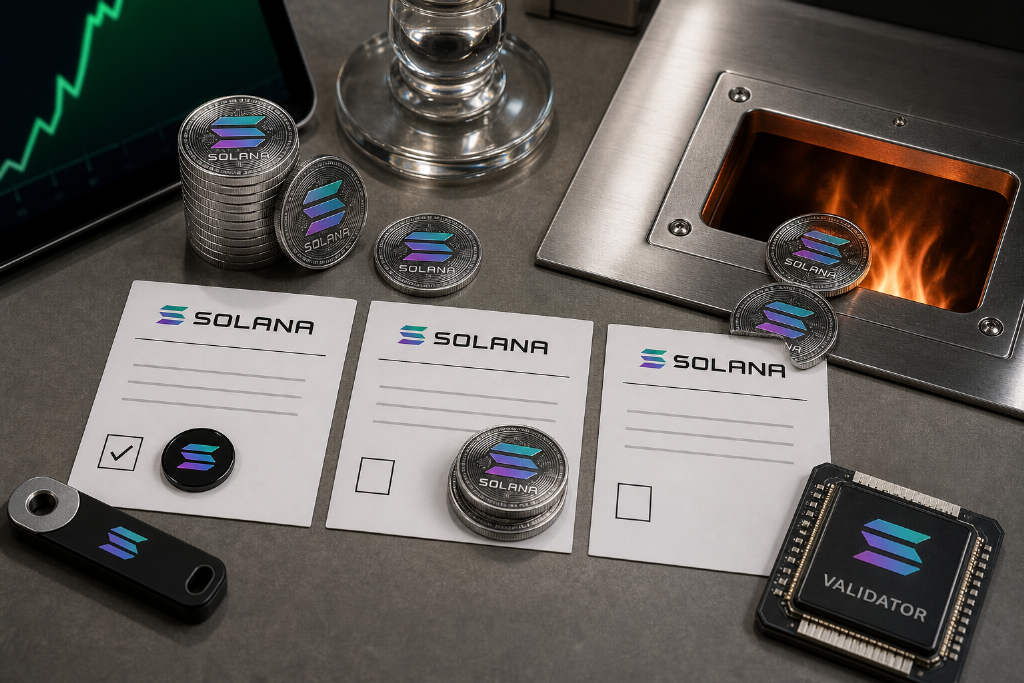
SOL rose to $109 on Aug. 27, setting a new high for 2026, as Solana’s first formal onchain governance vote closed and three proposals that could reshape the network’s token economics moved into the counting phase. August gains reached 44%, making it the strongest month for SOL since 2024. If all three proposals are approved, annual new issuance would decline at a faster pace and average daily SOL burns could increase by roughly 14x.
At the center of the vote is a question that has followed Solana for some time: the network has posted clear usage growth, but that activity has not translated into equally strong economic returns for SOL holders.
Heavy usage, weak protocol-level value capture
According to the source text, Solana processed 25.3 billion transactions in the first quarter of 2026, more than 120 times Ethereum’s total in the same period. It has ranked first in spot DEX market share for seven straight quarters at about 30%. Network uptime has exceeded 90 days, and Solana has not suffered a chain-wide outage since February 2024. Onchain supply of real-world assets, or RWA, passed $3 billion in June, accounting for 24% of total value locked.
Institutional interest has also expanded. Charles Schwab said it would add SOL to its crypto trading product lineup, while SBI Holdings shifted its blockchain business toward Solana through a joint venture.
Yet the protocol’s direct economic capture remains limited. Solana’s cumulative historical fee revenue stands at about $586 million, versus $13.12 billion for Ethereum, a gap of more than 22x. Value captured by the application layer is 134 times that of the protocol layer. Galaxy Research said in its Q2 2026 report that Solana network fees fell 44% quarter over quarter to about $155 million, while network revenue, or REV, dropped 43% from $89.8 million in Q1 to $51 million. In a multichain revenue ranking, Solana placed fourth with a 12% share, behind Hyperliquid, Tron and Ethereum.
The fee structure is a major reason. In February 2025, validators approved SIMD-0096, sending 100% of priority fees to block-producing validators with no burn. Priority fees plus Jito tips account for more than 85% of daily network revenue, while the base fee that can create deflationary pressure makes up only a small share, and only 50% of that base fee is burned. The result, as described in the source, is that Solana burns about 650 SOL a day while issuing around 60,000 SOL a day. 21Shares summarized the imbalance in one line: 「Scale has been proven, value capture has not yet.」
Three proposals at the center of the vote
The three governance proposals opened on Aug. 22 and are the latest attempt by the Solana community to address that gap.
SGP-0001: a formal governance framework
SGP-0001, described as a “Solana constitution,” would establish a formal onchain governance framework. Voting power would be assigned by stake weight, and ordinary stakers would have the right to override validator votes. That structure forms the institutional base for the other two proposals.
SGP-0002: faster disinflation
SGP-0002 was proposed by engineers at infrastructure company Helius. It would double the annual disinflation decay rate from 15% to 30%. Solana’s current inflation rate is about 3.8%, and under the existing schedule it would not reach the terminal inflation rate of 1.5% until 2032. The new plan would compress that timetable to 2029. Over six years, the source estimates the change would reduce issuance by about 18.9 million SOL, worth roughly $1.5 billion at the current price.
SGP-0003: splitting transaction fees into two parts
SGP-0003 came from research and development firm Temporal. It would break the flat base transaction fee into two components: a fixed entry fee paid to block producers, and a resource fee priced according to actual compute consumption and fully burned. If implemented, average daily SOL burns could jump from about 650 to 7,500-9,000, close to a 14x increase.
Vote participation and support base
Before the Aug. 27 deadline, participation in SGP-0002 had reached 33.84%, clearing the one-third quorum threshold. Votes in favor accounted for about 25.84% of stake weight, compared with about 5.54% against and 2.65% abstaining. More than 80% of valid votes supported the proposal.
Among the backers, Helius deployed about 16 million SOL in support, Jupiter committed 12.47 million SOL, and Jito pre-authorized all three proposals through its internal governance process.
Who is pushing back
Support is not universal. Nasdaq-listed Solana Company, ticker HSDT, backed SGP-0001 but voted against SGP-0002 and SGP-0003. Chief executive Joseph Chee said the issue was timing. In his view, institutions need stable and auditable economic parameters for multiyear planning, and changing staking returns and transaction cost structures just as Solana ETFs begin attracting traditional capital could slow adoption.
There is also a direct economic incentive behind that stance. Solana Company reported Q2 revenue of $2.526 million, of which $2.512 million, or 99.4%, came from staking. Faster disinflation would mean staking yields falling from about 5.25% now to roughly 2.25% within three years, directly affecting its main income stream.
The debate runs deeper than one company’s balance sheet. Under Solana’s new governance framework, validators vote by default with the full delegated stake they manage unless individual stakers override them. CryptoSlate’s analysis highlighted the agency problem that creates: a validator whose business depends on staking income can vote against cuts to staking yields using SOL delegated by other holders, while many of those delegators may not know how their voting power is being used.
Smaller validators face another problem. A model cited from 21Shares shows that if SGP-0002 is enacted, some small validators with higher operating costs could become unprofitable and be forced to exit. In the short term, that could intensify validator concentration rather than support Solana’s decentralization goal.
Not the first attempt to change inflation
This is not Solana’s first effort to adjust issuance. In March 2025, SIMD-0228 proposed cutting inflation by 80% and introducing a dynamic issuance mechanism tied to staking participation. The proposal failed after 61.39% of participating stake voted against it.
The source says the core reason for that rejection matches today’s divide: validators were unwilling to reduce a major source of revenue. This time, the design is milder. SGP-0002 changes the slope of disinflation rather than imposing an abrupt cut. The technical implementation under SIMD-0550 was also designed with a continuous anchoring mechanism to avoid a discontinuous jump in issuance at activation.
Even if SGP-0002 and SGP-0003 both pass, the current vote would amount only to directional authorization. Actual protocol changes would still need later SIMD implementation, testing and onchain activation, leaving a window that could last months before the changes take effect.
SOL’s price setup remains delicate
The source places SOL at a sensitive point in the market. The token remains down more than 60% from its all-time high of $293, but August’s 44% rebound brought it back to $109. The article ties that move to several factors listed together: a recovery after technical oversold conditions, early pricing of governance expectations, and sector rotation after BTC broke above $80,000. It also notes that RSI has entered overbought territory.
For short-term traders, the immediate risk flagged in the source is a “buy the rumor, sell the fact” move once the governance result is confirmed. For long-term holders, the central issue is unchanged: can Solana convert undeniable network usage into economic returns for SOL holders?