


Solana held its first truly binding on-chain governance vote on Aug. 27-28, 2026, marking a shift from off-chain validator signaling to stake-weighted voting. It was the first time institutions, public companies, and everyday staking delegates were forced into the same formal decision process. Of the three proposals on the ballot, two passed. The only one that failed was the fee reform aimed at increasing SOL burns.
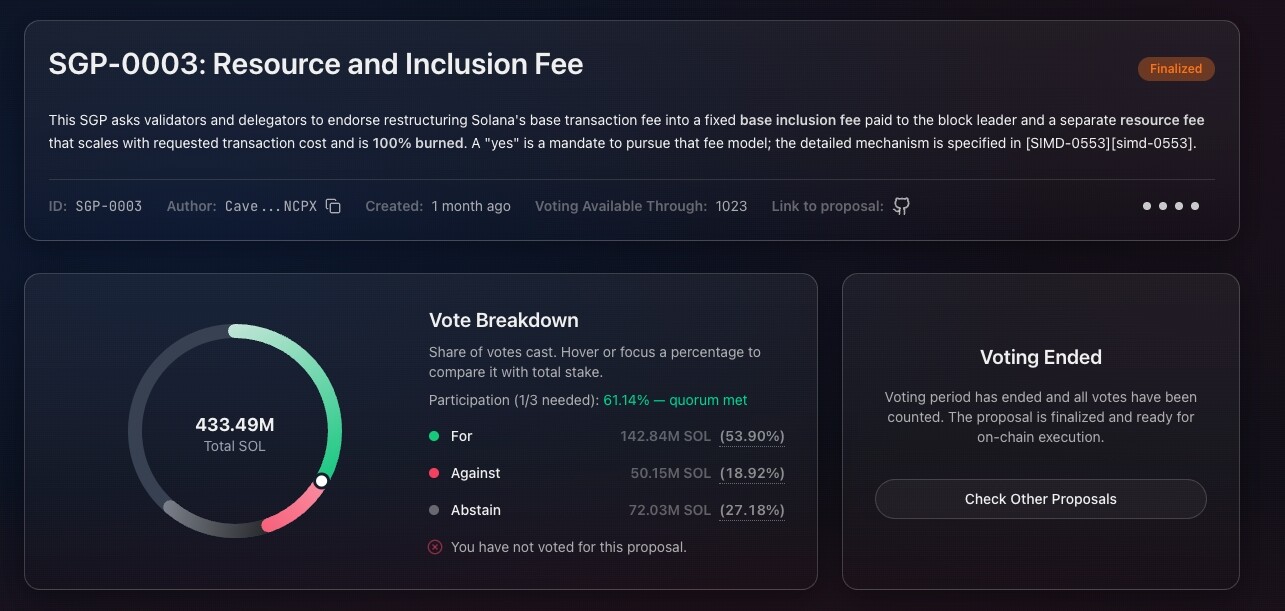
The vote ran under the new Solana Governance Proposal, or SGP, framework, which went live on July 1, 2026. It replaced the earlier informal process that was limited to validators. One of the biggest changes is an override right for delegators: even if tokens are staked with a validator, the actual token holder can still overturn that validator’s vote.
What passed and what did not
SGP-0001, the “Solana Constitution,” set the basic rules of the governance system, including quorum at one-third of staked supply and a two-thirds approval threshold. It passed with about 86% support, about 2% opposition, and about 12% abstentions.
SGP-0002, known as “Double Disinflation” and tied to technical proposal SIMD-0550, raised Solana’s annual disinflation rate from 15% to 30%. That change would move the timeline for reaching the network’s 1.5% terminal inflation rate from around 2032 to around 2029, and it is expected to reduce SOL issuance by about 18.9 million tokens over the next six years.
The vote on SGP-0002 turned dramatic in the final stretch. Roughly 70 minutes before the deadline, the largest validator under Kraken switched about 8.9 million SOL from support to opposition, putting the proposal behind by roughly 58 million SOL. Near the end, Kraken flipped about 8.1 million SOL back to support. Galaxy also moved from abstain to support in the last few minutes, and some Jito staking pool delegates were overridden by stakers. SGP-0002 ultimately passed at exactly 67.00%, only about 0.33 percentage points above the two-thirds threshold.
SGP-0003, the “Resources and Admission Fee Proposal,” corresponding to SIMD-0553, failed. The final count showed 53.90% in favor, 18.92% against, and 27.18% abstaining. Participation cleared quorum, but support remained well below the two-thirds requirement.
What SGP-0003 would have changed
The failed proposal was not a plan to burn treasury assets or destroy MEV revenue, despite how some outside coverage described it. It targeted Solana’s base transaction fee model. Under the current structure, each signature on a Solana transaction carries a fixed fee of 5,000 lamports. Half is burned, and half goes to the validator that produced the block.
SGP-0003 would have split that charge into two parts. One would be a fixed 2,500-lamport admission fee paid entirely to the block producer. The other would be a resource fee, priced according to the actual compute resources consumed by the transaction, and that portion would be burned in full.
The idea was to make heavier users of on-chain compute pay more while keeping more value inside the protocol through burns rather than routing it to block producers. According to estimates from 21Shares, if the plan had taken effect, daily SOL burns would have increased from about 648 tokens to between 7,500 and 9,000. At the price used at the time, that would have lifted the daily dollar value of burns by nearly 14x.
Even at the upper end, though, that burn level would still sit far below the roughly 60,000 SOL currently issued each day. The proposal would not have made SOL immediately deflationary. It would have increased the force of disinflation.
Why the burn proposal failed
The decisive factor was not the opposition vote. It was abstentions, which reached 27.18%.
Under the counting rules set by the Solana Constitution, abstentions count toward quorum and also remain in the denominator when approval is calculated. That means a large abstention share raises the hurdle in practical terms. SGP-0003 drew a far higher abstention rate than the other two proposals, and collective abstentions by large validators shaped the result.
One calculation cited in the report showed that if abstentions were excluded from the denominator, the proposal’s support among decisive stake would have been about 74%, enough to pass. That gap in methodology later turned into a public dispute over how the rules should be read. Michael Hubbard, chief executive officer of SOL Strategies, said the constitution text and some pre-vote communication materials described the calculation differently, and that based on the rule participants believed they were voting under, the proposal should have been considered approved. He also said that despite his procedural objection, he personally believed the failed result may have been the better outcome.
According to reports that cited on-chain data, decentralized exchange protocol Jupiter, lending protocol Drift, public company Forward Industries, and staking provider Anagram Staking were viewed as having voted against the proposal. Everstake was viewed as abstaining. Figment, Staking Facilities, P2P.org, and backers that had already supported the earlier signaling stage, including Helius, OtterSec, Solana Compass, Blueshift, and Temporal, along with DeFi Development Corp, which is described as the first publicly listed SOL treasury company in the U.S., were viewed as supporters.
Public companies split from parts of the ecosystem
One of the most closely watched positions came from The Solana Company, the Nasdaq-listed firm trading under HSDT. The Philadelphia-headquartered digital asset treasury company, which operates institutional validator services in the Asia-Pacific region, made its stance public before voting began: yes on the constitution, no on the disinflation proposal, and no on the burn proposal.
Chairman and chief executive officer Joseph Chee said that, based on the company’s conversations with institutional investors, issuance rate by itself is rarely what keeps institutions out of crypto. The bigger issue is whether the network’s economic parameters remain stable and dependable over a period of years. In his view, changing the two most important and most stable parameters, issuance and transaction fees, in the very first formal voting cycle after the governance framework launched creates too much risk and could slow institutional adoption.
On SGP-0002, Chee said staking yield for many SOL holders functions as a financial statement item that must be forecast, disclosed, and audited, and in some cases can be treated as part of operating cash flow. He said the company did not want to see what had been a fixed and predictable issuance schedule reopened for debate. On SGP-0003, his position was more direct: today’s transaction fee is a known constant, which allows financial institutions using Solana to budget in advance. Turning that cost into a floating variable before the ecosystem has fully adapted would shift cost-estimation risk to end users and operators.
Media-cited financial statement data showed that staking income generated from the company’s SOL holdings accounted for 99.4% of its total revenue in the second quarter. The company earned more than 30,000 SOL through staking during the quarter and restaked those tokens automatically, but still posted a net loss of about $30 million after impairment tied to a decline in the price of SOL.
Solana co-founder Anatoly Yakovenko publicly backed the broader direction of the proposal set. He said a yes vote should be read as authorization for the direction, while technical details could still be refined in later proposals. At the same time, he said SGP-0003 bundled too many issues into one package and would be better split into several narrower votes, such as separating the replacement of the fixed signature fee from the question of how the floating rate should be determined.
Austin Federa, co-founder of decentralized infrastructure project DoubleZero and a former Solana Foundation member, cited data showing that the application layer in the Solana ecosystem captures about 93% of the total value generated on-chain, while the base network layer keeps only the remaining 7%. In his view, a fee tied to compute usage, with the resource component burned in full, would redirect more value back to the protocol itself instead of leaving it with applications or block producers.
The vote also exposed a split among digital asset treasury, or DAT, companies inside the Solana ecosystem. DeFi Development Corp backed both economic proposals. The Solana Company opposed both. SOL Strategies, another Nasdaq-listed infrastructure and treasury firm, had its CEO Michael Hubbard call the disinflation proposal “too early” and raise procedural objections to the way the burn proposal was counted. Forward Industries, whose backers reportedly include Multicoin Capital, Galaxy Digital, and Jump Crypto, was also reported to have opposed the burn proposal.
SOL rose during the vote as ETF inflows stayed firm
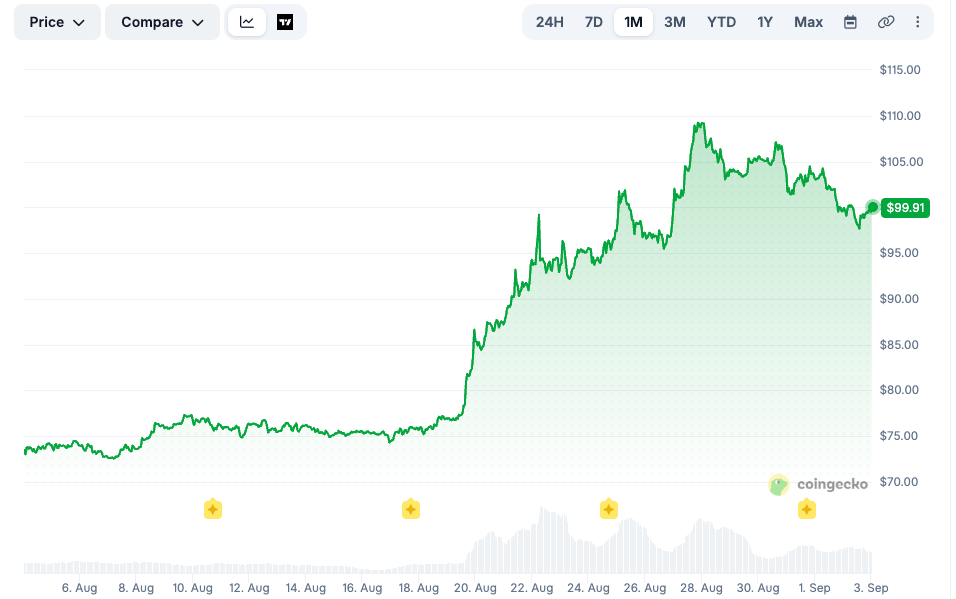
The governance vote coincided with a stronger stretch for SOL. Market data cited in the report showed SOL touched $110.38 on Aug. 27, the day of the vote, its strongest price level since late January that year. It ended August around $106, up about 46% for the month, snapping a run of 10 straight monthly declines.
The move also came alongside solid inflows into SOL exchange-traded fund products. Cumulative net inflows across the category reached about $1.322 billion, while total assets under management stood at about $1.49 billion. On Aug. 27 alone, net inflows reached $60.91 million, the third-highest single-day intake since launch for the category. Of that day’s inflows, a Bitwise SOL ETF product accounted for about 66%. Its assets under management moved past $1 billion, with about 9.3 million SOL held, and Goldman Sachs disclosed as its largest institutional holder.
A revised version may return
Even though SGP-0003 failed this time, the positions laid out after the vote suggest a revised version is likely to come back for another decision. No formal revote timetable has been announced so far.
Yakovenko has already argued that the original package should be broken into simpler, separate proposals. The Solana Company, one of the better-known opponents, has also said it would revisit its stance if a revised plan preserved a fixed fee floor. The report added that SIMD-0553 has already passed technical review by Anza, the core development team, and by the team behind the Firedancer validator client. That means if the governance side approves a revised proposal later, technical implementation could move quickly.