

Solana kept its lead in decentralized exchange activity in the second quarter of 2026, but the chain’s revenue metrics continued to soften as the market cooled and speculative trading faded, according to a quarterly report by Galaxy Digital Vice President of Research Lucas Tcheyan.
The report says Solana still ranked near the top across core on-chain indicators, including DEX volume, application fees, and network fees. At the same time, it argues that headline figures alone do not capture the broader transition under way. Solana is trying to move from an on-chain economy driven largely by meme-coin speculation toward a platform that can support tokenized equities, stablecoins, lending, prediction markets, and other categories of financial activity.
That transition is advancing across several layers, the report says: base-layer infrastructure, execution environments, legal and technical frameworks for bringing traditional assets on-chain, new trading venues, DeFi integrations, and consumer-facing applications meant to reduce friction and widen access. The challenge, however, is that technical capacity still exceeds real adoption. Most tokenized assets on Solana remain idle, lending markets have not yet converted growth in tokenized assets and stablecoins into durable borrowing demand, and fee generation still depends heavily on meme-coin trading.
Network performance stayed stable as major upgrades moved forward
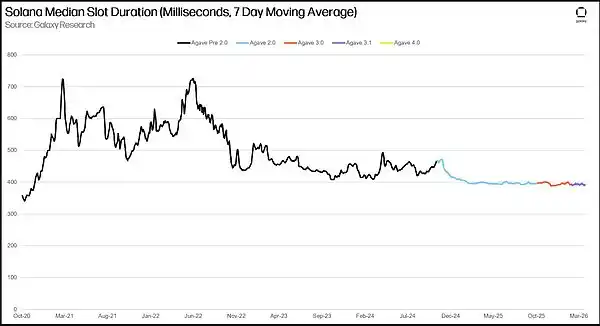
In Q2 2026, Solana maintained a median block time at the 400-millisecond target and recorded its ninth consecutive quarter without an outage, the report says. Anza R&D labs continued to iterate on the Agave client line, with Agave v4.0 becoming the recommended mainnet release in late May and Agave v4.1 going live in late June.
Agave v4.2, which was scheduled for initial mainnet deployment in early to mid-August, includes several changes: a higher compute limit of 100 million compute units, XDP networking improvements, direct mapping, and stronger data repair. The report highlights SIMD-0525 as the most closely watched part of the upgrade path, with the goal of reducing block time from 400 milliseconds to 200 milliseconds and cutting confirmation latency in half.
That rollout is expected to happen in stages, not all at once. Block time would be reduced by 50 milliseconds across consecutive epochs, moving from 400 to 350, then 300, 250, and finally 200 milliseconds. Each step depends on skip rates remaining low enough to proceed. The report says the full process is expected to stretch across the rest of 2026. Shorter block times would also reduce the window during which a single leader controls block construction, improving censorship resistance.
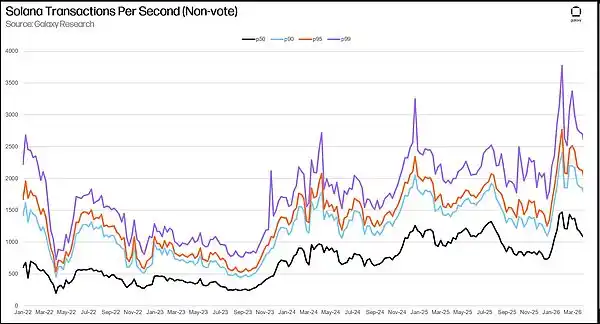
Non-vote transaction throughput remained stable near the upper end of Solana’s network capacity. Median transactions per second stayed in the thousands, while high-percentile spikes were only intermittent and did not translate into persistent congestion. For most of the quarter, block space under the 60 million compute-unit cap was enough to fit all user transactions. On July 30, Solana mainnet activated SIMD-0286, lifting the block compute limit to 100 million compute units, the second capacity increase since the limit was raised to 60 million in July 2025.
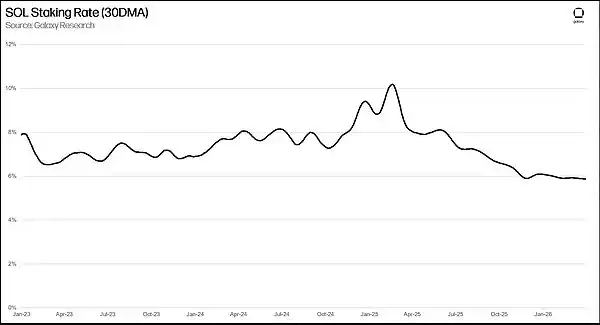
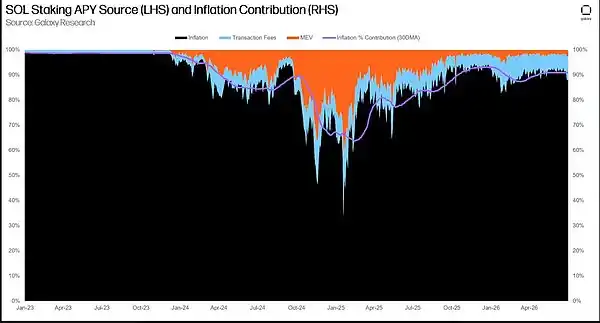
Nominal SOL staking yield slipped about 7% during the quarter, extending the gradual decline seen since the previous quarter. Inflationary issuance still accounted for nearly 90% of staking returns, while maximum extractable value, or MEV, and transaction fees made up only a small remainder. With fee income shrinking, fee-derived real yield fell again in Q2.
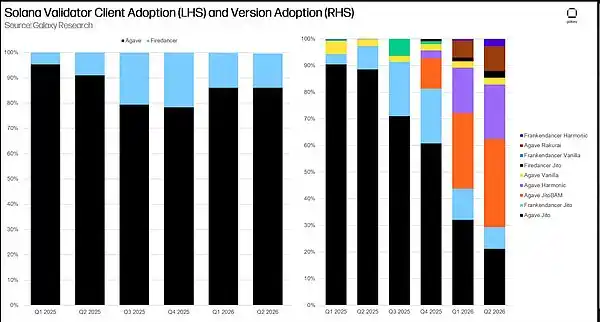
Client diversity also widened. Agave remained dominant, but Jito’s Agave-based JitoBAM increased its market share from 28% to 33%. The report describes BAM, or Block Assembly Marketplace, as a system that lets applications influence transaction ordering through plug-ins, also referred to as application-controlled execution, or ACE. That gives a general-purpose chain like Solana capabilities that were previously associated more often with app-specific chains.
Protocol governance centered on Alpenglow and SOL tokenomics
The report calls Alpenglow the largest protocol upgrade in Solana’s history. Public testing began on May 11, when Anza deployed the new version to a community test cluster and demonstrated a live migration from the existing consensus mechanism. According to the report, Alpenglow would replace Proof of History and Tower BFT with a new architecture, reduce transaction confirmation time to roughly 150 milliseconds, improve finality speed by nearly 100x, eliminate on-chain vote transactions, and introduce a validator admission threshold of 1.6 SOL per epoch.
The design is described as resilient enough to keep the network operating even if up to 20% of stake is controlled by malicious nodes and another 20% is offline. Prerequisite features have already been integrated into Agave 4.0 and Agave 4.1. Agave 4.2 includes Alpenglow code for continued community testing, with mainnet activation targeted for Agave 4.3 in October.
SOL tokenomics became another major governance focus. The report says weak SOL price performance intensified debate around two proposals. Helius-backed SIMD-0550 would double the pace of annual disinflation to 30%, move the timeline for reaching the 1.5% terminal inflation floor forward from 2032 to 2029, and reduce future SOL issuance by about 18.9 million tokens. The tradeoff would be a faster decline in nominal staking yield.
Temporal’s SIMD-0553 would introduce a resource-based fee that floats with resource consumption and is permanently burned. Based on current on-chain activity, the report estimates daily burns of 7,500 to 9,000 SOL, about 10 times the current burn rate and equal to roughly 12% to 15% of daily issuance. SIMD-0550 is meant to slow supply growth. SIMD-0553 is meant to link token value more directly to network activity. Both proposals entered formal review and first-round governance voting on Aug. 3. The report says that if they are paired with SIMD-0123, they would form the clearest reform path so far for sending network value back to SOL holders rather than only to block producers.
Elsewhere, Anza published its Constellation design at the end of March. The proposal introduces multiple concurrent proposers to reduce temporary monopoly control over transaction ordering by a single block producer and to limit MEV extraction. The implementation path remains under discussion, and no mainnet date has been set. On April 27, Anza and the Firedancer team each released post-quantum migration plans. Anza estimated the probability of a cryptographically capable quantum computer emerging within five years at 3% to 5%.
DEX volume fell 45%, though Solana kept the top spot
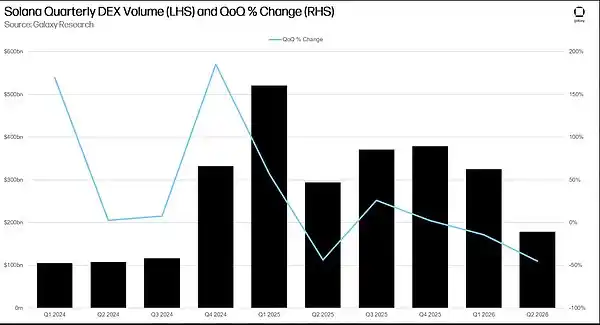
Solana’s DEX volume fell 45% quarter over quarter in Q2, the report says, marking a second straight quarterly decline and the lowest total since the third quarter of 2024. Monthly DEX volume never returned to the January high during 2026. A 20% month-over-month rebound came only in June, helped by renewed meme-coin trading tied to the launch of the $ANSEM token and by tokenized assets such as SPCX coming online.
By composition, SOL-stablecoin trades and stablecoin-to-stablecoin swaps still made up the bulk of activity. Meme-coin trading represented about 15% to 20% of volume. Tokenized stocks and wrapped foreign assets from other chains accounted for roughly 10%.
The report notes that critics will point to those numbers as evidence that Solana still depends too heavily on meme coins. But it argues that a parallel trend became clearer in Q2: teams are building the infrastructure needed for a broader non-meme on-chain economy.
In May, Securitize, Jump Trading, and Jupiter launched what the report describes as the first fully on-chain regulated equities infrastructure. The stack combines Securitize’s broker-dealer and alternative trading system, Jump’s proprietary automated market maker liquidity, and Jupiter’s distribution network, allowing issuance, settlement, and clearing to happen atomically within a single block.
In June, Backpack Securities and Sunrise launched tokenized services with broker-dealer status. Those assets are held as security entitlements under Article 8 of the Uniform Commercial Code of New York, using the same legal structure as Charles Schwab and Fidelity accounts, and they support cash dividends and corporate actions. Jito introduced JTX, a self-custodial trading venue supporting professional order types and real-world assets, opened early access at the end of June, and planned a full launch in July. In April, Nasdaq-listed Galaxy (GLXY) became the first publicly listed stock tokenized on a public blockchain. Through transfer agent Superstate, the asset was integrated with Kamino to be used as collateral in DeFi.
According to the report, Solana now has the infrastructure needed for tokenized equities and offshore assets to scale in a way that could reduce reliance on meme-coin activity. During the quarter, Solana carried more than 95% of all tokenized stock trading across the market.
Still, even with a seventh straight quarter at No. 1 in DEX volume, Solana’s market share fell 6 percentage points to 30%, its lowest level since Q3 2025. The report says this largely tracked a broader contraction in marketwide trading, with most lost flow dispersed across other chains that tend to show larger percentage swings because of smaller bases.
The broader point, in the report’s view, is that Solana’s edge will shift over time. The chain will compete less as the cheapest and fastest execution venue alone, and more as the place where the market can access assets it actually wants to trade.
Network fees and app fees both declined sharply
Network fees on Solana fell about 44% in Q2 2026. Base fees and priority fees, or tips, both continued their multi-quarter decline. The report points back to the late-2024 to early-2025 peak, when quarterly network fees reached $919 million and MEV tips alone accounted for more than 60% of total revenue. Current fee levels are only about 6% of that peak.
The report attributes the slide to both cyclical and structural causes. On the cyclical side, meme-coin trading has cooled steadily since early 2025, reducing congestion, priority fee bidding, and MEV competition. On the structural side, tokenized equities and other RWA trading that supported volume in June generated less bot-driven congestion and less aggressive fee bidding than meme-coin speculation. Combined with ongoing efficiency gains, that means Solana may produce structurally less fee revenue per unit of economic activity than it did during the prior speculative peak.
Solana’s share of total network fees dropped from 26.6% in Q1 2026 to 17.3% in Q2, reversing the previous quarter’s gains and falling below the 18.9% level seen in Q4 2025. The report says the trend reinforces a key point made in earlier quarterly updates: Solana’s fee income is highly exposed to speculative trading cycles. Fee markets weakened across the industry in Q2, but the decline on Solana was steeper than the sector average.
Application fees also fell for a third consecutive quarter, down 31% to $552 million. That is about one-quarter of the peak reached in Q1 2025, when a January speculative wave, highlighted by the launch of a Trump-themed meme coin, drove roughly 40% quarter-over-quarter growth.
Revenue remained concentrated in meme-coin activity. Pump alone generated $212 million in fees in Q2, accounting for about 38% of total application fees excluding MEV- and staking-related income. The top applications were still launchpads, DEX infrastructure, and trading terminals or aggregators.
There were a few signs of diversification. Collector Crypt, a collectibles marketplace highlighted in the previous quarter’s report as well, nearly tripled its fee base quarter over quarter and became the fifth-largest application on Solana for the period. Solana has now led all chains in application fee share for 10 consecutive quarters, a streak that began in Q1 2024, but its share has dropped from about 48% in Q1 2025 to 23% in the latest quarter.
Perpetuals looked strong on the surface, but the core market shrank
At first glance, Solana perpetual futures volume doubled in Q2 to $111 billion. The report says that number is misleading. Almost all of the increase came from a single venue, GMTrade, which contributed about $90 billion in volume while open interest stayed largely flat.
That pattern, the report says, is more consistent with users wash trading to earn points and airdrop rewards tied to FX perpetuals than with genuine trading demand. If GMTrade is excluded from both quarters, Solana perpetual volume actually fell 43%, extending the decline that began in Q3 2025.
A large part of that drop reflected the collapse in activity at Drift, once Solana’s second-largest perpetual venue. Drift halted trading after a $285 million exploit on April 1, described in the report as the largest DeFi theft of the year, and had not meaningfully resumed operations by the end of the quarter.
Not everything in the segment moved lower. Phoenix, a newer perpetual platform on Solana, increased volume 14-fold to nearly $700 million. Its open interest rose 5x to more than $5 million. Phoenix also expanded listed assets and introduced “Flight Codes,” a builder-code mechanism that lets any application, trading terminal, or bot route order flow to the venue in exchange for fees.
Even so, Solana’s share of perpetual volume and open interest, excluding GMTrade, remained only around 1%. The chain continues to trail specialized trading venues such as Hyperliquid and Lighter by a wide margin. The report points to Hyperliquid’s recent rise as being closely linked to TradeXYZ, the leading builder in its permissionless HIP-3 market, which listed tokenized stocks, indices, and commodities before many competitors did. In June, HIP-3 open interest reached about $3.2 billion, several times the size of Solana’s perpetuals market. Lighter, meanwhile, finalized a deal in early July to become the built-in perpetuals provider inside the Robinhood wallet.
The report argues that broad asset coverage and institutional distribution are now baseline requirements for any competitive on-chain perpetual platform. Phoenix’s growth, the expected launch of venues such as Bulk, and continuing front-end improvements from products including JTX and Imperial are constructive. But they are not enough on their own to push Solana into the top three in on-chain perpetuals.
As an example, the report notes that Phoenix launched an incentive program at the start of Q3, distributing $15,000 in daily platform rewards. Activity and open interest hit new highs early in the campaign, but daily data still showed fewer than 1,500 active traders, far below the 50,000-plus trader base at leading venues such as Hyperliquid.
The report suggests that Solana’s clearest path may lie in allowing traders to use the growing supply of tokenized stocks on-chain as collateral for perpetual positions. Spot tokenized equities and perpetual contracts tied to those assets could then settle on the same composable chain.
Prediction markets stayed small, but native products started to appear
Prediction markets on Solana remained small in Q2, though the segment kept developing. After early experimentation in Q1 through DFlow, which tokenizes Kalshi markets, and Jupiter integrations, the category still lagged far behind spot DEXs and perpetuals in volume. Even so, the report says product differentiation became clearer across retail-focused, event-driven, and professional trading use cases.
In June, Jupiter launched Forecast, described as Solana’s first native prediction market. It initially offered 15-minute crypto asset trading markets, with market makers competing to narrow bid-ask spreads and each market issuing a distinct token for composability. Around the same time, non-custodial prediction exchange Pascal opened a private test version for professional traders. Pascal uses an off-chain matching engine with on-chain settlement, holds collateral in Solana smart contracts, and includes an OTC desk for large negotiated trades.
Shortly after quarter-end, on July 1, the non-custodial protocol World went public and replaced Kalshi as the built-in prediction market service inside the Phantom wallet. The report specifically notes that this project should not be confused with the iris-scanning crypto project of the same name associated with Sam Altman.
Native prediction market volume remained modest. Jupiter and DFlow integrations accounted for most of the activity, but total scale was still only in the tens of millions of dollars. Solana’s strongest advantage here, the report says, is composability. DFlow can convert regulated Kalshi positions into SPL tokens, which can then be traded, lent, or used as collateral across Solana DeFi. That is something neither native Polymarket positions nor centralized exchanges can offer in the same way.
TVL declined again, while RWA passed $3 billion for the first time
Solana’s total value locked fell for a third straight quarter, down about 14% to $12.5 billion in Q2, with part of the decline coming from lower SOL prices. Solana’s share of total crypto TVL across the market stayed roughly stable at about 7% by quarter-end. The report says this looked more like a broad-based market contraction than a targeted withdrawal from Solana.
At the protocol level, liquid staking and lending or aggregation remained the core pillars of TVL, with Jito, Marinade, Binance Staked SOL, Sanctum, Kamino, Jupiter, and Raydium among the main contributors.
Stablecoin supply kept expanding, rising about 1.9% quarter over quarter to $15.6 billion. USDC’s share of stablecoins on Solana fell sharply, from about 77% in Q1 2025 to less than 47% in Q2 2026, while USDT, USD1, USDG, and PYUSD all captured meaningful share. Solana’s portion of the global stablecoin market edged up to about 5.0%, from 4.9% in Q1, though Tron and Ethereum still dominated globally.
Real-world assets were one of the quarter’s clearest growth areas. RWA on Solana crossed $3 billion in June, the first time it has exceeded that level since mainnet launch. These assets now account for nearly one-quarter of Solana’s TVL. The composition changed as well. Public equities became the largest single RWA category during the quarter, overtaking private credit, while bond exposure stayed roughly flat from the previous quarter.
Still, most of that value remains idle. Based on custody data analysis from 21Shares, only about 9% of tokenized real-world assets on Solana are being used in DeFi as trading liquidity or lending collateral. Excluding non-circulating issuer reserve funds, the figure rises to about 16%. Issuer reserves and personal wallets together hold more than three-quarters of the total supply.
In lending, Jupiter Lend and Kamino dominate the tokenized equities niche and hold about 83% of tokenized stock collateral. Those equities are among the few RWA assets actively used inside Solana DeFi. The report names QQQx, NVDAx, SPCX, and COINx as examples where more than 15% to 30% of circulating supply has already been deployed in DeFi. Kamino also supports other tokenized strategy products. An Apollo tokenized private credit fund, for example, underpins a looping strategy that lets users borrow against positions to amplify yield. More than $17 million of assets under Superstate, including Galaxy stock GLXY, were also deposited on the platform as borrowable collateral.
The report says the critical next step for Solana in the RWA segment is to move these assets beyond simple trading. The chain’s differentiation would come from making them useful as collateral, supporting lending, and letting yield compound across DeFi.
The second half of 2026 will test whether diversification creates real economic value
The report concludes that Solana’s path is becoming clearer, but the bar for success is getting higher. Faster execution, consensus redesign, and tokenomics reforms may improve speed, stability, and value distribution to SOL holders. But those upgrades alone will not decide the next stage of competition.
As block space becomes cheaper and supply more abundant, Solana’s position will depend less on raw performance and more on the assets, liquidity, and applications that choose to build on it. The central question for the second half of 2026 is no longer whether the supporting infrastructure exists. It is whether token issuance and asset distribution on Solana can be converted into repeatable collateral use, lending demand, trading activity, and fee income.
In the report’s framing, tokenized equities, stablecoins, prediction market assets, and other instruments need to move beyond issuance and trading into collateral, borrowing, margin use, and yield generation. That is where a general-purpose chain can stand apart from standalone trading venues. Solana’s next test is whether those pieces can reinforce one another strongly enough to create durable demand and lasting economic value.