
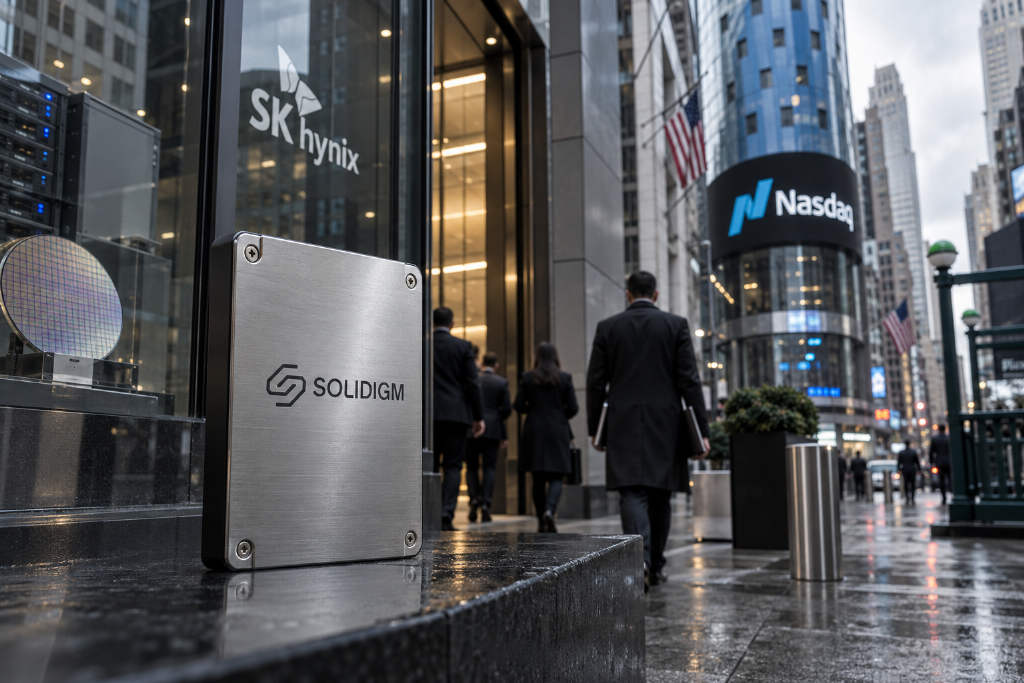
Solidigm, the U.S. subsidiary of SK Hynix, is preparing for a potential initial public offering that could rank as the biggest semiconductor IPO ever in the U.S. if the deal reaches the valuation now being discussed.
According to Reuters, the company has held underwriting pitch meetings with multiple investment banks and could list as early as next year. The target is to raise about $15 billion at a valuation of up to $150 billion. SK Hynix said Solidigm is reviewing various options to strengthen competitiveness and that no specific plan has been confirmed.
From an Intel divestiture to a possible record IPO
Solidigm was formed from Intel’s former NAND flash and solid-state drive business, which Intel agreed to sell to SK Hynix in October 2020 for about $9 billion. At the time, Intel was trying to focus resources on businesses it viewed as having higher strategic priority, while SK Hynix wanted to expand its NAND market share and broaden its storage lineup.
If Solidigm ultimately lists at $150 billion, the implied paper return on that acquisition would be close to 17x. That would make the transaction one of the most dramatic reversals in recent semiconductor dealmaking.
The numbers also stand out against recent chip listings. Arm debuted in 2023 at a valuation of about $54 billion and raised $4.87 billion. In 2026, AI chip company Cerebras completed its IPO at a fully diluted valuation of about $56.4 billion based on the offering price, raising about $6.38 billion. A $150 billion valuation for Solidigm would be about 2.7 times those levels, and a $15 billion fundraising target would be well above both deals.
The business struggled after the acquisition
The path from acquisition to IPO was not smooth. After the deal closed, Solidigm ran into a downturn in the storage market.
From the second half of 2022 through the first half of 2024, chip prices kept falling. At the same time, the company had to complete production-line tuning and customer qualification. Losses mounted quickly.
Financial data cited in the report showed Solidigm lost about KRW 3.3 trillion in 2022 and KRW 4 trillion in 2023, for a combined loss of more than KRW 7 trillion over two years, or about RMB 37 billion. By the end of 2023, shareholder equity had turned negative KRW 906 billion. In 2024, the asset-liability ratio at one point reached 4,484.6%.
Under that pressure, Solidigm moved to cut its consumer business in October 2024. It discontinued consumer SSD products including the P44 Pro and P41 Plus, then removed the consumer SSD product entry in January 2025 and shifted its focus fully to the enterprise segment.
AI inference changed the demand picture for storage
The main support for Solidigm’s valuation is the sharp improvement in operating performance, driven by a change in storage demand tied to AI deployment.
SK Hynix said that, as of the end of June 2026, Solidigm posted first-half revenue of KRW 12.25 trillion, up 265% year over year, and net profit of KRW 5.839 trillion, up 44 times from a low base a year earlier. Net margin rose from 3.9% in the first half of 2025 to 47.7% in the first half of 2026, and the company recorded its first cumulative return to profitability.
That margin level is unusual for hardware. Most semiconductor hardware companies tend to operate with net margins in the 20% to 30% range, while Nvidia is currently around 55%, according to the article. For a company focused on high-capacity enterprise SSDs, a margin close to 48% puts Solidigm well above most hardware peers and near Nvidia’s level.
The report ties that shift to the AI market’s move from model training to inference deployment. Counterpoint Research data cited in the article showed enterprise SSDs accounted for 48% of global NAND flash shipments in the second quarter of 2026. AI inference demand, not model training, had become the main growth engine for the storage market.
In inference workloads, models repeatedly pull large amounts of data to answer user prompts. A single query can generate tens of thousands of tokens and produce large volumes of KV cache data, putting heavy pressure on memory resources. Traditional DRAM and HBM are expensive and limited in capacity, making them less suitable for large-scale cache demand. As a result, the industry has increasingly adopted external KV cache architectures, using high-capacity, high-speed enterprise SSDs to take on cache data and lower AI operating costs through a storage-for-compute tradeoff.
That has changed the role of enterprise SSDs. They are no longer treated only as storage repositories. They are now being used as memory extension hardware that participates in real-time AI workloads and supports temporary cache layers.
Product positioning, pricing and customers all shifted
Solidigm’s flagship D5-P5336 uses a 3D QLC architecture and offers up to 122.88TB per drive. The article said the product is designed around low storage cost and can reduce energy consumption by as much as 84% in data-center NAS scenarios compared with traditional HDD and TLC-based options.
Pricing moved sharply higher as demand tightened. In the second quarter of 2026, enterprise NAND contract prices rose 70% to 75% from the prior quarter. Solidigm’s 122TB flagship product increased from $12,399 in the second half of 2025 to $37,128, nearly tripling in nine months. The price per terabyte rose from $101 to $302.
The customer list expanded as well. The article named CoreWeave, Vast Data, Dell and Tencent among Solidigm’s customers. In August 2026, CoreWeave signed a multi-year strategic agreement with Solidigm to secure priority supply of high-capacity enterprise SSDs.
The comparison in the report was straightforward: just as major technology companies rushed to lock in GPU and HBM supply over the past two years, enterprise SSD capacity is now also being reserved in advance.
What SK Hynix gained, and why Intel sold
Solidigm’s rebound has also fed into SK Hynix’s broader results. In the second quarter of 2026, SK Hynix Group posted operating profit of KRW 60.54 trillion, up 557% year over year, with an operating margin above 76%. In the first half of 2026, group sales topped KRW 100 trillion for the first time. The company held about 21.1% of the global enterprise SSD market, according to the article.
Strategically, Solidigm’s enterprise SSD business also complements SK Hynix’s HBM and DRAM portfolio, giving the group a more complete position in AI infrastructure storage.
From today’s perspective, Intel appears to have sold before the AI storage boom arrived. But the decision made sense in 2020. The memory business was capital intensive, cyclical and structurally lower margin. Unlike CPUs, which carried stronger pricing power, NAND flash was a standardized commodity market with fierce competition.
Before 2020, the global memory market was split among Samsung, Kioxia, Western Digital, Micron, SK Hynix and Intel. Intel’s NAND business had only about 11% global share, the smallest among the six major manufacturers mentioned in the article.
The financial record was weak. Intel’s Non-Volatile Memory Solutions Group posted losses of $540 million in 2016, $260 million in 2017 and $5 million in 2018. Over the 12 months through the second quarter of 2020, the business accumulated a loss of $340 million.
Against that backdrop, Intel chose to divest a non-core asset and redirect resources toward higher-margin CPUs as well as AI and edge computing. SK Hynix, for its part, gained production capacity at Intel’s Dalian plant, along with NAND intellectual property and core R&D talent.
The integration period was painful, and the losses in 2022 and 2023 were severe. Even so, management changes and the exit from consumer SSDs helped stop the bleeding. With Solidigm now moving toward an IPO, SK Hynix’s original $9 billion outlay is being measured against a possible $150 billion valuation. The AI storage upside that Intel did not stay around to capture has instead accrued to SK Hynix and Solidigm.