
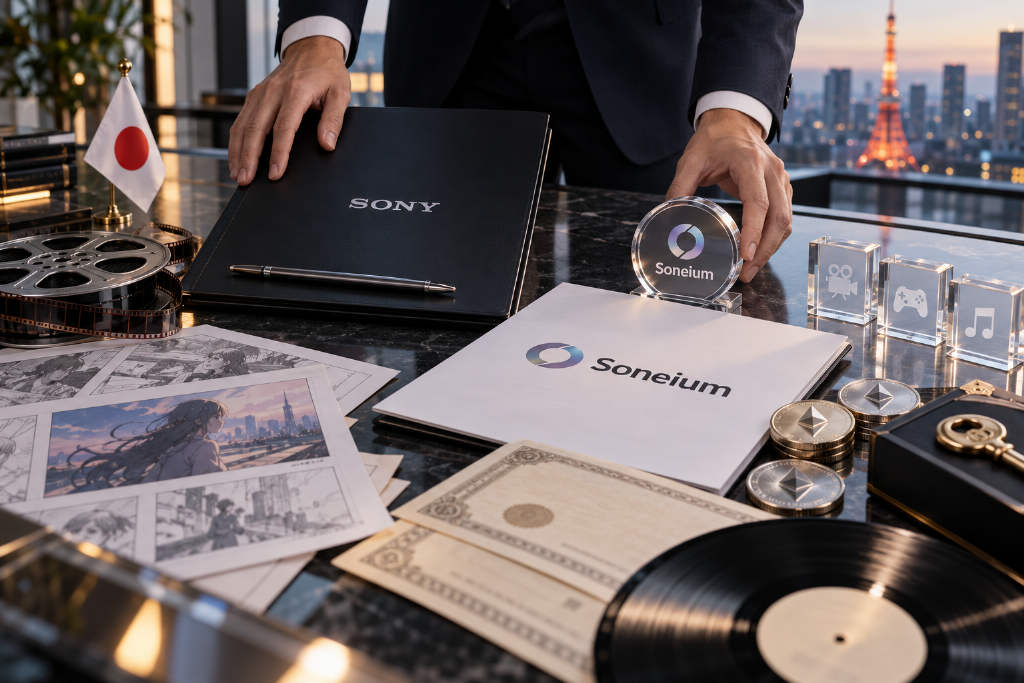
Sony-backed Ethereum Layer 2 network Soneium has disclosed plans to issue its native ecosystem token, SONEIUM. The Oct. 26 announcement came with a broader entertainment-focused roadmap built around tokenized intellectual property, or Tokenized IP.
The plan points to a clear shift in emphasis. Since launching its mainnet in January 2025, Soneium had built much of its ecosystem around games, anime, music, and consumer-facing Web3 applications. Now it is putting more weight on the intellectual property behind entertainment content, along with the revenue streams and financing needs tied to those assets.
Under Soneium’s framework, the planned SONEIUM token is meant to connect creators, rights holders, fans, developers, and investors in a shared economic network.
On-chain slowdown pushed Soneium toward IP-focused products
Soneium was originally positioned as a blockchain designed to connect Web3 applications with mainstream users. The network was introduced in August 2024 and is operated by Sony Block Solutions Labs, a joint venture between Sony Group and Startale Group. Mainnet access opened in January 2025.
At that stage, Sony Group said Web3 still faced major obstacles, including complexity for users and the lack of applications capable of attracting ordinary consumers. Soneium’s answer was to combine blockchain infrastructure with application services in a way that could open new monetization channels for creators and strengthen ties with fan communities.
On Dec. 26, 2025, Soneium published its first annual review after mainnet launch. It reported 455 million cumulative transactions, 5.3 million wallet addresses that had been active at some point, more than 3.4 million deployed smart contracts, and over 250 ecosystem applications.
By Oct. 26, 2026, the picture had changed. Daily transactions were down to about 160,000, while active addresses stood at just over 4,000. Compared with the millions of wallets accumulated over time, day-to-day usage was relatively limited.
DefiLlama data cited in the source report showed Soneium’s DeFi total value locked falling from a peak of about $203 million in May 2025 to roughly $9.4 million on Oct. 26, 2026, a drop of more than 95%. Over the same period, stablecoin supply on the network was about $6.72 million, and 24-hour decentralized exchange volume was only around $160,000.
The slowdown also showed up in the way the project described its ecosystem. Soneium had already said by the end of 2025 that it had more than 250 applications. In its latest strategy update released in October 2026, it repeated that figure without disclosing more detailed data on active apps, paying users, or ecosystem revenue growth.

Against that backdrop, Soneium’s new answer is to move deeper into IP tokenization, entertainment financing, and royalty-linked assets.
Three product lines: IP Token, IP Vault, and IP Bond
Soneium’s roadmap groups the new business into three categories.
- IP Token: issued for individual creators, studios, or specific works, potentially in the form of digital collectibles or tokens, for fan participation, community activity, and commercial expansion of an IP.
- IP Vault: aimed at entertainment investment opportunities such as music royalty funds. Investors deposit capital in exchange for rights linked to the performance of underlying royalties or entertainment assets.
- IP Bond: tokenized bonds backed by entertainment businesses, designed to finance concerts, music production, and other entertainment projects.
Together, the three products cover different stages and types of IP assets. Compared with Soneium’s earlier focus on digital collectibles, gaming campaigns, and community tasks, the new structure puts more emphasis on long-term commercial development of IP and on cash flow generated by royalties and entertainment revenue.
IP Vault is the first part of the plan to show concrete progress. On Oct. 27, Soneium said it would launch IP Vault and the stablecoin ipUSD the following day, allowing eligible users to participate in a $549 million royalty fund managed by Partners Group and supported by tokenization infrastructure provider Asseto.
The underlying assets include more than 100,000 royalty income sources tied to works by The Weeknd and Discovery’s television content library. The expected annualized yield was listed at 7% to 9%.
Moriusa and DayOneDream show two different tokenization paths
Whether an IP-centered business model can work depends first on the commercial value of the IP itself. Soneium’s early examples point to two different routes: one extends a character franchise into on-chain markets, while the other looks closer to traditional financial asset tokenization.
Moriusa: a character IP moving into Web3 markets
Soneium’s first IP Token project is Moriusa (もりうさ), a purple rabbit character created by Japanese entertainment company STPR. Moriusa had already been operating as a standalone character business since 2023, with LINE stickers, emoji packs, and original music, later expanding into music videos, manga, and merchandise.
Backed by STPR’s production capabilities and fan distribution channels, Moriusa developed into an IP with a more mature merchandise system. In 2025, the team began pushing the character into the international Web3 market.

On April 24, 2025, Moriusa released its first NFT collection on Ethereum mainnet. The collection consisted of 2,222 items priced at 0.05 ETH each, and it sold out on the day of launch. Secondary-market activity picked up quickly. The floor price reached 0.338 ETH the next day, then climbed to 0.44 ETH on April 27, equal to 8.8 times the mint price. STPR said cumulative secondary trading volume exceeded 1,400 ETH in about one month.
After Soneium announced its partnership with Moriusa, the NFT floor price rose again. An OpenSea market snapshot from Oct. 27 showed a floor price of about 0.48 ETH, with the 24-hour gain reaching roughly 43% at one point.
That makes Moriusa an example of a character business extending an existing fan base and merchandise model into an on-chain economy.
DayOneDream: bringing concert and royalty income on-chain
The second route is closer to conventional asset tokenization. On Sept. 28, Soneium entered into a partnership with South Korean entertainment company DayOneDream. The company is involved with artists and related entertainment businesses including BTOB, LEE CHAE YEON, MEMI, and 2F, and it operates the IP tokenization platform WAVIST.
The next step in that partnership is to bring royalty-related income from K-pop concert businesses onto Soneium and offer eligible participants access to entertainment asset investments through products such as Tokenized IP Bond.
This model follows a different commercial logic. Concerts and music copyrights may already have relatively mature revenue sources, including ticket sales, licensing, royalty fees, and commercial sponsorships. Compared with early-stage character IP that depends more heavily on future market enthusiasm, these assets are easier to structure around historical income, contract duration, and expected cash flow.
For entertainment companies, that creates another financing option alongside bank loans, equity financing, and copyright presales.
Soneium Portal is meant to connect discovery, subscriptions, and payouts
Soneium is also building a unified entry point called Soneium Portal. The portal will start with primary sales of IP assets, then expand into fan participation, income distribution, and other investment services. Startale App is set to serve as a broader gateway for user asset management and ecosystem applications.
The goal is to connect content discovery, product subscriptions, position management, and income distribution in one setup, reducing the need for users to move across multiple applications.

Key token details for SONEIUM are still missing
In this strategy reset, SONEIUM itself sits at the center. According to the official description, the token will link creators, IP holders, developers, fans, and investors, and provide a shared incentive layer across applications.
Still, Soneium has not disclosed total supply, initial circulating ratio, allocation structure, or the timing of its token generation event. It also has not fully explained how value capture will work. Without those details, there is little basis yet for judging the token’s practical utility.
IP on-chain is not a new idea, and the business friction remains
The bigger question is whether a blockchain-based economic system built around IP can work at scale. Over the past several years, the industry has tested multiple versions of the idea, from NFTs and music royalty tokenization to IPFi protocols.
Story Protocol is one of the better-known examples. Story proposed internet-native IP infrastructure that would let content be registered on-chain, licensed programmatically, and monetized through automated revenue sharing.
That model ran into commercial resistance in practice. In June 2026, Story said it would rebrand as DATA Foundation, rename its native token from IP to DATA, and shift its focus from broad IP licensing to infrastructure for AI training data.
In the announcement explaining that transition, the project said its 2025 business exploration had found some demand across music, entertainment, gaming, and creator tools, but most of those directions proved harder to develop than expected. Companies that control high-value music, gaming, and brand IP tend to place heavy importance on control over core intellectual property, while open and permissionless licensing frameworks can conflict with the need to protect copyright and commercial rights.
That points to a central tension in putting IP on-chain. Blockchains favor openness, composability, and permissionless use. Mature entertainment IP often derives much of its value from tight control over licensing scope, brand image, counterparties, and derivative works.
Soneium’s differences are clear, but the market still has to test them
Based on what has been disclosed so far, Soneium’s approach stands out in several ways.

First, it is starting from specific entertainment assets and concrete business demand rather than relying entirely on an open protocol model to attract content owners. Moriusa and DayOneDream both map to real entertainment properties and operating entities, and DayOneDream also has prior experience completing issuance and repayment processes for IP bonds.
Second, Soneium’s vision document says copyright ownership and creative control remain with the original rights holders. What is issued on-chain is participation exposure tied to the future economic value of a work. That is closer to traditional copyright financing and securitization of revenue rights: rights holders can raise capital while keeping control over development, licensing, and brand use.
Third, Soneium benefits from shareholder ties and partnership networks that are closer to the entertainment industry. Sony Group’s long-running businesses in music, film, and gaming give the project a base for reaching industry resources, understanding copyright business models, and building corporate relationships.
Even so, a Sony connection does not automatically mean Sony-owned IP will move into the Soneium ecosystem. Sony Music, PlayStation, and Sony’s film businesses each have their own commercial and rights-management systems, and there is no indication that those core assets will be opened directly to SONEIUM or Tokenized IP products.
There are also unresolved business issues in entertainment asset tokenization itself. Mature IP owners already have access to issuance channels, licensing deals, loans, and equity financing. If on-chain financing is going to attract them, it needs to offer real advantages in funding cost, issuance efficiency, access to global investors, or payout settlement.
For investors, entertainment assets are also more complex than standardized financial products such as government bonds. Tokenization may improve record-keeping and distribution efficiency, but it does not remove operating risk.
There is another split as well: fans and investors do not participate for the same reasons. Fans may support a work out of emotional attachment, while professional investors focus on cash flow, valuation, and exit mechanisms. How that boundary is managed will shape market acceptance for both IP Token and IP Bond.
Soneium’s token launch plan has brought fresh attention to the network. The larger test is whether this on-chain entertainment economy can create a lasting connection between existing revenue in the entertainment industry and blockchain-based capital.



