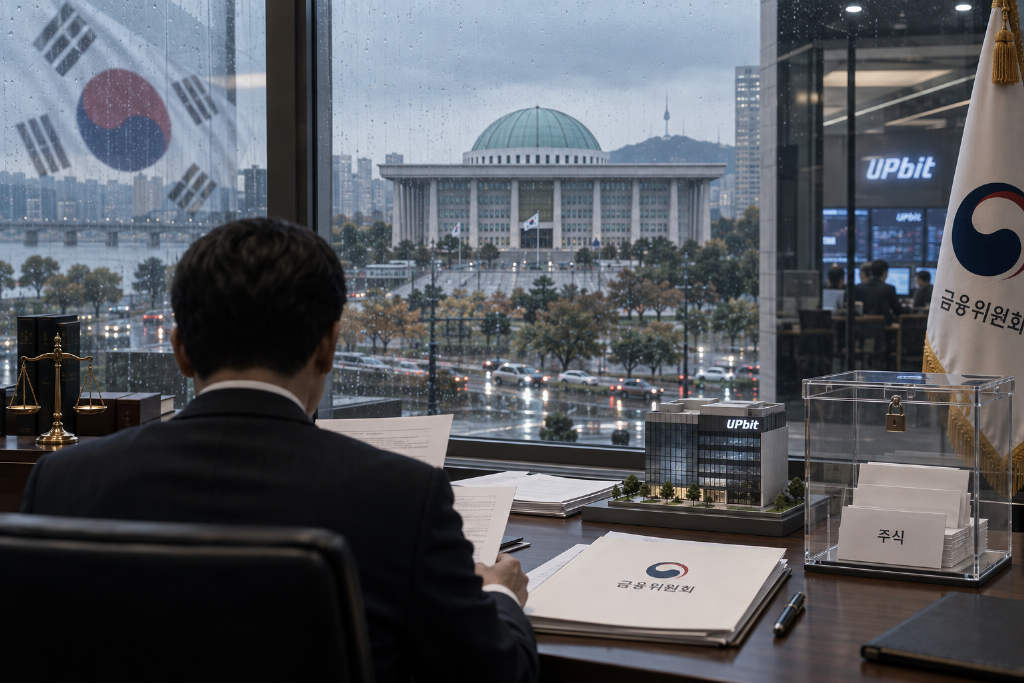
South Korea’s Financial Services Commission Chairman Lee Eok-won said a proposed cap on major shareholders of virtual asset exchanges in the country’s pending Digital Asset Basic Act was not introduced at the direction of any specific person. According to Yonhap News Agency, Lee said the provision reflects the higher level of public responsibility that exchanges would be expected to bear once they move into a more formalized regulatory framework.
Speaking during a parliamentary audit of the FSC at the National Assembly’s Political Affairs Committee, Lee said South Korea’s virtual asset exchanges currently operate under a reporting system that must be renewed every three years. Once the Digital Asset Basic Act takes effect, he said, exchanges would shift to an institutionalized licensing regime. In his view, exchanges have infrastructure-like characteristics and should therefore meet a level of public accountability and responsibility consistent with that role.
The remarks came after a lawmaker questioned whether the shareholder restriction clause had been added under outside influence, noting that the FSC’s earlier draft did not include such a provision. The lawmaker also said that if the rule were enforced, major shareholders of Korean exchanges and potential acquirers could be forced to sell shares worth trillions of won. Lee responded that the government is still drafting the bill, that the exact shareholder cap can be adjusted during parliamentary review, and that the government’s version of the Digital Asset Basic Act is in final coordination before submission, though no timeline was disclosed.
South Korea’s Financial Services Commission Chairman Lee Eok-won said a provision in the proposed Digital Asset Basic Act that would limit holdings by major shareholders of virtual asset exchanges was not introduced at the instruction of any specific person, according to Yonhap News Agency.
Lee said the clause was included because exchanges would be expected to take on greater public responsibility once they are brought into a more formalized regulatory system.
Speaking during a parliamentary audit of the FSC at the National Assembly’s Political Affairs Committee, Lee said South Korea’s virtual asset exchanges currently operate under a reporting system that is renewed every 3 years. After the Digital Asset Basic Act takes effect, he said, exchanges would move to an institutionalized operating model that requires a license.
He added that exchanges have the characteristics of infrastructure and should therefore carry a level of public nature and responsibility that matches that status.
Earlier, a South Korean lawmaker questioned whether the shareholder restriction clause had been influenced by outside parties, noting that the FSC’s original proposal did not contain such a provision. The lawmaker also said that if the measure is enforced, major shareholders of Korean exchanges and potential acquirers may need to sell shares worth trillions of won.
In response, Lee said the government is still drafting the bill and that the specific details of the shareholder limit can be further adjusted during parliamentary deliberations. He also said the government’s draft of the Digital Asset Basic Act is in final coordination and will be submitted as soon as possible, but did not provide a specific date.
This article was originally published by Bit.Fan. For more cryptocurrency news and market insights, visit www.bit.fan. Disclaimer:
The market information, project data, and third-party content displayed on this platform are for industry information sharing only and do not constitute any form of investment advice or return commitment.
Cryptocurrency trading carries high risks. Users should fully assess their risk tolerance and make independent decisions. All profits, losses, and legal responsibilities are borne by the users themselves.