
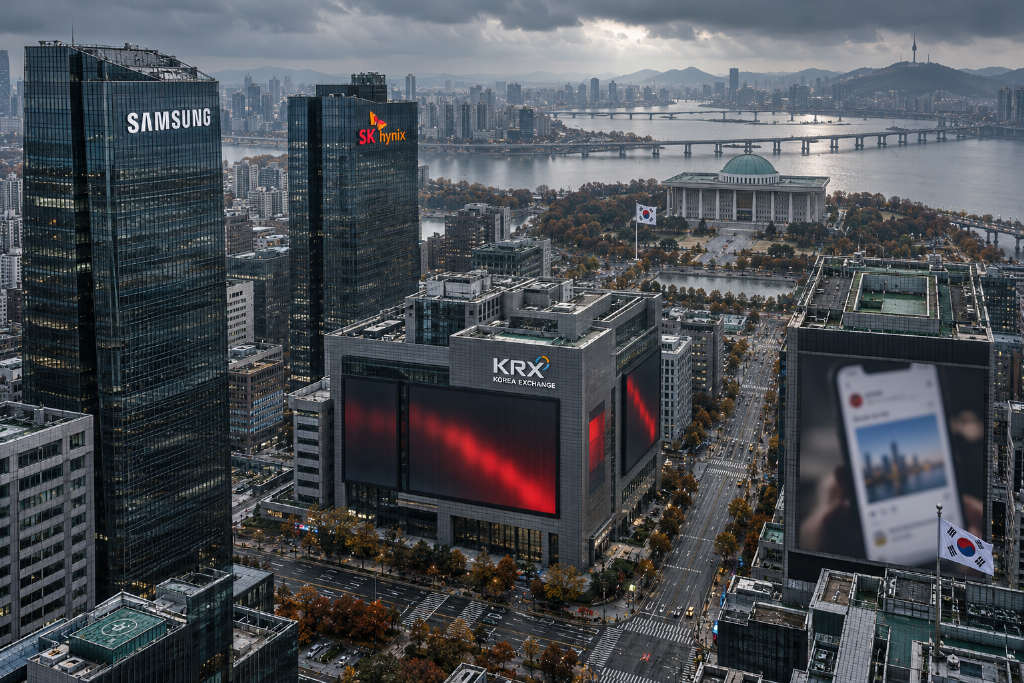
South Korean stocks got slammed in one of their nastiest selloffs of the year on Oct. 15. The Korea Composite Stock Price Index, or KOSPI, dropped 7.57% and finished at 5,554.22, marking a seventh straight trading day of losses. Across those seven sessions, the index is down more than 20%.

Foreign investors dumped semiconductor heavyweights such as Samsung Electronics and SK Hynix, and both of South Korea’s main stock markets hit intraday circuit breakers, stopping trading for 20 minutes. Seoul Economic Daily said roughly KRW 1,193 trillion in KOSPI market value disappeared in only seven trading days.
Chip stocks lead the decline
The selloff was centered on chip shares. On Oct. 15, Samsung Electronics tumbled 9.48% to KRW 210,000, while SK Hynix fell 11.06% to KRW 1,262,000. For both stocks, it was the biggest one-day drop since late July.
The damage piled up fast. Since Oct. 2, Samsung Electronics has fallen about 24%. SK Hynix, after seven straight losing sessions, has dropped a cumulative 31%. In just one day, foreign investors were net sellers of about KRW 2.57 trillion combined in the two companies.
The report said the selloff shows growing doubt about whether AI infrastructure spending can keep producing profits. And there was another hit: rising expectations for higher interest rates after U.S. inflation data came in hotter than expected. Investors are also tracking fears that expansion by Chinese memory maker ChangXin Memory Technologies, or CXMT, could alter global memory supply and demand and hurt the long-term pricing power of South Korean chipmakers.
At the same time, the stronger-than-expected U.S. inflation figure forced investors to rethink the chance that the Federal Reserve may keep rates elevated or even push them higher. For AI-related businesses that lean heavily on capital spending, company financing, and future growth assumptions, pricier funding can weigh directly on valuations.
Lee Jae-myung’s post spread during the market slump
South Korean President Lee Jae-myung wrote on X on Oct. 14: “Stay alive. No matter what, stay alive. If you are in pain, call 109. We will help you find a reason to keep living.” The timing mattered. Korean stocks had already been falling for days, so the message landed harder in an already grim market mood.
But it was not originally about the stock market. The report said Lee was referring to news that South Korea’s suicide death toll this year had dropped by more than 10%. He used the post to promote suicide prevention and mental health support resources, not to send a warning to stock investors.
South Korean government data showed suicide deaths in the first half of 2026 fell 11.8% from a year earlier. Officials saw a drop in cases linked to economic hardship as one reason for the improvement. That was the backdrop when Lee urged people struggling to ask for help.
Dark humor and memes spread online
As chip shares drove the plunge, retail investors did what they often do. They turned to jokes online. One South Korean user drew a cute guitar-playing character over a sharply falling stock chart and added the caption, “The stock market could use a little Chiikawa too.” The post spread widely.
The meme became one of the more recognizable social media responses to the selloff. The report said a run of falling candlesticks was reworked into the outline of a character, giving frustrated investors an ironic way to react to the market.
K-pop idols also entered the conversation
The market slump even spilled over into K-pop fan communities. According to fan retellings cited in the report, NMIXX member Sullyoon jokingly wrote on the paid fan platform Bubble: “If you open your securities app today, you’ll see me there. Just look at my photo and exit. This isn’t possessiveness. I’m thinking about NSWER’s feelings, haha.”
ITZY member Chaeryeong, also under JYP Entertainment, came up again as the market fell. She had previously said she invested in JYP Entertainment, or JYPE, stock and at one point was up nearly 30%. Later, on Lee Young-ji’s show, she joked that because of the weak economy, she planned not to open her stock app for three years.
So with South Korean stocks dropping hard again, that old comment is making the rounds once more. The report closed by saying Chaeryeong’s “don’t look at the market for three years” method now sounds, at least emotionally, more useful than many investors’ stop-loss strategies.