

South Korean stocks fell sharply on Thursday, with the KOSPI down more than 4% to 6322.55 at the time of writing. SK Hynix dropped more than 8% and Samsung Electronics fell more than 5%. In Hong Kong, the South Korea-related leveraged products Nanfang 2x Long Hynix and 2x Long Samsung fell more than 15% and 11%, respectively.
Weak reaction to storage guidance in the U.S. spilled into Asia
The immediate trigger came from the U.S. storage sector after Wednesday’s market close in New York. SanDisk and Western Digital both released their latest earnings reports.
Their results for the previous quarter were stronger than expected, but guidance for the current quarter did not match Wall Street’s more aggressive growth expectations. SanDisk said it expects next-quarter revenue of $10.3 billion to $10.8 billion, below the analyst estimate of $11.16 billion. Western Digital projected revenue of $4.0 billion to $4.2 billion for the next quarter, slightly above the analyst estimate of $4.04 billion.
That left investors focusing less on the strong past quarter and more on the softer forward outlook. After the earnings release, SanDisk fell more than 8% and Western Digital dropped more than 11%.
Foreign flows turned negative as chip names came under pressure
The weak tone in U.S. storage stocks quickly spread through the supply chain into Asia. When trading opened in South Korea on Thursday, SK Hynix and Samsung Electronics faced heavy selling pressure.
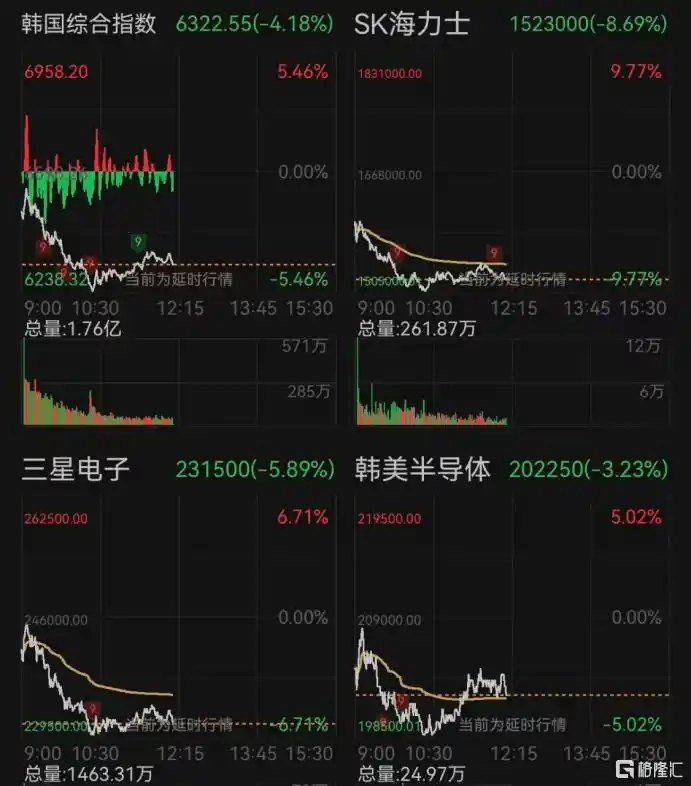
Data showed that foreign investors had been net buyers of KRW 1.4513 trillion worth of shares on the Korean composite market through the previous trading day. On Aug. 6, however, they turned into net sellers of more than KRW 500 billion in that market.
Han Ji-young, a researcher at Mirae Asset Securities, said that although geopolitical and macro conditions had improved, weakness in the Philadelphia Semiconductor Index and profit-taking after a rapid short-term rise in share prices made a phase of consolidation and sector rotation likely.
Han added: “The unusually amplified volatility seen during the July sell-off has already passed its peak.”
Presidential office says officials are reviewing all scenarios
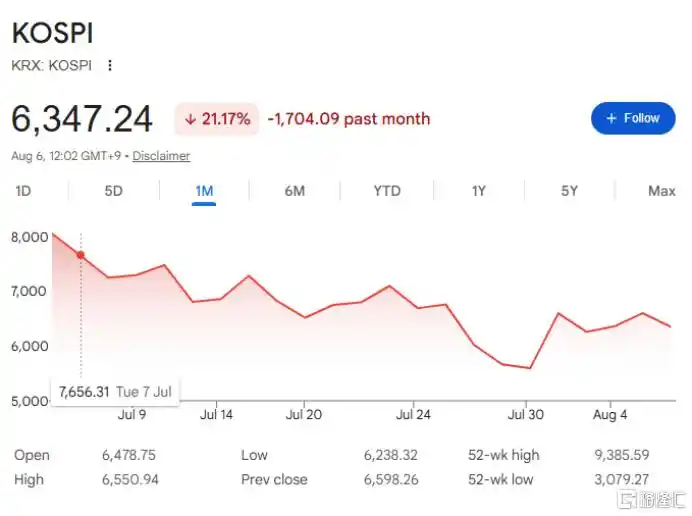
After rising to a record high on June 19, South Korean stocks have moved lower in a volatile pattern. Over the past month, the KOSPI has fallen 21.17%.
As market swings intensified, the South Korean government moved to address the situation. Earlier, Kim Yong-beom, head of policy at the presidential office, faced criminal accusations over the rushed introduction of leveraged ETFs.
Responding to that issue, Seong Gi-hong, senior secretary for public relations and communication at the presidential office, said the more pressing task now is to closely monitor market conditions and prepare corresponding measures.
He said: “All relevant officials at the presidential office are carefully reviewing every possible situation and are studying with great caution how related measures should be designed.”
Tighter rules hit leveraged ETF trading
Last Friday, South Korea’s financial regulators raised the minimum cash margin requirement for single-stock leveraged ETFs. After those restrictions were introduced, trading volume in Korean leveraged stock ETFs dropped sharply.

According to the latest figures from the Korea Exchange, the average daily trading value of 16 single-stock leveraged ETFs fell to KRW 919.8 billion on Wednesday. That was the first time the figure had dropped below KRW 1 trillion since the products were listed on May 27.
Brokerages and banks differ on what comes next
Morgan Stanley said the violent leverage washout was nearing its end and that KOSPI valuations had dropped to historically low levels, creating a more attractive entry point for investors.
CITIC Securities took a different view. The firm said leverage among South Korean retail investors had been reduced quickly, but margin balances were still shrinking at the fastest pace of the year and forced-liquidation rates remained well above normal levels. In its view, market volatility is still likely to stay elevated.
Analysts also said that after a long bull market, the global memory semiconductor sector has entered a phase of high sensitivity and high volatility, and that the short-term sentiment shock will take time to absorb.
On a medium- to long-term basis, Goldman Sachs maintained a 12000 target for the KOSPI and said the market still had roughly 80% to 90% upside. The bank said current pricing does not reflect what it sees as a severe memory chip shortage that could last through 2030. As AI computing demand accelerates, it said the semiconductor sector, which accounts for more than 50% of the KOSPI by weight, could become a global earnings engine.
JPMorgan also kept a constructive view on SK Hynix and the memory chip sector, treating the current pullback as a buying opportunity.
This article was sourced from the WeChat account “Gelonghui APP” (ID: hkguruclub), written by Gelonghui editors.