
S&P Dow Jones Indices and digital asset investment firm Pantera Capital have launched the S&P Pantera Digital Asset Index, a benchmark built around observable and sustainable protocol revenue. The index is intended to give institutional investors a more systematic and transparent way to approach digital asset allocation.
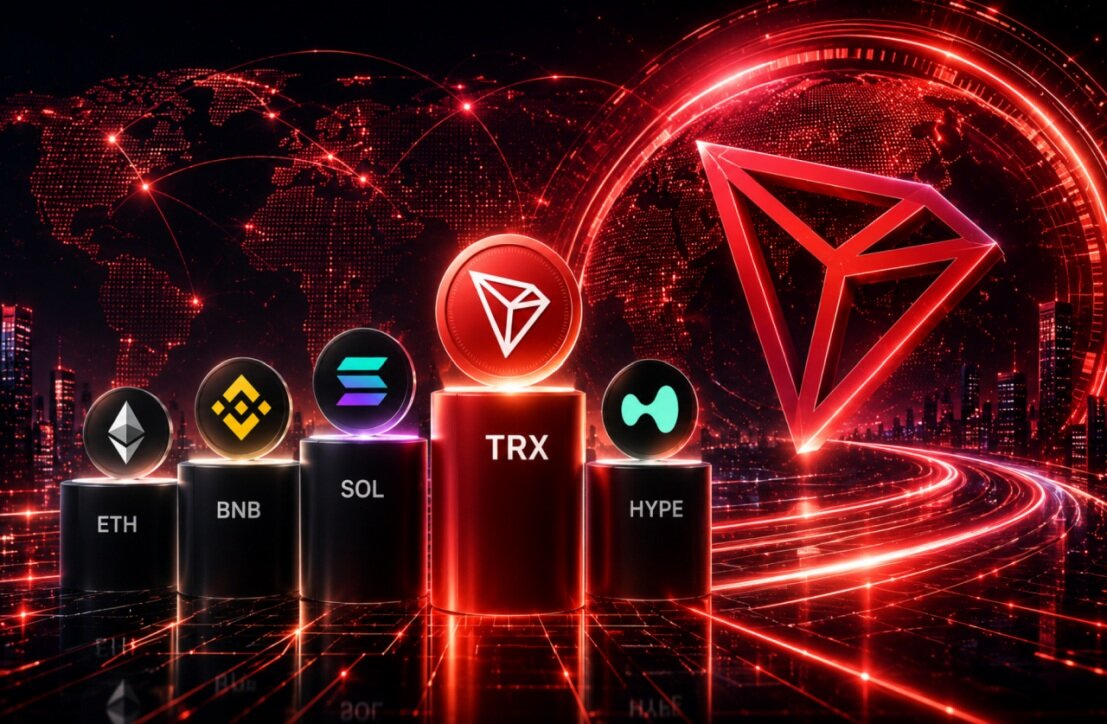
TRON’s native token, TRX, was selected for inclusion and placed among the index’s five largest weighted constituent assets alongside Ethereum, BNB, Solana and Hyperliquid. The source says TRON’s selection comes against a backdrop of more than $90 billion in USDT issued on the network, 4 million daily active users and what it describes as steady protocol revenue.
A benchmark centered on protocol revenue
Unlike crypto benchmarks that lean mainly on market-cap weighting or token-price performance, the new index uses protocol revenue as a core screening and evaluation metric. In the source article, that shift is presented as a move away from narrative-driven valuation and toward an approach that puts greater weight on fundamentals and measurable value.
Under the methodology described in the report, the index draws its candidates from the S&P Cryptocurrency Broad Digital Asset Index. Only assets that meet minimum thresholds for protocol revenue, market capitalization and liquidity are eligible. Those assets are then ranked by cumulative protocol revenue over the previous two quarters and weighted by adjusted market capitalization. The largest single holding is capped at 35%, while the other constituents are generally capped at 20%. The index is rebalanced once every quarter.
S&P said the rules-based framework was designed for institutional allocation. The report says it is meant to separate “proven, mature blockchain activity” from “speculative exposure,” and can serve either as the basis for investment products or as a reference point for actively managed portfolios.
18 assets at launch, with TRON in the top tier
According to the official S&P Dow Jones Indices blog cited in the article, the index debuted with 18 constituent assets. TRON ranked among the five most important holdings. Under this protocol-revenue-first structure, Bitcoin (BTC) and XRP were described as among the most notable exclusions relative to the broader index.
The article frames that outcome as evidence that TRON’s standing did not come from market narrative alone, but from recurring and quantifiable on-chain revenue and network usage. It also says TRON has remained near the top of the industry in stablecoin settlement, daily active addresses and transfer count, and presents its inclusion by S&P as recognition from a major traditional financial institution.
Stablecoin scale and network activity were key points in the report
The source material says USDT issued on TRON has surpassed $90 billion. In 2025, the network processed about $7.9 trillion in USDT transfers, while average daily USDT transfer volume stayed above $20 billion. It also says TRON handled roughly 65% of global retail USDT transfers below 1,000 yuan.
The report adds that TRON’s roughly 3-second block confirmation time and low transfer costs have helped make it a dollar-transfer channel in emerging markets including Latin America, Africa and Southeast Asia. Those figures and usage patterns are presented as part of the explanation for why TRON ranked strongly in an index that prioritizes revenue.
Expansion into AI-related payment infrastructure
Beyond stablecoin settlement, the article also focuses on TRON’s AI-related plans. It says that as AI moves toward the era of autonomous agents, conventional bank accounts are not well suited to high-frequency, small-value settlement that does not require manual authorization. In that setting, TRON is described as extending its high-throughput, low-cost payment network into AI use cases.
According to the source, TRON has established and expanded an AI fund to $1 billion. The fund is focused on agent identity systems, micropayment settlement and on-chain computing services. The article also names B.AI within the TRON ecosystem as an early example of AI agents using cryptographic on-chain wallets to pay for access to leading large language models worldwide.
The report says TRON is building a flywheel that runs from cross-border remittances for human users to decentralized, high-frequency payments and resource calls for AI agents. It argues that this combination of real payment demand and AI development has supported substantial and steady protocol revenue, pushing TRON beyond its earlier role as a payment rail and toward a broader value-transfer infrastructure.
Index inclusion seen as another signal from mainstream finance
In its closing section, the article says that as spot ETFs, multi-asset crypto index funds and AI-plus-Web3 ecosystems gain traction, public blockchains with real revenue, network utility and forward-looking product development may draw more institutional attention.
Within that framing, TRON’s inclusion in the joint index from S&P and Pantera Capital is presented as another endorsement from mainstream traditional finance of the network’s fundamentals and longer-term prospects.