
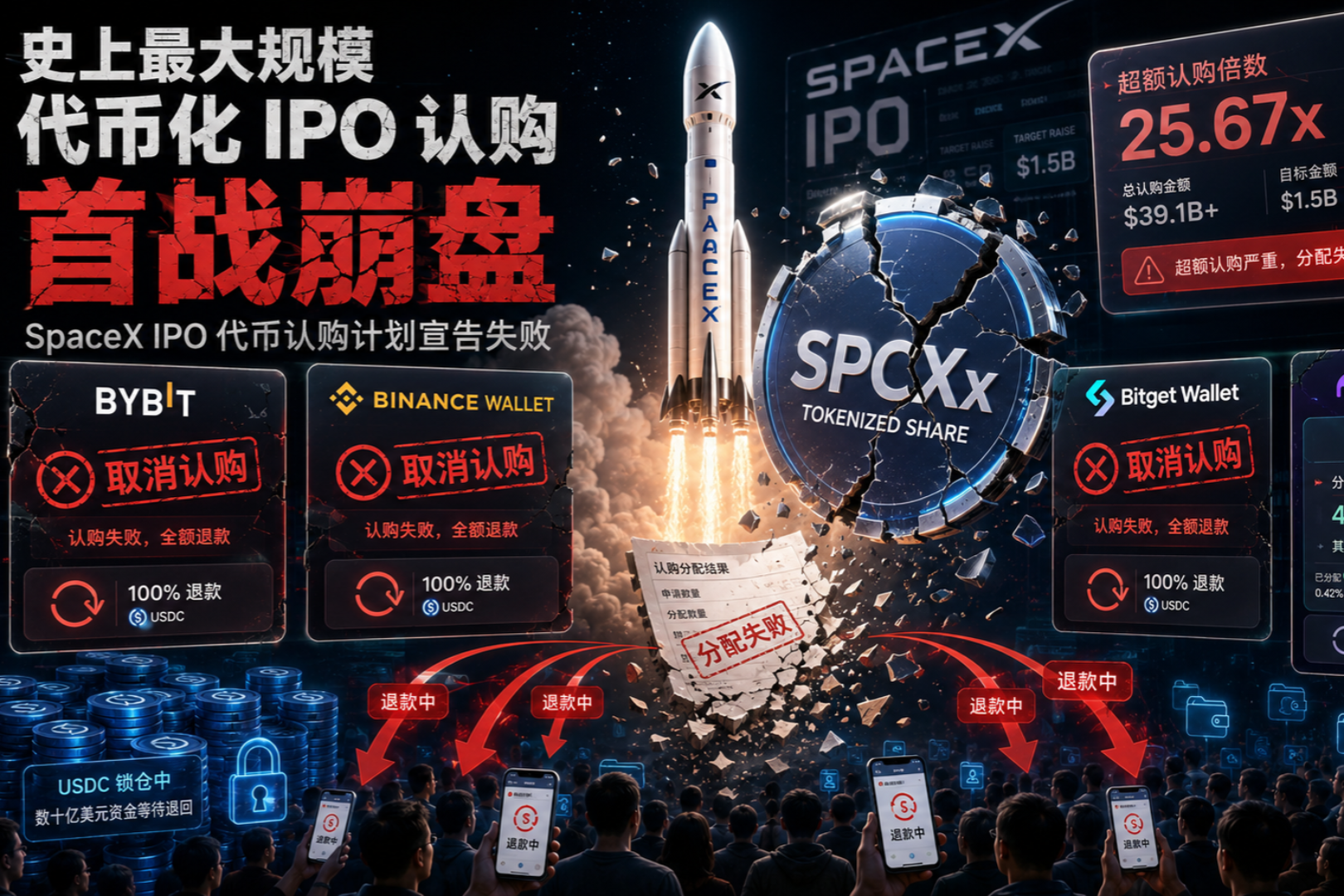
On June 12, 2026, SpaceX listed on Nasdaq at an offering price of $135 per share under the ticker SPCX. The company raised $75 billion, setting a financing record in IPO history. After the opening bell, SPCX briefly traded above $170, more than 25% higher than the offer price. While the traditional financial market celebrated the debut of a trillion-dollar-scale IPO, the crypto industry’s first large experiment in using tokenized structures to open IPO access to retail users ran into a broad allocation failure.
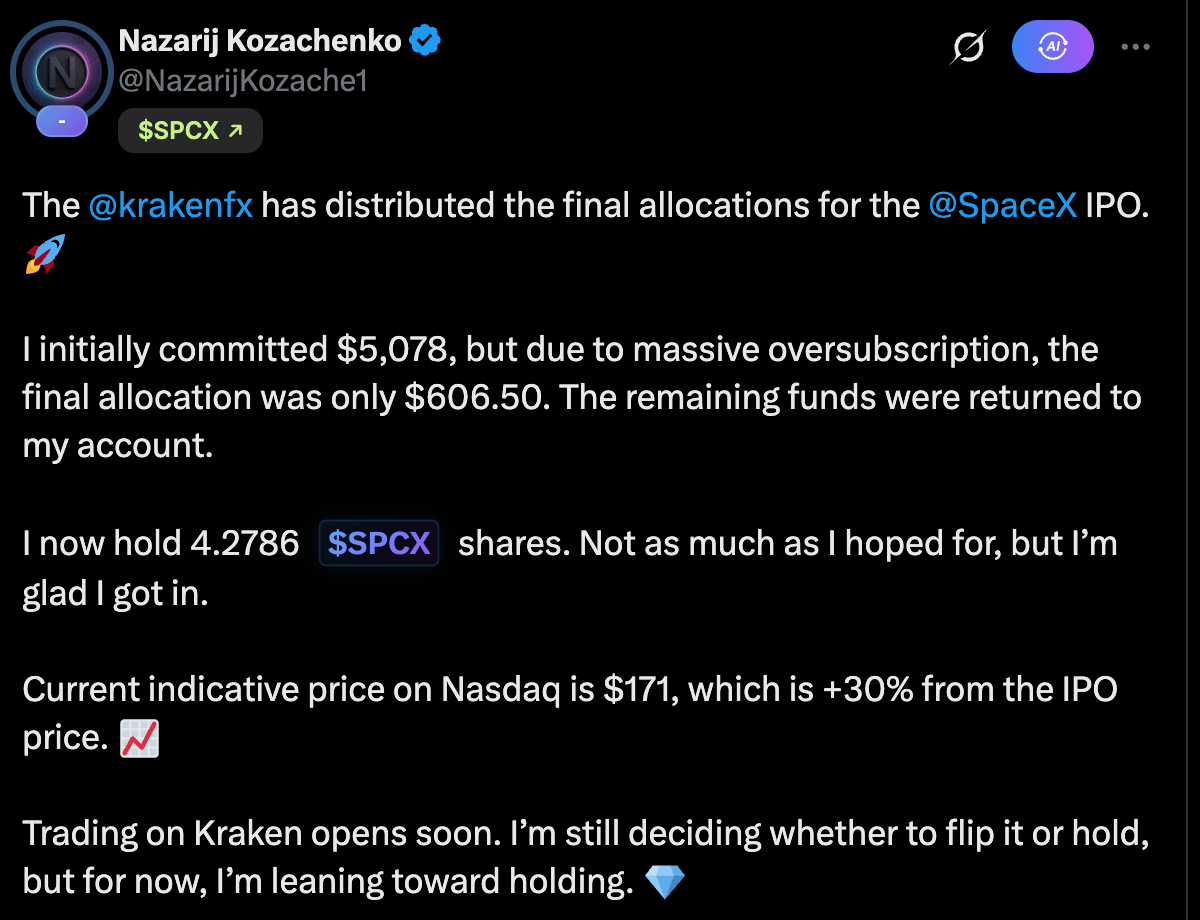
Bybit, Binance and Bitget Wallet all announced cancellations and full refunds for their related campaigns. Kraken, which many users had viewed as the more credible route because of its connection to xStocks, also disappointed participants: according to community feedback, many successful subscribers received only about 4.2786 SPCXx tokens regardless of how much they had committed. At the $135 offer price, that allocation was worth roughly $578 to $606, with the remaining funds returned.
xStocks was the key infrastructure behind the campaigns
The core infrastructure in this episode was xStocks, a tokenized equity framework issued by Backed Assets (JE) Limited, a company under Payward Services, the parent company of Kraken. The xStocks design aims to match each token 1:1 with an underlying real share, with the actual shares custodied by a regulated broker. Kraken was the first to launch SpaceX IPO Access on June 5, using the token code SPCXx and opening subscriptions to verified users across more than 110 regions.
Bybit followed on June 7 with its IPO Express product and made the SpaceX subscription its first listed target. The indicative price was set at 135 USDC, with an additional 5% underwriting fee. Each user could subscribe for a minimum of 100 USDC and submit up to 50 subscription orders. Binance then launched an SPCXx subscription under the name of its “first IPO Campaign.” Bitget Wallet also rolled out a similar product through the xStocks framework on Solana, initially setting a $3 million quota. Due to strong demand, the quota was quickly expanded to $13 million, and the product became four times oversubscribed within 30 minutes.

Underlying share delivery fell short, leading to refunds
On the same day that SpaceX formally listed on Nasdaq, multiple crypto platforms said the actual underlying share allocation obtained by xStocks from the underwriters was far below expectations and could not be delivered to platforms in line with demand. Bitget stated on X: “The xStocks team made every effort to secure allocations, but ultimately could not fulfill them as expected.” Bybit also confirmed on X that because xStocks could not deliver the underlying assets, Bybit did not receive any SpaceX share allocation. It said all subscription funds would be automatically refunded 100% to the original accounts, and eligible participating users would receive compensation rewards at an approximately 10% annualized rate.
Binance, Bitget and Bybit then announced cancellations, full refunds and additional compensation for affected users. On-chain data showed that within 28 hours of the start of Binance’s SPCXx subscription campaign, about $557 million in USDC subscription commitments came from 27,689 wallet addresses. More than 81% of addresses made a single subscription of no more than $20,000, while 114 addresses each staked at least $500,000. After canceling the campaign, the exchange said it would fully refund the locked USDC and airdrop a total of $1 million worth of bStocks SpaceX tokens, SPCXB, to all participating users, with arrival expected before June 18.

Kraken users reported nearly fixed allocations
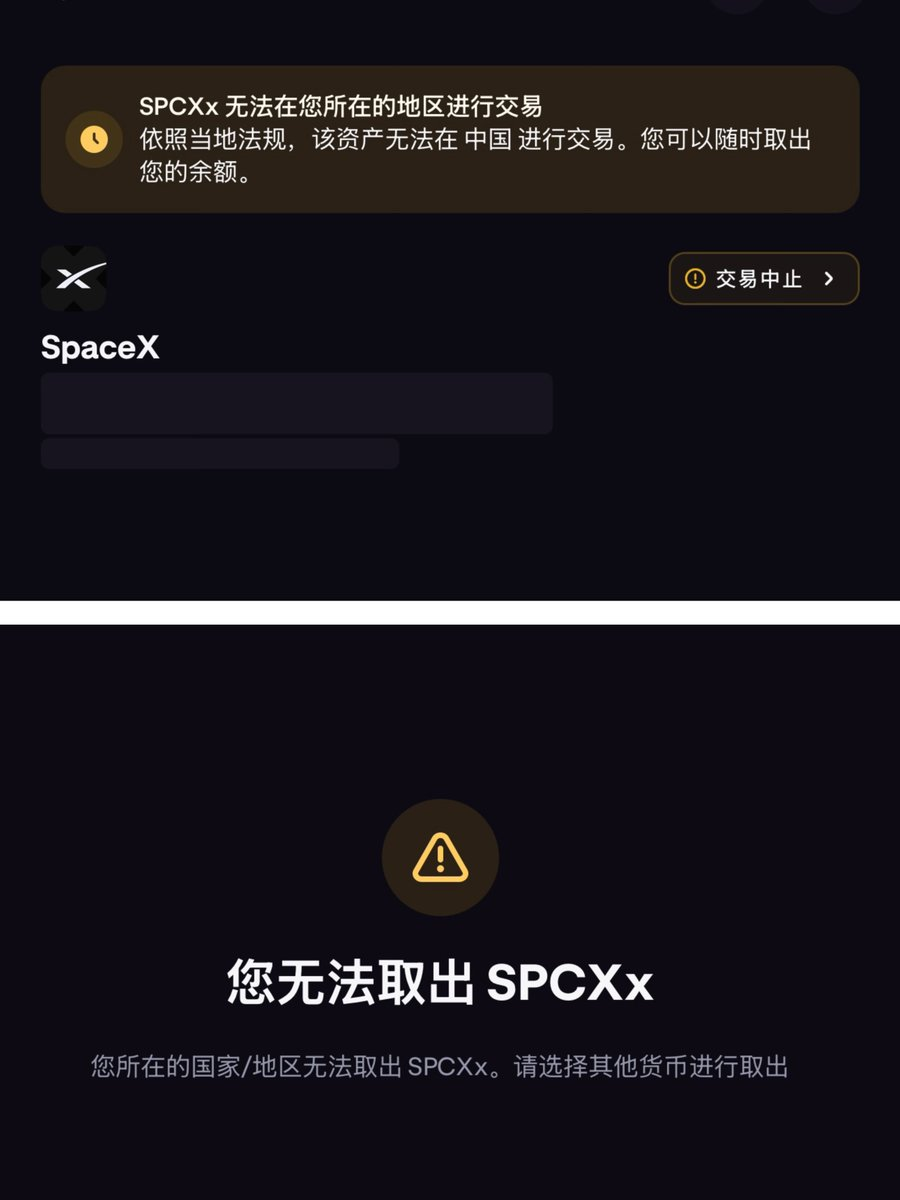
Kraken, the exchange associated with xStocks, also faced negative feedback. Community reports indicated that successful Kraken subscribers mostly received a fixed allocation of 4.2786 SPCXx tokens regardless of the amount they had invested, while the rest of their funds were refunded. Kraken has not officially confirmed that figure. At the same time, some mainland Chinese users who received allocations said the app page showed that they could not trade SpaceX stock fractions because of regional restrictions, meaning the roughly four shares obtained through the subscription could not be sold smoothly.

Kraken explained on its support page that IPO allocation rights belong to the underwriters. Allocations may be distributed on a pro rata, random, tiered or relationship-based basis, and partial allocations or even zero allocations can occur in high-demand environments. After the incident spread, Chinese-language users on X, formerly Twitter, posted screenshots and complaints. Kraken user @joeylu0627 wrote: “For me, I put in 200,000 U and eventually got 4.2786 shares of SPCX (worth about 700 dollars), and the rest was refunded. Luckily I didn’t lose money, but I only used a large amount of capital to earn a tiny bit…”
User @jijioulei33190 used stronger wording: “Whether you put in 1,000 U or 100,000 U, everyone gets 4.2 shares of SpaceX… Chinese-region users got the stock, but I ** cannot trade it, can only buy and cannot sell?” Overseas user @MengLayer, also known as Chen Xiaomeng, posted a screenshot showing SPCXx being swapped back into USDC on Kraken Pro and wrote: “One million in the subscription, earned 60 U, I’m really amazing.” He also cited another user’s complaint: “If it rises, they refund you; if it falls, they give it to you.” Some users also speculated that it was even possible that “because the value of the allocation rose, the users’ allocation was taken privately.”

Gate users received allocations, but the upstream bottleneck remained
Not every crypto platform ended with refunds only. Gate.io also had actual share allocations. User @px521com2 posted a detailed subscription bill: “Sesame (Gate) subscribed 5,786 dollars → 5,557 dollars refunded → sold for 268 dollars, profit 39 dollars; together with the Kraken portion, today’s total net profit is 127 dollars. In today’s crypto market, where ‘90% of people are cursing,’ being able to pick up 127 dollars already makes me very satisfied.” Compared with Kraken’s “4.2 shares per person” fixed-style allocation, Gate’s pro rata allocation mechanism gave some users more room to actually sell and realize gains.
Kraken emphasized that the allocation shortage came from the underwriters’ distribution decisions rather than a platform technology or operating issue. In other words, the problem was not whether tokenized stocks could be issued, settled or displayed on-chain. The real issue was that crypto platforms did not control the upstream resources of IPO placement. SpaceX issued approximately 555.6 million shares at $135 per share in this offering, raising about $75 billion and reaching an implied valuation of $1.75 trillion, setting a global IPO financing record. With extremely high retail subscription demand, the demand aggregated by crypto platforms far exceeded the quota they could obtain from the traditional underwriting system.

In this SpaceX IPO event, most crypto retail users ultimately did not get a meaningful seat at the table. The large-scale trial of so-called “on-chain IPO” access showed that demand from users had already gathered, while the supply side remained in the hands of the traditional financial system. Unless allocation sources, underwriting relationships and asset delivery capabilities are connected, a smooth on-chain entry point alone cannot change ordinary retail users’ position in the IPO allocation chain.