

The key rule is simple: the party closest to user funds is the party closest to the matching regulatory duty.
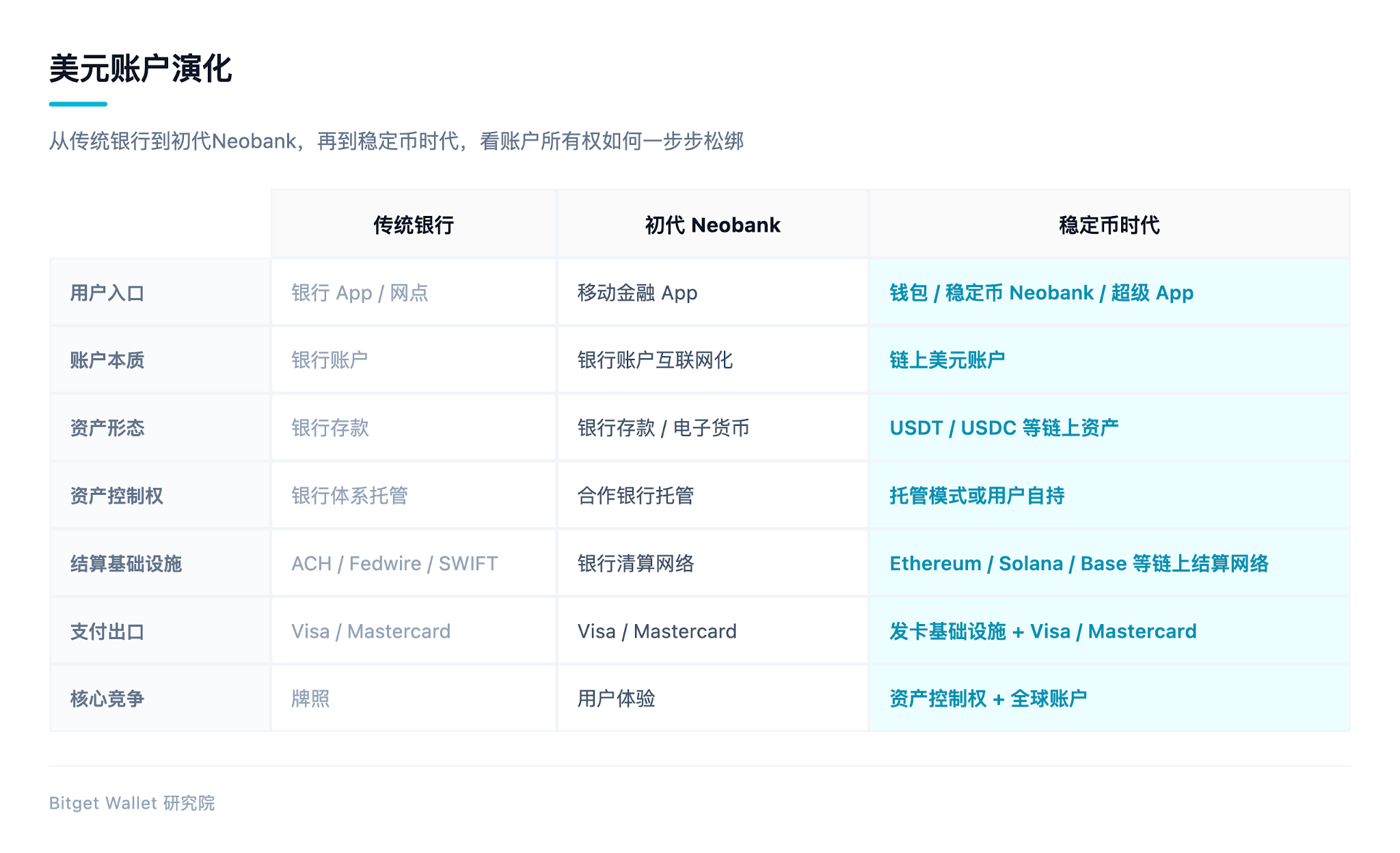
In a TechFlowPost article, Bitget Wallet researcher Emily Sun argues that the question of who owns an account barely existed in the traditional financial system because the answer was built in from the start: the bank did. A user could see a balance, but under law and regulation the real owner of the account structure was the bank. A bank account was a debt-based financial account issued by a bank and recognized by the regulatory system. The bank obtained the right to use the funds; the user held a claim on the deposit; and the bank, as the licensed institution, had to meet capital, segregation and supervisory requirements.
Stablecoins, she writes, were the first instrument to pull apart two functions that had long been bundled together: custody of funds and bank-style regulatory oversight. Once dollars could exist as USDT or USDC in a blockchain address instead of on a bank balance sheet, the ownership question stopped having a single default answer. That shift, in Sun’s telling, is structural rather than technical. What had once been settled in advance became an open design problem that each company now has to answer for itself.
KAST brought the ownership question into the open
Sun frames the July 2026 dispute over KAST’s terms of service as the first moment this problem was exposed in plain view. On the surface, the controversy looked like a wording issue in a legal document. When a user topped up stablecoins into the card account, the transfer was defined not as a deposit but as a “sale.”
She argues that reading the episode as a public-relations mistake misses the larger point. KAST’s terms, in her view, were answering a far more important question: who owns the next generation of dollar accounts. The answer embedded in that structure did not match what many users likely assumed. Once the terms were examined, the broader industry was forced to confront something that had been unresolved all along: nearly every company calling itself a neobank had already chosen an answer through product design, even if users had not noticed.
That leads to the article’s central issue. Once dollar accounts move outside banks, who actually owns them?
Why dollar access starts as a survival problem in many markets
Sun says a typical answer in the U.S. to the question of why someone needs a dollar account would be familiar: payroll, rent, stock investing. The account sits in the background of daily life. In much of the rest of the world, she writes, the function is very different. The problem is not portfolio management. It is survival.
Argentina is one of her clearest examples. In 2023, the country’s inflation rate rose above 200%, according to the article. In that environment, a household that kept wages in local currency for more than a few days could see purchasing power erode quickly, so converting income into dollars became an immediate priority. Nigeria, she writes, illustrates a different version of the same logic. With official and parallel exchange rates coexisting for extended periods, importers struggled to obtain enough dollars through formal channels, which pushed USDT into use as a de facto trade settlement instrument.
Sun cites Chainalysis rankings that have placed Nigeria among the world’s most active crypto markets for several years. In her telling, that activity was not mainly speculation but a response to real dollar scarcity. The common lesson from Argentina and Nigeria is that when local money cannot be held reliably, people build their own route to dollars. Once that route reaches scale, businesses emerge to serve it.
Another source of structural demand has been growing inside the internet economy itself. Sun points to World Bank and International Labour Organization statistics showing that India, the Philippines, Pakistan and Bangladesh have become major exporters of digital labor. Programmers, designers and freelancers in those markets earn dollars through Upwork, Fiverr or direct work for overseas SaaS companies, yet their payout rails remain stuck inside local banking systems.
One Philippine designer may wait several days for a U.S. client payment to arrive, she writes. A Pakistani developer may lose more than 5% to receive a cross-border transfer. The article cites World Bank estimates that global personal remittances reached about $905 billion in 2024, including roughly $685 billion in officially recorded flows to low- and middle-income countries. Those transfers still take days on average, with average fees around 6% globally.
For Sun, the contradiction is clear. Labor has been globalized for close to two decades. The account infrastructure has not.
Why banks left a gap for the first wave of neobanks
The article asks why banks did not simply step in and satisfy this large, durable demand for dollar access. Sun’s answer is not that banks lacked interest. It is that their cost structure was built country by country, while internet-era dollar demand appears globally. Each additional jurisdiction brings another stack of KYC obligations, anti-money-laundering checks, foreign-exchange controls and capital requirements. Those costs are hard to spread across a freelancer earning a few hundred dollars a month or a household making routine conversions in Argentina.
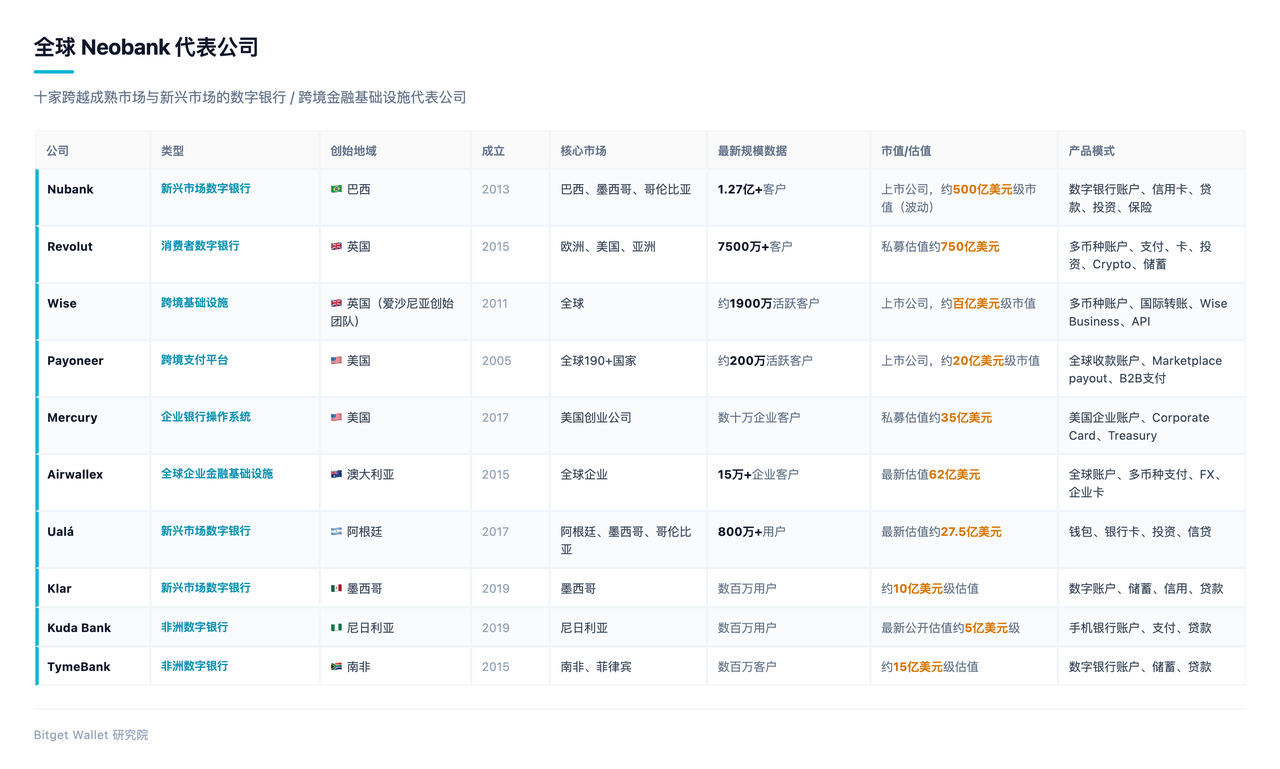
That mismatch created the opening for the first generation of neobanks, including Nubank, Revolut, Wise, Payoneer and Mercury. Sun describes them as companies that did not reinvent the dollar so much as repackage bank access.
- Wise broke one cross-border transfer into two domestic transfers and used a global account network to net flows against each other, reducing dependence on the correspondent-banking model.
- Payoneer partnered with licensed U.S. banks, allowing freelancers around the world to remotely apply for a dollar account that could receive ACH transfers.
- Mercury turned U.S. corporate banking into an internet product so founders in places such as Singapore or Brazil could gain a more convenient financial entry point into the U.S.
Those companies improved onboarding and transfer costs, Sun writes, but the funds behind the accounts still sat in regulated commercial banks. The regulatory burden remained with the banks. In that sense, these products were still an online interface layered on top of the banking system, not something meaningfully outside it. That was also their ceiling. As long as asset sovereignty remained with banks, the compliance cost of serving low-ticket, high-frequency, cross-border users did not disappear.
Stablecoins unbundled assets, settlement and payments
What broke that ceiling, Sun argues, was not cleaner app design but a change at the asset layer. Tether launched USDT in 2014. Circle and Coinbase jointly launched USDC in 2018. On the surface, those were just new digital-dollar products. At a deeper level, she says, they allowed dollars to exist independently of bank accounts for the first time.
For a Nigerian entrepreneur, that could mean receiving dollars from a U.S. client without opening a U.S. bank account. For an Argentine household, it could mean switching wages into digital dollars without waiting for local bank approval.
The most important effect, in Sun’s view, was not faster transfers or lower fees. It was that three functions banks had long bundled together could now be split apart: account assets, settlement and payments.
In the bank era, those layers were tightly linked. Funds sat at a bank. Banks handled clearing through systems such as ACH, Fedwire and SWIFT. Consumer spending relied on Visa and Mastercard to connect bank accounts to merchants around the world. The same regulated entity effectively carried all three burdens, which made the supervisory target relatively obvious.
Once the asset layer became on-chain USDT or USDC, the settlement layer could run directly on public blockchains such as Ethereum, Solana and Base. The payment layer could rely on card infrastructure and the Visa and Mastercard networks to convert digital dollars into fiat a merchant could accept. For the first time, those layers belonged to different participants: wallets, blockchains and card networks.
That separation matters because regulators had not previously needed to decide how the duties once concentrated on banks should be redistributed when the functions split apart. Sun says this is what changed the core competence required of second-generation neobanks. The first generation competed on plugging into banks more smoothly. The second competes on matching every layer in a new stack with a form of responsibility that regulators will recognize.
She lists several projects as examples. RedotPay has tried to connect stablecoin accounts directly with global bank cards. Gnosis Pay links a smart-contract wallet to the Visa network so payment authority stays with the user. Ether.fi Cash combines stablecoins, staking yield and a spending account in one on-chain account. Plasma connects an on-chain account with fiat infrastructure from Bridge, the company acquired by Stripe.
They may all look like attempts to build a better dollar account, but Sun says the real disagreement is more basic: who owns the account once the old banking wrapper is removed.
KAST’s structure: the user as creditor
Sun says KAST’s product experience did not obviously signal anything unusual. It offered a global dollar account, a Visa card that could be added to Apple Pay and Google Pay, stablecoin balances and dollar-denominated yield. To many users, it looked and felt like a modern banking app.
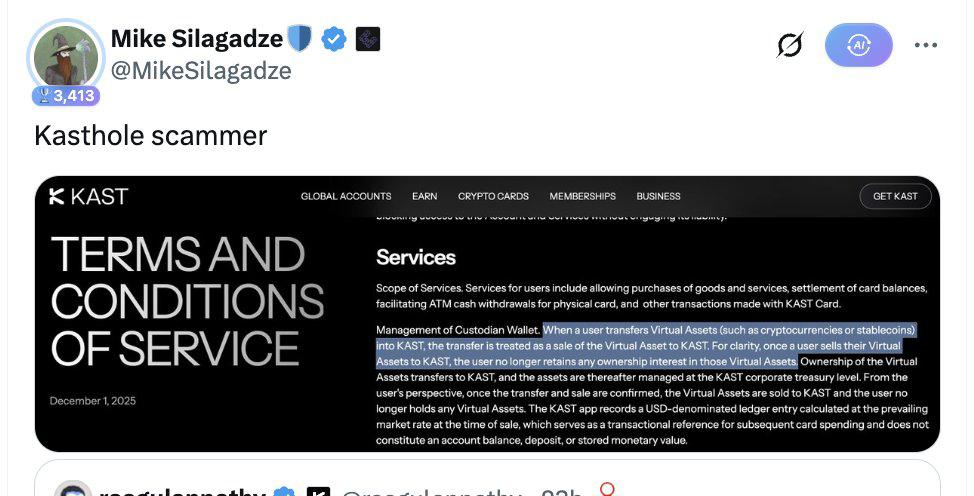
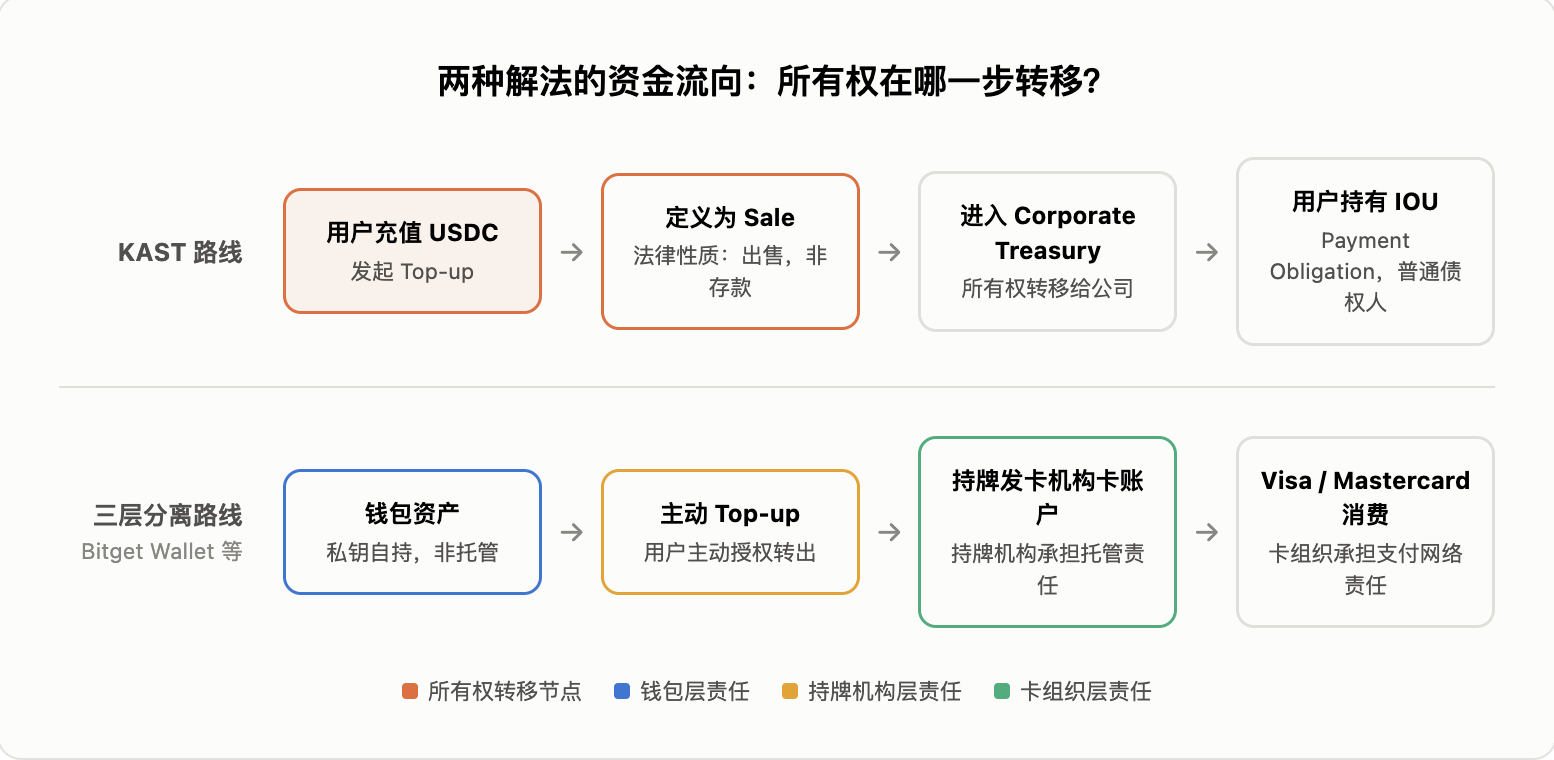
That is precisely why the article says the deeper legal structure could be missed. In KAST’s terms, when a user topped up USDC into the card account, the transfer was not treated as a deposit. It was treated as a sale.
The legal effect was much bigger than the wording suggested. If the transfer were a deposit, ownership of the funds would remain with the user and the company would merely hold them on the user’s behalf. If it were a sale, the user would transfer ownership of the stablecoins to KAST. The funds would then enter the company treasury, while the account balance shown to the user would represent only a payment obligation owed by the company — effectively a digital IOU.
In normal times, Sun says, users may not feel the difference. In a liquidity event or bankruptcy, the difference becomes decisive. The issue is whether the user can recover funds as the owner of assets or must line up in liquidation as a creditor. The article adds that KAST’s terms at the time capped the company’s liability at $500, which Sun presents as further evidence that the user’s place in the structure resembled that of an ordinary creditor rather than that of an asset owner.
She does not describe this as a drafting oversight. Instead, she argues that it responds to a specific regulatory reality. In many jurisdictions, a fintech that holds customer funds over time can be treated as operating e-money or stored-value account services. That can trigger licensing requirements such as a European Electronic Money Institution, or EMI, license, along with customer-fund segregation, capital adequacy and ongoing audit obligations. Those licenses are costly and difficult to replicate cheaply around the world.
By redefining a top-up as a sale, Sun argues, KAST could step outside that framework. If the company purchased the assets for itself rather than taking a customer deposit, then rules built around customer funds would not apply in the same way. In the article, she calls this a calculated form of regulatory avoidance.
That structure also changes the business model. Once the funds sit in the company treasury, they can be allocated to short-dated U.S. Treasuries or money-market funds. At short-end yields of 4% to 5%, the article says, $100 million in retained funds could generate $4 million to $5 million in annual income. That income is largely independent of whether users spend. Sun compares the logic to how Circle and Tether earn from reserve assets, except transplanted into the account architecture of a neobank.
Put differently, many products need users to transact in order to make money. In the KAST structure as described by Sun, revenue can be generated even when users do nothing, because the source is not payment flow but interest on the retained funds. The trade-off is equally clear in her framing: the company owns the money, the user holds a claim.
A different model: serve payments without owning the assets
Sun contrasts KAST with another group of products: Ether.fi Cash, Avici, Plasma and Bitget Wallet. They can also connect to Visa or Mastercard and support stablecoin spending, but they share a different design principle. Their business model, she writes, is built on payment services rather than ownership of user assets, so they try from the outset to avoid becoming the owner of funds at any stage.
That principle shows up in different ways across products.
- Ether.fi Cash uses smart contracts to lock user assets as spending collateral, while the actual payment is funded through credit extended by the card issuer rather than a direct withdrawal of stablecoins from the wallet.
- Plasma outsources the fiat-conversion step to licensed entities such as Bridge, acquired by Stripe, while keeping its own focus on the on-chain account and network layer.
- Avici works with banking partners to provide virtual accounts, and once fiat enters, it is converted into stablecoins in the user wallet rather than remaining on the platform for long periods.
Sun says the shared logic is straightforward. Instead of trying to secure a single license that would cover a wallet, a bank and a payment institution all at once, these firms return each layer’s responsibility to the participant best suited to carry it and easiest for regulators to understand.
Bitget Wallet’s three-layer structure
The article presents Bitget Wallet Card as a more complete version of that approach. It separates accounts, funds and payments into three layers so that each layer matches a different regulatory obligation instead of forcing one company to absorb the full burden.
The first is the wallet layer. Bitget Wallet remains a non-custodial wallet, Sun writes. Users’ USDT and USDC stay in their own wallet addresses on-chain. The private keys remain under user control, and the platform cannot proactively move or pool the assets. On that basis, she argues, the wallet layer does not constitute a customer-fund custody relationship and therefore does not fall into the corresponding custody framework.
The second is the card-account layer. Funds enter this layer only when a user actively initiates a top-up and transfers part of the balance into a card account managed by a licensed card issuer. Because a licensed institution controls that layer, it is the part that naturally needs to meet local payment-regulation requirements.
The third is the payment-network layer, handled by the global merchant networks of Visa or Mastercard, which convert that value into real-world spending. The regulatory duty at this layer remains with the card networks.
According to Sun, the result of this separation is that no single point has to carry all three roles at once, and control over user assets stays with the user until the moment of explicit authorization. The extra authorization step costs some convenience. In return, she says, it changes the user’s position in a worst-case scenario. The user is not merely a creditor in a company liquidation; the user is the asset owner, holding the private key while the funds remain at the on-chain address.
That is the basic contrast Sun draws. KAST simplifies compliance by transferring ownership of the assets. Bitget Wallet and similar structures preserve user control by splitting regulatory responsibility more precisely.
What regulators are actually looking at
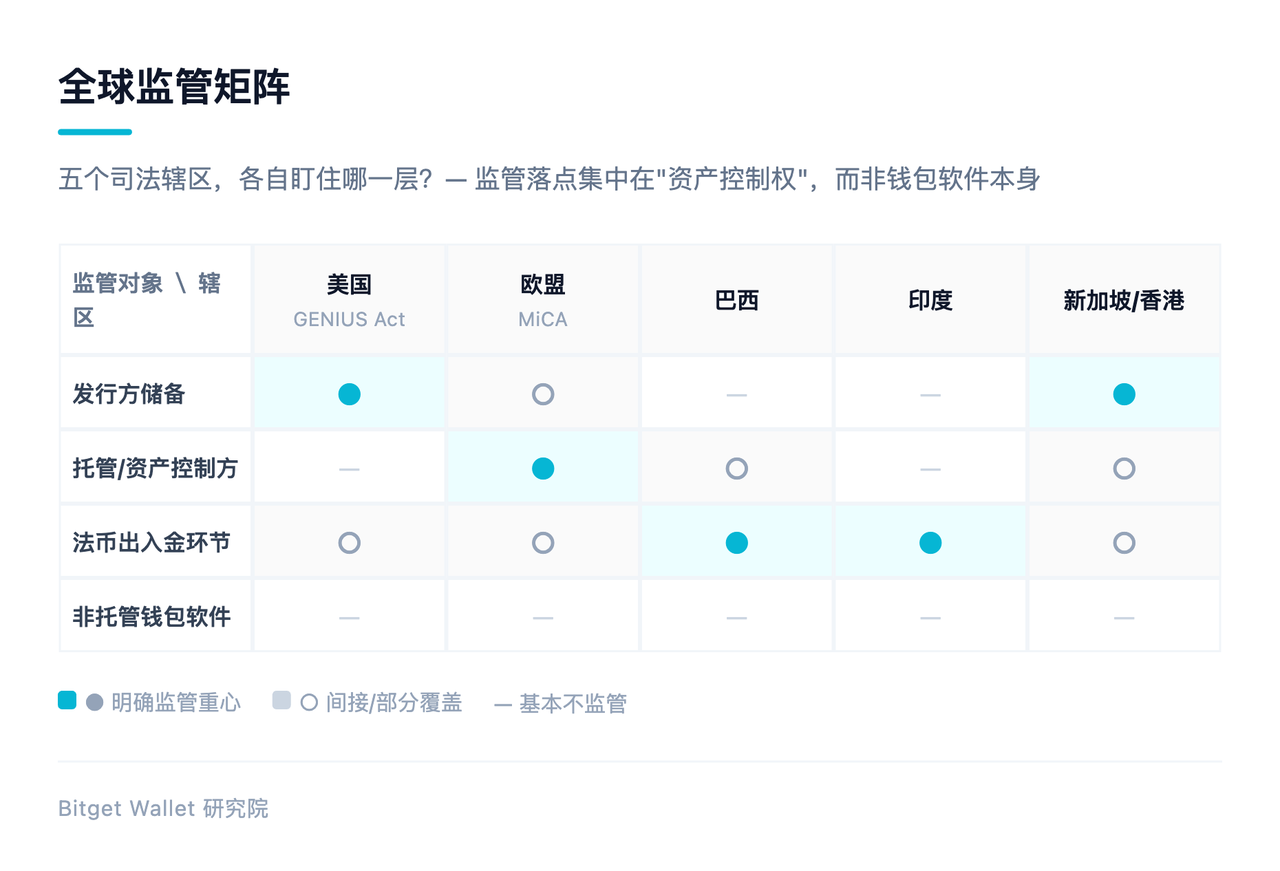
Sun then compares stablecoin policy across major jurisdictions and says a pattern appears quickly: very few countries treat wallet software itself as the main target. The recurring question is who controls the user’s money and on whose balance sheet the money sits.
In the United States, the article says, the 2025 GENIUS Act did not ban stablecoins and did not ban non-custodial wallets. Instead, it concentrated on stablecoin issuers, requiring reserve assets to be safe, audited and not used to pay interest directly to token holders. The real U.S. question, in Sun’s formulation, is who is issuing dollars, not who wrote the wallet code.
Europe’s MiCA framework takes a different route but lands on the same underlying concern. It does not require every wallet to obtain a financial license. It focuses on crypto-asset service providers. If a company holds customer assets, executes transactions on behalf of customers or manages funds, it needs the relevant authorization. Pure software providers, where users hold their own private keys, are treated more cautiously. Sun says this is why a KAST-like transfer of asset ownership is more likely to draw harder scrutiny, while a non-custodial, layered structure can be mapped more easily into the existing framework.
In emerging markets such as Brazil and India, the focus leans more heavily toward on- and off-ramps and capital movement. The article says Brazil’s central bank has promoted Pix into one of the world’s most successful real-time payment networks while also tightening oversight of stablecoin-to-fiat conversion, with the aim of making sure funds eventually enter and exit through regulated rails rather than remain outside the banking system. India, by contrast, has not directly restricted wallets but has increased the cost of on-chain trading through high capital-gains taxation and tax deducted at source, putting pressure on the movement of funds rather than on wallet software.
Singapore and Hong Kong, Sun writes, have welcomed stablecoin innovation while requiring issuers to be licensed, reserves to be secure, and wallets, payments and custody to be addressed under separate regulatory structures.
The rules differ, but the logic beneath them is shared. Regulators are becoming less concerned with which blockchain a given asset uses and more concerned with who holds it on the balance sheet at a given moment.
That is why, in Sun’s view, marketing language does not decide which regulatory framework a modern neobank falls under. The decisive factor is the fund structure itself. KAST may describe itself as a dollar account with stablecoin support rather than a crypto wallet, but the clause that matters is the one that turns a top-up into a sale. Regulation has not blocked the rise of second-generation dollar accounts. What it has changed is how responsibility must be divided behind them. A polished terms document cannot alter the basic rule that the party nearest the money must also be nearest the regulatory burden.
The endgame is trusted holding, not just issuing dollars
Sun closes by arguing that the internet spent two decades reshaping most industries while leaving banking structurally intact. The reason was not lack of technology. It was that the ownership structure of accounts never moved. As long as ownership of funds remained anchored to bank balance sheets, even the best fintech interface was still only an interface.
Stablecoins loosened that anchor for the first time. Dollars could exist independently of banks. But loosening the anchor did not resolve the issue of responsibility. It only turned a question with a default answer into one each company has to answer for itself.
In that frame, the split between KAST on one side and Bitget Wallet, Ether.fi Cash and Plasma on the other is not a narrow product disagreement. It is the clearest current expression of two different solutions. One transfers asset ownership in exchange for a simpler compliance route and reserve income, at the cost of turning the user into a creditor. The other preserves user control through a layered, separately licensed structure, at the cost of some one-click convenience. Sun says neither is automatically the wrong answer. They simply choose different positions along the axes of regulatory friendliness and user asset sovereignty, and both regulators and the market are still testing which one can last.
She also argues that the pressure on this question will intensify as the number of on-chain dollars grows. As of January 2026, the article says, USDT had exceeded $180 billion in size and USDC had surpassed $70 billion. PayPal had launched PYUSD, Open Standard had introduced OUSD, and major U.S. banks were discussing jointly issued tokenized deposits. In a world where dozens of digital-dollar formats circulate at once, users are unlikely to want a larger list of token names to remember. As with payment networks today, the infrastructure will move into the background.
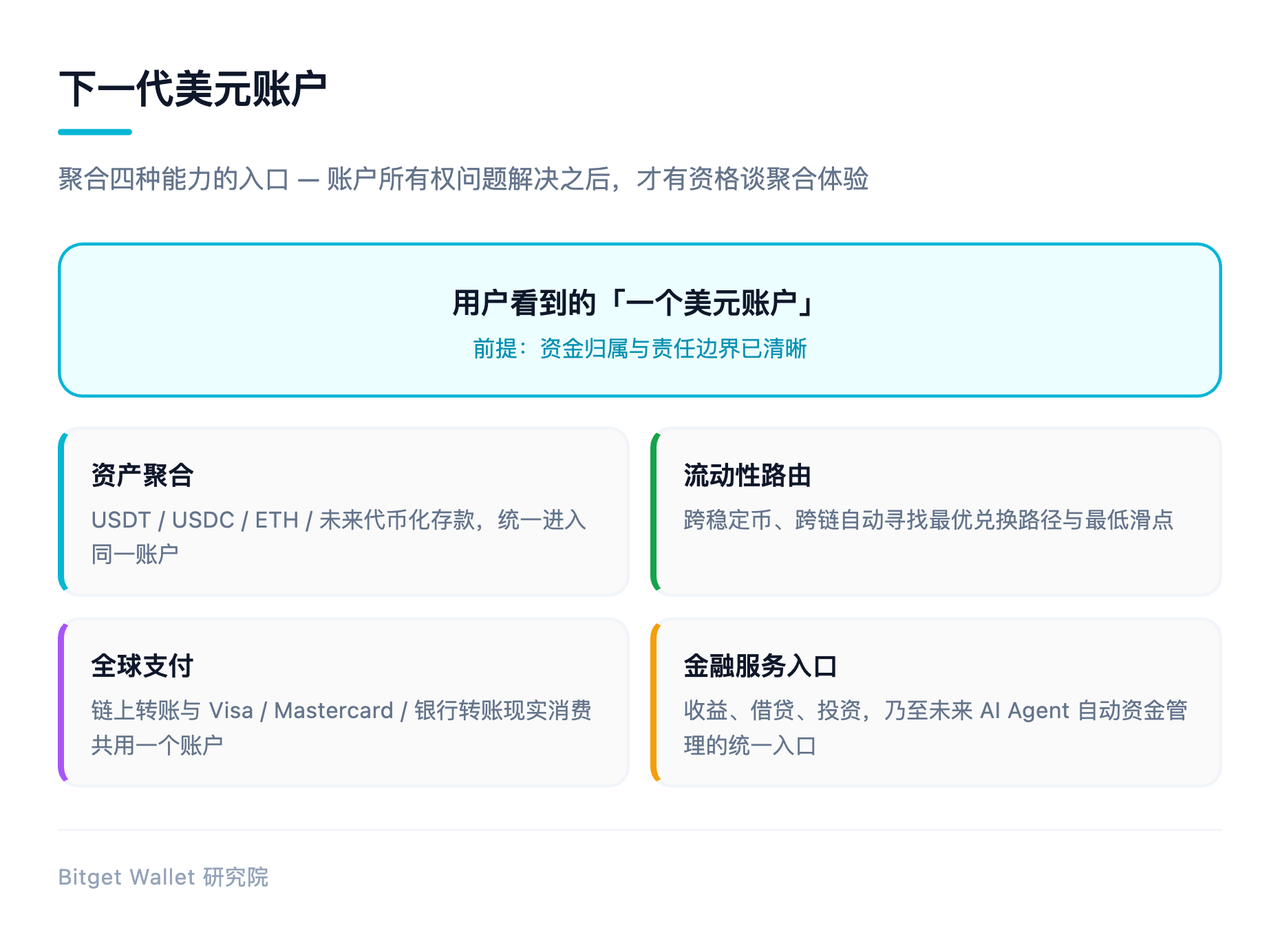
That pushes the ownership question one step further. It becomes not only who owns the account, but who can aggregate dozens of forms of digital dollars into what the user experiences as one dollar. Sun says the products that can do that will need four capabilities at once:
- They must aggregate USDT, USDC, ETH and future tokenized deposits into a single account view.
- They must find the best routing and lowest slippage across different stablecoins and chains.
- They must let one account handle both on-chain transfers and real-world spending through Visa, Mastercard and bank transfers.
- They must absorb yield, lending, payments, investing and even future AI Agent-based money management into one entry point.
Yet all four capabilities, she says, depend on the earlier question already being resolved. Ownership and responsibility have to be clear before many dollars can be turned into one trusted experience. Otherwise, aggregation itself is fragile, because users will not trust an entry point if the terms can quietly transfer ownership of their assets away from them.
Sun’s final point is that users in the future may not care whether the balance they hold is USDT, USDC or a tokenized deposit issued by a bank, much as few users today care which bank settlement system sits behind their account. The deciding factor for the next generation of dollar accounts, she writes, will not simply be scale of issuance. It will be who can find a balance between being outside the bank and still surviving regulatory scrutiny — a balance users are willing to trust and regulators are willing to accept.