A $1.1 Million Crypto Card Hack Crashed Neobank Token AVICI by 49%
According to CoinDesk, a $1.1 million crypto card hack crashed the neobank's AVICI token by 49% from a 24-hour high. The token hit a record low before paring some losses.

According to CoinDesk, a $1.1 million crypto card hack crashed the neobank's AVICI token by 49% from a 24-hour high. The token hit a record low before paring some losses.

Solana-based neobank Avici has been hit by a hack that moved more than $600,000 out of user accounts. Rain, the service provider behind Avici's Visa card and payment infrastructure, said its monitoring system detected vulnerabilities in a small number of projects using old Solana contracts. Rain said contract upgrades for all affected projects have been completed, the issue is resolved, and monitoring will stay in place. A third-party forensics firm has also been hired to investigate, and Rain said all affected users will receive full compensation. Avici later added that the attack affected only the separate Solana contract used to hold card balances. Users' self-custodied Solana and EVM wallets were not touched. Verified figures show 1,685 users were affected, with roughly $500,000 in card balances involved. Avici promised full refunds to all affected users. The team has filed a report with the FBI's Internet Crime Complaint Center (IC3).

TRON’s latest weekly industry report, covering Aug. 16 to Aug. 23, said crypto markets rebounded sharply as macro pressure, liquidity expectations, and friendlier U.S. policy signals converged. Bitcoin climbed from about $62,819 on Aug. 16 to an intraday high near $79,306 on Aug. 21 before easing back to roughly $76,000-$76,300 by Aug. 23, a gain of about 21% for the period. Ether rose from around $1,876 to about $2,390, with a weekly increase of roughly 27% and a peak near $2,544 on Aug. 21. TRON linked the move to an expanded long-dated Treasury buyback plan from the U.S. Treasury, a warmer regulatory backdrop including renewed momentum for the CLARITY Act and a new Securities and Exchange Commission proposal for crypto asset issuance, plus about $1.6 billion in net inflows into U.S. spot Bitcoin ETFs from Aug. 17 to Aug. 20. The report also focused on two institutional on-chain yield projects. Cap, which has raised $15.4 million with participation from Franklin Templeton, Triton Capital, GSR, and Flow Traders, is presented as a credit-backed, yield-bearing stablecoin system on Ethereum built around underwriters, overcollateralization, liquidation, and integration with Symbiotic restaking infrastructure. Ground, which has raised $3.6 million led by Bain Capital and ParaFi with backing from Nascent, Robot Ventures, and Chapter One, is described as an institutional yield infrastructure layer that connects stablecoin balances to multiple on-chain yield sources through APIs, portfolio wallets, routing, and non-custodial key management. The report further reviewed fresh SEC, CFTC, CLARITY Act, and MiCA developments.


The article argues that the most important battleground in payments is no longer the transaction alone, but the account layer that sits before and after it. In the author’s framework, payment is an event — a moment when money moves — while an account is a state that records where funds sit, who owns them, what balance remains, and what can happen next. That distinction carries legal, regulatory, and commercial consequences, especially once providers begin holding customer funds rather than simply processing movement. The piece traces how large payment firms including Stripe, Adyen, and Airwallex have expanded from payment processing into accounts, balances, cards, financing, foreign exchange, and treasury products. It links that shift to a deeper commercial logic: transaction revenue is tied to one payment, while account infrastructure opens the door to longer-term balance economics, richer cash-flow data, and tighter customer relationships. The analysis also explains why this trend is particularly strong in cross-border payments, where businesses must manage multi-currency positions rather than isolated transfers. It then broadens the frame to banks, fintechs, neobanks, and stablecoins, arguing that while account forms may change, the core competition remains the same — control over the customer’s primary financial relationship and the next financial action that follows.

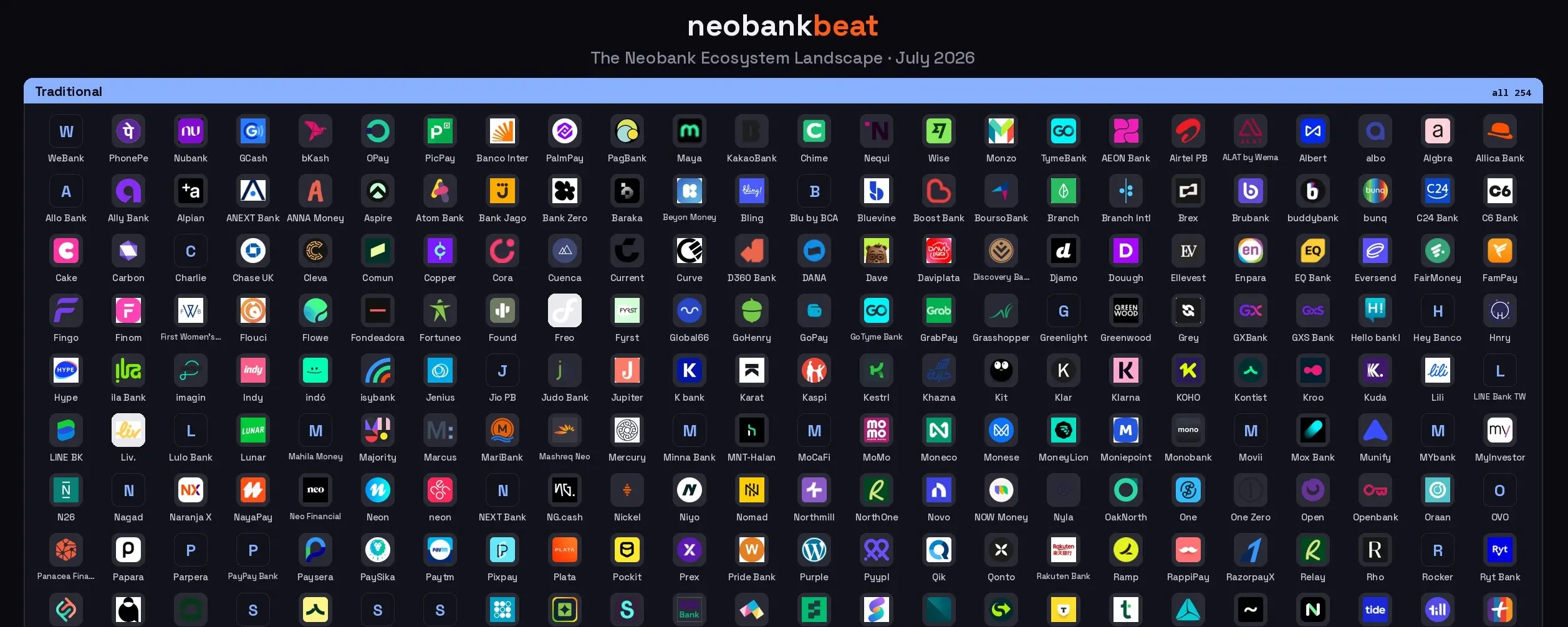
A new industry census by Francesco Andreoli, head of developer relations at Consensys and MetaMask, argues that the real story in neobanking is not how many companies have raised capital, but how many quietly disappear. His dataset, published on neobankbeat.com, identifies 368 verified neobanks still operating as of July 2026. Together, based on self-reported figures, they serve roughly 1.46 billion customers. The breakdown shows a business with very different models under one label: 254 traditional challenger banks, 58 hybrid fiat-crypto apps, and 56 web3-native apps. Andreoli says 30% of neobanks founded in the 2020s and still alive today are web3-native self-custody applications, compared with 4% among those launched in the 2010s. The sharper finding is regulatory. Only 127 of the 368 active companies hold full banking licenses. The rest rely on sponsor banks, e-money licenses, or card-issuing partners. Andreoli ties that dependence to past failures such as WaveCrest in 2018, Wirecard in 2020, Synapse in 2024, and Ready in 2026. His review also challenges widespread AI claims. After checking 368 firms against filings, regulatory disclosures, and production evidence, he says only 67 passed, or 18%. The report adds that 106 infrastructure providers support the 368 consumer-facing brands, highlighting concentration risk below the surface.

A report highlighted by Consensys and MetaMask developer relations lead Francesco Andreoli says the global neobank sector is far larger, and more fragile, than many users realize. Andreoli said he tracked and verified 368 active neobanks that together report 1.46 billion users worldwide. Yet only 127 of those firms hold full banking licenses, leaving roughly two-thirds dependent on sponsor banks, e-money permissions, or banking-as-a-service infrastructure. The data points to Asia as the dominant market with 817 million users, led by China’s WeBank at more than 400 million. Europe’s Revolut, while still one of the best-known names in the segment, was cited at more than 50 million users. Andreoli also said the industry mix is shifting, with 56 surviving neobanks founded in the 2020s classified as Web3-native self-custodial apps, and another 58 operating hybrid fiat-and-crypto models. The report also challenged claims around artificial intelligence adoption. Of the 368 firms reviewed, only 67 were said to have deployed AI in production, or about 18%. Andreoli added that many of the real-world AI lending use cases are appearing in emerging markets such as Nigeria, the Philippines, Mexico, and Bangladesh rather than in Western markets.

Francesco Andreoli, head of developer relations at Consensys and MetaMask, says he verified 368 neobanks still operating as of July 2026 after spending six months tracking the sector. His dataset, published on neobankbeat.com, points to an industry with roughly 1.46 billion reported users, but also one with deep structural fragility. Asia accounts for 817 million of those users, with WeBank alone serving more than 400 million. Nubank has 131 million customers, while Revolut has more than 50 million. Andreoli also breaks the market into 254 traditional challenger banks, 58 fiat-crypto hybrid apps, and 56 web3-native apps, supported by 106 infrastructure providers and backed by 219 investors. The striking number in his analysis is not just the size of the sector, but how much of it sits on rented infrastructure. Of the 368 companies, only 127 hold full banking licenses. The rest depend on sponsor banks, e-money licenses, or card issuers. Andreoli points to WaveCrest in 2018, Wirecard in 2020, Synapse in 2024, and Ready in 2026 as reminders that when the infrastructure layer breaks, customers often face frozen funds and bankruptcy queues rather than direct deposit insurance protection. He also reviewed AI claims across the sector and found that only 67 companies, or 18%, had evidence in financial filings, regulatory disclosures, or live production deployments. In his view, the most effective AI lenders are often in emerging markets such as Nigeria, the Philippines, Mexico, and Bangladesh, where underwriting models fill gaps left by weak credit systems.

Bitget Wallet Research defines the past 18 years of financial innovation as a 'financial power migration,' from Neobanks to stablecoins to onchain wallets, progressively dismantling traditional banks' monopoly on accounts, payments, currency, and clearing.