Macro backdrop and crypto rebound
TRON said in its latest weekly industry report that the dominant macro theme from Aug. 16 to Aug. 23, 2026, was a mix of renewed inflation pressure, elevated long-end yields, and uneven growth. In the U.S., minutes from the July Federal Open Market Committee meeting were released on Aug. 19 and showed that “multiple” officials believed further rate hikes could still be needed if inflation does not keep easing. The federal funds rate remains at 3.50%-3.75%.
The report added that U.S. initial jobless claims for the week ended Aug. 15 fell to 206,000, pointing to still-low layoffs, while housing stayed under pressure. Single-family housing starts for July fell 9.9% month over month, and total housing starts dropped 12.4%. Markets, according to TRON, repriced the odds of rates staying higher for longer. The 10-year U.S. Treasury yield briefly returned to about 4.7%, the 30-year approached 5.25%, and major U.S. equity indexes ended the week lower. Fiscal deficits, pressure from long-dated Treasury supply, and higher energy costs tied to tensions in the Middle East also added to the inflation picture, with Brent crude moving back above $90 a barrel.
Against that backdrop, crypto assets staged a sharp recovery in risk appetite. TRON said Bitcoin climbed from about $62,819 on Aug. 16 to an intraday high near $79,306 on Aug. 21, then pulled back to roughly $76,000-$76,300 by Aug. 23. That left BTC up about 21% over the period. Ether rose from around $1,876 to about $2,390, up roughly 27% for the week, and touched about $2,544 on Aug. 21, outperforming Bitcoin.
TRON tied the rally to three drivers. First, the U.S. Treasury announced an expanded long-dated Treasury buyback plan, which fed expectations for a weaker dollar and easier liquidity conditions. Second, the U.S. regulatory environment for crypto improved, with renewed policy momentum for the CLARITY Act and a new SEC proposal covering crypto asset issuance. Third, institutional money returned. U.S. spot Bitcoin ETFs recorded about $1.6 billion in net inflows from Aug. 17 through Aug. 20, including about $606 million on Aug. 20 alone.
Capital then spread beyond BTC into higher-beta assets. TRON said ETH and XRP both caught up, with XRP’s weekly gain at one point reaching about 40%. Even so, Bitcoin and Ether both saw intraday pullbacks of roughly 1%-4% on Aug. 22 and Aug. 23, which the report said showed profit-taking had already started after the rapid move higher.
What TRON is watching next week
For Aug. 24 to Aug. 30, TRON said market attention will center on the Jackson Hole gathering of global central bankers, policy signals from Federal Reserve Chair Kevin Warsh, and U.S. data including PCE, the second-quarter GDP revision, and durable goods orders.
The report said markets have now priced in roughly one 25 basis point rate hike before year-end. If Warsh continues to emphasize sticky inflation, fiscal expansion, and energy price risks, long-end Treasury yields may stay elevated, the dollar could find short-term support, and expensive growth stocks along with other risk assets could stay under valuation pressure. If core PCE cools more clearly and Warsh sounds more neutral, longer-dated yields may ease and risk assets could rebound.
In crypto, TRON said the short-term trend has shifted from weak consolidation to a more constructive setup, though it has entered a phase where volatility will test that move. The report highlighted Aug. 26 U.S. PCE, core PCE, and the second-quarter GDP revision, along with Warsh’s Aug. 28 speech at Jackson Hole, as the key variables.
If PCE comes in below or in line with expectations and Warsh delivers a more dovish tone, TRON said BTC could retest $79,000-$80,000. A clean break there could open room toward $82,000-$85,000. For Ether, the report said the market should watch whether ETH can break back above $2,500-$2,550. If it does, capital may continue rotating into ETH and major altcoins.
At the same time, the report warned that Bitcoin had already surged from about $63,000 to near $80,000 in just a few days, leaving the market clearly overheated in the short run. If PCE runs hot or Warsh keeps stressing inflation risks, TRON said the first BTC support to watch is near $73,000, followed by $69,000-$70,000. For ETH, the report pointed to $2,200-$2,250, with a possible retest of about $2,000 if that area fails. TRON’s baseline view is that the next week is more likely to bring “high-level consolidation with macro data deciding the second move,” rather than confirming a fresh one-way bull market off this week’s roughly 22% BTC rise.
Primary market themes: AI Agent, privacy, and DeFi credit
TRON said overall fundraising volume in the primary market was not especially high during the week, but the direction of capital was clear. The main sectors were AI Agent, represented by NeoSoul, privacy infrastructure through Beldex, DeFi credit and lending infrastructure through Twyne and Concrete, and AI × DePIN through Botanika.
The largest publicly disclosed early-stage deal of the week was NeoSoul’s $11 million Series A. TRON said AI Agents and autonomous on-chain economies remain two of the most closely watched emerging themes in the private market.
Cap: credit-backed yield infrastructure built around a stablecoin entry point
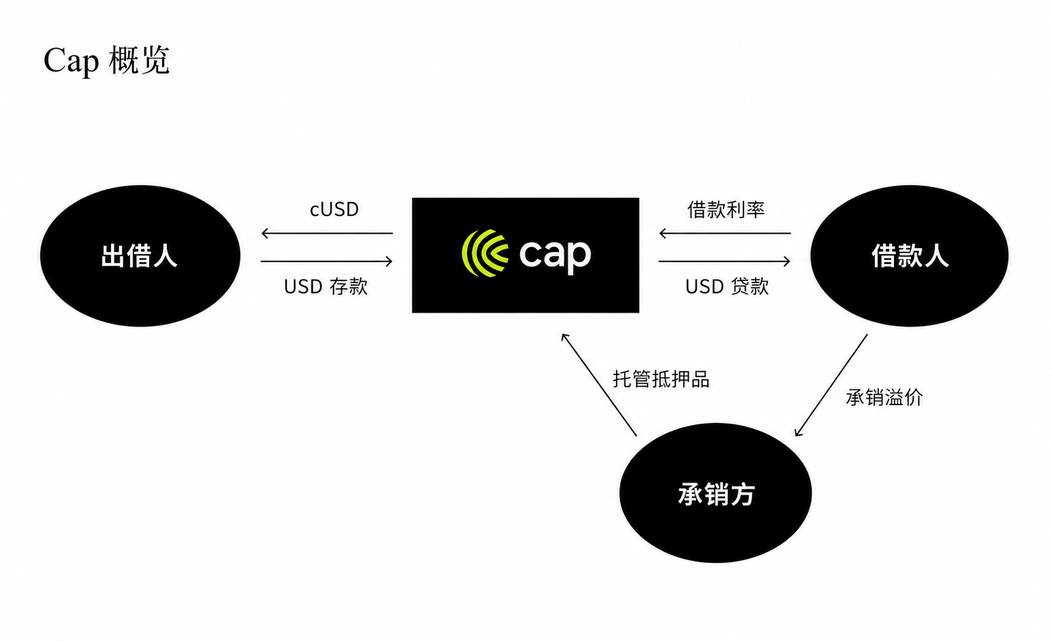
In its project deep dives, TRON first examined Cap. The report said Cap has raised a total of $15.4 million, with Franklin Templeton, Triton Capital, GSR, and Flow Traders among participating investors. TRON framed the project as an institutional-grade infrastructure play aimed at building sustainable yield and on-chain credit around stablecoins.
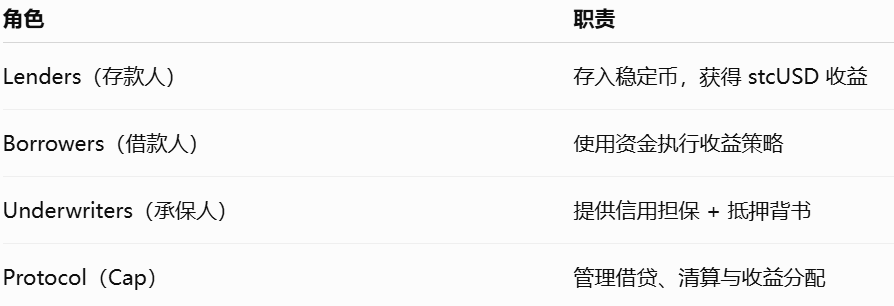
Cap is an on-chain credit lending platform built on Ethereum and supported by a financial guarantee structure. TRON said every loan is overcollateralized through escrowed collateral to protect lenders’ funds. The core of the platform is an underwriter market. Underwriters independently decide whether to issue loans, provide credit backing for each loan, and commit their own capital as risk support.
In return, underwriters earn underwriting yield from the loan spread. Lenders receive what TRON described as safer yield backed by underwriter capital, with all risk coverage rules handled transparently and enforced automatically through smart contracts.
The lending engine revolves around stcUSD, which the report described as a yield-bearing stablecoin. Users deposit stable assets such as USDC and receive yield driven by the credit lending market. TRON said the design combines three supports: overcollateralization, underwriter guarantees, and on-chain liquidation.
The report broke the yield sources into three parts:
- Base stablecoin yield, such as rates available on Aave or Morpho
- Interest paid by borrowers
- Risk premium supplied by underwriters
To borrow, a borrower must be overcollateralized, must secure an underwriter guarantee, and must generate a yield above the protocol’s hurdle rate, according to TRON.
On the happy path, stcUSD earns stable yield, the underwriter receives the insurance fee, and the borrower keeps the residual profit. In a risk event, triggered when a borrower’s collateral ratio falls below the liquidation threshold, the borrower is forcibly liquidated, the underwriter’s collateral is auctioned, and stcUSD holders remain fully protected on a 1:1 basis.
Cap uses a Dutch auction liquidation model, TRON said. The price declines over time, and liquidators who step in earlier receive stronger incentives. The purpose is to repair system risk quickly and prevent bad debt from spilling into stcUSD.
The borrow-rate model has two parts: a base rate and a utilization adjustment. The base rate is the higher of an external market rate, such as Aave, and a protocol-defined floor. As utilization rises, rates rise. Past a threshold, the increase accelerates.
TRON’s bottom line was that Cap should not be viewed as a standard lending protocol. It described the design as a yield-bearing stablecoin system backed by underwriter credit. The key pillars are dual protection through overcollateralization and credit backing, yield priority for stcUSD, risk absorption by underwriters, and a liquidation system that protects funds.
Fractional reserve vaults and yield enhancement
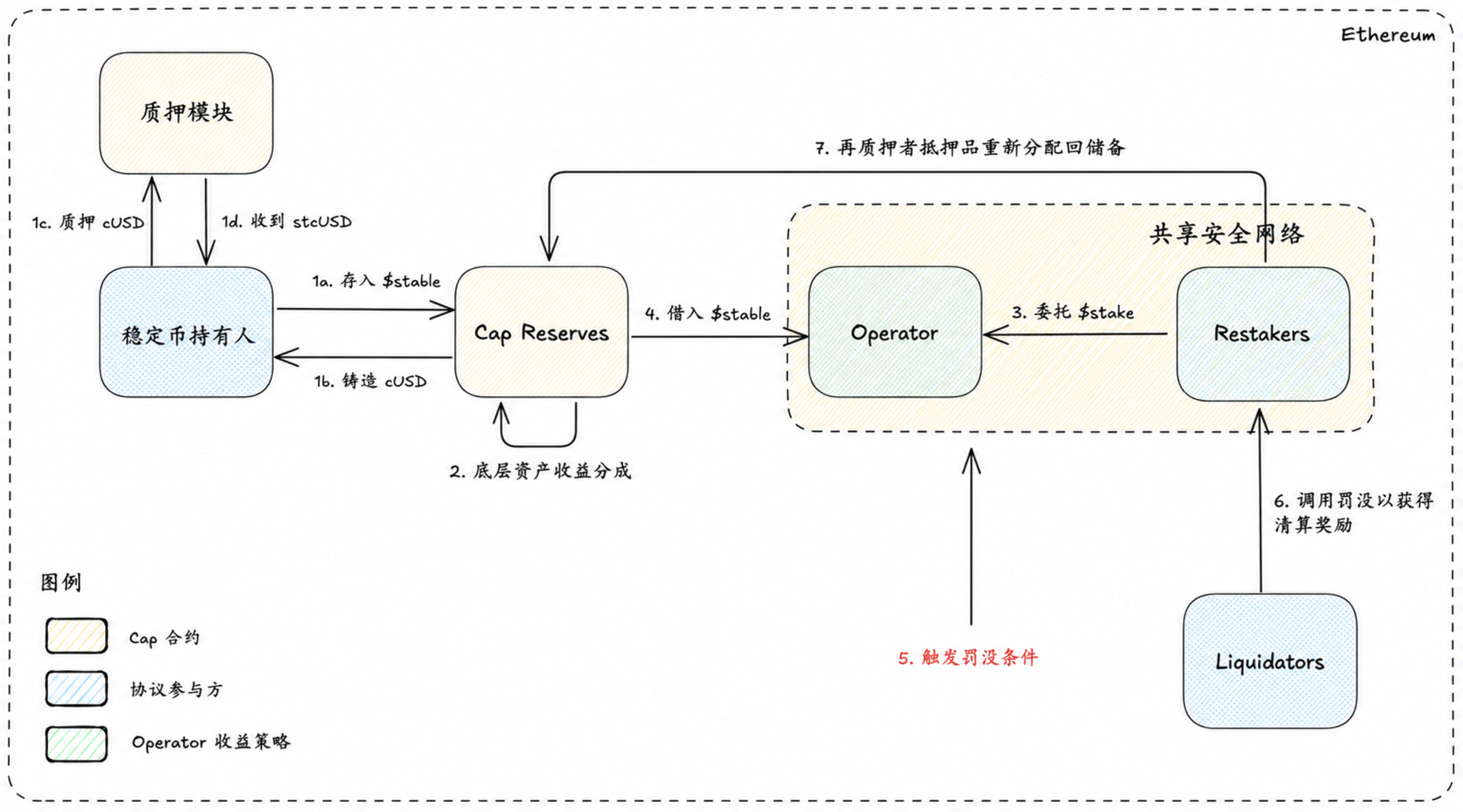
The report also detailed Cap’s vault structure. Fractional Reserve is presented as a capital-efficiency, yield-enhancement, and liquidity-management module. Its stated purpose is to put idle reserves into lower-risk DeFi strategies while keeping cUSD redeemable at all times.
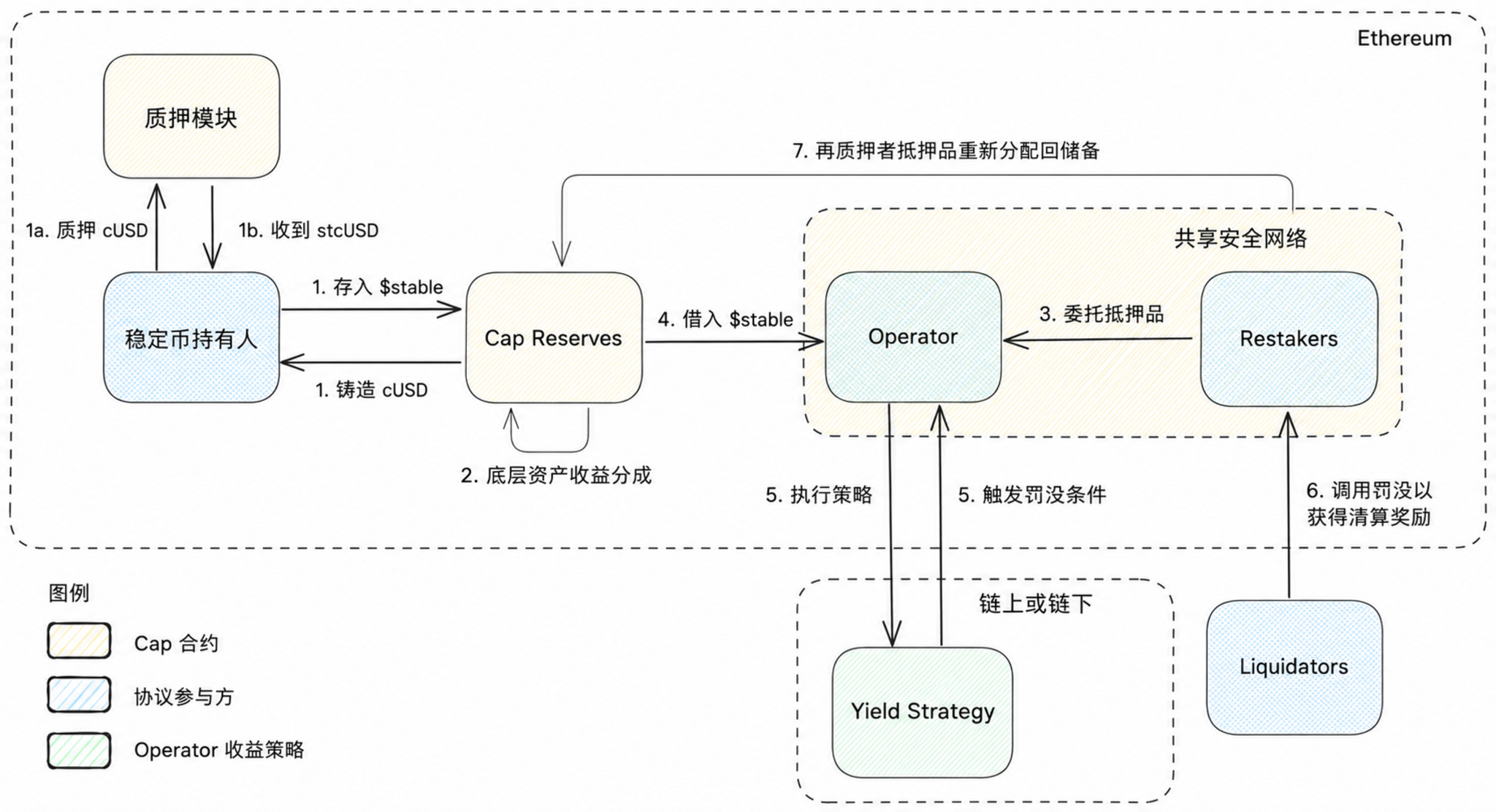
TRON described the flow of funds this way: cUSD minters deposit assets into the Cap Vault; excess capital is moved into the Fractional Reserve Vault, where a TokenHolder strategy generates passive yield; accumulated yield is sent to the Fee Auction and converted into cUSD; that cUSD is then sent to the Fee Receiver and distributed periodically to stcUSD holders.
The protocol deploys an ERC4626-standard TokenHolder Fractional Reserve Vault for reserve assets such as USDC. That vault runs as the strategy layer and follows the Yearn V3 Tokenized Strategy model, with Aave V3 given as an example destination. Only the Fractional Reserve Vault can deposit into or withdraw from the main vault.
TRON said the CapSweeper contract automatically moves idle assets into strategy positions every six hours. Assets continue earning interest until they are withdrawn. CapInterestHarvester is used to harvest strategy yield automatically and send it to the Fee Auction.
The report listed the key parameters as Reserve Level, the minimum amount of each asset that must remain in the vault; Loaned Amount, the total assets currently deployed into the Fractional Reserve strategy; Interest Receiver, set as the Fee Auction; Claimable Interest, the amount of yield currently available to realize; and Investment Threshold, the minimum capital required to trigger deployment.
How Cap integrates Symbiotic
Cap also integrates Symbiotic’s restaking infrastructure to build a delegated credit system. In that setup, underwriters provide risk coverage to borrowers. Underwriters can deploy vaults to support borrowers with staked coverage, while capital providers can deposit into or withdraw from those vaults.

The vault-borrower relationship is designed as a unique pairing:
- Each Symbiotic vault can delegate to only one borrower
- A borrower that wants delegation from a new vault must use a new Ethereum address
- An underwriter that wants to support a new borrower must deploy a new vault
- Once a vault starts delegating to a borrower, that borrower address becomes immutable
TRON said underwriters create vaults through Cap’s Symbiotic Vault Factory contract, and each vault supports only one ERC20 collateral asset. After creation, Cap whitelists the vault and the borrower address, then sets loan terms and the underwriting premium. Once the borrower-vault pair becomes active, the underwriter can control depositor permissions and reward distribution. If a risk event occurs, the vault enters liquidation.
TRON said Cap’s strengths lie in combining Shared Security Networks, identified in the report as EigenLayer and Symbiotic, with an underwriter-driven coverage model. That structure is designed to link on-chain credit with restaked capital, let borrowers access funding without fully self-collateralizing every position, and give underwriters a way to earn risk premiums by backing credit with staked capital. The report also pointed to borrower-level risk isolation, automated liquidation, system transparency, and structured risk management as advantages.
On the downside, TRON said the system depends on a fairly complex mix of on-chain and off-chain coordination, including SSNs, restaking, legal underwriting, and liquidation systems. That makes the structure heavier and harder to understand or join. The report also said yield and safety depend heavily on underwriters’ risk judgment and on the quality of restaked collateral. In stressed markets, the design could face undercoverage or tighter liquidity, while also introducing some centralization and compliance dependence through the underwriting layer.
Ground: an on-chain yield infrastructure layer for institutional capital
TRON’s second featured project was Ground. The report said Ground has raised $3.6 million, led by Bain Capital and ParaFi, with Nascent, Robot Ventures, and Chapter One also involved. TRON described the company as an on-chain yield infrastructure layer for institutions.
Ground is built for banks, fintech firms, and a broader range of financial applications. It offers non-custodial integrations that let those users earn yield on stablecoin and cash balances. Through APIs and configurable portfolio strategies, Ground connects idle assets to diversified on-chain yield sources while offering transparency, risk controls, compliance tooling, and automated allocation management.
TRON said the platform is meant to help companies launch yield-enabled financial products, improve treasury efficiency, and open new revenue streams without building complex DeFi infrastructure from scratch.
Portfolio Wallets and the operating model
One of Ground’s core components is its Portfolio Wallets. TRON described them as multi-strategy yield wallets with blended yield, automated rebalancing, and liquidity-tier management. Neobanks, exchanges, and treasuries can connect once through an API and route idle stablecoins into a yield system, while Ground handles asset allocation, rebalancing, withdrawals, and reporting.
The workflow in the report has five steps:
- Configure: choose yield sources and target weights from the source directory
- Create: create a wallet using the chosen strategy, with Ground assigning deposit addresses across chains
- Deposit: send USDC to the wallet’s deposit address on the relevant chain
- Earn: Ground allocates funds across yield sources and dynamically rebalances to keep target weights
- Withdraw: submit a cross-chain withdrawal request, after which Ground unwinds positions, bridges if needed, and delivers USDC
Once a wallet is created and deposit addresses are available, TRON said the lifecycle becomes straightforward: deposit stablecoins, monitor balances and earnings through polling or webhook, and request withdrawals when needed. The withdrawal process requires transaction signing through Turnkey before Ground broadcasts the transaction and settles funds to the destination address.
Custody, security, and on-chain architecture
Ground uses non-custodial key management. Each wallet’s private key is managed by Turnkey, and Ground does not touch any signing keys, according to the report. Institutions can define which withdrawal actions require approval. Strategy updates are carried out through API-authenticated target allocation changes, while later rebalancing can run automatically and asynchronously under the chosen policies.
Each wallet also has a dedicated deposit address, so funds are not mixed across wallets. All API and webhook communication is protected through HTTPS transport encryption.
TRON then outlined the on-chain deposit flow. A user sends USDC from an external wallet to the Portfolio Wallet deposit address. Ground detects the transfer through on-chain monitoring, signs and submits a deposit transaction, and the Portfolio Wallet calls the MasterRouter contract. MasterRouter resolves the target yield venue through AdapterRegistry, then deposits USDC into the underlying yield protocol, such as a Morpho vault or a Maple pool. Receipt tokens remain in the Portfolio Wallet, and Ground updates the position and balance data.
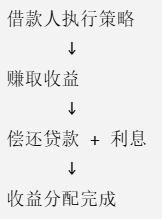
The withdrawal flow works in reverse. The API first plans the withdrawal path and identifies which positions need to be unwound, with each position forming a separate payout leg. For each payout leg, Ground signs and submits a redeem transaction. The Portfolio Wallet calls MasterRouter, which uses AdapterRegistry to resolve the correct yield protocol. Receipt tokens are redeemed back into USDC, and once each payout leg settles, USDC is immediately sent from the Portfolio Wallet to the user’s destination address. The payout legs do not wait on one another and can settle in parallel.
TRON summarized the mechanism this way:
- Deposits: user → Ground monitoring → router pathing → yield protocol → receipt tokens credited
- Withdrawals: yield protocol → redeem → USDC returns → payout legs settle in parallel
- Core components: MasterRouter, AdapterRegistry, and Portfolio Wallet
- Core features: a unified entry point for multiple strategies, automated routing, leg-by-leg settlement, and fast withdrawal capability
TRON said Ground’s strengths come from its API-based access layer, Portfolio Wallet design, and automated routing architecture. Together, they give banks and fintech firms an institutional entry point into on-chain yield without requiring them to build DeFi infrastructure internally. Idle stablecoins can be routed into multiple yield protocols, including Morpho and Maple, while the platform supports automated rebalancing, cross-chain settlement, and transparent reporting. The report also highlighted Turnkey’s non-custodial key management and policy-based permissions as features that help balance compliance, security, capital efficiency, and product readiness.
The weaknesses, according to TRON, are tied to complexity and dependency. The system relies on several layers of on-chain routing and off-chain coordination, including monitoring, signing, webhooks, and cross-chain execution. That creates a heavier architecture and raises dependence on infrastructure stability, protocol integrations, and the quality of third-party yield sources. In stressed conditions, the report said, cross-strategy liquidity and execution delays could still create operational risk.
Macro review: housing weakens, PMI stays firm
TRON’s macro review repeated several of the week’s headline data points. U.S. housing starts for July, released on Aug. 18, fell 12.4% month over month to a seasonally adjusted annual rate of 1.239 million and were down 13.5% year over year, showing that elevated financing costs were still weighing on property investment. Building permits, however, rose 5.0% to 1.443 million.
The July FOMC minutes, released Aug. 19, showed clear differences inside the Fed. The July meeting held rates unchanged by a 9-3 vote. Multiple officials said further rate hikes could still be necessary if inflation fails to cool more. TRON said this limited expectations for a rapid shift toward easier policy.
On Aug. 21, the preliminary August S&P Global U.S. Composite PMI came in at 56.0, the highest reading in 52 months. Services PMI rose to 56.8, while manufacturing PMI slipped from 53.9 to 53.2. TRON described that mix as strong services growth, cooling manufacturing at the margin, and some easing in price pressures.
Key data events for Aug. 24-30
TRON said the most important window next week falls between Aug. 25 and Aug. 28.
- Aug. 25: U.S. consumer confidence for August, July new home sales, and June Case-Shiller home price data
- Aug. 26: U.S. July PCE, core PCE, personal income and spending, and the second-quarter GDP revision
- Aug. 27: U.S. initial jobless claims, July goods trade balance, and inventory data
- Aug. 28: final August University of Michigan consumer sentiment and 1-year and 5-year inflation expectations
TRON called Aug. 26 the most important data day of the week. The report said the market expects core PCE at about +0.2% month over month and about +3.2% year over year, and said that figure will directly affect expectations for the September FOMC rate path.
The bigger issue, TRON added, is not just the data itself but the repricing of central bank expectations around it. On Aug. 28, Fed Chair Kevin Warsh is scheduled to speak at Jackson Hole. Markets will be watching closely for his assessment of inflation still running above target, recent growth resilience, and the likelihood of future rate hikes.
Policy and regulation: SEC, CLARITY Act, CFTC, and MiCA
Regulation was another major focus of the weekly report, with TRON highlighting fresh developments in the U.S. and Europe.
SEC proposes a dedicated issuance framework for crypto assets
On Aug. 18, the U.S. Securities and Exchange Commission formally proposed “Regulation Crypto Assets.” TRON called it one of the most important crypto regulatory changes globally this week and said it marks the SEC’s first attempt to build a securities issuance regime tailored to some crypto asset investment contracts.
The framework includes two Securities Act registration exemptions:
- One category would allow projects to raise up to $5 million over four years
- A second category would allow up to $75 million in any 12-month period, with stricter financial disclosure and ongoing reporting obligations
The SEC also proposed a conditional safe harbor for “investment contracts.” If an issuer has completed, or permanently ceased, its promised key managerial efforts and meets the stated conditions, the related crypto asset may no longer be treated as subject to an investment contract analysis.

TRON said the proposal points to a shift away from a regime built mainly on enforcement actions and case-by-case judgments, toward a clearer framework for token fundraising and project development. The proposal was published in the Federal Register on Aug. 21, and comments will be accepted until Oct. 20, 2026.
CLARITY Act gets a clearer timetable
On Aug. 19, the White House convened executives from Coinbase, Kraken, Ripple, Gemini, and Robinhood, along with regulators including SEC Chair Paul Atkins and CFTC Chair Michael Selig. TRON said Donald Trump publicly urged Congress to advance the CLARITY Act.
The bill’s core purpose is to establish a comprehensive regulatory framework for U.S. digital asset markets and clarify the line between the SEC and the CFTC. The Senate has scheduled a procedural vote for Sept. 15.
TRON stressed a key distinction here: as of Aug. 23, the CLARITY Act has not passed. The new development this week is a clearer vote timetable and more explicit political backing, not enactment.
CFTC pushes for a larger federal role in DeFi and prediction markets
From Aug. 19 to Aug. 21, the CFTC kept advancing discussions tied to digital assets, AI, and prediction markets. TRON singled out the fight over jurisdiction in prediction markets as especially important. Several U.S. states are trying to take action against related platforms under gambling laws, while the CFTC argues those contracts fall under the federal Commodity Exchange Act and should primarily be regulated by the commission.
That leaves an active legal dispute between state-level regulators and federal jurisdiction. TRON said the shift shows how U.S. digital asset oversight is expanding beyond SEC-led arguments over whether tokens are securities and into a broader redefinition of the CFTC’s authority over on-chain derivatives, prediction markets, and decentralized trading activity.
MiCA enters the fully licensed supervision phase
On Aug. 21, the European Securities and Markets Authority updated the MiCA Interim Register, continuing to publish information on crypto-asset white papers, asset-referenced token issuers, e-money token issuers, authorized CASPs, and non-compliant entities.
TRON emphasized that MiCA’s transition period ended on July 1, 2026, which was not a new policy move this week. The fresh change during Aug. 16-23 was ESMA’s continued update of the centralized database and supervisory system under a fully licensed regime. For the European market, the report said, the focus has shifted from drafting MiCA to license execution, market access, identification of non-compliant entities, and ongoing supervision.
TRON ended the report with a reminder that markets carry risk and that the report does not constitute investment advice. Readers, it said, should assess whether any opinions, views, or conclusions fit their own circumstances and bear responsibility for investment decisions made on that basis.