
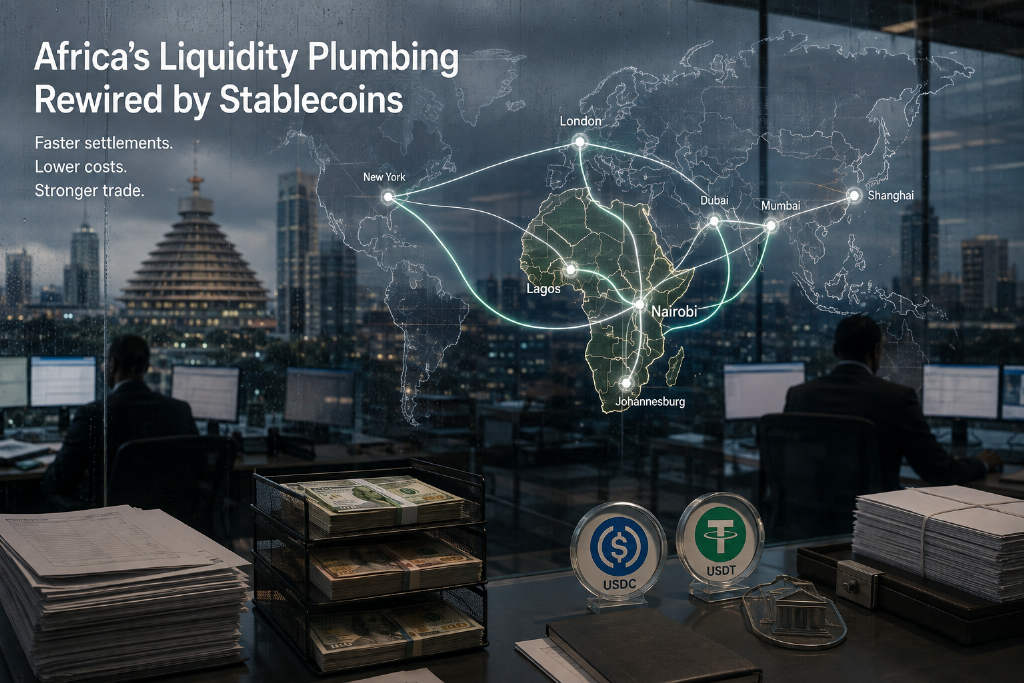
As stablecoins move into cross-border settlement flows in Africa, the debate usually starts with three questions: Will they accelerate capital outflows and strain local currencies and regulatory systems? If connecting counterparties and payment rails is enough to start doing business, where is the real barrier to entry? And if more participants enter and FX spreads keep tightening, where does long-term value actually settle?
The article’s answer is that stablecoins may open the door to a restructuring of Africa’s liquidity markets.
Africa does not lack dollars in the abstract, it lacks liquidity plumbing
The piece describes the issue as a “plumbing problem.” In many African cross-border trade scenarios, money is not completely absent. The problem is that it cannot reach the right counterparty, at the right time, and at an executable price.
Trade revenue may sit in Europe or the United States, while procurement payments need to be made in China or elsewhere in Asia, with local fiat delivery still required on the receiving side. Capital is spread across different countries, accounts, banks, and counterparties, without a financial hub that can move, concentrate, recycle, and redistribute liquidity efficiently.
That means the challenge is not just the total stock of dollars. It is whether dollars can be mobilized at the right node. One participant holding dollars or stablecoins does not mean an importer on the other side can obtain a firm quote. A quoted exchange rate in the market does not mean a business can complete FX conversion, settlement, and final delivery.
According to the article, stablecoins do not create dollars. What they may do, for the first time, is change how these fragmented pools of capital connect: making it easier to move funds across institutions and time zones, shortening the lag between pricing, execution, and delivery, and creating links between liquidity pools that were previously trapped in separate corridors.
The regulatory question is not simply whether to open up
The article says stablecoins will, by definition, lower friction in dollar movement and cross-border transfers. Capital outflows, pressure on local currencies, and market stability are therefore issues regulators have to treat seriously.
But the author says what they have observed in Africa is not blanket hostility from regulators. Instead, many governments and regulators that want to push trade, capital formation, and financial systems forward are exploring how to move fragmented, inefficient, low-visibility liquidity into a market that is more open and more connected.
Relying for too long on official quotes, bank limits, and fragmented settlement routes, the article argues, cannot support further trade expansion or regional economic opening. The opportunity with stablecoins is that funds stranded across different accounts, countries, and counterparties can be moved, settled, and put back to work more quickly.
That opening is not cost-free. For many African markets, this is not a simple acceleration layered on top of an already mature system. The article calls it a fundamental transition from fragmented, low-visibility liquidity structures toward more market-based price discovery. Existing banking, FX, payment, and informal settlement chains would all need to adjust, while demand, exchange rates, bank positioning, and market expectations would be repriced.
That friction, in the author’s view, does not mean countries are unwilling to open. It means the process needs sequencing, speed control, supervised channels, and liquidity buffers.
The real policy questions, the article says, are these: which genuine trade and settlement needs should gain more efficient liquidity first; which channels must remain inside regulated systems; who should provide buffer liquidity; and under what conditions can the market absorb fuller price discovery?
In that framing, stablecoins are not the endpoint of liberalization. They are an opportunity to turn openness itself into infrastructure.
Connecting liquidity requires more than access to a token and a payment channel
From the outside, this can look like a low-barrier business. Find stablecoins, find local fiat on- and off-ramps, find counterparties, and quotes can start flowing.
The article pushes back on that idea. What stablecoins open up is not merely a trading opportunity. They open the possibility of building a next-generation liquidity market. And building a market requires more than matching one trade at a time. It requires capabilities that can sustain activity at scale and earn acceptance across institutions.
Settlement capacity
The first requirement is settlement capacity. That includes global dollar liquidity and settlement capabilities through international counterparties, banking networks, SWIFT, stablecoins, custody arrangements, and clearing networks. It also includes local fiat collection, payout, and final delivery. The difficult part, the article says, is not sending money out from one end. It is completing executable delivery on both the global and local sides.
Compliance and regulatory capacity
The second requirement is compliance and regulatory capacity. Trust here is not a branding exercise. It is expressed through customer identification, source-of-funds checks, transaction records, sanctions screening, exception handling, audit capability, and ongoing communication with regulators. Only when banks, regulators, and global counterparties can see and manage risk can liquidity move from fragmented bilateral networks into the formal financial system.
Institutional FX operating capability
The third requirement is institutional foreign-exchange operating capability. The article says this goes well beyond ordinary back-office work. It covers pricing, positioning, trade confirmation, fund transfers, settlement timing, failed-trade handling, and risk controls. There is a large gap between completing a trade and operating a cross-border liquidity market in a stable way.
By that logic, the real barrier in this market is not whether a firm can connect to a single source of liquidity. It is whether it can organize global settlement, local delivery, compliance, regulatory oversight, and institutional-grade FX operations into a durable market capability.
If liquidity becomes more efficient, value may migrate up the stack
The article says investors often ask what happens once participation broadens and pricing becomes more transparent. Do FX spreads keep compressing until the business turns into a race to the bottom?
If the activity remains limited to stablecoin dealing and FX spread capture, the author says the answer may well be yes. Narrower spreads are not an anomaly. They are a sign that a liquidity market is maturing.
But the more important question is what firms, banks, and trade networks can build once liquidity is organized more effectively. The article maps that progression as: liquidity → settlement → treasury management → trade finance.
Liquidity allows funds to be found, priced, and moved. Settlement makes cross-border transactions stable, trackable, and deliverable. Repeated trading and settlement capability then lets firms manage balances, currencies, and positions across multiple jurisdictions. And when orders, invoices, logistics, and receivables can be linked, trade finance can begin to form a credit layer that can be assessed and priced.
The article is careful on one point: settlement capability does not automatically become trade-finance capability. That next layer still requires risk models, real trade data, recourse structures, and balance sheets.
That, in the author’s view, is exactly why the opportunity does not stop at spreads. Tightening spreads do not mean the opportunity disappears. They mark the beginning of a shift from moving a single payment to organizing corporate funding and real trade activity.
From connecting funds to forming a market
The article closes by saying Africa does not need to replicate the financial infrastructure of other regions. It has a chance to build a new market capability around its own trade structure, liquidity distribution, and cross-border demand.
In that sense, the value of stablecoins is not that they replace the existing financial system, nor that they simply make dollars move faster. Their significance lies in turning capital that could not previously be pooled and circulated efficiently into financial resources that can be settled, managed, and used in support of real trade.
That is why, according to the article, the most important stablecoin opportunity in Africa is not a faster rail. It is a reorganization of the liquidity market itself.