

An article published by MarsBit, written by Decentralised.co and translated by TechFlow, makes a broad claim about stablecoins: once monthly stablecoin settlement volume moved past the U.S. ACH network, the dollar stopped being just a reserve currency story and started looking like an export technology for American institutions.
The piece argues that blockchain rails are emerging as infrastructure through which U.S. rules, market structure, and dollar liquidity can move into the rest of the world. It develops that idea through three areas: cross-border payments, tokenized assets, and programmable credit.
From monetary reach to institutional reach
The article says its starting point came from a note sent by OMVC’s Marc, who argued that stablecoins solve an orchestration-layer problem, not a dollar-scarcity problem. Dollar scarcity, in his framing, remains unresolved. Stablecoins alone do not fix that. Markets still need dollar liquidity to be injected into them.
Building on that view, the author says a number of startups are now creating a global financial orchestration layer on blockchain rails. The thesis is that blockchain may become the core infrastructure for exporting U.S. institutions and U.S. assets abroad.
To explain the idea of a common commercial language, the article reaches back to a story cited in The Ascent of Money from Herodotus: Carthaginian traders and an unnamed Libyan tribe on the west coast of Africa carried out silent trade by leaving goods and adjusting piles of gold until both sides accepted the price. No words were exchanged, but both parties still shared a mechanism for agreement.
The author uses that story to argue that commerce has always been about finding a shared language for pricing. In modern markets, that price may show up as an interest rate, an FX cost, or the dollar amount needed to complete a transaction.
Institutions such as the World Bank and the International Monetary Fund are presented as one layer of that shared language for sovereign finance. SWIFT is treated as the equivalent for bank-to-bank cross-border communication. Visa, Mastercard, and the Depository Trust & Clearing Corporation, or DTCC, extended that grammar into payments, card networks, clearing, and settlement. For more than 70 years, the article says, global trade has leaned on institutions that make strangers legible to one another.
But the author also argues that these systems have limits. Trust sits in legislation, bank relationships, and operating procedure, yet cannot be continuously verified or enforced through shared technology. A globally shared ledger, verified by all relevant parties, is presented as a possible improvement.
The piece says Visa, Mastercard, DTCC, and even SWIFT have all recognized that possibility and have moved toward blockchain in different ways. Its internal thesis is direct: blockchain could do to capital market assets what the internet did to information. Access costs fall toward zero, verification speeds up, and the world starts to resemble a single capital market.
Tokenization, in that framework, is an attempt to give different economies a common language. But the assets flowing through that language only matter if the institutions backing them are strong enough. The article places the United States at the center of that structure, arguing that its institutional setup has been able to balance risk through interest rates and public interests through regulation, while also supporting the development, export, and capitalization of technology.
That leads to the article’s central formulation: the dollar is a mechanism through which the world can access the benefits of those institutions, stablecoins are an export form of the stability those institutions provide to Americans, and tokenization is the grammar that executes the language.
Several figures are used to support that argument. The article says total stablecoin supply is now about $315 billion. Tether alone is described as having roughly $141 billion in direct and indirect exposure to U.S. Treasuries, placing it 17th among global holders of U.S. government debt, ahead of South Korea and the United Arab Emirates. It also says stablecoins settled $7.2 trillion in February 2026, the first month they exceeded the U.S. ACH network. On that basis, the author says the world economy is moving on-chain, with tokenized equities, credit, and treasuries acting as major routes into that transition.
Tokenized assets as a new capital aggregation layer
The article argues that developers around the world will soon be able to build end-user products on top of the assets these financial technology platforms have brought on-chain.
It lists a range of examples:
- Robinhood as a route to tokenized stocks and real-world assets, or RWA;
- Centrifuge, through products such as JAAA, for tokenized AAA-rated credit;
- BlackRock’s BUIDL for money market funds on-chain;
- Ondo for bringing public securities on-chain;
- Apollo and Hamilton Lane, through Securitize, for private credit and private market funds;
- Superstate for infrastructure that would let listed companies issue and trade stock on-chain;
- and tokenized venture fund interests from Blockchain Capital that can already be bought on-chain.
The article says most users will not interact with these products directly. In many emerging markets, the dollar remains the main gateway into global finance. Exporters, freelancers, and others who earn dollars are likely to view dollar-denominated instruments as attractive for three reasons outlined in the piece: they can hold value better than local currencies under inflation pressure, they can connect to global capital markets through venues and assets such as Hyperliquid, tokenized stocks, and meme assets, and they are highly liquid and easy to send across borders.
In a number of emerging markets, the article says, these dollar representations can trade at a premium. During periods of market stress and at specific points in time, that premium has reached 10% to 15%. Companies that can turn local economic flows into something legible on a global ledger are therefore likely to become valuable. The author describes them as businesses that extract context from local institutions and make it understandable to the rest of the world.
The comparison offered is the internet. Google Maps mapped streets. Social feeds mapped culture. A new set of financial products, the article says, is now mapping where assets come from and how they move.
Keyrails and the trade-finance problem
The article’s first detailed case study is cross-border trade. Exports and imports, it says, are among the most common forms of communication between nation-states, and SWIFT has long served as the messaging layer for that communication. Settlement times, though, vary widely by region.
One example in the piece is a Nigerian importer buying goods from China. According to the article, the Chinese supplier may demand a 60% prepayment in dollars.
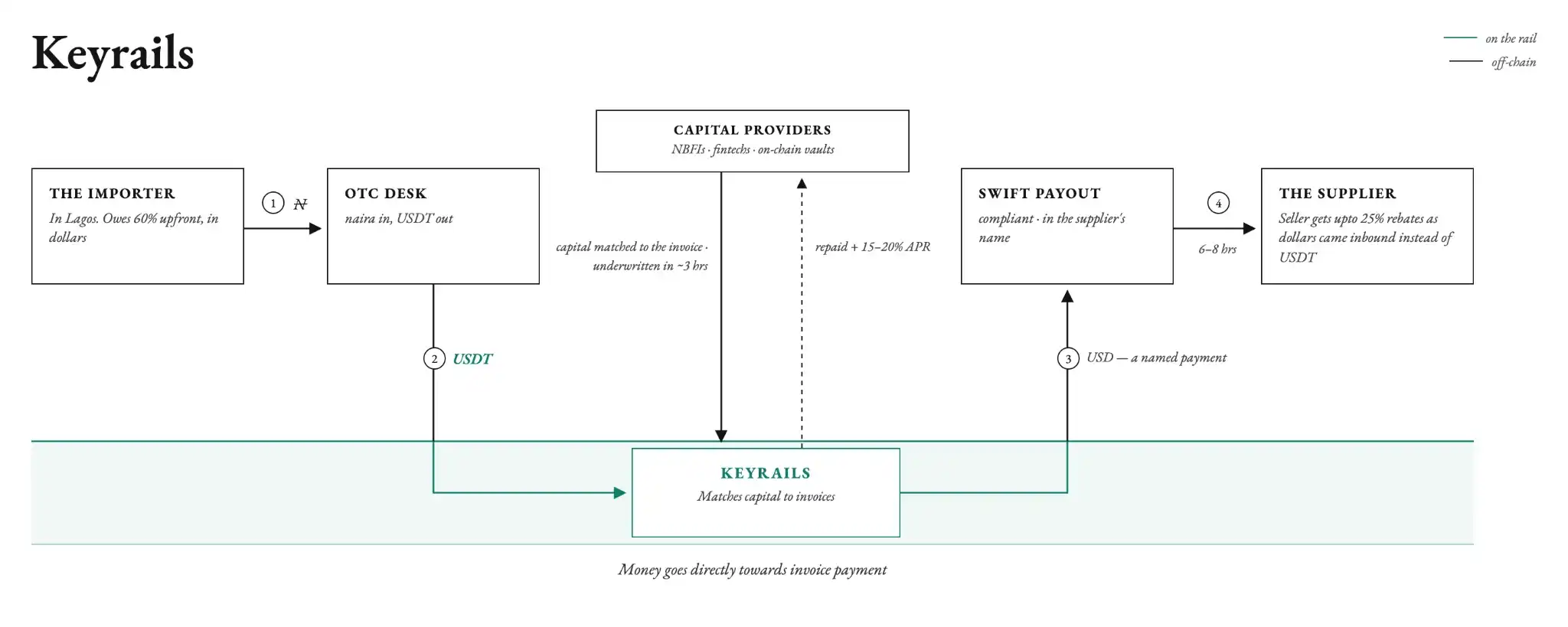
The obstacle is access to dollars. States often restrict dollar availability to protect foreign exchange reserves. A wire transfer in dollars to China, the article says, may take seven to 10 days even if the sender has the right banking relationship, uses the right bank, and maintains the required balance. In most cases, it adds, people do not have all three conditions at once.
On the other side, if a Chinese supplier accepts payment in stablecoins, the supplier may give up an export tax rebate of as much as 13%. That leaves both sides wanting to transact, but without rails that support the trade efficiently. Documentation burdens, fraud risk, and the difficulty of litigating disputes across jurisdictions all add friction.
Keyrails is presented as a payment and credit orchestration layer rather than a lender using its own balance sheet. The company acts as a clearing layer that connects importers with outside capital providers, including non-bank financial institutions, fintech firms, and more recently on-chain treasuries, while controlling how the borrowed funds can be used. The economics cited in the article are that lenders earn about 15% to 20% annualized, borrowers pay 20% to 25%, and Keyrails keeps around 2.5% to 5% of spread plus fees from the payment rails.
The author stresses that this is borrowing cost, not FX conversion cost. For many importers, the relevant alternative is not a cheap bank loan that does not exist in practice, but the premium paid in parallel currency markets.
In the structure described, Keyrails absorbs naira held in the form of USDT after conversion through regional over-the-counter desks or exchanges. It then pays the supplier through its SWIFT rails. Lenders can pull three months of transaction history through an API and complete loan approval in roughly three hours. The funds never go to the borrower directly. Instead, the capital is matched to the seller’s invoice and settled in China over SWIFT.
The economics work, the article argues, because borrowers compare Keyrails not with hypothetical cheap financing but with a 20% to 30% FX premium in stressed periods and a settlement time of seven to 10 days. Against that benchmark, an annualized loan priced at 20% to 25% that settles in six to eight hours can still be cheaper, especially when the loan tenor is short. Over a three-month period, the article notes, a 20% to 25% annualized rate works out to roughly 1% for the term before fees and collateral effects, far below paying a 20% to 30% currency premium upfront.
The supplier’s benefit is also straightforward in the article’s telling. Dollars arrive directly into a bank account as a compliant named payment, allowing the supplier to keep access to local export tax rebates, something direct stablecoin settlement does not offer.
From there, the author says Keyrails’ real value is not its cost of capital. It is control over the rails that make lending safer. The company standardizes digital intake of trade data, builds cross-border payment rails, and restricts how funds are used inside its own system so borrowed capital can only pay genuine invoices. Its moat, in this framing, is the combination of underwriting data, compliant settlement, and purpose-constrained funds. Each completed transaction makes regional trade flows easier for global dollar capital to understand.
SemiLiquid and programmable collateral
The second case study focuses on SemiLiquid, which the article says addresses a different part of the equation. If Keyrails is about moving money more quickly across less organized sectors, SemiLiquid is about keeping collateral still among known counterparties that share access to it. The common idea is scope control. In Keyrails, money can leave only through approved rails. In SemiLiquid, the asset does not need to leave custody at all.
The article argues that tokenization changes an asset’s representation, but not automatically its usefulness as collateral. If a bank, fund, or trading desk holds tokenized treasuries, money market funds, equities, or credit instruments at a custodian, those assets become much more productive if they can be financed. Without margin or credit, tokenized assets are little more than digital wrappers around existing exposures. With credit attached, they become part of a larger financial machine.
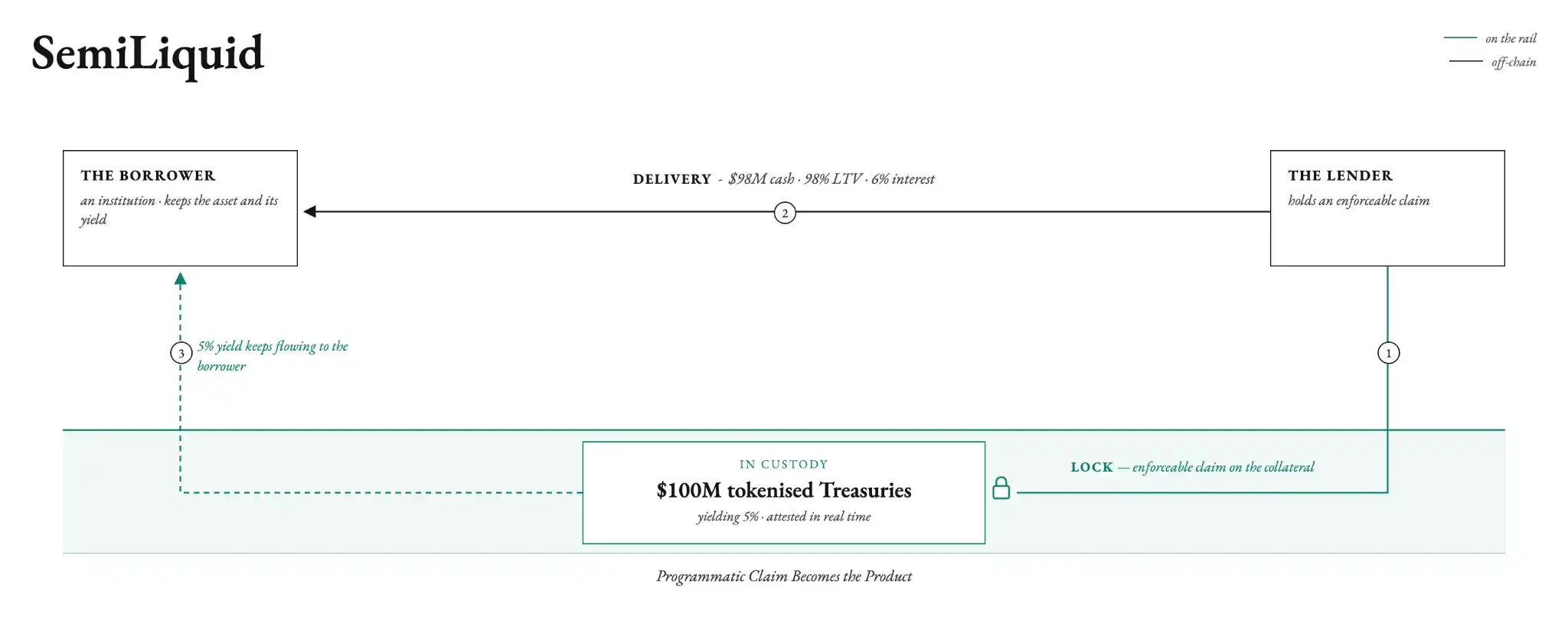
SemiLiquid’s Programmable Credit Protocol, or PCP, is described as a system that lets borrowers and lenders finance tokenized instruments without moving them out of custody. The borrower keeps the asset at the custodian and continues earning the underlying yield. The lender gets an enforceable claim on the asset. If the borrower repays, the lock is removed. If the borrower defaults, the lender can take control of the collateral under pre-agreed rules. The article sums this up as “delivery against lock”: cash can move, while collateral stays where it is unless enforcement becomes necessary.
To illustrate the structure, the piece gives a numerical example. An institution holds $100 million in tokenized U.S. Treasuries yielding 5% annually. At a 98% loan-to-value ratio, it can borrow $98 million without selling the underlying asset. At a 6% annual borrowing rate, the nominal interest expense is $5.88 million per year. But the collateral keeps earning 5%, generating $5 million annually. That leaves a net cost of about $880,000, or roughly 0.9% on the $98 million borrowed, before protocol fees, valuation haircuts, and custody charges.
The point, the author says, is that the borrower is not simply paying 6%. The relevant cost is the spread between debt expense and retained yield on the collateral. In a traditional arrangement, that retained income might be captured by a bank or custodian. With programmable collateral, the asset can stay locked for the lender while its yield still flows back to the borrower. The article says SemiLiquid is extending this logic across a broader network of tokenized assets and institutions that want to lend to one another.
The comparison to DeFi lending markets such as Aave is explicit. Institutions using this structure do not need to transfer assets into open smart contract pools, accept public liquidation mechanisms, or absorb the risk premium attached to permissionless borrowing. Assets can remain with regulated custodians and still become financeable. For lenders, the claimed advantages are faster due diligence and cleaner enforcement. Custodians can prove collateral status in real time, while the protocol prevents the same asset from being pledged twice on the same rail.
To show why that matters, the article points to the collapses of Three Arrows Capital and Archegos. Three Arrows left creditors with roughly $3.5 billion in claims. Archegos exposed a similar blind spot in traditional finance: Bill Hwang’s family office built overlapping swap exposure across multiple prime brokers, and Credit Suisse alone lost about $5.5 billion when positions were unwound. In both cases, the article says, the problem was not only falling prices. It was that lenders lacked a shared real-time view of what collateral existed, where it sat, and whether the same balance sheet strength was being shown to multiple counterparties at once.
SemiLiquid is framed as an attempt to close that trust gap through real-time collateral verification. Loans do not have to be visible to the whole market, but relevant parties can know whether collateral exists, whether it is locked, and whether it can be enforced.
The article says traditional secured lending often requires lawyers, back-office operations, custodians, and manual reconciliation to coordinate a single financing transaction. SemiLiquid compresses that process into programmable credit infrastructure. More importantly, it turns idle tokenized assets into collateral that can support borrowing, margin, and repo-like activity. In the author’s view, the next stage of tokenization is not simply to put assets on-chain, but to make them usable enough for institutions to earn extra basis points, borrow against them, and keep custody at the same time.
USD.AI and financing the GPU economy
The third case study is GPU-backed lending. GPUs, the article says, sit at the center of the AI economy and are expensive productive assets. It gives capex numbers for Meta, Amazon, Alphabet, and Microsoft: about $410 billion in 2025, with plans to spend roughly $725 billion in 2026, an increase of about 77%.
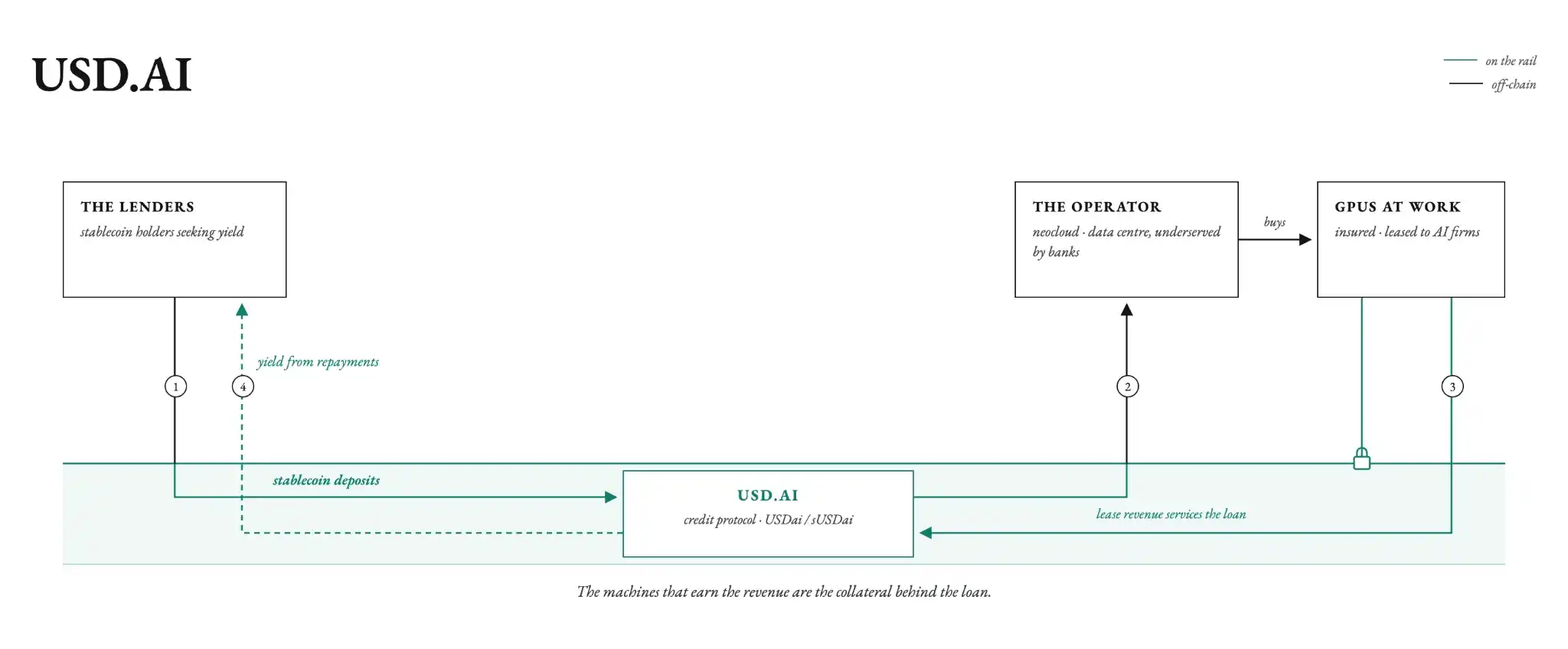
The comparison used is agriculture. If farming is the source of income, the article says, GPUs are the tractors: machines that convert capital expenditure into recurring output.
Companies can obtain credit facilities to buy GPUs if the hardware is expected to generate revenue by renting out compute power through third parties. Yet data centers and smaller AI infrastructure operators often cannot secure capital on the same terms available to Google, Amazon, or Microsoft. That creates an underserved market. Even setting loan terms is difficult because GPU prices, performance efficiency, and residual values change as models improve and enterprise demand shifts.
As of the time of writing, the article says USD.AI had about $398 million in total value locked, with around $202 million deployed in active loans. Loan sizes have grown from $1 million to $5 million in the early phase to a $98 million credit line tied to a 2,304-GPU cluster. The author says that means the collateral model has moved well beyond a pilot stage.
For lenders on USD.AI, the platform offers access to a market driven by hyperscaler demand and the growth of AI compute. For borrowers, the benefit is the ability to financialize existing assets without relying on traditional capital channels, while also getting access to funds more quickly. Both sides, the article says, benefit from the fact that GPUs can be treated as financial collateral if something goes wrong.
The target market is described as broader than data centers, startups, or hyperscalers alone. It is anyone interacting with the GPU economy. The value proposition lies in building a liquid loan market around a productive physical asset that is hard to finance. But underwriting in that market requires years of specialized experience, because a single bad loan could undermine confidence in the category itself. Put differently, the article says USD.AI is translating native GPU context into a credit framework that a global stablecoin liquidity pool can underwrite.
Why context becomes the moat
The article closes by saying these businesses look very different from what the market used to call DeFi. They use tokenization, blockchain rails, and stablecoins to speed up markets that have historically been underserved or badly organized. Their moat does not come only from code. It also comes from the depth of contextual information produced through every transaction cycle.
A loan on SemiLiquid PCP, a borrowing transaction on USD.AI CHIP, and a trade flow on Keyrails have one thing in common in the author’s view: each one creates trust and reputation that are difficult to replicate, while also giving the platform a way to review and refine its own processes.
That is why the article says the value of these companies will not come only from transaction volume. It will also come from the context they build around users, borrowers, and counterparties. The analogy is banking. The longer a customer stays with a bank, the more value the bank can extract through credit cards, mortgages, or fixed-income products. In the same way, these crypto-native businesses may be able to reduce their exposure to the sector’s cyclical swings, because import-export activity, lending, and margin demand persist across the wider economy in a way exchange trading does not.
The article ends on that note: this is how crypto may grow beyond trading and speculation and become the operating system for capital formation in the real world.