
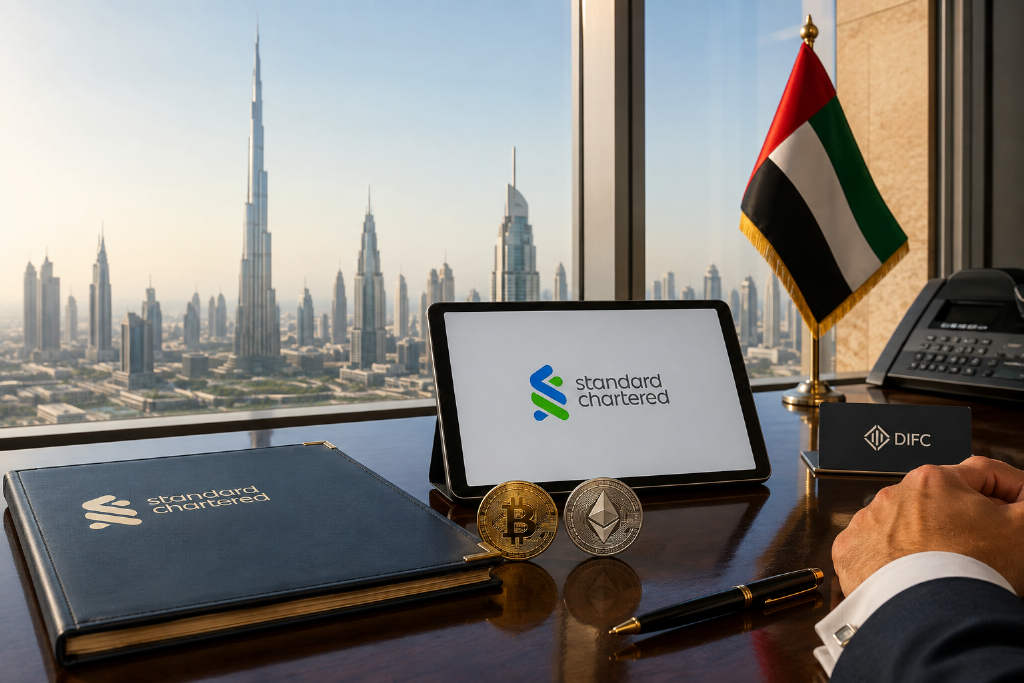
Standard Chartered said on Thursday that it has gone live with spot trading for Bitcoin (BTC) and Ether (ETH) for institutional clients in the United Arab Emirates, becoming the first global systemically important bank (G-SIB) to offer this kind of service. The bank is also described as the first mainstream international bank to provide institutional digital-asset trading in the market.
Service runs through its DIFC entity
The offering is being launched through Standard Chartered’s regulated entity in the Dubai International Financial Centre (DIFC). Eligible institutional clients can access BTC and ETH spot trading through the bank’s existing electronic trading channels and platforms.
That setup means clients do not need to open separate accounts with third-party cryptocurrency trading platforms to buy and sell digital assets. Instead, the trades can be executed inside the bank’s own system, folding crypto access into infrastructure clients already use.
A two-year buildout from custody to trading
The trading launch is not Standard Chartered’s first step in crypto. The report traces the bank’s recent expansion in the UAE through three milestones:
- September 2024: launch of digital-asset custody services in the UAE
- June 2026: banking agreement with crypto exchange CoinMENA covering fiat on- and off-ramps, client money accounts and virtual account trading management
- September 2026: launch of BTC and ETH spot trading
Taken together, those steps form a chain that runs from custody to banking rails and now to direct trading.
UAE continues to add crypto operators
The report says Standard Chartered’s move is part of a wider buildout in the UAE, which has been positioning itself as a crypto-asset hub in the Middle East. It cites recent approvals for other firms in the market:
- Capital.com received a virtual asset license from the UAE Capital Market Authority (CMA) in August 2026 and plans to offer spot crypto services
- Revolut received in-principle approval from Dubai’s Virtual Assets Regulatory Authority (VARA) in July 2026 to roll out crypto-related services
According to the report, clearer regulatory rules and a more developed licensing regime are giving both crypto firms and traditional banks a compliant route into the UAE market.
Why the G-SIB label matters
Standard Chartered is classified as a global systemically important bank, a designation used for banks seen as critical to the global financial system and subject to tighter oversight than ordinary lenders. Banks in that group have generally approached crypto cautiously, with concerns centered on capital requirements, anti-money-laundering compliance and the volatility of digital assets.
Against that backdrop, the bank’s decision to offer spot crypto trading to institutional clients carries broader significance than a similar launch by a smaller lender. The report says the move points to greater regulatory tolerance for digital assets at systemically important institutions, stronger institutional demand that large banks can no longer ignore, and the possibility that other G-SIBs may follow.