

Researchers at Stanford University and Together AI have introduced Next-Concept Modeling, or NCM, a text generation method positioned as an alternative to both autoregressive and diffusion-based language models. Rather than generating one token at a time or repeatedly denoising an entire sequence, NCM first produces a coarse conceptual outline in parallel and then refines that representation layer by layer until it is decoded into full text.
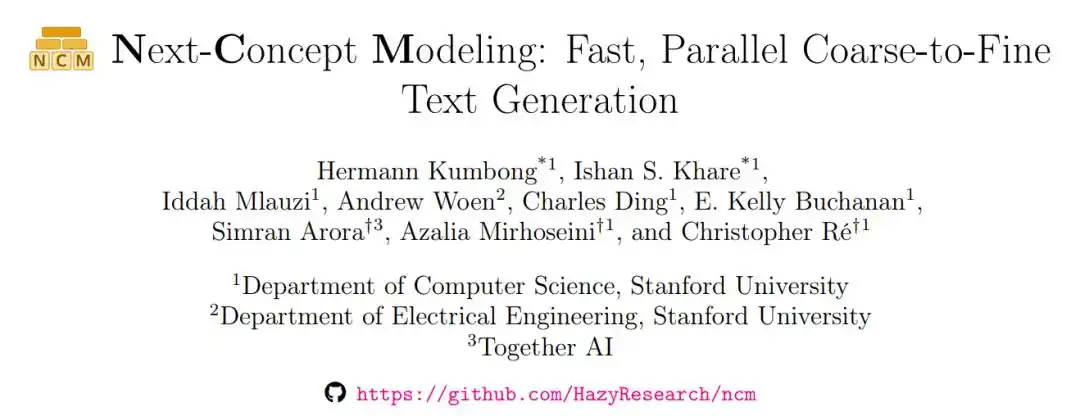
The paper is titled Next-Concept Modeling: Fast, Parallel Coarse-to-Fine Text Generation. The authors have also released code on GitHub.
Applying next-scale prediction to language
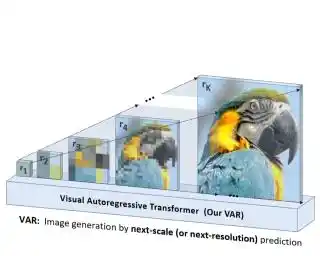
The work adapts the "next-scale prediction" recipe from VAR, the NeurIPS 2024 best paper in image generation, to text. In images, a model can generate a low-resolution version first and then add detail across scales. NCM asks whether text can also be represented in a hierarchical form, starting with a compact high-level sketch before expanding into a complete sequence.
That differs from the two main approaches now used in large language models. Autoregressive systems such as GPT, Claude, and DeepSeek predict the next token based on prior context, so later output depends on earlier output. Diffusion language models can process multiple positions at once, but they still need repeated denoising steps, and cutting those steps can hurt quality. Each round can also be expensive because the full sequence is handled repeatedly.
NCM changes not only the order of generation but also the object being generated at each stage. The question behind it is simple: if an image can begin as a low-resolution draft, can text begin as a form of thumbnail that still preserves meaning and can be refined later?
Language makes that hard. Shrinking an image usually leaves the main subject recognizable, while dropping a few characters from a sentence can change its meaning sharply. To handle that gap, the model learns a representation that is both abstract enough to summarize text and structured enough to support later refinement.
Two training stages
NCM uses a two-stage training setup.
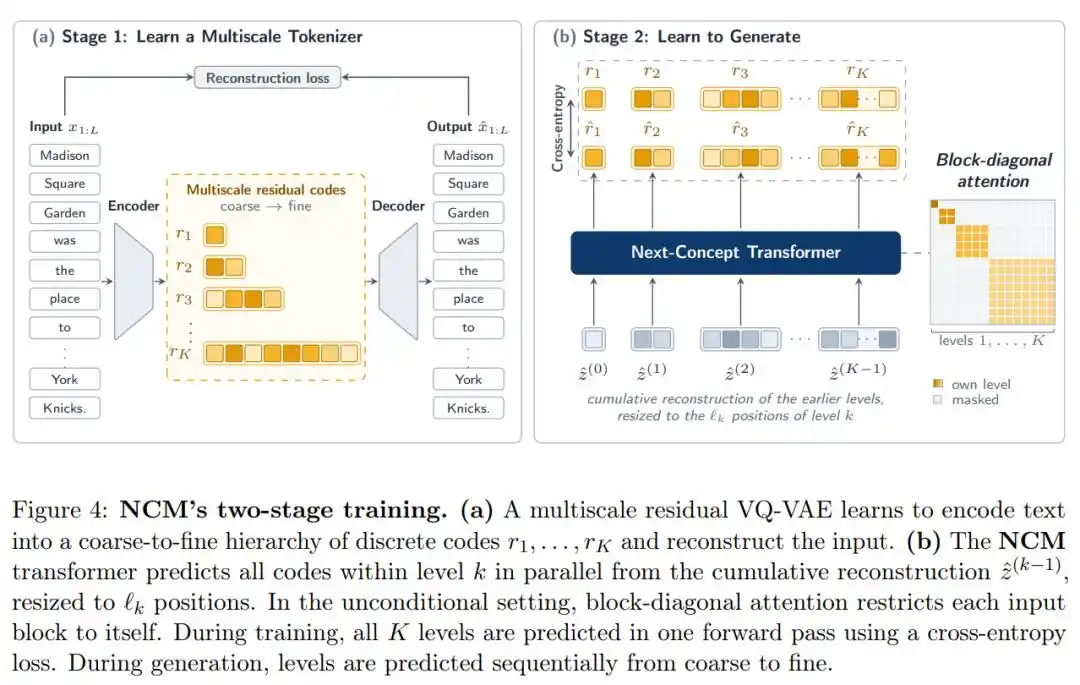
First, the researchers train a multi-scale residual VQ-VAE. In practice, this acts as a text encoding and reconstruction system. Original text is converted into several layers of discrete codes: earlier layers use fewer codes, later layers use more, and each layer adds information that earlier layers have not captured.
To keep the coarse layers from carrying too little information, the training process randomly drops later fine-grained layers and asks the system to reconstruct the original text using only what remains. That forces the earlier layers to contain useful content rather than offloading everything to later stages.
After that system is trained, it is frozen. A Transformer is then trained to predict the next layer from the accumulated representations of previous layers. At inference time, generation moves from layer to layer, with codes inside the same layer predicted in parallel, and a decoder turns the full stack back into text.
Example shown in the paper
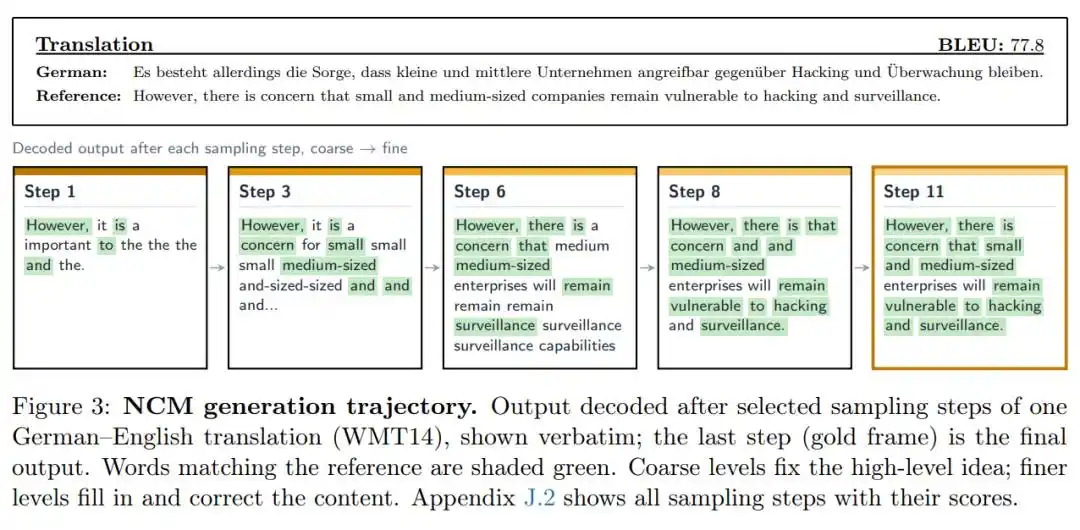
The paper includes a German-to-English translation example. Intermediate decodes show that early layers still contain repetition and incomplete phrasing. As more layers are added, the content becomes clearer, and by the eleventh step the output is a fluent translation.
That is a different generation pattern from straightforward token-by-token decoding. The model forms a rough global structure first and only then fills in the details.
Reported speed gains from 10x to 31x
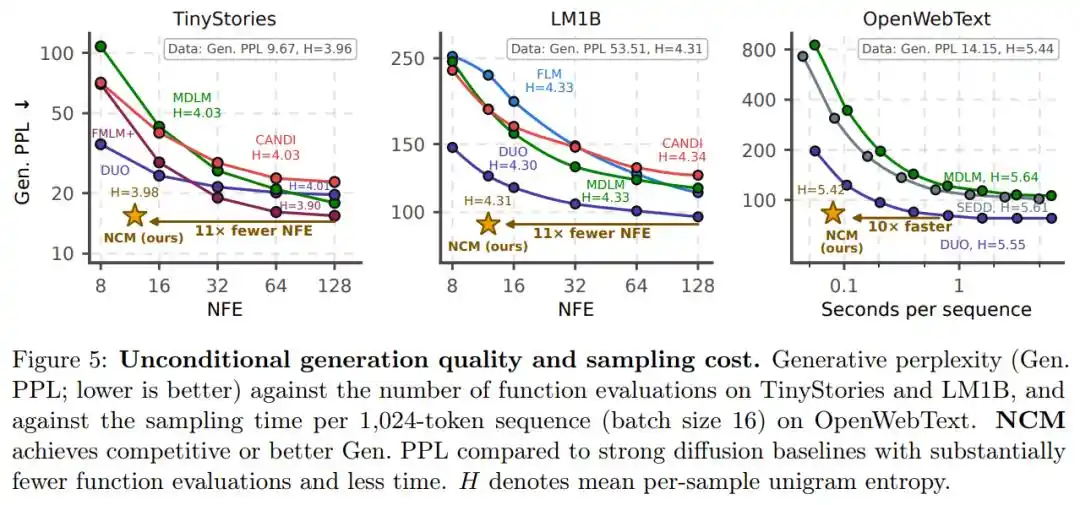
Speed is one of the paper's main claims. The authors attribute the gains to two factors. Fewer generation rounds must be executed sequentially, and early stages work on shorter code sequences, which lowers average per-step cost.
Tests were run on a single H100 SXM 80GB. On LM1B unconditional generation, NCM was about 21x faster than a strong diffusion baseline while also achieving better perplexity. On OpenWebText, the paper reports competitive quality with about 10x speedup. On XSum summarization, NCM reached roughly 31x the speed at comparable ROUGE-L.
The paper also reports lower training cost. On two datasets, it used 4.9x fewer tokens and 4x fewer tokens, respectively. For comparison, the baselines DUO and MDLM on OpenWebText were trained for 1 million steps and processed more than 500 billion tokens.
Sudoku results with fewer sampling steps
The authors also evaluated NCM on reasoning tasks including Sudoku. According to the paper, NCM outperformed autoregressive and diffusion baselines while using fewer sampling steps.
On difficult puzzles with only 30 clues, NCM achieved a full-solve rate of 86.1%, compared with 81.3% for FMLM+. The number of generator calls was 12 for NCM and 16 for FMLM+.
The paper suggests that refining the entire board layer by layer may be better suited to handling global constraints.
Using speed to sample more candidates
The authors also describe another way to use the extra speed: generate more candidates within the same time budget and then pick among them.
To test that idea, the team tried minimum Bayes risk decoding, selecting outputs based on similarity across candidates. The paper says this improved metrics on translation and summarization tasks.
Open questions remain
The paper stops short of presenting NCM as a finished path to general-purpose large models. The main experiments use a generator with about 100 million parameters, with scaling experiments extending to 725 million parameters. Whether the method keeps its advantages at larger sizes, and how it performs on precise text generation and long-form content, remains to be tested.
At the core of NCM is the idea that text can be modeled as a hierarchy of concepts and details. That lets a model plan first and write later. Whether that changes the roadmap for future language generation will depend on what later large-scale experiments show.
Paper: https://arxiv.org/abs/2610.14162
GitHub: https://github.com/HazyResearch/ncm
The source article also cited reference posts from Stanford Hazy Research and Scaling Intelligence, and said the piece originally came from the WeChat account "Jiqizhixin," edited by Zenan.