

China’s stock ETF market recorded a net outflow of 5.255 billion yuan on Aug. 28 after A-shares erased earlier gains and the three major indexes all closed lower. Combined turnover across the two exchanges reached 2.1 trillion yuan.
Some funds moved to the sidelines during the session. Even so, sector ETFs tied to semiconductors and chips, as well as broader products tracking the STAR 50 Index and the ChiNext Index, ranked among the day’s leading inflow targets. Over the past five trading days, ETFs linked to the ChiNext Index took in more than 4.6 billion yuan, while CSI 500-related ETFs absorbed more than 2.7 billion yuan.
Net outflow reaches 5.255 billion yuan
According to Wind data, China’s market had 1,551 stock ETFs with total assets of 3.51 trillion yuan as of Aug. 28, 2026.
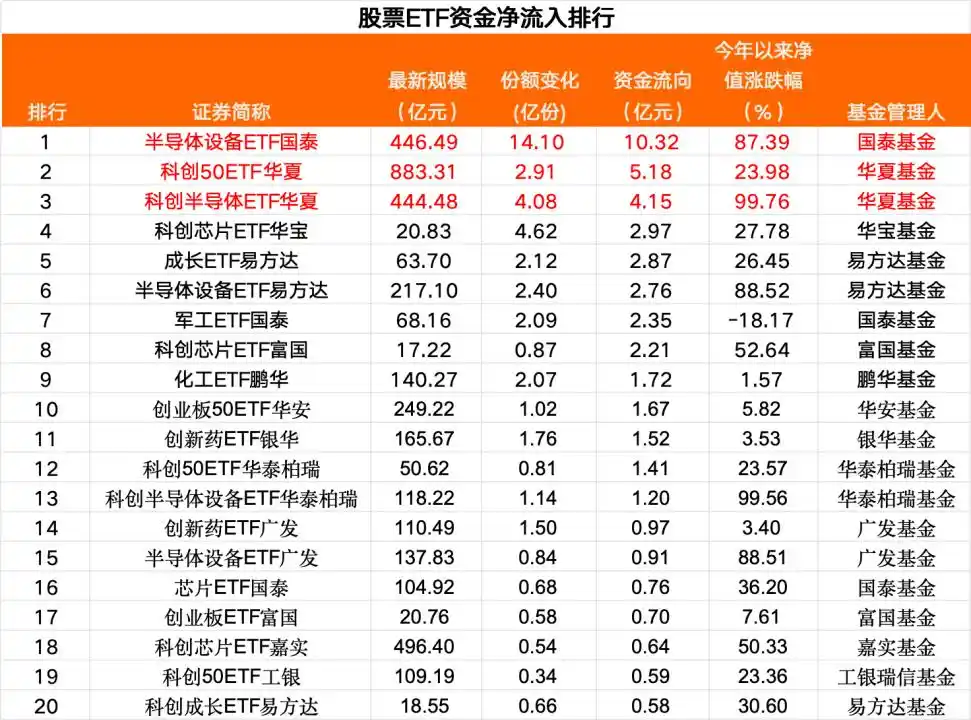
Wind data showed total ETF shares outstanding dropped by 2.219 billion units on Aug. 28. Based on the average trading price, that translated into a net outflow of 5.255 billion yuan for the day. Thirteen stock ETFs posted net inflows of more than 100 million yuan. Guotai’s Semiconductor Equipment ETF, ChinaAMC’s STAR 50 ETF, and ChinaAMC’s STAR Semiconductor ETF ranked first, second, and third in net inflows.
Among the top 20 stock ETFs by net inflow, nine were semiconductor- or chip-related products, drawing nearly 2.6 billion yuan in total. Five were tied to STAR Market semiconductors or STAR chip themes. Three tracked the STAR 50 Index, and two tracked the ChiNext Index.
Broad-based ETFs lead outflows
The market as a whole was dominated by net outflows on Aug. 28. By category, sector-themed ETFs and global market ETFs led inflows in the previous trading session, taking in 471 million yuan and 149 million yuan, respectively. Broad-based ETFs saw the largest outflows at 3.973 billion yuan. In terms of asset changes, broad-based ETF assets fell by 13.448 billion yuan.
At the index level, ETFs tracking the semiconductor materials and equipment index ranked among the strongest daily inflow products, with 1.47 billion yuan in net inflows. ETFs tracking the CSI 300 Index posted the largest daily net outflow at 1.552 billion yuan.
On a five-day basis, recent inflows into ChiNext Index-related ETFs exceeded 4.6 billion yuan, while CSI 500-related ETFs took in more than 2.7 billion yuan.
Wind data also showed that since the start of August, stock ETFs have still posted combined net outflows of more than 100 billion yuan, including more than 3 billion yuan in net outflows last week.
Large fund houses continue to draw money into selected ETFs
Data in the report showed that some ETFs managed by leading fund companies continued to attract inflows.
As of Aug. 28, notable inflow recipients under E Fund Management included E Fund Growth ETF, with assets of 6.37 billion yuan and net inflows of 284 million yuan; E Fund Semiconductor Equipment ETF, with assets of 21.71 billion yuan and net inflows of 272 million yuan; E Fund STAR Growth ETF, with assets of 1.855 billion yuan and net inflows of 57 million yuan; E Fund STAR Chip ETF, with assets of 4.648 billion yuan and net inflows of 46 million yuan; and E Fund Dividend ETF, with assets of 18.878 billion yuan and net inflows of 32 million yuan.
At ChinaAMC, the previous trading day’s leading ETF inflows went to ChinaAMC STAR 50 ETF and ChinaAMC STAR Semiconductor ETF, which posted net inflows of 518 million yuan and 415 million yuan, respectively. Their latest asset sizes reached 88.331 billion yuan and 44.448 billion yuan. The average daily turnover of their underlying tracked indexes over the past month was 8.17 billion yuan and 7.972 billion yuan, respectively.
Fund managers point to structural opportunities and AI
Chen Xiaoyang, a fund manager at China Universal Asset Management, said that while domestic demand in China still needs support and structural issues such as overcapacity in some industries remain unresolved, the conditions supporting the economy’s long-term positive trend and its underlying direction have not changed. In investing, he said, the focus should shift away from swings in aggregate data and toward structural opportunities in the stock market. Over the medium to long term, he said China’s “engineer dividend” is taking over from its “demographic dividend,” with a deep supply of highly skilled talent helping Chinese companies move up the global value chain, and that he remains positive on high-quality areas supported by that trend.
Looking to the second half of the year, Wang Wenlong, a fund manager at Yongying Fund, said AI remains a fast-growing track within the technology sector and may be the only change that is clearly real. He added that both domestic and overseas markets show earnings clues moving in sync across cloud, computing, storage, and networking. He said the next step will be to focus investment on AI subsegments where earnings delivery is more certain, while raising requirements for asset quality.
The report was published by the WeChat account China Fund News (ID: chinafundnews) and written by Tianxin. It was republished by MarsBit.