
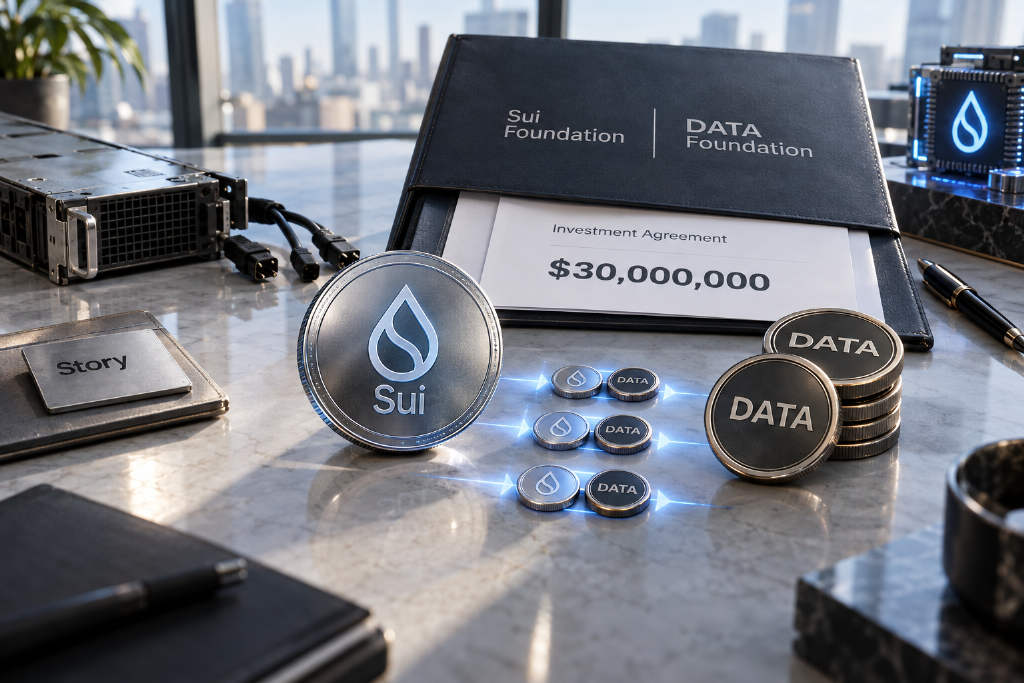
Sui Foundation and DATA Foundation said on Oct. 12 that Sui will invest $30 million in DATA Network, making Sui the network’s largest institutional holder. PIP Labs and DATA Foundation will retain their existing stakes.
Under the plan, DATA Network will become a protocol native to Sui, and its standalone blockchain will be retired. SY Lee will also join Sui Foundation as a strategic adviser.
The token reacted quickly after the announcement. DATA climbed from about $0.197 to $0.221 within two hours, up roughly 12%, while 24-hour trading volume expanded from around $10 million to more than $60 million. The move faded later in the day, with the price falling back to around $0.20.
DATA Network was previously known as Story Protocol, a project that once carried a $2.25 billion valuation. Over three years, it moved from a programmable IP blockchain to AI training data, and now it is giving up its own chain.
From Story Protocol to DATA Network
Story Protocol was founded in 2022 by SY Lee, with PIP Labs as the development company. The project was originally pitched as an IP blockchain where intellectual property could be registered, licensed, and monetized on-chain through automated revenue sharing. The idea was that creators’ works could then be used, adapted, and traded.
According to RootData, Story raised three rounds: $29.3 million, $25 million, and $80 million. Andreessen Horowitz, or a16z, participated in all three. Its Series B in August 2024 valued the project at $2.25 billion.
Story’s mainnet and IP token launched in February 2025. CoinGecko data shows IP reached an all-time high of $14.78 on Sept. 21 that year, then fell steadily. As of publication, the decline from that peak exceeded 98%.
After that high, the project changed direction. On June 25, 2026, Story rebranded as DATA Foundation. The IP token was converted to DATA on a 1:1 basis, and the business focus shifted from general IP infrastructure to AI training data.
At the same time, the team introduced Trace, an on-chain registry designed to record the origin and usage rights of training data and settle payments to contributors. Human data marketplace Kled joined as a core partner, and its founder Avi Patel became chief data officer at DATA Foundation.
Four months later, DATA changed course again. This time, it also gave up its own chain.
Rights holders did not arrive, and on-chain activity collapsed
DATA Foundation said the first pivot came because rights holders never truly entered the system. In explaining the rebrand, the organization said major music, gaming, and brand owners cared more about retaining control over their copyrights than placing valuable IP into an open licensing framework. That ran against Story’s original goal of making all IP programmable.
The gap had already surfaced in September 2025. At Story Origin Summit, SY Lee said Pinkfong, the producer behind Baby Shark, would launch its first official token through third-party issuance platform IP.World.
Days after the token went live, Pinkfong posted on X that the token had no connection to the company. The token price then crashed. IP.World later said the rights it obtained from one of Pinkfong’s licensees were defective. The on-chain registration had been completed, but the underlying rights were not valid.
As rights holders stayed away, usage on the chain shrank. DefiLlama data shows total value locked on the chain peaked at $45.12 million on Sept. 23, 2025. By publication, that figure had fallen to about $32,000.
Application revenue on the chain also dropped sharply, from about $145,000 in September 2025 to $3,893 in September 2026. The chain’s DEX recorded only $0.30 in trading volume over the past seven days.
There were also changes inside the team. In August 2025, co-founder Jason Zhao stepped down from his full-time role and became a strategic adviser.
Token unlock delays and limited traction in AI data
By 2026, a new pressure point had emerged: team and investor token unlocks that were originally due in February. In late January, Story’s board said it would delay the unlock by six months to August. The board said it would use that time to push revenue growth and product validation, and expected to announce a partnership with a large AI company in the third quarter.
When asked in February about near-zero on-chain revenue, SY Lee said on-chain revenue was the wrong metric. He said the team had intentionally kept gas fees very low and that Story’s business model centered on off-chain data licensing, not the kind of revenue profile seen on DeFi-focused public chains.
That framing changed six months later. On Aug. 5, DATA Foundation published a long post provided by PIP Labs saying the board had approved another delay. All locked tokens were pushed back to Feb. 13, 2028. The stated reason was that the model had started to work, with growth of more than 200x in a matter of weeks and chain fees ranking in the top 20.
The post also said insiders reviewed the on-chain data and chose to keep their tokens locked rather than cash out. DefiLlama data shows the chain was generating about $918 in fees over 24 hours as of publication.
At the same time, the AI data business had not yet produced much publicly named demand. As of publication, the project had not publicly identified any AI lab buying its data, and the large AI partnership previewed in January for the third quarter had not been announced.
Kled, described as a core data source, was said in June to have brought more than 1.5 billion data points to the network. By October, however, Sui’s official blog still described that data as being integrated, while Trace had recorded a cumulative 250 million data contributions since launch.
RootData also shows DATA Foundation itself is an investor in Kled.
Even with little usage, the cost of maintaining a standalone chain remained. The project said the move to Sui is meant to improve scalability and reduce the cost of running an independent Layer 1. The chain fees cited in August as evidence of traction will disappear with the chain itself.
What the $30 million deal includes, and what it does not
The size of Sui Foundation’s investment is notable. CoinGecko data shows DATA’s circulating market capitalization was about $73 million as of publication, which means the $30 million commitment is close to 40% of that figure.
Still, the public announcement did not explain the form of the investment, the source of the tokens, or the purchase price. It only said locked and vesting positions would remain unchanged after the migration. That came just two months after the project said insiders had chosen to keep tokens locked instead of selling.
At the token level, DATA will migrate to Sui on a 1:1 basis, with total supply unchanged. According to official materials, team and investor tokens will still follow the schedule announced in August, beginning to unlock in February 2028 and then releasing in tranches through 2031.
Once the migration is complete, validators, staking, AMMs, and other contracts on the original chain will be phased out. DATA will shift from being the protocol token to becoming the native token of Trace. On Sui, transaction fees will be paid in SUI, which means DATA will no longer serve its previous gas and staking functions.
The project said governance rights and tokenomics will be at least comparable to the current setup, but it did not provide specifics. Holders do not need to take any action for now, and a migration timeline will be announced later. Walrus is expected to become the default storage layer for DATA Foundation applications in the coming months.
Sui gains an AI data piece, but the core question remains
For Sui, the partnership adds an AI data component. Mysten Labs co-founder Adeniyi Abiodun said Sui and Walrus are positioned as a platform for AI data storage, licensing, and payments, and that the licensed data brought by DATA is already serving leading AI labs globally.
The migration also addresses one technical limitation in Trace. According to Sui, a Trace record currently proves only when a file was registered, and the hash in that record depends on metadata supplied by the application. After integrating Walrus, Trace will be able to store an encrypted copy of the original file, and the hash will be generated directly from the data itself.
That technical improvement does not answer the issue Story has faced from the beginning. The Baby Shark episode showed the distance between on-chain registration and actual authorization. From an IP blockchain to an AI data protocol, that gap has remained.
Crypto KOL AlΞx Wacy said that over the past few years, building a standalone Layer 1 had often been treated as a sign of project strength, but running a blockchain and building a product are two different jobs. Cutting something that has consumed years of work is harder than adding another feature to a roadmap.
In a broader context, Story’s position is not unusual. DefiLlama chain fee data shows that as of Oct. 14, 400 of 560 blockchains generated zero fees over 24 hours, 449 generated less than $10, and only five produced more than $100,000 in daily fees. DATA is not at the bottom of that list, but it still faces the same problem of not generating enough to cover the cost of maintaining an independent chain.
Story may not be the last project to hand over its chain. For DATA, moving to Sui addresses the cost side. Whether this third reinvention works will still depend on whether AI companies are willing to pay for the data.