

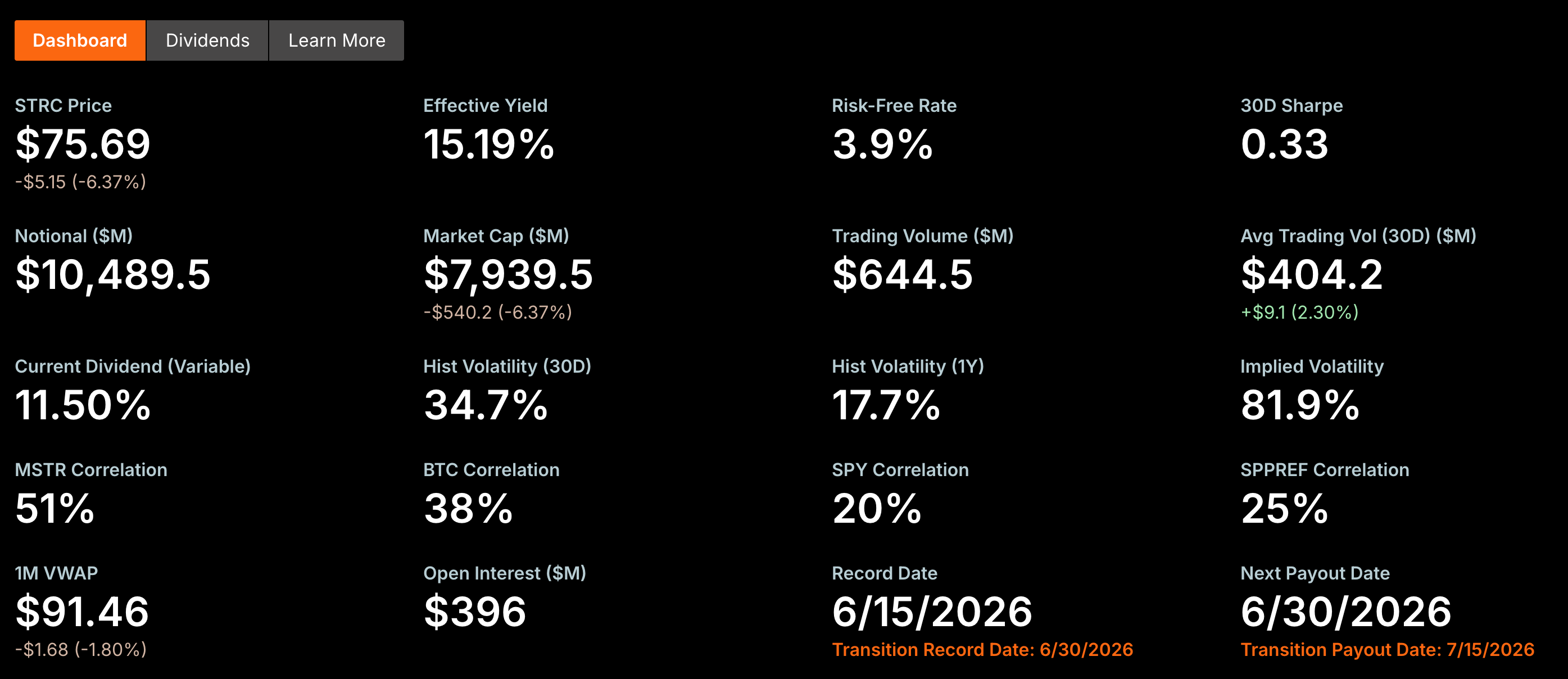
Strategy's perpetual preferred stock STRC has suffered a severe de-peg, with the price falling below $80 for the first time on June 26, 2026. During U.S. trading hours, STRC hit an intraday low of $73.62 before closing at $75.69, representing a de-peg of nearly 25% from its $100 target par value. This marks a sharp acceleration from the 11% de-peg observed just one week earlier.
As the centerpiece of Strategy's funding machine, STRC's collapse threatens the company's entire business model and the Bitcoin market's most reliable institutional buyer. This article provides an in-depth analysis of the cascading consequences and their potential impact on the BTC market structure.
STRC De-Peg Deepens: Below $80, Nearing 25%
The de-pegging of STRC is not a temporary fluctuation but a structural breakdown of the instrument's core design. Strategy designed STRC as a perpetual preferred stock with no maturity date, no dilution to common shareholders, and only a fixed dividend obligation. By dynamically adjusting the dividend rate, the company aimed to keep STRC trading around $100, enabling it to continuously issue new shares at near-par value to raise funds for Bitcoin purchases.
Michael Saylor once boasted that STRC was "designed by AI, something humans couldn't create." However, the market now doubts the sustainability of this funding mechanism. The price drop below $80 implies that new investors can buy STRC on the secondary market at a 25% discount to the issuance price, making it irrational to participate in new offerings at $100. This effectively kills Strategy's cheapest funding channel.
STRC's Function: The Cheapest Funding Channel Now Blocked
STRC was the most efficient tool in Strategy's funding arsenal. Unlike common stock offerings that dilute existing shareholders, or convertible bonds that create future debt repayment obligations, STRC provided perpetual capital with only a fixed dividend cost. The company had issued approximately $10.49 billion in STRC at an 11.5% dividend rate, resulting in annual cash dividend obligations exceeding $1.2 billion. Including other preferred stock series (STRD, STRK, STRF), total annual preferred dividends reach approximately $1.7 billion.
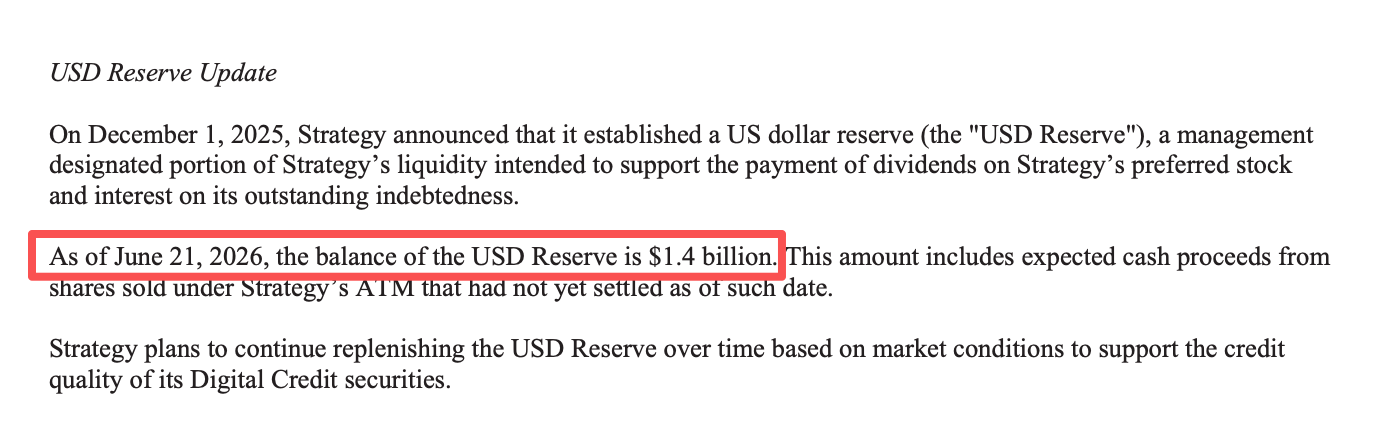
According to Strategy's June 21 common stock filing, the company's cash reserves stood at approximately $1.4 billion. At the current dividend burn rate, this cash pile covers less than one year of preferred dividend payments. The company faces an immediate cash crunch, not just a future funding problem.
Three Survival Paths: All With Heavy Costs
With STRC funding effectively blocked, Strategy has only three options to raise money, each with significant trade-offs.
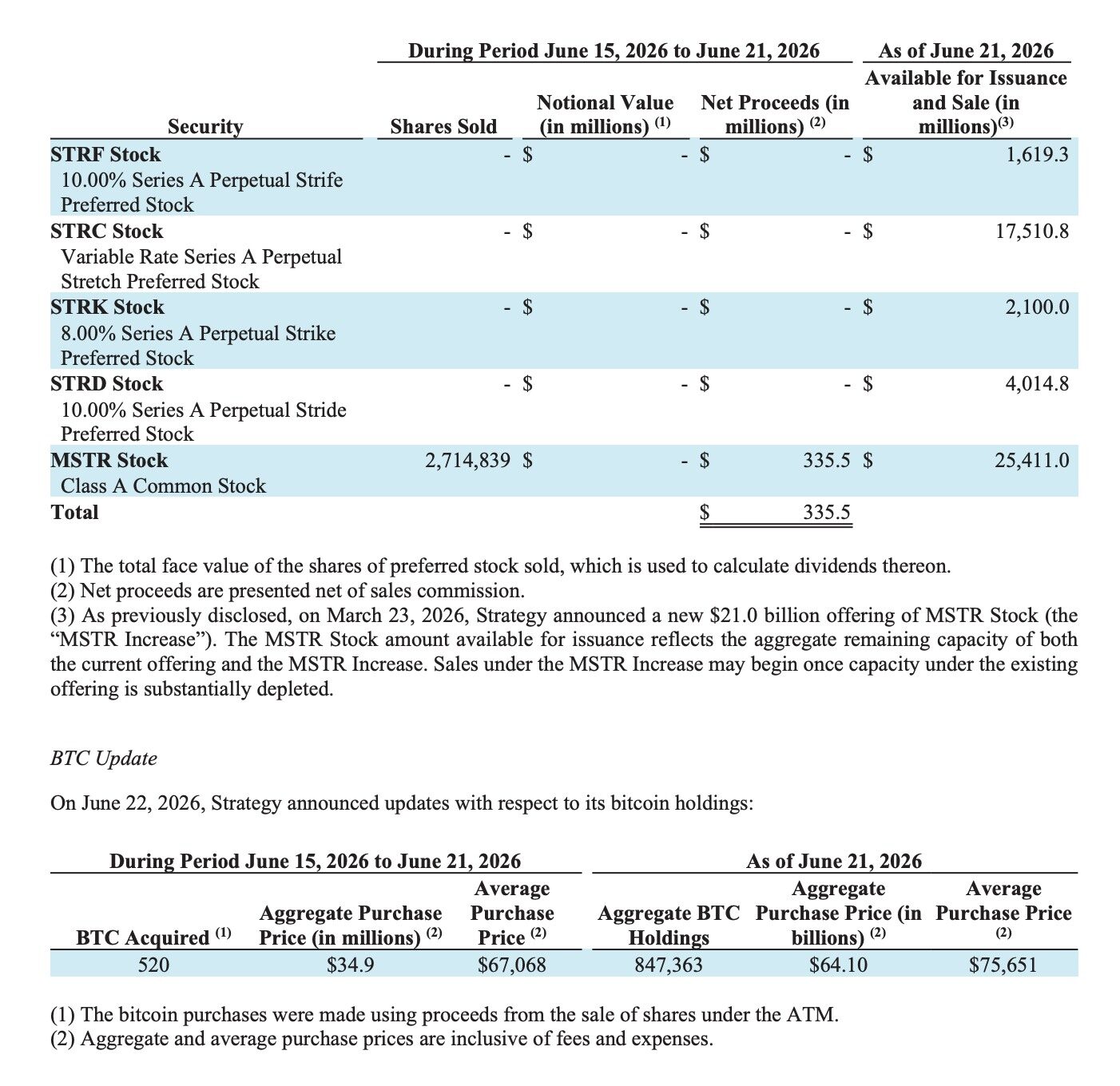
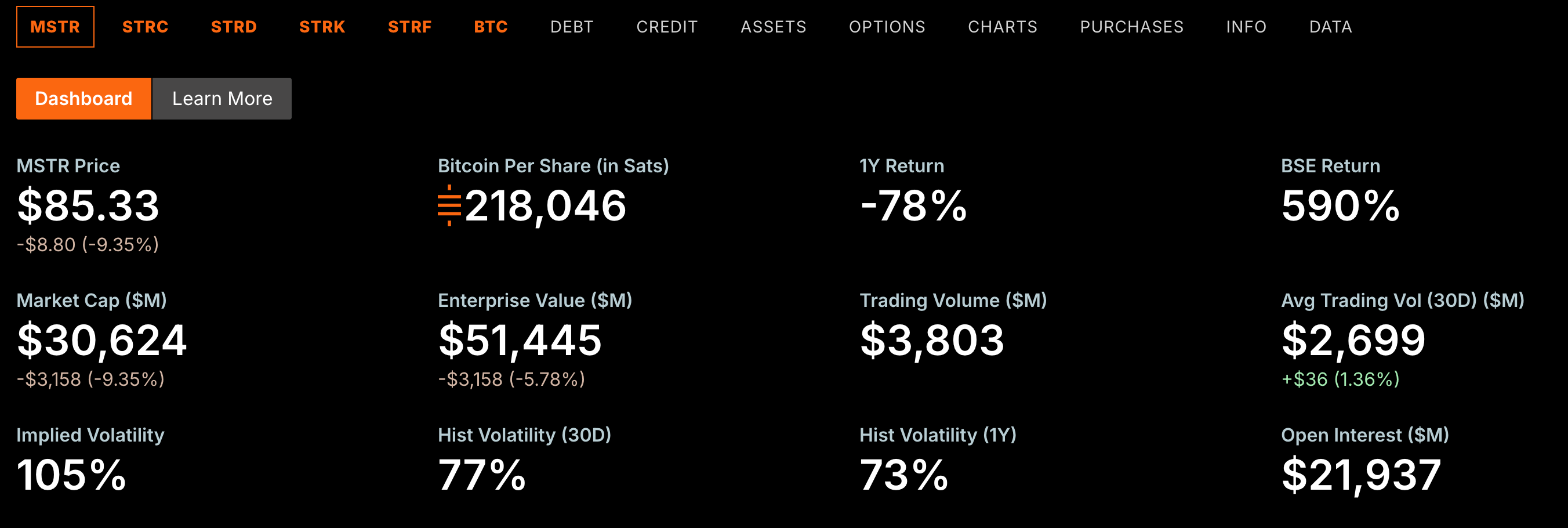
1. Common Stock Offerings (ATM). This is the most direct method. Through its At-the-Market offering program, Strategy can sell MSTR common shares continuously. The cost is dilution: as the share count increases, Bitcoin-per-share declines. Official data shows BTC-per-share has fallen from a peak of 220,900 sats to 218,046 sats. More critically, the most recent ATM (June 22) raised $335.5 million by selling 2,714,839 shares, but only 520 BTC (worth $34.9 million, about 10% of proceeds) were purchased. The rest went to replenish cash reserves, raising them from $1.1 billion to $1.4 billion.

2. Issuing More Debt. Strategy has historically used convertible bonds, but with rising dividend obligations and limited cash, additional debt would strain the balance sheet and limit future flexibility. Bond interest and principal payments are rigid obligations, and the company's deteriorating credit profile would likely result in higher borrowing costs.
3. Selling Bitcoin. This is the fastest way to raise cash but the most dangerous. Earlier this month, Strategy sold 32 BTC—its first-ever sale—framing it as a "market desensitization test." The sale triggered a sharp short-term market drop. As the largest single Bitcoin holder with 847,363 BTC (approximately 4% of circulating supply, worth over $50.7 billion), any significant selling by Strategy would severely impact BTC price. If BTC prices fall further, the value of Strategy's "reserve" would shrink, worsening its financial position.

The Trap of Common Stock Dilution: From Flywheel to Drag
Strategy has now relied on common stock ATM offerings for three consecutive weeks since June. The shift is structural: proceeds from equity issuance are increasingly diverted to cover cash needs rather than buying Bitcoin. This breaks the core feedback loop that sustained the company's high valuation: "raise money → buy BTC → strengthen market expectations → raise more money."
The market's willingness to pay a premium for MSTR stock has historically been based on the belief that Strategy would continue to increase BTC-per-share for common shareholders. When equity dilution outpaces BTC accumulation, that belief erodes. If STRC remains de-pegged for an extended period, Strategy may be forced to sustain this dilutive pattern, further reducing BTC-per-share and potentially triggering a revaluation of MSTR.

For the Bitcoin market, the most immediate consequence is the disappearance of the largest and most predictable marginal buyer. Over the past years, Strategy's weekly purchases became a fixture of market expectations, providing a foundation for BTC's price stability and upward momentum. Now, even as Strategy continues to raise capital, the proportion flowing into BTC has dropped dramatically. If the trend persists—or if Strategy eventually becomes a net seller—it could shift from being BTC's greatest bull to its most dangerous bear. The sword hanging over Bitcoin is no longer a hypothetical; it is sharpening with every STRC price tick lower.