
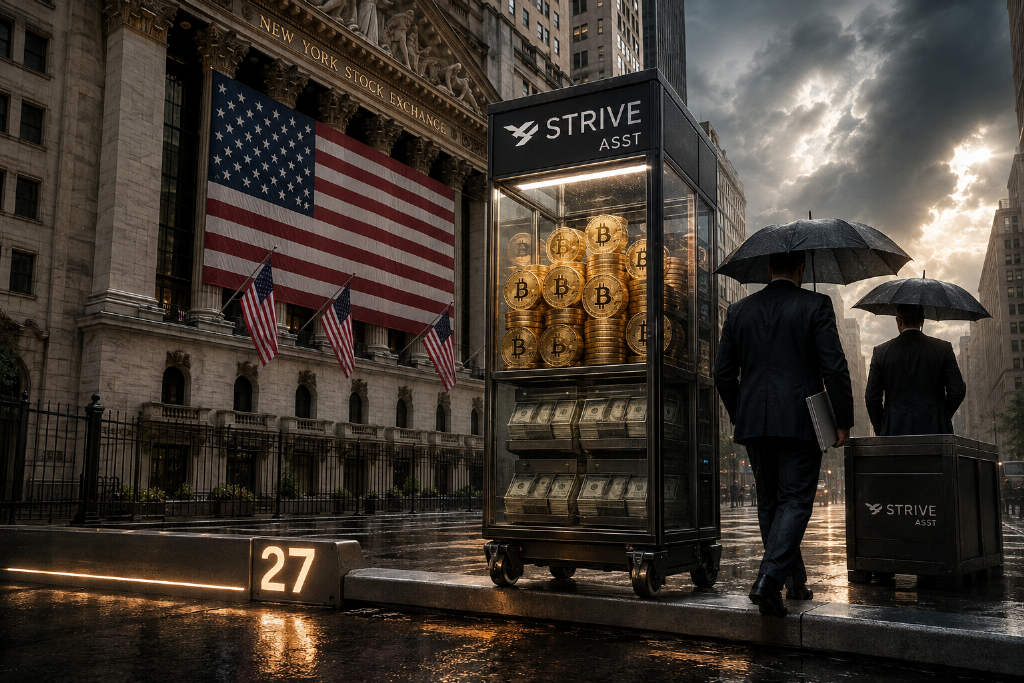
Strive (ASST) traded as high as $26.84 intraday on Sept. 3, leaving the stock just 0.6% below the roughly $27 strike price attached to a batch of warrants expiring in mid-October.
That level matters. If ASST moves above $27, holders of those warrants would have an incentive to exercise, which could bring about $700 million of cash onto the company’s balance sheet in a single step. Matt Cole said that another roughly $700 million of digital credit capacity could sit behind it. Taken together, the article frames that as about $1.4 billion in potential Bitcoin buying power concentrated around one price point.
Strive added 1,800 BTC in late August
SEC filings cited in the article show that Strive bought another 1,800 BTC between Aug. 24 and Aug. 28 at an average price of about $79,431. That lifted the company’s total Bitcoin holdings to 23,156 BTC.
Based on Bitcoin Treasuries’ ranking, Strive now sits fifth globally. It trails Strategy with 843,775 BTC, Twenty One Capital with 43,514 BTC, Metaplanet with about 43,000 BTC, and MARA Holdings with about 36,300 BTC.
On the One Share podcast on Sept. 3, CEO Matt Cole said Strive could become the world’s second-largest publicly traded Bitcoin holder by the end of 2026.
A capital structure designed to feed on itself
The article’s core argument is not simply that Strive is buying Bitcoin aggressively. It is that Cole has built a structure in which the stock price itself can unlock more financing, and that financing can then be used to buy more BTC.
The cycle is laid out in simple terms: ASST approaches $27, warrant holders exercise, the company receives cash, that cash buys Bitcoin, Bitcoin holdings and the company’s market standing rise, investors reprice its BTC reserves and financing capacity, and the stock moves higher, setting up more warrant exercises.
Cole described the setup on the podcast as a contest between short sellers and warrant holders. He did not hide his preference. He wants the warrants exercised rather than expiring worthless. With short interest at about 30% of the public float, according to the article, that contest could become much more intense over the next six weeks.
How Strive differs from Strategy
The comparison with Strategy (formerly MicroStrategy) runs through the piece. Strategy relies on convertible debt and at-the-market share issuance. Convertible bonds come with maturity dates, conversion prices, and interest costs. If Bitcoin falls sharply, repayment pressure can emerge when those bonds mature. Strategy’s scale, with 843,775 BTC, gives it a large buffer, but the article says term risk is still embedded in that funding model.
Strive has chosen a different path. Its capital structure includes only two securities: common stock ASST and perpetual preferred stock SATA. No convertible bonds. No senior debt. No maturity date.
SATA trades on Nasdaq with a $100 par value and a 13% annualized dividend yield. The dividend has been paid daily on business days since June 16, 2026, which the article describes as making it the first U.S.-listed security to provide daily cash dividends. When SATA trades above par, Strive can issue new shares through an ATM program and use the proceeds directly to buy Bitcoin.
Each side of that trade is clear in the article’s framing. SATA investors receive daily cash income at a 13% annualized rate. Strive receives perpetual capital with no maturity wall. The piece adds that Cole brought over 15 years of experience managing a $70 billion fixed-income portfolio at CalPERS into this structure.
The risk transmission path changes as well. Holders of Strategy’s convertible debt can demand principal repayment in cash at maturity, which can create liquidity stress during a Bitcoin downturn. Strive’s perpetual preferred stock has no maturity date and no mandatory redemption provision. In the worst case, the board could adjust the dividend rate. In the article’s words, the burden shifts from having to repay a large sum on one specific day to paying a smaller amount of interest every day.
The math behind a move from fifth to second
Strive’s 23,156 BTC leaves it 20,358 BTC behind Twenty One Capital, which holds 43,514 BTC and ranks second in the table cited by the article.
Using a price of about $80,000 per Bitcoin, closing that gap would require roughly $1.6 billion. Against that figure, the article places Strive’s potential $1.4 billion of buying power — about $700 million from warrant exercises and about $700 million from digital credit capacity — as close enough to make the goal mathematically plausible.
There is also a timing element. The article says 17 weeks remain in 2026. To close the gap within that span, Strive would need to buy about 1,200 BTC per week on average. In August, it bought 3,156 BTC in total, or roughly 790 BTC per week.
Cole did not present a detailed route map to second place. What he showed, according to the article, was the financing toolkit that could make such a move possible. That alone is treated as a signal: in the race among Bitcoin treasury companies, the size of the financial arsenal may shape expectations more than current holdings do.
The visible weak point: staying above $27 before mid-October
The flywheel also has an obvious failure point. If ASST cannot stay above $27 before the warrants expire in mid-October, the article says the roughly $700 million tied to those warrants would expire worthless.
Without warrant exercise, there is no cash inflow. Without cash inflow, there is no next large round of Bitcoin purchases. Without those purchases, the story built around climbing the rankings loses force, and the stock loses part of the narrative support behind it. The same mechanism that can accelerate on the way up can reverse just as quickly on the way down.
Cole used the phrase 「electric finish」 on the podcast to describe the outcome if the warrants are successfully exercised. The article reads that as something close to an options-style payoff curve: below $27, Strive can keep operating but does not leap; above $27, several moving parts begin accelerating at once.
30% short interest and a six-week countdown
About 30% of ASST’s public float has been borrowed and sold short, according to the article, an unusually high level for the public market.
The short thesis is straightforward in the piece’s telling. Strive has no substantial operating business. Its 23,156 BTC position corresponds to about $1.85 billion in value, and most of that value is the Bitcoin itself. Any premium in the stock depends on investor confidence in the company’s ability to keep raising capital. If Bitcoin drops sharply, or if the warrants expire without being exercised, that confidence could fade quickly.
The long thesis is equally clear. If ASST breaks above $27 and stays there within the next six weeks, the resulting $700 million warrant exercise would amount to a forced BTC-buying event. Short sellers would need to borrow more stock to maintain positions, while warrant exercise would also release a large amount of new float. The collision between those forces could drive sharp price swings.
The article presents this not as a bet on ordinary fundamentals, but as a structural contest with a clear trigger and a clear time window. Mid-October is when the answer arrives.
What Strive’s case says about the Bitcoin treasury trade
For the broader Bitcoin treasury sector, the article says Strive shows how quickly capital markets are absorbing one lesson: innovation in financing structure matters more than simply forecasting the Bitcoin price.
Strategy opened the template with convertible debt. Strive, through perpetual preferred stock and a warrant-driven flywheel, is pushing that template into a more extreme version. Where the next step goes depends, in the article’s framing, on how much capital is willing to back the idea that a stock price can function as a financing tool rather than merely an end result.