

Mysten Labs has teamed up with Google Cloud on a verifiable agent arbitration platform, and Sui followed that announcement with a claim that its offchain channel test hit 40,614,180 interactions per second. Even with those back-to-back AI-related updates, SUI stayed around $1.14 and did not break out of its recent range.
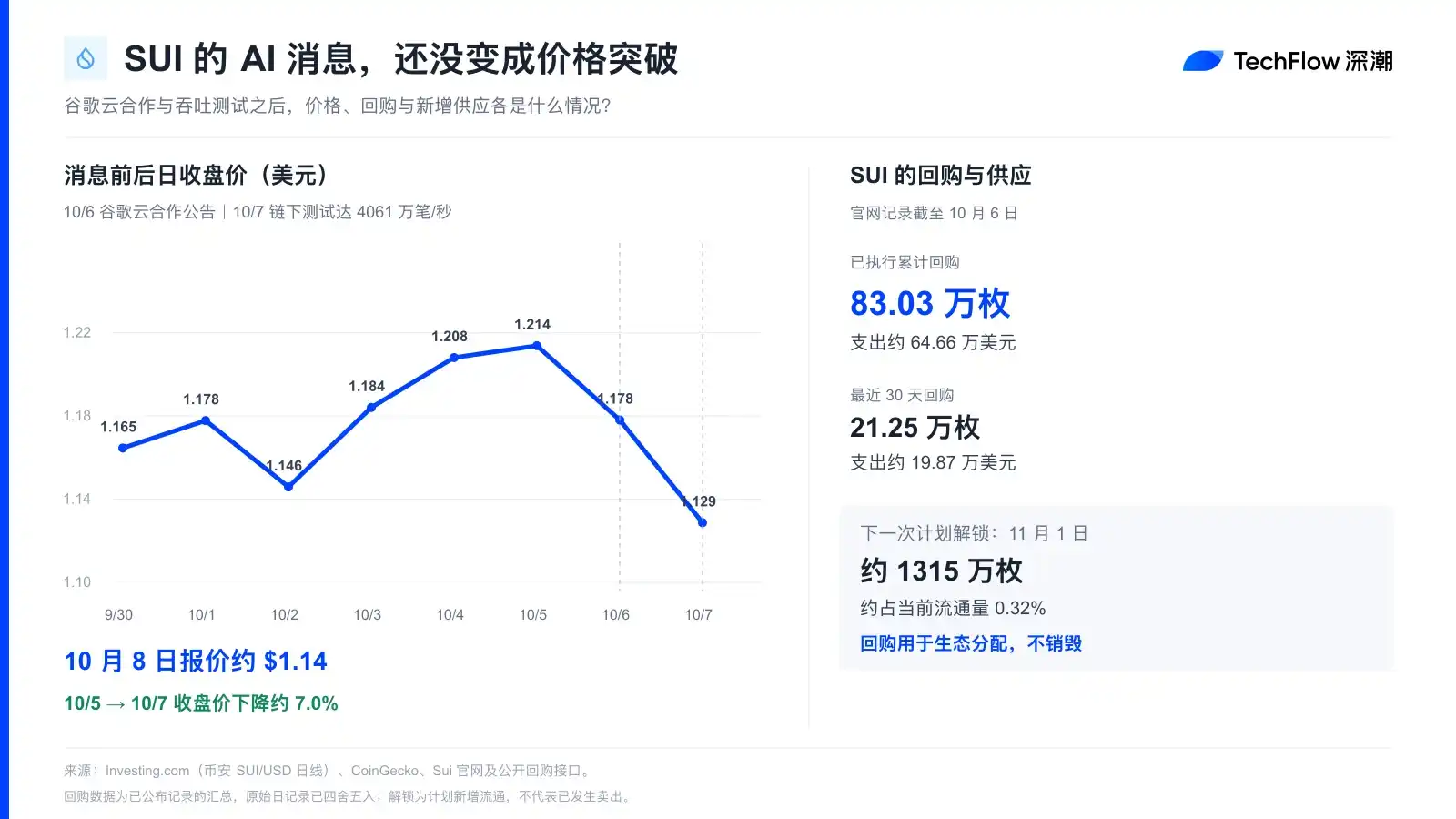
The gap, as laid out in the source article, comes down to token economics. SUI already has real buybacks in the market, but the funding does not come from the newly announced AI products. It comes from yield generated by stablecoin reserves, and the tokens bought back are still earmarked for ecosystem distribution.
Sui is trying to win enterprise AI budgets
On Oct. 6, Mysten Labs said it would jointly develop a verifiable agent arbitration platform with Google Cloud. The product is meant to provide auditable records for AI permissions, actions, and results. If agents from two companies end up in a transaction dispute, both sides can review the same credentials and reconstruct what happened. Security teams can also trace abnormal operations.
Full prompts, model outputs, and tool-call records remain in the customer’s Google Cloud storage. The related cryptographic proofs are stored in Walrus, while Sui coordinates verification. The platform is also expected to connect with agent payment services so service calls, payments, and authorization records can be matched. The team plans to start with enterprise deployments before widening availability.
A day later, at the Basecamp conference, Sui said its offchain channel test reached 40,614,180 interactions per second, above its preset target of 20 million.
That figure refers to programmable offchain channels. Participants open a channel on mainnet, interact at high frequency inside it, and submit the final result for settlement. Under normal operation, opening and closing the channel requires only two onchain transactions. Payments, chats, or in-game actions in between do not need to be posted onchain one by one or pay fees each time. Machines can interact constantly without costs rising in a straight line with every action.
Both products address the same need: letting AI transact more cheaply while giving enterprises a way to verify what those systems actually did. In that sense, Sui is trying to tie its performance pitch to paying customers rather than relying only on the race to be seen as the fastest public chain.
The announcements did not produce a breakout in price
If a big-tech partnership were already acting as a strong catalyst, the token price would usually show it more clearly. So far, SUI has not.
SUI closed at about $1.214 on Oct. 5, about $1.178 on Oct. 6, and about $1.129 on Oct. 7. Across the two days when the Google Cloud partnership and throughput test were announced, the token’s closing price fell by roughly 7%.
As of publication on Oct. 8, CoinGecko showed SUI at about $1.14, with roughly $610 million in 24-hour trading volume. Trading activity remained active, but the news did not push the token out of its prior range.
The chart referenced in the source article aligns SUI-related announcements, market action, and token supply and demand. It notes that buyback records run through Oct. 6, while the unlock figure reflects the next scheduled release.
The earlier rally also cannot be fully credited to these two announcements. From Sept. 18 to Oct. 6, SUI rose from about $0.814 to $1.18, a gain of roughly 45%. That move happened before the announcements, and by early October the token was already trading around the $1.2 area.
The article’s conclusion on this point is narrow: the news has expanded the product narrative around Sui, but it has not yet turned into a lasting price catalyst. To see why, the source breaks down where current buy pressure actually comes from.
SUI buybacks are already happening, but AI has not added new buyback income
The Google Cloud partnership adds to the case for future enterprise demand, but the money currently used to buy SUI comes from somewhere else.
According to Sui’s official description, the foundation uses yield generated by stablecoin reserves to buy SUI on the open market, then distributes those tokens to validators, DeFi participants, and other ecosystem actors. In practical terms, larger buybacks depend on Sui retaining more stablecoin capital inside that yield structure.
That buy flow is already active. Based on the public records cited by the official website and summarized in the article, cumulative purchases had reached about 830,300 SUI as of Oct. 6, at a cost of roughly $646,600. Over the most recent 30 days, buybacks totaled about 212,500 SUI for around $198,700. On the latest day alone, spending was about $7,300.
That is why the most relevant part of AI payments for token holders, according to the article, is whether they keep funds on Sui. If agents continuously buy services and settle orders, the resulting stablecoin balances and reserve yield could expand the buyback pool. The 40 million-plus offchain interactions per second show processing capacity, but the test itself does not add revenue to the buyback account.
The Google Cloud partnership, meanwhile, adds verification and storage business. Enterprises using Sui to preserve operation credentials, submit proofs, and complete settlement would generate usage. Storage fees in Walrus are charged in WAL, while onchain operations pay SUI fees. The announcement explained how the product works, but it did not disclose the scale of enterprise payments.
Supply is still being released alongside any buybacks
The supply side has not changed because of this round of announcements.
About 4.118 billion SUI are currently in circulation, equal to 41.18% of total supply. CoinGecko lists the next scheduled unlock for Nov. 1 at about 13.15 million SUI. Tokens repurchased by the foundation are still set to be distributed across the ecosystem, so any new buy pressure would exist alongside continued token release.
That frames the practical takeaway for holders. Sui may have identified a more specific AI customer need, but the revenue-growth case for SUI still depends on those customers actually paying. What has already happened is a buyback flow of roughly $200,000 a month. How much new enterprise business can increase that figure remains unanswered in the current announcements.
Google Cloud’s name is enough to put SUI back on traders’ screens. But if this new narrative is going to attract durable buying, the support would need to come from revenue growth after enterprise capital arrives, not from treating a throughput record as if it were token income.