
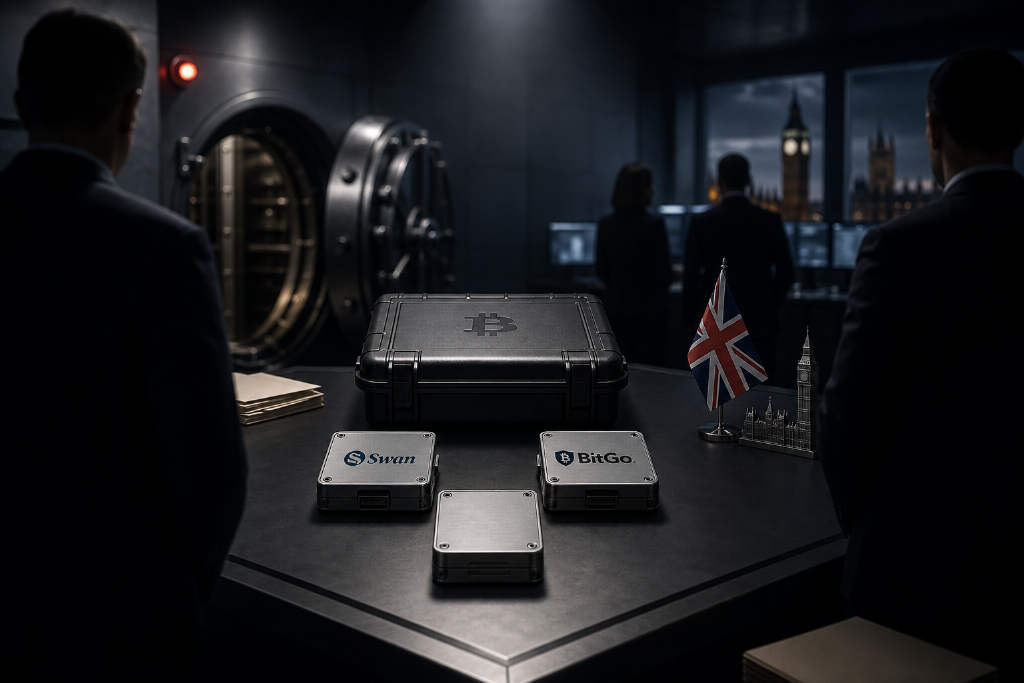
Swan is building a Bitcoin custody product that would divide control across three separate companies, with the client holding no key at all, according to comments from founder and chief executive Cory Klippsten on Monday’s episode of Unchained.
「We’re doing it now, so we will actually have that out hopefully by Q4. It’s called Swan Trinity,」 Klippsten said. He added that Swan would hold one key, BitGo would hold one key, and the company is still evaluating a third partner. That third holder, he said, would probably be a well-known UK company.
Swan has not publicly announced the product. It does not appear in the company’s published custody lineup, and no release has identified it by name.
How Trinity differs from collaborative custody
Klippsten contrasted the proposed structure with collaborative custody, the model Swan already offers through Swan Vault and one also used by Casa and Unchained Capital. In that setup, custody is typically arranged as a two-of-three multisig scheme in which the customer holds two keys and the company keeps the third as backup. If the customer loses one key, the coins are still recoverable. If the company disappears, the customer still controls two keys.
Trinity flips that arrangement. The customer holds none of the three keys, and each key is kept by a different institution.
Klippsten argued that the structure removes two kinds of single-point failure at the same time. 「You’re not gonna get two institutions colluding to steal your coins, and if one institution goes under, gets hacked or something, nothing happened to your Bitcoin,」 he said. 「Nobody actually owns your Bitcoin.」
He placed the model at one end of a five-step custody spectrum he uses to describe how Bitcoin storage is handled. That range runs from unassisted self-custody to advised self-custody, then collaborative multisig, then ordinary delegated custody with a single company, and finally what he called the fifth stop.
「The fifth stop on the far right would be multi-institutional, where you don’t have any keys,」 he said, 「with your three keys are split across three institutions.」
Klippsten credited the idea to BitGo co-founder and chief executive Mike Belshe. He said Belshe pitched the concept to him about four years ago, and added that one or two very small companies already offer something similar.
Existing ties with BitGo and Swan’s current custody stack
Swan and BitGo have worked together before. In September 2023, the two companies said they would form a Bitcoin-only trust company. BitGo Trust is also among the custodians Swan already uses, alongside Bakkt and Equity Trust.
In that sense, some of the components needed for Trinity are already in place. Swan’s existing custody setup already spans three regulated institutions. What Klippsten described is a different way of assigning keys, not an entirely new group of counterparties, apart from the still-unnamed third key holder.
Coldcard fallout and the pitch for layered custody
The proposed product comes after a month in which self-custody took a public hit. Earlier in August, several thousand Coldcard hardware wallets were drained. Klippsten said the losses totaled 「1,400 or 1,500 coins or whatever it was」 and added that one holder he saw reported losing 60 coins.
He argued that the damage was small relative to historical losses tied to custodians. According to Klippsten, 「something north of 1.5 million coins」 has been lost across Mt. Gox, Celsius, BlockFi, Voyager and Quadriga, which he said was about 1,000 times the cost of the Coldcard incident. The article noted that this figure was Klippsten’s own estimate and that Unchained had not independently verified it.
Klippsten also said demand changed after the hack. Swan Sovereign, an advised self-custody service that he said began in May and that Swan formally announced on August 17, days after the exploit, already has 「1,300 or 1,400 clients」 on the platform.
He said collaborative custody is 「probably the right move, especially in a post-ColdCard world.」
What remains unresolved
Two points now stand out: whether Trinity ships on Klippsten’s stated Q4 timeline, and who ultimately becomes the third key holder.
Klippsten did not name the company or explain the selection criteria. Because the security case for the model depends on three independent institutions, the identity and independence of that third participant will be central to how the market evaluates the product.
The full discussion was released through Unchained.