



MarsBit has published a PANews summary of a recent YouTube video from trader Taiki Maeda, who said he has put most of his net worth into Zcash (ZEC). His case rests on Zcash’s privacy design, the use of zero-knowledge proofs, rising assets in the shielded pool, and what he describes as an asymmetric risk-reward profile.

Maeda also addressed a trade that went badly. After losing conviction during a major security incident, he sold all of his ZEC below $300. He later bought back at higher prices once the market recovered and, in his view, rebuilt trust in the asset.
Zcash, in Maeda’s view, keeps Bitcoin’s monetary traits and adds optional privacy
Maeda said he wanted to explain two things in the video: why Zcash matters, and why he has committed the vast majority of his personal net worth to the trade.
He described Zcash as a decentralized blockchain network launched in October 2016 with a core focus on financial privacy. In his telling, it shares several key monetary properties with Bitcoin: a maximum supply of 21 million coins, a halving cycle every four years, and proof-of-work mining to secure the network.
The main difference, he said, is privacy choice. Bitcoin has only transparent addresses, which means anyone can inspect balances and transaction histories on-chain. Zcash offers both transparent and shielded addresses. Users can keep ZEC in a transparent address, then move it into a shielded address when privacy is needed.
For Maeda, understanding why Zcash matters in 2026 requires stepping back and looking at the history of crypto as an asset class and where that market may be heading.
Bitcoin’s limitations and where Zcash fits
Maeda said Bitcoin emerged from the financial crisis and has since become a widely accepted reserve asset and store of value used as a hedge against inflation and currency debasement. He pointed to Bitcoin’s trillion-dollar market capitalization and the existence of spot ETFs as signs of mainstream acceptance.
Still, he argued that Bitcoin’s rise exposed two major lines of criticism, and both opened very large opportunities. The first was the lack of programmability and scalability. In his view, Ethereum, Solana and a range of Layer 2 networks addressed that problem and created ecosystems worth hundreds of billions of dollars.
The second criticism was the lack of privacy. That, he said, is the bottleneck Zcash is trying to solve. If that problem is solved at scale, he believes Zcash could justify a market capitalization in the hundreds of billions of dollars.
Maeda also said that Satoshi Nakamoto originally wanted privacy features in Bitcoin and wanted to incorporate zero-knowledge proofs, but judged the technology too early and too immature at the time.
Zero-knowledge proofs and Zcash’s early technical lead
Maeda used a simple definition for zero-knowledge proofs: a mathematical proof that can verify the truth of information without revealing the transaction details themselves.
He said the Zcash team was the first in the world to deploy zero-knowledge proofs successfully in a production environment. The network went through what he called growing pains, but by 2026, he said, Zcash had made major improvements in UI and UX and was preparing for broader mainstream use.
Why he thinks 2026 is still early in the bull market
Before going deeper into Zcash, Maeda laid out his broader market view. He said crypto in 2026 remains in the early stage of a new bull market for two core reasons.
Reason one: fiat debasement
Maeda pointed to a recent announcement from new U.S. Treasury Secretary Scott Bessent to buy long-dated Treasury bonds to control long-term rates. After that, he said, both gold and Bitcoin bounced strongly from their lows. He added that the correlation between gold and Bitcoin had reached a record high.
That matters, in his view, because it signals a change in how investors classify Bitcoin. Five years ago, he said, many buyers treated Bitcoin as a levered Nasdaq stock or a pure speculation vehicle. Now, continuous inflows from outside crypto have provided a very strong floor in the mid-$70,000 area.
Reason two: crypto-native investors are too bearish and too lightly positioned
Maeda said crypto is highly cyclical and sentiment tends to break to extremes at both tops and bottoms. He recalled making a video on Oct. 17 last year saying the market had topped and urging viewers to sell because there was little upside left. According to him, the comment section was full of ridicule, with people fully loaded and waiting for a guaranteed Q4 rally. That, he said, left the market without marginal buyers in Q4 and vulnerable to a sharp collapse when negative news arrived.
He said the setup in mid-2026 is the mirror image. Two weeks before recording the new video, he argued that Bitcoin had bottomed and that he was bullish on Zcash and Hyperliquid. The comments again turned hostile, he said, with people mocking him as an idiot buying the top. He read that response as evidence that many market participants were underexposed and deeply bearish after missing the low.
A K-shaped crypto economy and capital rotation
Maeda cited veteran trader Stanley Druckenmiller, saying contrarian investing is overrated 80% of the time because clear trends and consensus can be profitable to follow. The remaining 20%, he said, is when the crowd gets destroyed by missing the move or buying too high. Catch that turn, take the other side, and excess returns can be extraordinary. Maeda said 2026 looks like one of those turning points.
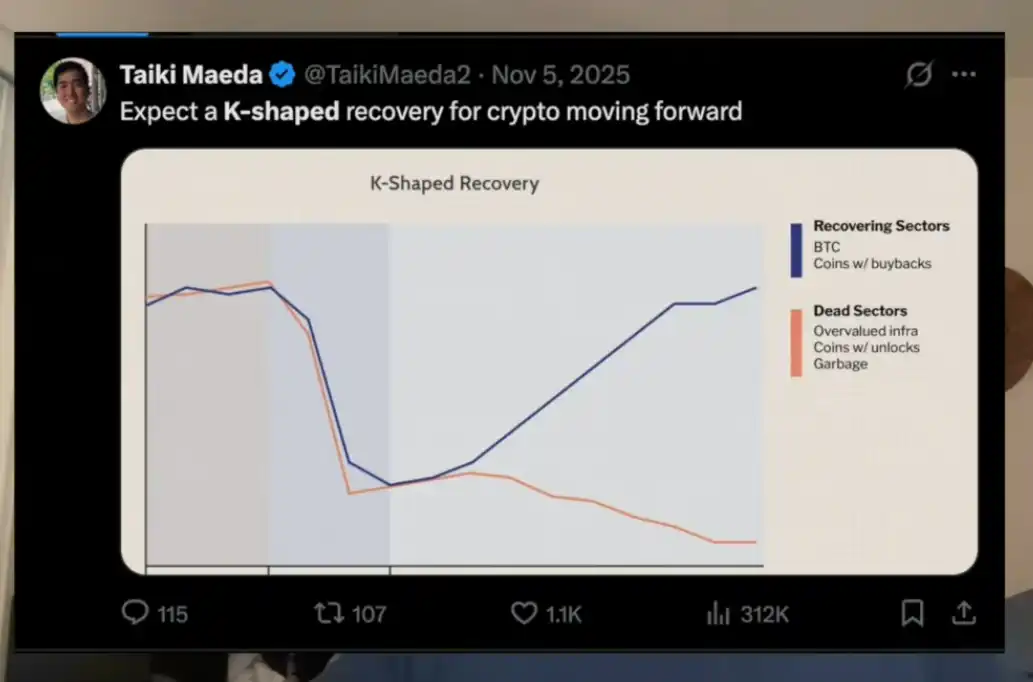
Even if someone is not very bullish on Bitcoin in the short term, he argued that the more important point is the internal split forming inside crypto. Maeda said he had shared a chart last year showing a future K-shaped outcome for digital assets.

On the upper side are what he called good assets, including store-of-value assets such as Bitcoin and Zcash. He also included buyback tokens, which in his framework represent ownership in a business that earns real income and returns that income to the token. Buying them, he said, is similar to investing in an actual business.
On the lower side are what he called pure junk, including many infrastructure tokens and VC tokens. He said most of them would keep drifting lower and should be avoided.
In that setting, Maeda believes crypto is already seeing a reallocation of capital from bad assets into good ones. He used this year’s price action as an example. Bitcoin has surged but has mostly traded around the same level since early May in a broad range. Over that same period, he said, some stronger assets have outperformed sharply: Hyperliquid is up more than 2x, Lighter nearly 4x, and Zcash more than 2x.
His conclusion is that existing crypto capital is cutting old VC positions and redeploying into assets with stronger long-term durability. He expects the trend to continue. Capital coming from traditional finance, he said, should flow directly into Bitcoin and keep it supported, while capital already inside crypto rotates from weaker assets into names such as Zcash.
The shielded pool and price reflexivity
Maeda then returned to the central question: why Zcash, why now, and why it has started moving so hard.
He said Zcash’s 10-year monthly chart shows a token that spent its first nine years badly underperforming almost everything else, only to show powerful upside momentum over the past year and a half. When a legacy asset dormant for nearly a decade suddenly regains life and volume, he said, traders should not short it out of arrogance. In his view, that usually points to a structural shift in fundamentals rather than a simple pump.
The key fundamental indicator for him is the amount of ZEC in the shielded pool. For the first eight years, that pool showed little progress. Over the last two years, he said, the amount of ZEC in the pool has been rising slowly but consistently. He sees that as evidence of genuine daily use and stronger network effects.
Maeda described Zcash’s fundamentals as a function of two variables: price and the amount of Zcash held in the shielded pool. He called that relationship reflexive.
He used a simple example. If the entire shielded pool held only $1 million worth of Zcash, a whale with $10 million could not really use it for privacy. A deposit that large would represent 90% of the pool and would make the behavior obvious, wiping out the privacy benefit. When the total value inside the pool is too small, large capital cannot use the system effectively.
If a higher ZEC price or more deposits expand the shielded pool to $10 million or even $100 million, then another holder with $10 million can enter much more comfortably because the position would make up only a small share of the pool. Privacy protection becomes stronger.
That is why Maeda says a higher ZEC price directly improves the network’s security fundamentals. More price and more market capitalization allow the system to absorb larger future inflows. In his framing, that creates a self-reinforcing loop: price rises, shielded pool capacity expands, privacy guarantees improve, fundamentals get better, and price rises again.
Zcash as an alternative store of value to Bitcoin
Maeda said some buyers are now turning to Zcash because they see it as an alternative store of value to Bitcoin. He listed two concerns behind that shift:
- Bitcoin lacks privacy.
- Bitcoin lacks a clear roadmap for resistance to quantum computing.
He said Zcash is far ahead of Bitcoin on the second point. Those concerns, he argued, create a long-term structural tailwind for Zcash.
Maeda compared the situation to traditional metals, where silver’s market capitalization is about 12% of gold’s. By contrast, he said, crypto has never really had a successful alternative store-of-value asset alongside Bitcoin. He believes Zcash has enough technical differentiation and real-world use to become the second major store-of-value asset in crypto, complementing Bitcoin rather than replacing it.
At the time the video was recorded, he said, Zcash was trading around $850 and its market capitalization was only about 1% of Bitcoin’s. At that stage, he sees ZEC as a higher-beta version of Bitcoin.
He then outlined a return scenario. If Bitcoin doubles in U.S. dollar terms, and if Zcash’s share relative to Bitcoin rises from roughly 1% to 5% of Bitcoin’s market capitalization, then holding ZEC could produce about a 10x dollar return. That kind of outcome is the excess return he is looking for in a bull market. He added that if the valuation gap narrowed from 1% to 10% or 15%, the profit potential would be even larger.
He admitted that the idea is highly contrarian and not broadly believed. Still, he argued that the data are already visible: shielded pool assets are rising, price is breaking out, reflexivity is taking hold, and the Zcash trust has been approved and listed.
Maeda also brought up Bridgewater founder Ray Dalio. He said Dalio likes gold and other debasement hedges but often criticizes Bitcoin because it lacks privacy and a quantum-resistance path. In Maeda’s view, that description sounds close to the problem Zcash is trying to solve. He asked whether Zcash could become the ultimate answer as concern over privacy and quantum risk grows, and said he believes the answer is yes.
Why he sold everything below $300 after the Orchard scare
Maeda said he forces himself to answer three questions before making an investment: what is the thesis, how strong is the conviction, and how much capital should be committed.

For him, money made in markets comes down to position size multiplied by percentage return. If conviction is weak and the position is only symbolic, even a 10x gain will not materially change a person’s financial outcome.
He quoted his friend Jez: “Why waste precious capital on your second-, third-, fourth- or fifth-best idea? I would rather put all my chips on my best one.” Maeda said it took him years to apply that principle in practice.
His present conviction in Zcash, he said, was shaped by a painful earlier experience. Viewers of his channel may remember that he started building a Zcash thesis in April and May of this year. He bought aggressively below $400 and kept adding as the token rose because he believed Zcash was heading for an epic breakout in Q2.
Then in June, the setup broke. Zcash technical researcher Taylor Hornsby found a potentially serious vulnerability related to the Orchard shielded pool. Maeda said the bug suggested a malicious attacker might be able to mint Zcash above the cap inside the shielded pool and withdraw it without detection. In his view, that struck at the protocol’s security integrity and damaged the core store-of-value thesis.
Before the news, he said, Zcash had been trading around $600 to $650. After the disclosure, price crashed by more than 60% in a very short period.
Maeda said he had been publicly defending Zcash online before the incident, only to be hit by what he called a nuclear-level technical problem. He was holding spot and was not liquidated by the system, but, as he put it, he liquidated himself. He sold all of his Zcash below $300.
He added that if anyone checks the chart, price only stayed below $300 for about 10 minutes. In other words, he sold very close to the low. Had this happened three or four years earlier, he said, he might never have recovered from it and would have permanently removed Zcash from his watchlist. Instead, he tried to step back and reassess the trade as objectively as possible.
The reason for selling was simple: he feared that a severe security flaw at the base layer could permanently destroy confidence in Zcash as a trusted store-of-value asset. Price, in his view, is the best signal for whether the market still trusts an asset.
So he made a rule for himself. He would sell now. If Zcash later fully recovered and returned to the level it traded at before the vulnerability, that would prove that the market and its participants had rebuilt trust. At that point, he would buy everything back, even at a higher price.
He acknowledged that this sounds irrational. He bought higher on the way up, sold near the bottom, then announced that if the price returned to the highs, he would buy it all back. But he said the logic rests on a contrarian investment philosophy, not on chasing headlines.
Antifragility, the Lindy effect, and the store-of-value trilemma
Maeda grounded that decision in Nassim Taleb’s concept of antifragility. An antifragile system, he said, does not merely survive severe shocks and disorder. It comes out stronger.
Bitcoin is his model case. He pointed to Mt. Gox, hard fork crises, technical flaws and hacking incidents across Bitcoin’s history. Each time, the network survived and eventually traded at higher levels.
That is also the Lindy effect in action, he said: the longer a system exists and the more hardship it survives, the more people trust that it can continue to exist. For money and store-of-value assets, which depend heavily on confidence, that kind of trust is hard to replicate.
During the June vulnerability, though, he said he could not know whether Zcash would earn that trust back.
From there he introduced what he called the blockchain store-of-value impossible trinity. Similar to a performance trilemma for smart contract chains, he argued that a store-of-value blockchain such as Bitcoin or Zcash can only fully satisfy two of these three properties at once:
- sufficient decentralization,
- full auditability,
- absolute privacy.
Bitcoin, in his framework, satisfies decentralization and auditability. Since all addresses and balances are visible, anyone can verify supply on-chain and gain confidence that the total will never exceed 21 million coins. The tradeoff is that privacy is sacrificed.
Zcash satisfies decentralization and privacy. The cost is that, because the shielded pool exists, no one can perform a perfect real-time public audit of total supply at every moment, and that leaves open the fear that a bug might allow unauthorized minting.
Maeda said he always understood that tradeoff, but when Taylor Hornsby disclosed a vulnerability related to possible over-minting in June, panic and pain got the better of him. At that moment he mostly wanted relief from the damage on the screen, and he sold.
How Best Loser Wins shaped his decision to buy back higher
Maeda said one of the books that influenced him most in the last bear market was Best Loser Wins. He called it one of the best books he has read on trader psychology, investor mindset and rational thinking in markets.
The book starts from a blunt premise, he said: 90% of people in markets lose money. The practical response is to study what those 90% do and then do the opposite when it matters.
He highlighted two common traps.
Trap one: averaging down while price falls
Someone buys an asset at $50, it drops to $40, and the immediate instinct is to buy more because it is cheaper. Maeda said the deeper reason is often emotional rather than analytical. Investors do not want to admit they are wrong, do not want to sell at a loss, and use extra buying to rationalize the original decision.
Trap two: taking profits too early on the way up
He also challenged the common line that no one goes broke taking profits. In practice, he said, people can absolutely ruin their long-term outcome by repeatedly cutting winning positions too early.
Any real investing career will include losses and gains. The only way to survive and compound, in his view, is to make sure the gains from strong positions are many times larger than the losses from failed ones. If an investor keeps trimming assets that work while adding to assets that keep falling, the portfolio eventually fills with underperformers.
The route to outsized gains is the opposite: keep pressing winning positions and keep adding as the uptrend confirms the thesis. Maeda said it took years to absorb that lesson.
From the outside, he knows the sequence sounds absurd. He is a Japanese YouTuber who kept buying higher, capitulated near the floor, then bought back at a higher level after the rebound. He even joked that it can look as extreme as being a Zcash version of Michael Saylor.
But for Maeda, what matters is not what happened in the past. What matters is what happens next. Selling helped him remove the emotional burden and fear created by the bug. Once the vulnerability crisis was resolved and price reclaimed all of the lost ground, the market had effectively run the hardest stress test for him.
If the market had chosen to trust Zcash again, then he felt he had to overcome his pride and buy back, regardless of the ridicule.
He described investing as a highly personal and lonely contest. At the end of each day, the real opponent is internal: can you tolerate large swings, can you sell when selling is required, can you hold when holding is required, can you accept losses, and can you stop yourself from chasing fantasies after taking profit.
Druckenmiller’s position-building model and Maeda’s execution
Late in the video, Maeda returned to Stanley Druckenmiller and the kind of trade structure he most admires. As Maeda summarized it, the process is straightforward:
- Build a core thesis carefully and reach conviction.
- Start with an initial position, perhaps 10% or 20%.
- As time passes and price action validates the thesis, lean harder into the trend and commit more capital.
He said that framework sounds counterintuitive, so he gave a simple example. Suppose Bitcoin once traded at $1,000 and you believed it could reach $10,000. You buy a little at $1,000. Then it rises to $2,000. Do you sell, or do you add?
Under Druckenmiller’s logic, Maeda said, the move from $1,000 to $2,000 is the market validating the thesis with real money. Compared with $1,000, the case for eventually reaching $10,000 may actually be stronger at $2,000. Once the market confirms the idea and momentum starts to build, especially in a strongly reflexive store-of-value asset such as Zcash, the right move may be to add rather than cut.
Maeda said that is hard to do, but it is the logic he has tried to execute in real time on YouTube and X: buying spot and then adding leveraged longs as price rises. The ability to press in favorable conditions, he said, is what separates a trader who captures outsized gains from one who remains ordinary.
Even though discussion of Zcash has become louder on social media, Maeda said his conversations with crypto fund managers and professional traders suggest positioning is still very light relative to Bitcoin, Ethereum and even Hyperliquid.
He repeated a final point that sits at the center of his thesis. Most crypto assets become less attractive as they rise because valuations stretch and cash flow cannot support them. Zcash, in his view, is different. As price rises and the shielded pool can absorb more capital, the product’s utility and privacy value improve with it.
He ended by saying he is simply being open about his thinking and does not want to be responsible for losses others might suffer by following him. It is entirely possible, he said, that he could still end up blown out himself.
The related reading linked at the end of the article was titled: Grayscale report: Why Zcash should not be ignored in the age of AI-driven financial privacy.