
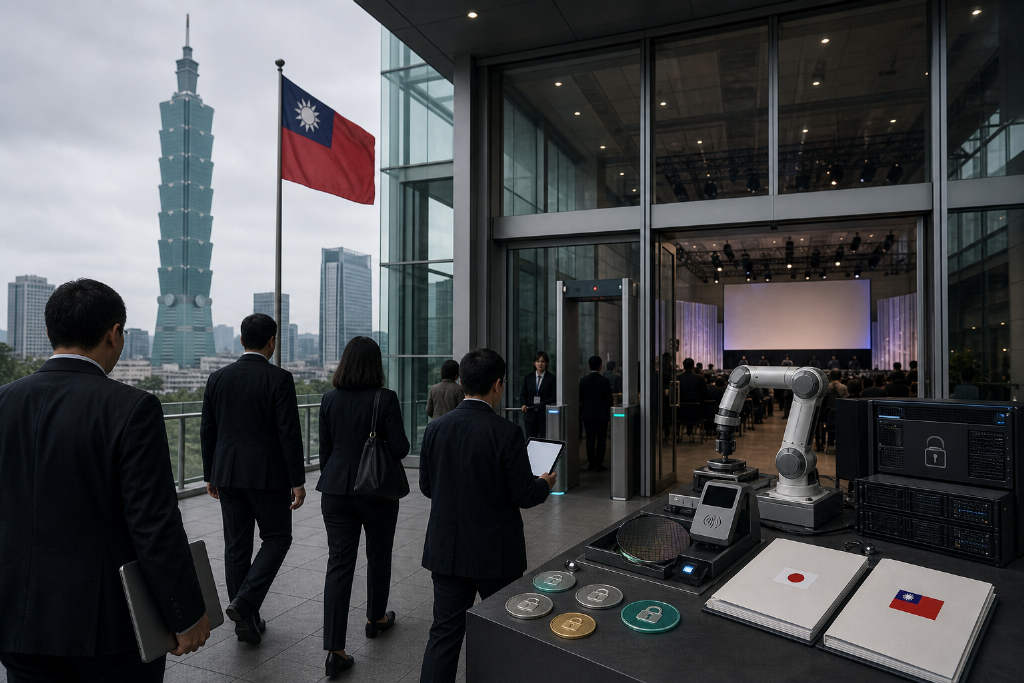
Taiwan’s government used the FinTechOn 2026 & AFA summit in Taipei on Sept. 3 to highlight an industrial and fintech policy agenda centered on AI adoption, digital trade coordination, and guarded experimentation with stablecoins and digital assets.
Speaking in the opening session, Deputy Minister of Economic Affairs Chiang Wen-jo said Taiwan’s semiconductor and Information and Communications Technology, or ICT, industries have long played a key role in global supply chains. She said that manufacturing strength now needs to be paired with digital technology if Taiwan wants to maintain long-term competitiveness.
Taiwan ties AI policy to SME upgrading
Chiang said the government is advancing its “New Ten Major AI Infrastructure Projects,” with a core aim of guiding small and medium-sized enterprises to adopt artificial intelligence to optimize production processes. The policy also places weight on expanding the pipeline of specialized digital talent.
Her remarks framed the initiative as a response to a changing competitive environment. Relying only on hardware contract manufacturing, she said, will not be enough to meet future challenges. The government’s focus is to help SMEs, which often face tighter resource constraints, connect with technology providers and improve their workflows through advanced computing tools. The stated goal is to lower production costs and raise the value added by output.
The policy also includes a more systematic talent training effort intended to strengthen the digital research and application capacity needed across the industrial ecosystem. The broader direction is to speed up the shift from traditional supply chains toward higher-value digital manufacturing.
Cross-border data rules with Japan are part of the trade agenda
Taiwan is also working closely with Japan on cross-border data transfers and the standardization of electronic documents. According to Chiang, that cooperation is aimed at addressing differences in national regulations and compatibility issues between technical systems.
By moving toward unified operating standards, the two sides are trying to reduce administrative friction in cross-border processes. Chiang said a trusted and transparent framework for international data transmission would deepen bilateral trade ties and could also serve as a working example for digital commerce cooperation across the Asia-Pacific region.
Stablecoin innovation comes with AML and cybersecurity demands
On fintech, Chiang said the government is paying close attention to the potential of stablecoins and emerging digital assets in cross-border payments, clearing, and settlement. At the same time, she drew a clear line on regulation: financial innovation must proceed together with risk controls.
The government’s position, as described at the summit, is that market order and investor rights need to be protected as new products develop. Authorities plan to enforce anti-money laundering rules, cybersecurity safeguards, and personal data protection requirements so that new forms of financial technology can operate within a controllable regulatory scope.