
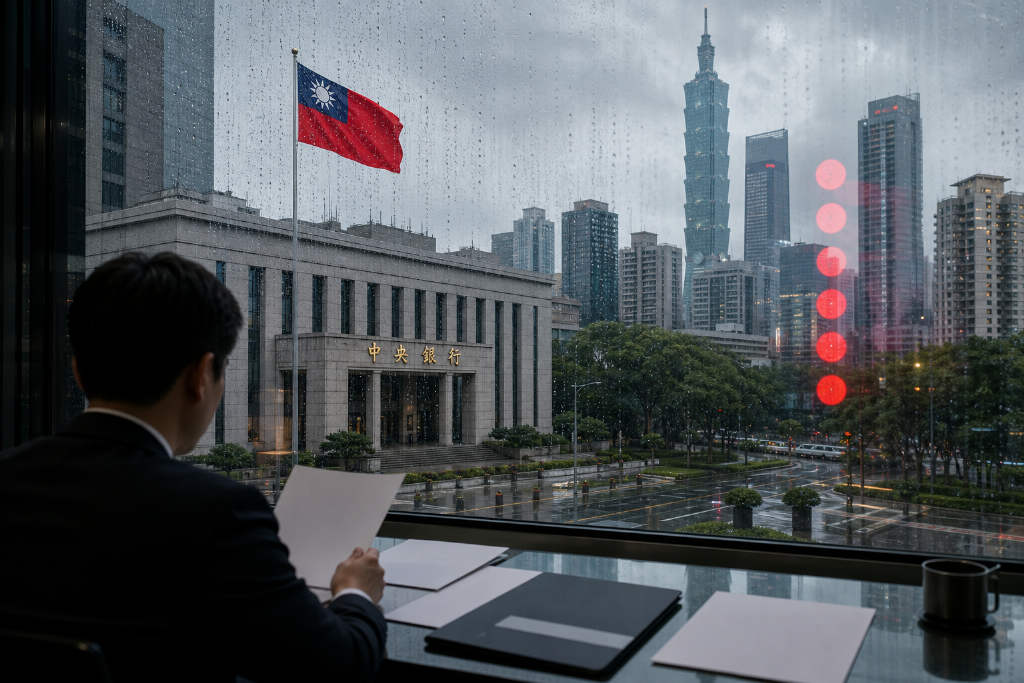
Taiwan’s economy is in a strong expansion phase, with the National Development Council’s business climate monitor flashing a red signal for eight straight months. On that basis, Bloomberg said the central bank could have room to raise rates as early as September.
Business climate score reached 41 in July
According to National Development Council data cited in the report, Taiwan’s business climate signal score came in at 41 in July, extending the run of red signals to eight consecutive months. Stock prices, industrial production and customs exports were all described as remaining in a high-expansion range, suggesting the growth impulse has spread from semiconductors into the domestic economy.
The report said large bonus payouts from semiconductor and other technology companies boosted cash flows to households, lifted real purchasing power and supported consumption as well as asset allocation demand. A new Taiwan public sentiment survey released by polling specialist Tai Li-an showed that 48.3% of respondents held a positive view of current economic conditions, the highest level since the survey started in 2006.
Bloomberg sees room for a September move
Bloomberg said Taiwan’s growth momentum stands out relative to nearby economies, while core inflation remains sticky. Moves in interest rate swap, or IRS, contracts indicate that financial markets have been pricing in tighter policy expectations.
The report said delaying a rate increase could reinforce expectations that asset prices will keep rising and raise the eventual cost of curbing inflation. Hyosung Kwon, Bloomberg Economics’ economist covering Korea and Taiwan, forecast that Taiwan’s central bank will lift rates by 12.5 basis points, or half a step, at its quarterly meeting in September.
Housing and election timing complicate the policy choice
The same report noted that even if macro data support tighter policy, the central bank still faces constraints tied to the real economy. Taiwan’s housing market is in a period of large-scale handovers for pre-sold homes, and some buyers are facing funding gaps after cuts to loan-to-value ratios. Transaction volume for pre-sale homes across the six special municipalities has also shown signs of contraction.
A higher benchmark rate at this stage would directly raise interest costs for mortgage borrowers and small and medium-sized businesses. With local elections approaching later this year, the timing of any rate move has become more sensitive, leaving policymakers to weigh inflation concerns against financial stability.
Local bank traders point to reserve ratio as another option
Local bank traders in Taiwan said interbank borrowing rates have risen recently, but they do not expect the central bank to move straight to a broad benchmark rate increase. Instead, they said the bank may start by raising the required reserve ratio, or RRR, to tighten liquidity conditions for banks without immediately increasing funding pressure on the public.
The report explained that required reserves are the minimum share of deposits that commercial banks must keep either at the central bank or in reserve rather than use for lending or investment. Raising that ratio would pull liquidity directly out of the market.