
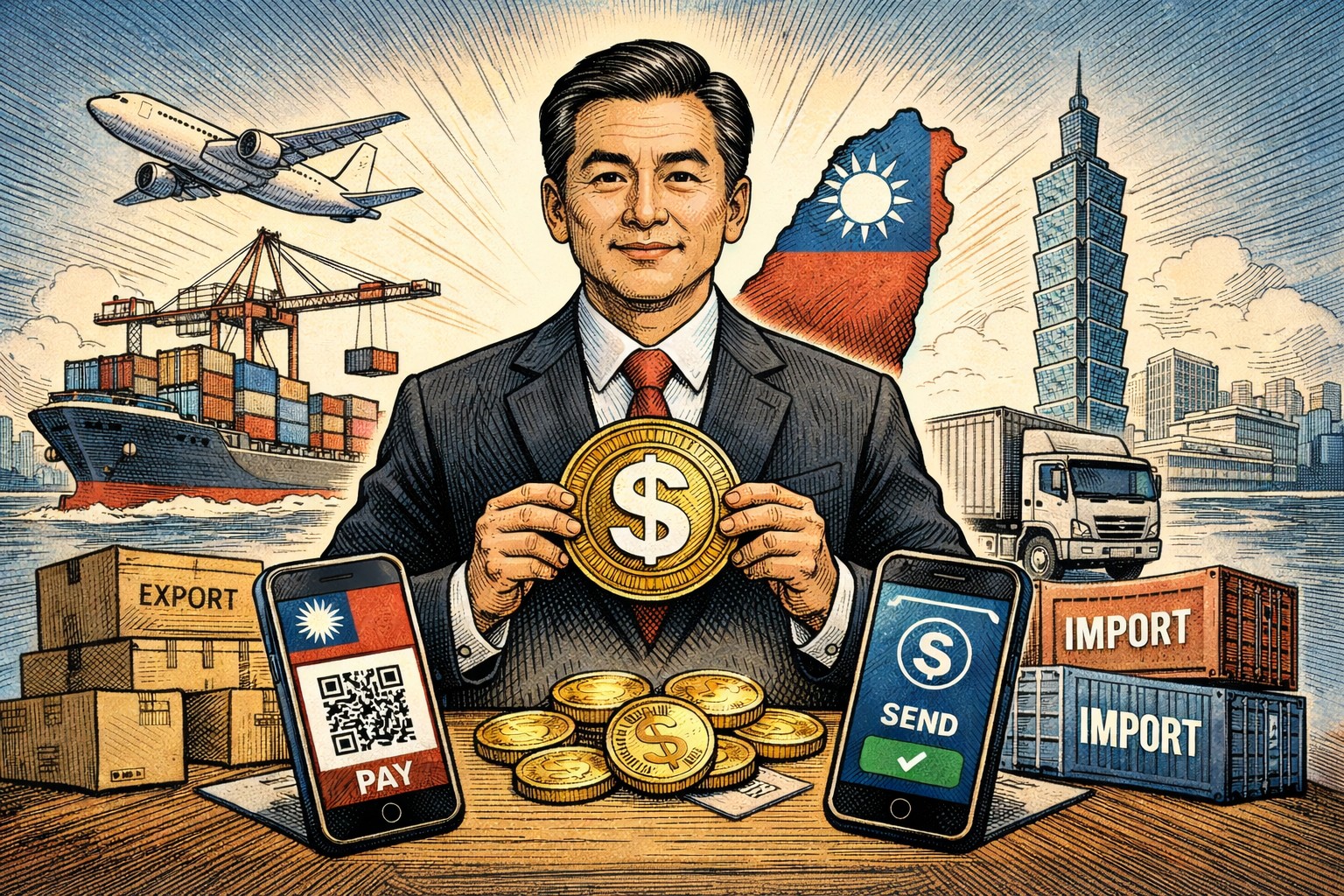
Taiwan’s financial regulator says many import-export trading firms are already using U.S. dollar stablecoins to receive and make payments. The use case has emerged before the dedicated law for stablecoins takes effect, and it is pushing financial institutions to get ready sooner. FSC Vice Chair Susan Chang said growing stablecoin use in cross-border trade is leaving companies with larger stablecoin holdings, which is creating demand for storage and management through trusted banks.
Banks are preparing for a custody role
According to the regulator, the stablecoins received by Taiwanese companies from overseas are mainly dollar-pegged tokens. Those firms are looking for domestic financial institutions to hold the assets on their behalf. Chang said this demand is leading some banks to prepare in advance for stablecoin custody services. The focus is not abstract experimentation. It is tied to actual payment flows tied to trade and supply chains.
She also said that if businesses begin using dollar stablecoins for supply chain payments, transactions that stretch across domestic and overseas links will naturally create demand for settlement in different currencies. That has opened discussion around the possible use of a New Taiwan dollar stablecoin. The FSC wants financial institutions to support cross-border payments in a way that connects fiat rails and on-chain assets without forcing companies to deal with a gap between the two systems.
Draft virtual asset law has completed Executive Yuan review
On the legal side, FSC Chair Peng Jin-lung said on January 29 that the draft Virtual Asset Service Act had completed review within the Executive Yuan. The next step is submission to the Executive Yuan meeting, followed by delivery to the legislature for deliberation. The bill is seen as a key step in placing stablecoins and virtual assets inside a clearer regulatory framework, while also creating a legal basis for cooperation between financial institutions and virtual asset service providers, or VASPs.
Heavy use of offshore platforms remains a regulatory concern
FSC data shows that about 70% to 80% of people in Taiwan use offshore virtual asset trading platforms. Yet under the current registration-based VASP regime, none of the 9 qualified operators is an offshore platform. The regulator sees this mismatch as a risk for anti-fraud enforcement and a weak point for investor protection.
Huang Ching-ping, director general of the FSC’s Securities and Futures Bureau, said any operator, domestic or overseas, must obtain approval from the competent authority if it conducts virtual asset services in Taiwan under the current Anti-Money Laundering Control Act. Operating without approval would violate the rules and could involve criminal liability.
Cold wallet thresholds have been raised
Compliance demands are also expanding into technology and security controls. In December last year, the FSC issued a directive requiring operators’ core systems to meet specific cybersecurity certification standards. It also required a significant share of customer virtual assets to be held in cold wallets. Measured by market value, the cold wallet ratio must not be lower than 85%. Measured by customer-held quantity, the ratio must not be lower than 75%. As stablecoin and virtual asset business grows, supervision is tightening at the same time.