
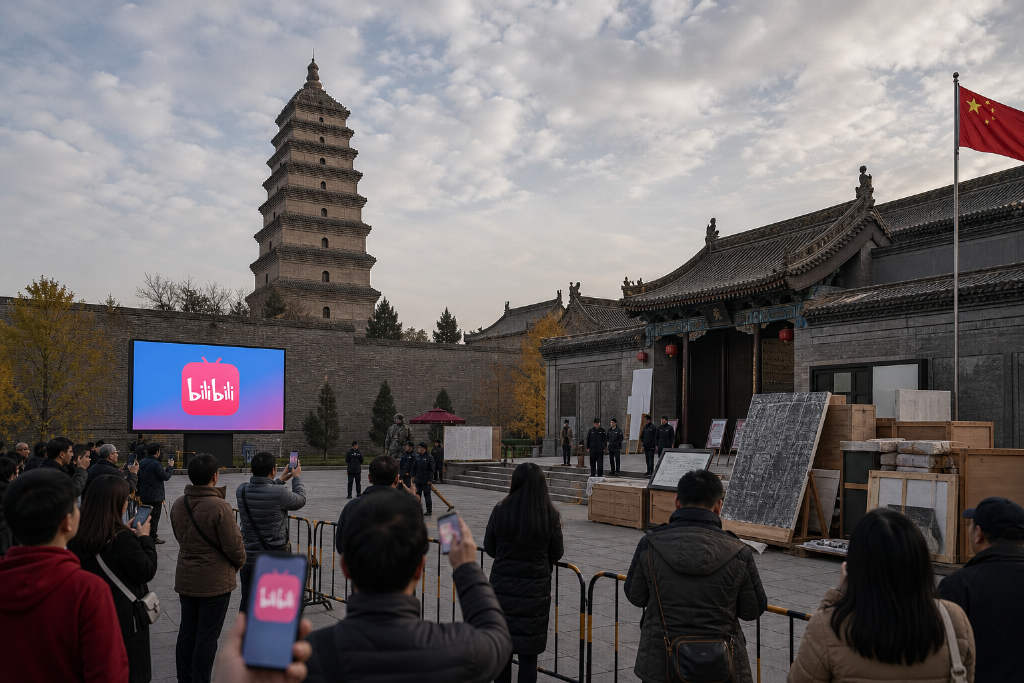
Claims that the Tang dynasty never existed have gained traction on the Chinese internet, moving beyond online debate and into real-world demands directed at public agencies. According to BlockTempo, the narrative can be traced to a series of videos uploaded to Bilibili by creator qiao喬於yu from late April to early May 2026. The videos argued that China’s ancient history had been tampered with, that the Song dynasties ruled continuously for 800 years, and that the Sui, Tang, Five Dynasties and Ten Kingdoms period, and even the Yuan dynasty were inventions of later historians.
Discussion tied to the claim accumulated tens of millions of views on Weibo. By mid-August, the account had been banned by the platform and all of the videos had been removed.
The online claim spilled into offline action
Chinese state media recently reported that large numbers of people had called Shaanxi tourism and culture authorities to demand the removal of Tang-related heritage sites in the province. Their argument was that if the Tang dynasty never existed, those sites must have been fabricated in a later era.
CNN also reported that some parents in China said their children’s understanding of history had been thrown into confusion after watching videos with themes such as “the Tang dynasty never existed” and “the Ming dynasty ruled the world.”
The issue drew broader international media attention in mid-to-late August. In a report published on Aug. 19, CNN interviewed a 24-year-old Beijing resident identified as Callum, who said the trend was “a way for people to attack established authority,” adding that “those so-called experts aren’t that impressive.”
William Kirby, a Harvard University professor of China studies, offered a blunt assessment: “This is basically crazy. History has facts, and the Tang is unquestionably one of them.”
Why the Tang dynasty became the target
CNN pointed to a political and ethnic angle behind the narrative. The founding emperor of the Tang dynasty was not Han Chinese, and that fact has long been used by some Chinese nationalists as a line of criticism. The Song dynasty that followed is viewed as a Han Chinese regime. In that framing, erasing the Tang from history and extending Song rule to 800 continuous years also removes that ethnic complication.
The source material says this helps explain why the idea found an audience: it supplied language for an existing current of nationalist sentiment.
How the argument was constructed
The report breaks the reasoning into two parts.
The first was an adaptation of the “phantom time hypothesis,” a Western fringe theory that argues several centuries of the Middle Ages were fabricated. The hypothesis has long been rejected by both historians and astronomers. The Bilibili creator borrowed astronomical terminology from that theory and built an argument that appeared, on the surface, to resemble mathematical proof.
The second step was to create a self-contained test for historical authenticity. Any written source or archaeological object that conflicted with the conclusion was labeled a later forgery.
That is where the framework becomes difficult to refute. Produce the Old Book of Tang, and the answer is that the book is fake. Produce unearthed artifacts, and the answer is that they were buried later. As the source text notes, the more material that is examined, the easier it becomes for believers to claim the scale of forgery must have been even larger.
Scholars answered with three categories of evidence
Li Hongbin, a professor at Shandong University’s School of Northeast Asian Studies and vice chairman of the Chinese Tang History Society, laid out three types of evidence against the “Tang never existed” claim:
- canonical historical texts including the Old Book of Tang, New Book of Tang, and Zizhi Tongjian;
- records left by other peoples during the Tang era, including the Turkic, Tibetan, and Uyghur polities;
- surviving texts from overseas regions such as Japan, Persia, and the Arab world.
Those materials came from different regimes, languages, and political positions, yet they align with one another. Li said modern historiography is built on strict empirical research and that irresponsible online speech can do serious damage to the historical record.
Official response and platform cleanup
On Aug. 20, the Chinese Social Sciences Today ran a front-page article titled “The ‘Tang Dynasty Never Existed’? How Pseudohistory Bloggers ‘Manufacture’ Historical Nihilism,” describing the episode as something that had “seriously endangered national ideological security.”
Wang Bo, an assistant researcher at the Institute of Ancient History under the Chinese Academy of Social Sciences, criticized such accounts more directly. He said they were “creating fake revelations, abandoning academic textual research, and relying on sensational language to chase traffic.”
Platforms have also acted. According to the source text, several platforms launched targeted cleanup campaigns, removed content denying Tang history, throttled accounts that repeatedly posted pseudohistory, and raised review standards for history-related material.
Concern that false history may enter AI training datasets
Sing Tao Daily wrote in a commentary this month that the spread followed a clear traffic incentive. Educational videos that carefully explain source materials draw limited viewership, while contrarian and sensational headlines pull in clicks. In that environment, creators can monetize rumors and fabricated history.
The paper argued that the bigger problem is AI. As these claims spread online, they accumulate in the datasets used to train models. In its words, “AI does not have the independent ability to judge whether historical facts are true or false”; it counts which claims appear most often on the internet.
If enough pseudohistorical material builds up, chatbots may begin to reproduce falsehoods. The risk grows further if users employ AI to generate fake archaeological footage or forged historical documents. In that scenario, even the old instinct that “pictures prove it” would break down.
Timeline
- Late April to early May 2026: qiao喬於yu uploaded the Bilibili videos that advanced the “Tang never existed” claim.
- Mid-August 2026: the account was banned and the videos were removed.
- Aug. 19, 2026: CNN published its report on the controversy.
- Aug. 20, 2026: Chinese Social Sciences Today put the issue on its front page.