
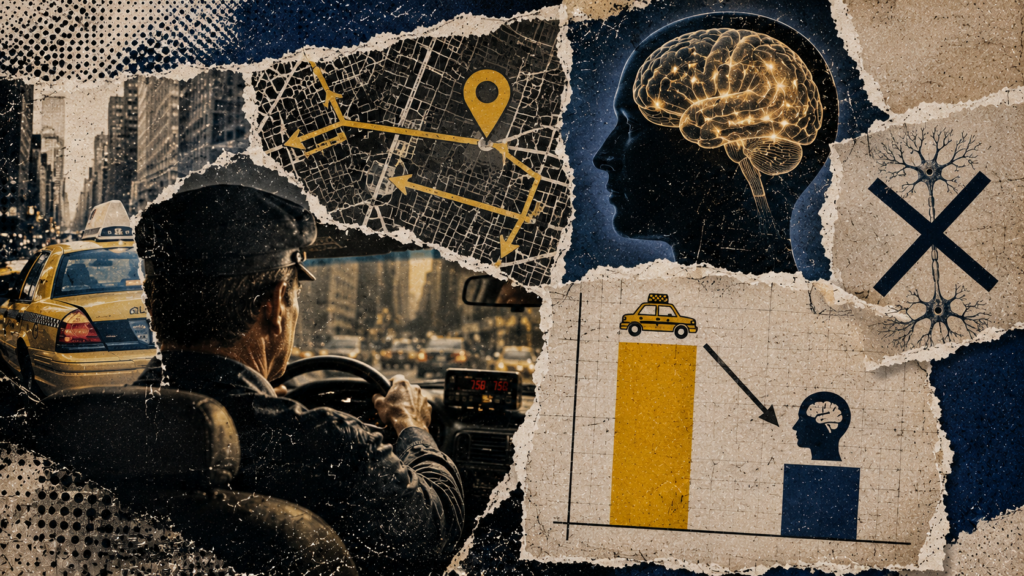
Taxi drivers and ambulance drivers appear to have a lower risk of dying from Alzheimer’s disease than the broader population, according to research discussed by Hatim Sharif, a civil and environmental engineering professor at the University of Texas at San Antonio, in an article published by The Conversation.
Sharif wrote that several studies have linked complex spatial reasoning and real-time navigation to a lower risk of Alzheimer’s-related death, and said those skills can be developed through training rather than treated as fixed traits.
Nearly 9 million death certificates point to one pattern
One study published in 2024 analyzed nearly 9 million U.S. death certificates spanning January 2020 to December 2022 and compared causes of death across 443 occupations. In that analysis, taxi drivers and ambulance drivers had the lowest risk of dying from Alzheimer’s disease among all occupations reviewed.
The figures cited in the article showed that about 1 in 100 taxi and ambulance drivers died from Alzheimer’s, compared with about 1 in 60 people in the general population. After adjusting for age, sex, race, ethnicity and education, the risk for those two occupations was still about 40% lower than in the overall population.
Sharif said the signal does not appear to come from driving alone. Bus drivers on fixed routes and pilots did not show the same apparent protection. The distinction, he wrote, may lie in continuous real-time navigation. Taxi and ambulance drivers deal with changing destinations and must repeatedly plan and revise routes in their heads, keeping spatial reasoning under constant demand.
The hippocampus is at the center of the explanation
The proposed biological link is the hippocampus, a brain structure involved in memory and spatial navigation. Sharif noted that it is also one of the earliest regions affected by Alzheimer’s disease. Many patients develop spatial disorientation before more obvious memory decline, including getting lost in familiar places.
That focus has drawn renewed attention to a well-known study published in 2000. In that research, neuroscientists compared the brains of London taxi drivers with those of other people and found that the drivers had more gray matter in the posterior hippocampus, the region associated with storing large-scale spatial maps.
The article said the amount of gray matter rose with years spent driving, a result taken as evidence that the change reflected training and repeated practice rather than inborn ability.
London taxi licensing is known for its demands. Drivers seeking a license must memorize more than 25,000 streets within a 6-mile radius of Charing Cross. The test, known as “The Knowledge,” usually takes 3 to 4 years to pass.
Neighborhood complexity may matter as well
Sharif also pointed to a 2023 machine-learning study based on data from 22,500 people. That research found that the environmental complexity of a person’s ZIP code alone could predict local Alzheimer’s incidence with 84% accuracy.
People living in areas with denser street networks, more intersections, and a wider mix of landmarks and points of interest showed lower disease rates in the study cited. One possible explanation is that these environments require residents to make spatial judgments and navigate more often in daily life.
Sharif linked that idea to the concept of cognitive reserve, the brain’s ability to keep functioning despite disease-related damage. Previous research, he wrote, has connected mentally complex occupations with slower cognitive decline and lower dementia risk, independent of education level.
Spatial reasoning may be trainable, but causation is unproven
Sharif said he has more than 20 years of experience in geographic information systems, or GIS, working with spatial data from neighborhood scale to entire watersheds. He noted that cognitive scientists often distinguish between two forms of spatial thinking: an egocentric perspective used by taxi drivers navigating within a scene, and an allocentric perspective used by GIS professionals working from a map-like overhead view.
Both forms engage the hippocampus. What remains unclear is whether screen-based spatial work can offer the same kind of protection as real-world navigation, because no study has confirmed that yet.
Sharif added that many universities around the world now offer GIS and remote sensing courses in geography, engineering, public health and environmental science, which gives the public more ways to access spatial analysis skills.
He argued that the findings may have implications not only for personal health habits but also for education design and retirement planning, with active navigation potentially becoming part of a brain-health strategy.
At the same time, the article stressed that current evidence shows correlation, not confirmed causation. Lower dementia risk among people who live in more complex environments or work in spatially demanding jobs does not prove that those activities prevent Alzheimer’s disease.
Still, the research points to a concrete direction for further study: relying less on automated navigation and using one’s own sense of direction more often may be associated with brain health.