


PANews published an article by danny arguing that the most important change in trading card games after they move on-chain is not the card becoming digital. It is the way the transaction itself gets rebuilt.
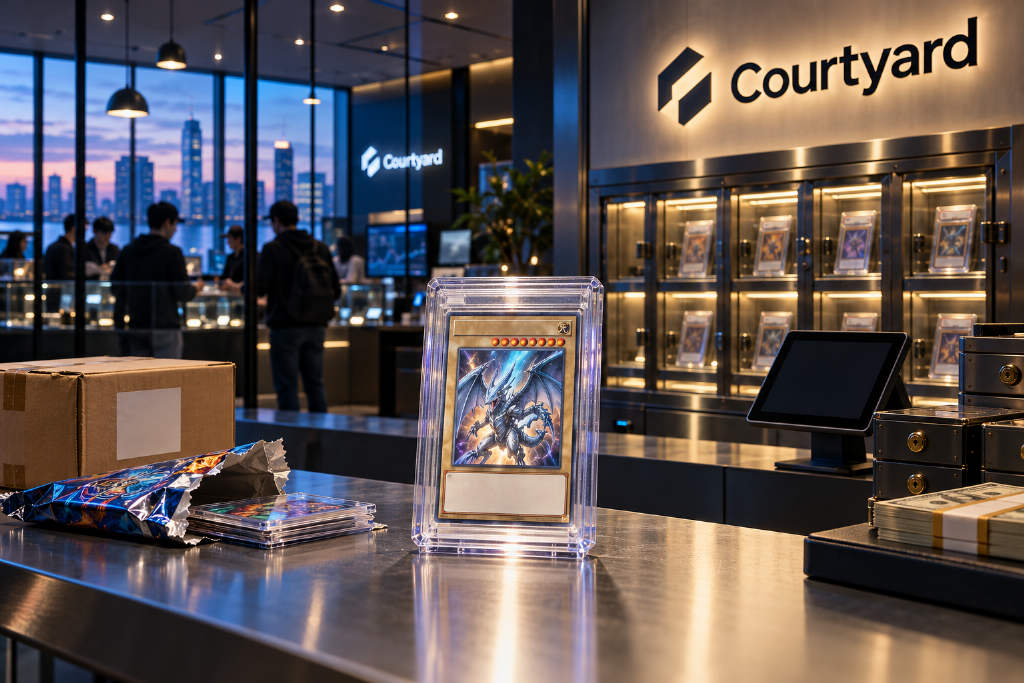
On Courtyard’s product page, collectors can open a random pack, keep the card in a vault, request physical delivery, or accept the platform’s offer and sell it right away. A Pokemon card sealed in a transparent slab can therefore end up in several different paths. For one user, it is exit liquidity after missing the desired pull. For another, it may be the version missing from a collection. The physical item stays where it is. What changes is ownership, and who is willing to pay for it.
Cards can keep trading without moving
The article says this is where the key shift sits. In the old model, once a pack was sold, the operator waited for the next customer. In the newer setup, pack opening, quoting, buybacks, and another purchase can happen one after another. The same card, and even the same budget, may take part in multiple transactions in sequence. Inventory stays still, while trading volume can expand by multiples.
The piece ties that appeal to a familiar form of risk-taking: some people are willing to spend a small amount for a chance at a much larger outcome. The question is where that money goes. Some spend it on heavy promotion or influencer endorsement. Others spend it inside a cultural IP they already know. TCG becomes that vehicle. Instead of playing a slot machine with symbols they do not understand, they buy a Pokemon card because they already know Pokemon.
Market size and user data around Pokemon and TCG
As of the end of March 2026, cumulative Pokemon card production had exceeded 85 billion cards, with sales spanning more than 90 countries and regions. The digital card app Pokemon TCG Pocket announced in October 2025 that cumulative downloads had passed 150 million.
Straits Research, in an updated report published in October 2026, projected the global trading card game market at about $16.3 billion for that year. Business Insider, citing eBay data in December 2025, reported that trading cards were the most-purchased secondhand category among Gen Z users in the United States on the platform at the time of the report.
From hobby-store product to collectible and investment item
The article traces the business back well before crypto. In 1993, Magic: The Gathering debuted. Wizards of the Coast co-founder Peter Adkison traveled along the U.S. West Coast visiting game stores and demonstrating a new format built around buying cards, building decks, and battling. Small stores opened one after another. Those shops were not only sales channels. They were also social spaces for fans.
More than 30 years later, the children who once played these games have more spending power, and cards have shifted from game tools into collectibles and investment items. Some people study deck construction. Some chase artwork and print variants. Some buy the card they could not afford when they were younger. The audience keeps widening.
Hasbro’s 2025 investor materials showed that the average tabletop Magic player was about 35 years old, with average engagement of more than five years, while the Wizards Play Network covered about 9,600 stores. In 2025, Magic tabletop and digital products generated a combined $1.72 billion in revenue, up 59% year over year.
Why younger users are paying attention
The article points to a higher barrier to traditional wealth accumulation as one reason more people are showing up. A 2025 survey from the National Association of Realtors found that first-time buyers accounted for 21% of all homebuyers, while the median age of first-time buyers rose to 40. A 2026 survey from Northwestern Mutual found that among U.S. Gen Z respondents who use or are considering high-risk speculative tools, 80% said they were financially behind and hoped those tools, described in the article as TCG or crypto, could help them reach their goals faster.
Those figures show two realities at once: large assets require long accumulation periods, while smaller, immediate products with the image of high returns are competing for attention.
Cards also come with cultural familiarity. A person may not understand a company’s cash flow, but may know which character they like and which version is popular in a community. The article says familiarity does not equal profit, but it does make participation easier. Even if prices do not rise right away, collecting and displaying the card can still justify holding it.
An eBay-commissioned Deloitte collectibles study in Australia in 2025 found that 35% of surveyed collectors viewed collecting as a good investment. Among those collecting for investment purposes, 40% expected returns above 50%. The report, citing eBay data, also said the One Piece OP-01 booster box had risen 200% in transaction price since 2022. The article argues that stories like this can easily turn a hobby into an investment attempt.
Cards sit between consumption and investment
In the author’s view, buyers themselves may not draw a strict line between spending and investing. A favorite character gives them a reason to buy. A rare version gives them a reason to hold. Other people’s profit stories supply the image of appreciation. That mix spreads.
Still, traditional spot trading in cards is slow. Cards are non-standardized items, similar in that sense to NFTs, and hard to price uniformly. That holds back volume, turnover, and liquidity, and leaves little room for a derivatives market. To stimulate spot trading and the dream of a windfall, merchants fold blind-box and pack-opening probability games into a single sale.
That creates two different kinds of upside. One is buying a card and waiting for it to rise from $100 to $300. The other is spending tens of dollars and pulling a card worth much more. The first depends on a later buyer bidding higher. The second depends on the prize pool probability. The article says the traditional process is either too slow or too opaque to scale.
Why the old model limits turnover
To fit more people around the table, the article says, the market first has to solve the problem of moving a card back and forth. Selling a card in the traditional way means taking photos, confirming condition, packing, shipping, and, in cross-border trades, dealing with customs and taxes.
Under eBay U.S. base fees, trading cards are charged a 13.25% final value fee on the first $7,500 of the total sale amount for each item, plus a per-order charge. On a hypothetical $100 order with no tax or shipping, after deducting 13.25% and a $0.40 order fee, the seller receives $86.35.
Under that cost structure, a move from $100 to $110 may not be enough to justify taking profit. The article adds that "friction" in the card market is not only fees. It also includes condition risk created by handling and transport.
Custody and on-chain records separate movement from ownership
That is why some companies use centralized custody. The article points to Fanatics Collect as an example. Once a card is deposited, it can change owners multiple times and only leaves storage when someone requests delivery. That solves a large part of the efficiency problem.
But the author says it is still not fast enough, and it does not fully solve ownership. On-chain certificates add another layer. Where the product allows it, the certificate can move into an external wallet, be used by other marketplaces and smart contracts, and connect payment with stablecoins. Custody solves the need to stop moving the card. Putting the ownership record on-chain expands where that certificate can circulate and which services can call it.
Price discovery and turnover are the core metrics
The article frames price discovery and table turnover as the two key ideas for understanding the business.
A card listed at $100, with a platform valuation of $100, does not mean someone is willing to pay $100 right now. The listing price reflects the seller’s expectation. The transaction price records what happened in the past. The bid tells the holder what they can get if they exit now. The more independent buyers there are, the more complete the quoting and execution process becomes, and the easier it is for collectors to decide whether to hold or sell.
Turnover answers a different question: how many times can the same inventory take part in transactions? If inventory is worth $1 million and both price and inventory size stay unchanged, one turn per month means $1 million in monthly sales. Ten turns per month means $10 million. If the old average was one turn every ten months and that rises to ten turns a month, gross flow becomes 100 times larger.
Courtyard founder Nico Le Jeune has said the same card is sold eight times per month on average on the platform. Sporting Crypto, using CryptoSlam data, said monthly sales rose from about $449,000 in April 2024 to about $66 million in April 2025. The article presents that as a small-base expansion case showing what can happen when trading frequency and distribution range both widen.
Random packs and instant buybacks speed the loop up again
Inside that system, random packs and instant buybacks push turnover even faster. If users pull a card they do not want, they do not need to wait for another buyer. They can accept the platform’s quote and turn the result back into balance. The platform takes the inventory back and organizes another sale.
From the perspective of random rewards and cash-out mechanics, the article says this looks like a new gambling table dressed in IP. Whether the operator can make money, though, depends on the probability structure of the full card pool, costs, and cash reserves. Looking only at the buyback discount is not enough.
The article gives a simplified example. If a user spends $50 and pulls a card valued at $100, then sells it back to the platform for $85, the card returns to the platform and the platform’s cash change is 50 - 85 = -$35.
It then gives an average-value model. If a pack sells for $50, the probability-weighted average card valuation is $45, and the buyback ratio is 85%, then if all cards are sold back immediately and probabilities and valuations stay unchanged, the average buyback expense per round is $38.25, leaving the platform with $11.75 in cash on average, excluding any costs.
That $11.75 consists of the $5 gap between sale price and average valuation, plus the $6.75 discount applied to the $45 valuation at buyback.
How much money users get back determines whether they can keep going into the next round. In that model, the average return ratio is 76.5%. If funds can be divided infinitely, the return ratio stays constant, all balance is reinvested, and there is no minimum purchase amount, then an initial $50 budget can support a theoretical cumulative purchase amount of 50 / (1 - 76.5%) = $212.77.
The article also notes that real products are not that simple. Pack prices are fixed, and pull outcomes vary. If each pack costs $50, getting back $38.25 means the user must add more money or switch to a cheaper product.
Platforms run a marketplace and carry inventory risk
Reality is more complicated because users do not sell every card back. Some keep the card they want. Some request delivery. Some look for a better quote in the secondary market. Even if a card never leaves the vault, once it belongs to a user it is no longer inventory the platform can freely put back into the prize pool. The platform has to source new cards to keep the pool attractive and also handle buyback payouts when high-value outcomes cluster.
The article lists Courtyard’s fee structure to show the difference between business lines:
- P2P secondary trading between users carries zero platform fee.
- Buyback quotes for pulled cards come with a seven-day acceptance window, and valuations reference recent transactions, market trends, and grading differences.
- Transfers triggered by accepting a pull buyback are charged a 6% fee, while ordinary marketplace trades do not carry that fee.
That means a TCG platform is both a trading venue and a business taking inventory risk through quoted buybacks.
A similarity with perpetual futures
The article also draws a comparison with perpetual futures. The similarity, it says, is that both products try to reduce trading friction while accommodating different reasons for participation.
In perpetual markets, some traders bet on direction, some hedge, some earn funding, and some make markets. In card markets, some chase IP, some collect, some gamble on pulls, some play the game, some look for arbitrage, and some manage inventory.
What determines whether the table stays open
In its outlook section, the article says Magic: The Gathering brought people together through local game stores more than 30 years ago. Today, card platforms are trying to connect people in different places, with different motives, around the same pool of physical inventory. Culture helps them recognize what is on the table. Mechanism helps them transact faster. Custody and settlement remove the need to wait for another shipment before the next round starts.
One group is willing to spend a small amount for a chance to change the outcome. Another is willing to spend a known amount to buy the outcome they already want. Connecting those two groups is, in the author’s view, the most interesting business opportunity in putting TCG on-chain.
But the article says the long-term question is not how many times a card changes hands inside a vault. It is whether the platform can keep supply coming, keep randomness fair, keep buybacks available, and keep quotes competitive. Those factors will decide how long the table can stay open and how large it can become.
Postscript: cards are not only about price
The article closes with a story about Jirachi from Pokemon. It says a child named Avery had endured cancer treatment since the age of four, and Pokemon cards became emotional support during that period. His favorite card was Jirachi, but he had never managed to pull it.
Near the end of his life, he finally opened a Jirachi. In the video, the boy froze and repeatedly said he could not believe it. The article says that recording became his final pack-opening video. Not long after, he died following a long period of treatment.
The author writes that during those cold and difficult years of chemotherapy, the cards gave him something to hold onto. In a card market full of hype, promotion, rarity, and return stories, the feeling left by the 12-year-old was this: 「What moves people is never the price or the card grade, but the thing you truly love from the bottom of your heart and are willing to treasure for a lifetime.」
The article ends by recalling the Pokemon lore that Jirachi sleeps for a thousand years and wakes for only seven days, and that only a clear and pure voice can awaken it. The author says that kind of pure affection is worth keeping, because that purity is where hope remains.