
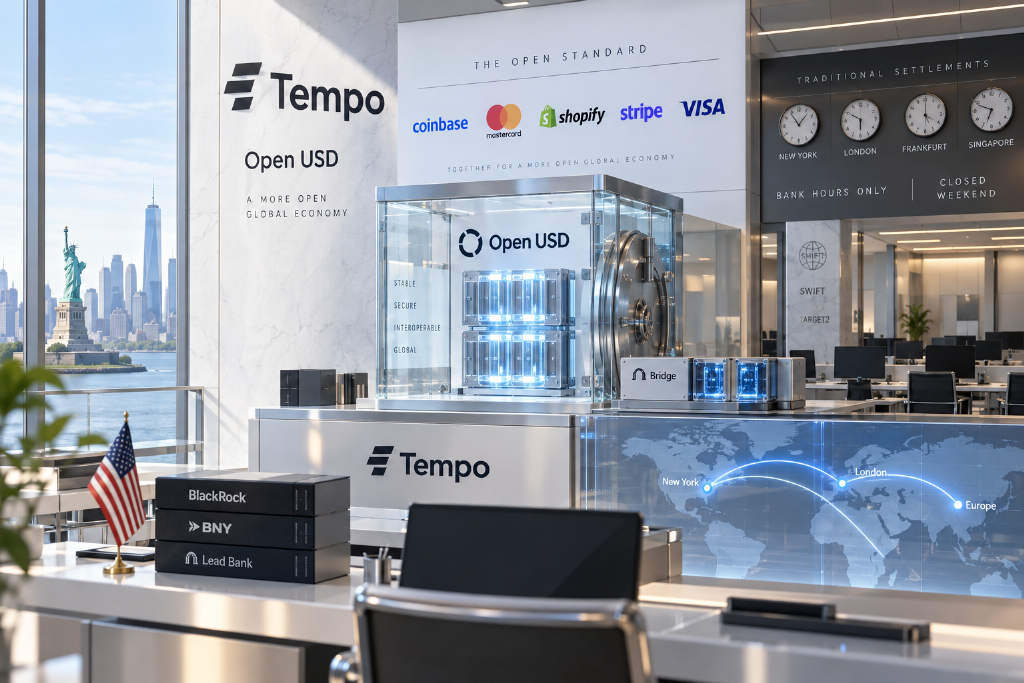
Dollar settlement still stops on weekends even though markets do not. Alea Research argued that this is the opening Tempo is trying to capture, as Fedwire, T2, CHAPS, and CLS remain unavailable for 44 to 60 hours over a typical weekend while Tempo settles every hour.
That gap became visible right after the launch of Open USD. The dollar stablecoin went live on Sept. 30 through Open Standard, a consortium created by Coinbase, Mastercard, Shopify, Stripe, and Visa. Bridge, a Stripe company, issues the token, and BlackRock, Lead Bank, and BNY hold the reserves. By Oct. 1, the first full day of operation, $447 million of the $490 million in circulating Open USD was running on Tempo.
Weekend trading continues, but settlement rails still close
The article said Fedwire settled $1.15 quadrillion in 2025, but none of that moved on Saturday. Large-value payment systems still run on weekday schedules. Fedwire opens at 9 p.m. New York time on the night before each business day and closes at 7 p.m., leaving a 50-hour weekend shutdown. The euro system T2 closes for 48 hours, sterling system CHAPS for 60 hours, and CLS, which settles foreign-exchange trades, for 44 hours.
Those schedules are not changing quickly. The Federal Reserve plans to add Sunday operations for Fedwire in 2028 or 2029, with Saturday still closed. The Bank of England will move CHAPS’ opening time earlier to 1:30 a.m. beginning in September 2027. Instant systems such as FedNow already run hourly, but individual payments are capped at $10 million.
Tempo has built part of its pitch around what it calls off-hours cash. In its paper on the subject, the team modeled a bank with $500 billion in assets converting wholesale deposits into its own stablecoin at 4:30 p.m. on Friday. Clients could use that coin over the weekend for margin or settlement, with unused balances automatically converted back into deposits on Monday. For a bank with a peak pool of $5 billion, the paper estimated an annual cost of about $38 million to support roughly $260 billion in flow, equal to a break-even fee of 1.5 basis points.
That figure, the article said, is below or in line with other weekend alternatives. Triparty collateral mobilization costs 1 to 3 basis points, weekend FX conversion costs 5 to 20 basis points, and after-hours prime brokerage funding spreads run at 5 to 15 basis points.
Open USD pushed most of its early supply onto Tempo
Most of Open USD’s initial dollars moved to Tempo. On Oct. 1, 91% of all circulating Open USD was on the network, accounting for 64% of Tempo’s total dollar stablecoin supply. By that date, the network’s dollar supply had reached $697 million, about double the level seen on Sept. 29.
The article broke down the shift in supply in more detail. Open USD added $424.3 million on launch day, while USDC, USDB, and pathUSD on Tempo fell by $114.5 million, leaving a net increase of $309.8 million across the network. Businesses can mint and redeem Open USD on Tempo for free through Coinbase, Stripe, and Visa.
As of Oct. 2, 88.3% of the reserves backing Open USD were held in Treasuries and 11.7% in cash.
Alea Research placed Tempo between Arc and Plasma in size. Tempo moved past Arc on Sept. 30, two weeks after Arc mainnet launched, and by Oct. 1 it had reached about half of Plasma’s $1.45 billion scale.
Cross-border payments still fall short of their own targets
The article said cross-border transfers remain slow because each corridor requires cash to be pre-positioned at the far end before payment can be made. Businesses move about $23.5 trillion across borders every year and pay roughly $120 billion in transaction fees for doing so. That number excludes FX spreads and the cost of trapped prefunded cash.
The G20 set a goal for the end of 2027: 75% of cross-border payments should be credited within one hour, and average retail costs should fall to 1%. Monitoring by the Financial Stability Board in 2025 showed that 54.6% of wholesale services and 35.4% of retail services reached beneficiaries within an hour. For business-to-business services, though, the figure was just 2.2%. Sending $200 overseas costs 6.5% on average, against a 2030 target of 3%, and the Financial Stability Board expects global progress by 2027 to remain unsatisfactory.
Companies that make daily outbound payments are feeling that friction first, and several are already using Tempo. MoneyGram joined as Tempo’s first remittance validator node and settlement partner. Felix settles remittances on Tempo. Deel launched DLUSD, a stablecoin wallet for contractors, with Tempo as its only chain. Coastal Bank built a corridor where messaging, screening, and bank confirmation stayed the same and only the value leg moved onto Tempo.
The report also offered a working-capital estimate. If 1% of business cross-border flow needed one less day of prefunding, around $644 million in operating capital would be released. At an assumed 4.5% cost of capital, holding that balance would cost roughly $29 million a year.
One pool of cash, multiple markets
Tempo’s own July paper argued that speed is no longer the real point of differentiation among settlement networks. The article said the more important attribute is liquidity mobility: the same cash can settle a repo trade, fund a cross-border payment, post margin at a derivatives venue, and settle a tokenized securities transaction without reissuing the cash in between.
On Alea’s Market Cap program, Borja Neira, one of the paper’s authors, said, 「Every generation of market infrastructure releases trapped cash, then traps it somewhere new.」
The article described the current trade-off as one between privacy and liquidity. Public chains split about $40 billion of liquidity across more than 20 rollups, while the largest private bank ledgers clear nearly $400 billion of repo trades a day but keep that cash inside a single market. Tempo separates private execution from shared settlement. Tempo Zones run private transactions on parallel chains, while balances remain on a shared network. The first Zone is scheduled to go live for a client in October.
Fees are close to zero, and the network has no token
Tempo priced transfers close to zero, the article said. From the July 10 fee cut through Oct. 1, the median transaction cost averaged $0.00003 per transfer, with the sender paying in stablecoins already held.
Activity data in the report showed that the network processed about 230,000 transactions a day while transfers were free. After charging began on May 19, daily transactions dropped to about 42,000 over the next month, while daily sending addresses held near 6,700. By Oct. 1, the seven-day average had climbed to 11,338 sending addresses and 92,228 transactions.
Tempo was built around treasury workflows after funds arrive. Senders can pay fees in any supported dollar stablecoin, and applications can sponsor fees for users. Every transfer carries a memo that can be tied to an invoice, and issuers can set roles and transfer policies on their own tokens. About 94% of each block is reserved for payment transactions, with the remaining 6% available for general computation.
Other stablecoin networks make different choices about what payers must hold to cover fees. Circle’s Arc, launched on Sept. 16, charges fees in USDC. Plasma uses its own XPL token for fees, while USD₮ transfers are free. Tempo lets each supported dollar stablecoin pay fees in its own unit, whether the issuer is a bank, a fintech firm, or USDC itself.
The article said Tempo has no token. It makes money by selling usage-based hosted APIs, including fee sponsorship, and a stablecoin consulting team that works with banks. It did not disclose take rates.
Who earns what when one dollar moves
The report split payment economics across four participants.
- Validators receive all network fees, though fees are intentionally low. From the July 10 fee cut through Oct. 1, the network collected $1,185 in fees across 5.8 million transactions over 84 days.
- Liquidity providers keep 0.3% of the fee when Fee AMM converts charges into the stablecoin accepted by validators.
- Issuers and their partners earn the yield on reserves backing each stablecoin. In Open USD’s case, reserve income is distributed to partners after a small management fee.
- Tempo sells adjacent services, including hosted APIs and consulting. The article did not disclose the company’s cut.
Tempo Earn, launched on Aug. 12, lets platforms deploy idle balances into tokenized money market funds, on-chain lending, and institutional credit, while setting their own reward-sharing terms with users.
The article summarized the model this way: senders or sponsors pay network fees in stablecoins, validators keep those fees, Fee AMM routes 0.3% conversion fees to liquidity providers, issuers keep reserve yield or share it with partners as Open USD does, and Tempo earns from APIs and consulting. There is no token, no buyback, and no claim by holders on network cash flow.
Built-in distribution and a fourth-quarter roadmap
Tempo launched with existing distribution channels. Stripe, Visa, and Zodia run validator nodes alongside MoneyGram. The validator set is permissioned for now. Tempo has described a path toward permissionless validation, but it has not given a date.
The article said businesses on Stripe processed $1.9 trillion in 2025, up 34% year over year and equal to about 1.6% of global GDP. Stripe runs its own money management on Tempo in more than 100 countries and, since Sept. 30, has offered Open USD to businesses on its platform. Those businesses can fund Stripe Treasury accounts from wallets on Tempo.
The next three milestones all fall in the fourth quarter. The T12 upgrade is scheduled for mainnet on Oct. 13 and adds payment sessions for closed-loop stablecoins, allowing issuers to move tokens across chains through burn-and-mint flows without requiring separate user approval. The first Zone is due in October. Stripe plans a full rollout of payments on Tempo in the fourth quarter. The article also listed two upcoming Open USD features: access through Mastercard and support inside Tempo Earn.
Stablecoin payments are still small, but the pools around them are not
The article estimated that stablecoin payments now run at about $390 billion a year, equal to 0.02% of the more than $2 quadrillion that moves globally each year. That figure covers wages, supplier payments, and remittances. Stablecoin transfer volume itself reaches $35 trillion a year, though most of that is trading activity and internal movement.
The surrounding pools are much larger. Fedwire alone settled about 2,900 times that annual payment figure in 2025. FX markets trade $9.6 trillion a day. Business cross-border flows total $23.5 trillion, roughly 60 times the stablecoin payment number.
The article closed with a comparison to shipping containers. Containers did not make ships faster; they removed the need to unload and repack cargo at every port. Tempo is presented in the same way for cash: money can move across markets on one network without being reissued at every stop. Stripe’s treasury operations are already on it, and on Open USD’s first full day the network held $447 million of the stablecoin. Fedwire will not add Sunday settlement before 2028, while Tempo is already settling every hour of every week.