


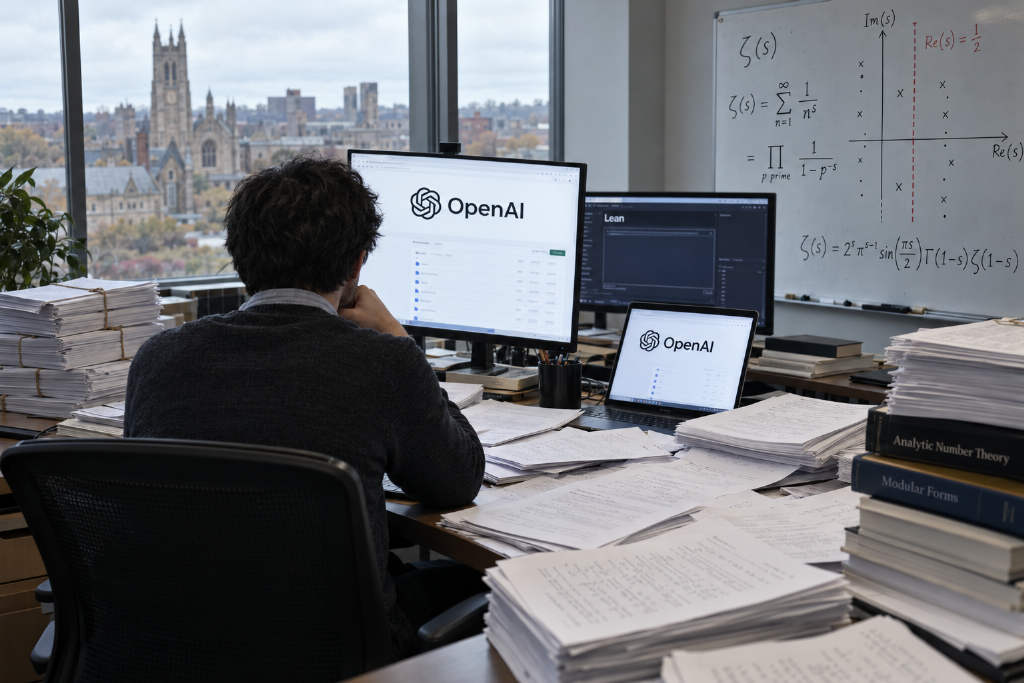
OpenAI’s early-October release of hundreds of AI-generated mathematics papers drew a split response from mathematician Terence Tao: he criticized the company for publishing without warning researchers already working on related problems, but also said one line of work tied to the Riemann hypothesis could be the field’s biggest advance in 50 years.
Tao made the remarks in an interview posted by Numberphile on Oct. 15. He said some younger researchers saw their projects effectively wiped out overnight because OpenAI had not informed people studying those questions before publication. In his words, the move was at least "extremely rude" and discourteous.
About 4,000 open problems and 719 released manuscripts
According to OpenAI’s description of its public math paper library on GitHub, the manuscripts were generated by an unreleased internal model. During evaluation, the model was given roughly 4,000 open problems, and each result used an average of three hours of ChatGPT Pro reasoning compute.
The library currently includes 719 manuscripts grouped into 372 families. OpenAI said about 42% of the main results have completed formal verification in Lean. The company also acknowledged that some results that have not been formalized "may have issues."
Chain News had previously reported that OpenAI withdrew three papers the day after publication because of a sign error.
Tao said he had looked at only about 10 papers out of more than 300. Some, he said, were extensions of existing research and might have been reached by the people already working on them within another year or two. One or two contained genuinely clever new ideas. Many others, though, still have not been understood by anyone. "OpenAI also has no one helping us," he said, adding that from the company’s perspective, the work was already finished.
Riemann hypothesis work pushes the zero-free region to 7/8
The most closely watched result in the collection is the so-called quasi-Riemann hypothesis in Family 3 of the library. According to OpenAI’s paper index, one manuscript proves that all Dirichlet L-functions, including the Riemann zeta function, have no zeros in the half-plane where the real part is greater than 7/8, and it includes Lean formalization.
Another paper in the same family proves an 11/12 version by a different method and, on that basis, rules out the so-called Landau-Siegel zeros. OpenAI’s library notes also say the work on zero-free regions for the Riemann zeta function was not produced entirely through a fixed pipeline, and that the 11/12 manuscript received human polishing.
Tao explained that the Riemann hypothesis says all nontrivial zeros lie on the line with real part 1/2. Previously, mathematicians only knew that the zeros lay in a region slightly less than 1. Reaching 7/8 means moving one quarter of the way toward the conjectured line.
He described the result as a "very clever new technique" that combines three or four existing ideas in a highly unusual way, something that "no single living mathematician" would likely have come up with alone. He also said the method cannot be pushed past 3/4 without another extremely clever idea. "The Riemann hypothesis has not fallen," he said, "but it has been dented quite a bit."
"Dynamite fishing" and a marathon analogy
Tao said mathematics has long had a class of medium-difficulty problems that are quietly left to students and postdoctoral researchers to build skill and credentials. There used to be plenty of such problems, and AI could not solve them, so the supply never felt constrained.
Now, he said, the situation looks like someone using explosives to fish, wiping out hundreds of problems at once. As a result, mathematicians are becoming less willing to publicly share problems they like, because they fear someone will use AI to solve them first.
He compared it to a marathon: in theory, a member of the public could drive on the same road and "beat" the runners, but everyone understands that doing so violates the norms of the event.
Tao said that before 2025, AI companies working on mathematics still needed to collaborate with mathematicians, so the two sides had aligned goals. Now that the tools are strong enough to solve problems independently, the incentives have split. He said the race to launch the strongest model has sacrificed not only human understanding of mathematics but also safety. "We are now putting them into real-world systems without really understanding how they work," he said, adding that this lack of understanding will eventually cause real problems.
The end of mathematics’ "heroic age"
Tao said the era of solitary breakthroughs, such as Andrew Wiles spending seven years in an attic to prove Fermat’s Last Theorem, is coming to an end. In his view, mathematics is moving toward an industrial model built around large-team collaboration.
He said he still hopes education can preserve older habits, much as children are taught arithmetic by hand before they use calculators.
The comments extend a view Tao expressed on Oct. 9. Chain News had previously reported that in a "Mathematics 2.0" talk, he said AI was pushing mathematics into an era of "proof abundance." In September, 25 Fields Medal winners also signed a joint statement criticizing the mismatch between AI companies’ problem-solving race and the goals of the mathematics community.