

AI is generating mathematical proofs at a pace the field is struggling to keep up with. The problem, as framed in the MarsBit report, is no longer just whether a result can be produced, but whether the community can read it, understand it, and make use of it.
On that point, two Fields Medalists from different generations, Terence Tao and Wang Hong, have landed on nearly the same answer: mathematics needs to learn how to absorb AI.
Peking University’s School of Mathematical Sciences recently released a long interview with Wang Hong. In that interview, she said the mathematical community cannot ignore AI-generated counterexamples or proofs, and needs both to learn how to use such systems and to understand and absorb what they produce.
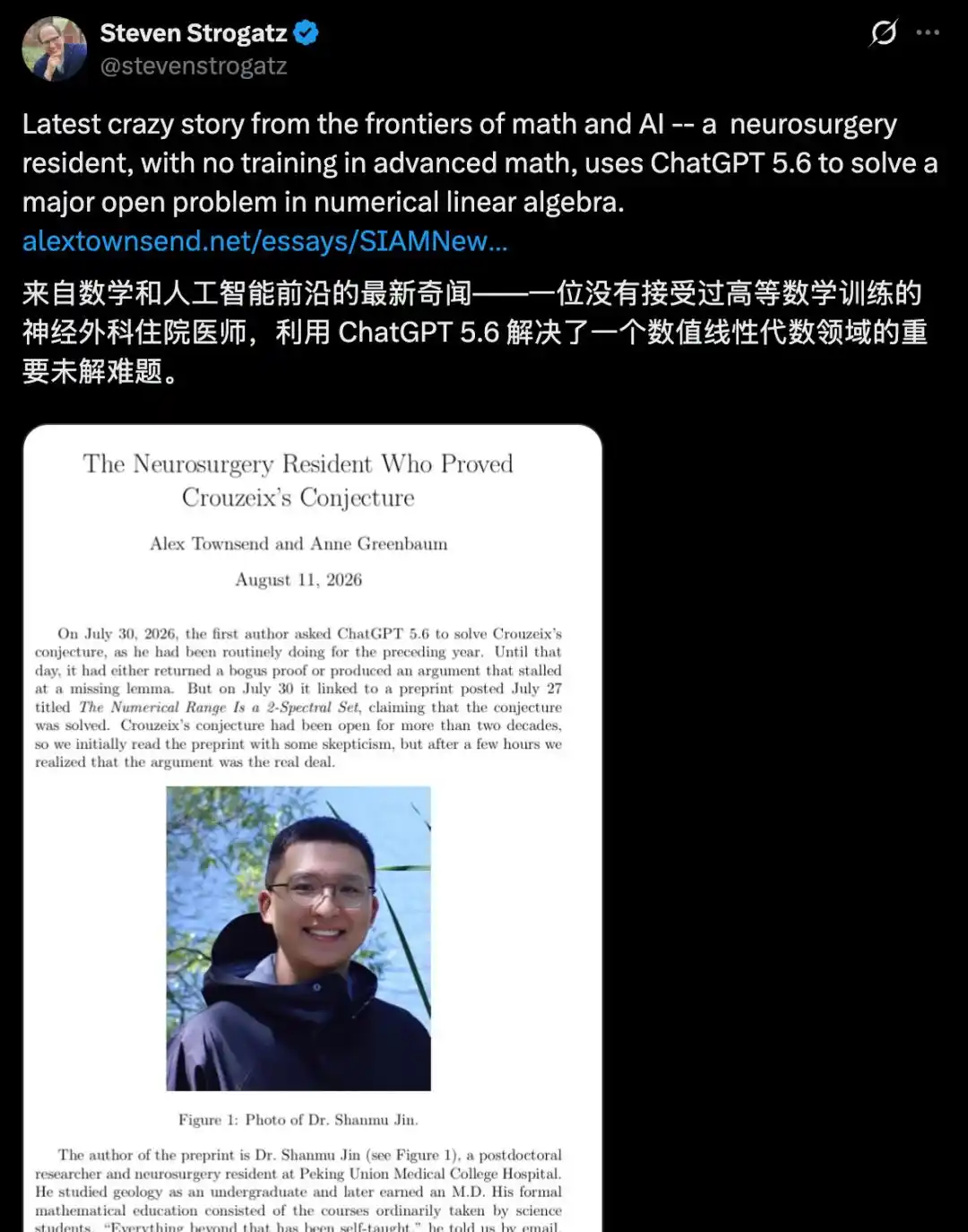
Tao has taken a similar line in practice. He spent several days working through an AI-assisted proof from beginning to end. The proof addressed the 67-year-old Sendov conjecture.
A proof is only the first stage
Tao’s argument, as quoted in the source text, is that a correct proof is only the first gate a mathematical result has to pass. Before a result becomes fully usable, professional mathematicians still need to understand it and absorb it.
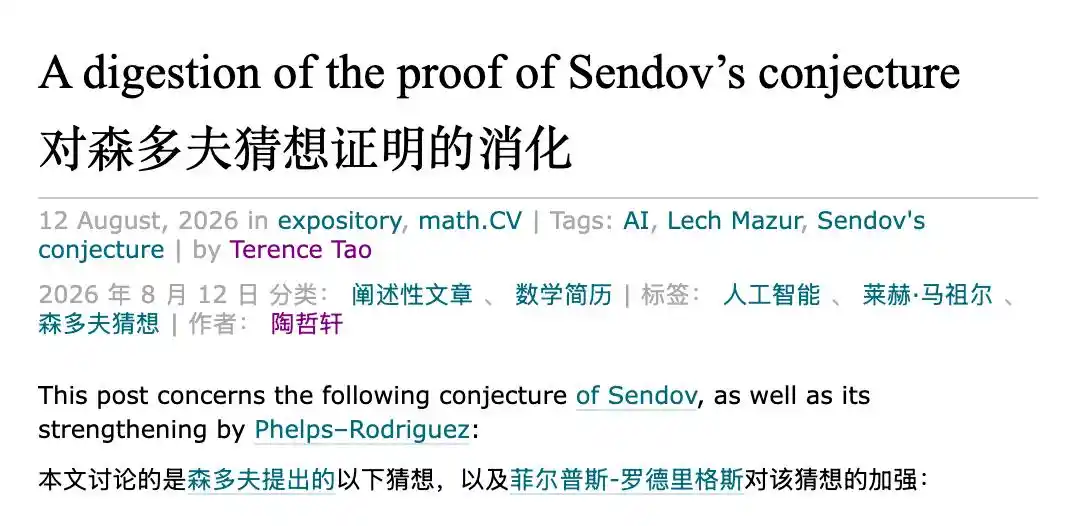
The report uses a comparison to explain the shift. In a traditional setup, an author resembles a parent who stays with a proof from birth to publication. In an AI-heavy workflow, the relationship may start to look more like an adoption model: one group uses AI to push a proof to the generation or verification stage, and another group takes over to explain, organize, and publish it.
That leaves mathematicians with substantial work to do, even if AI becomes more capable at producing answers.
Tao’s five-part view of mathematical results
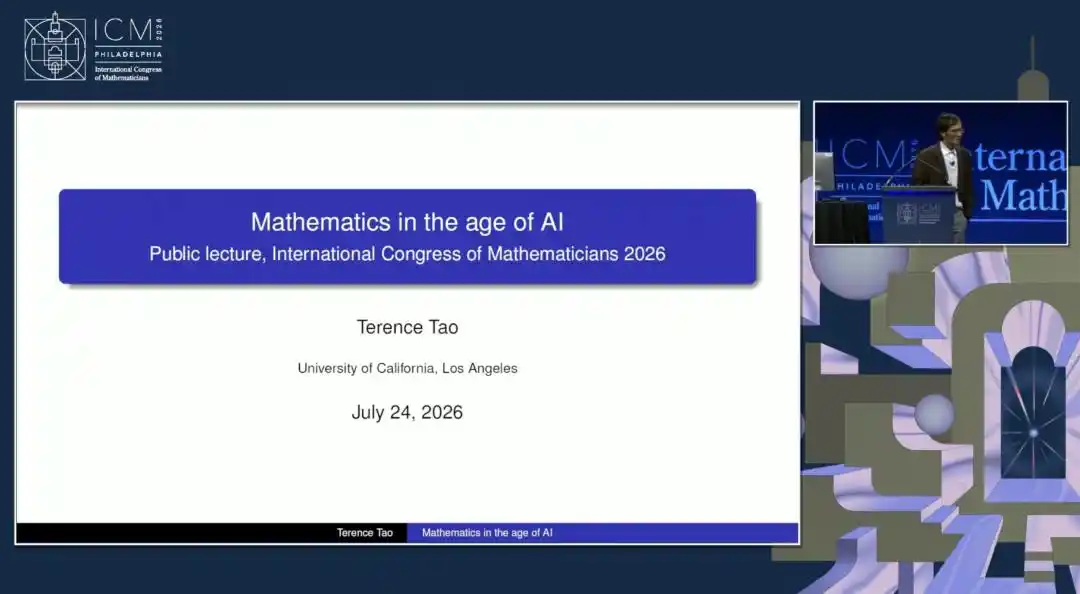
The discussion also ties back to a question Tao raised in an ICM talk a month earlier: if AI can mass-produce answers, what should mathematical research aim for?
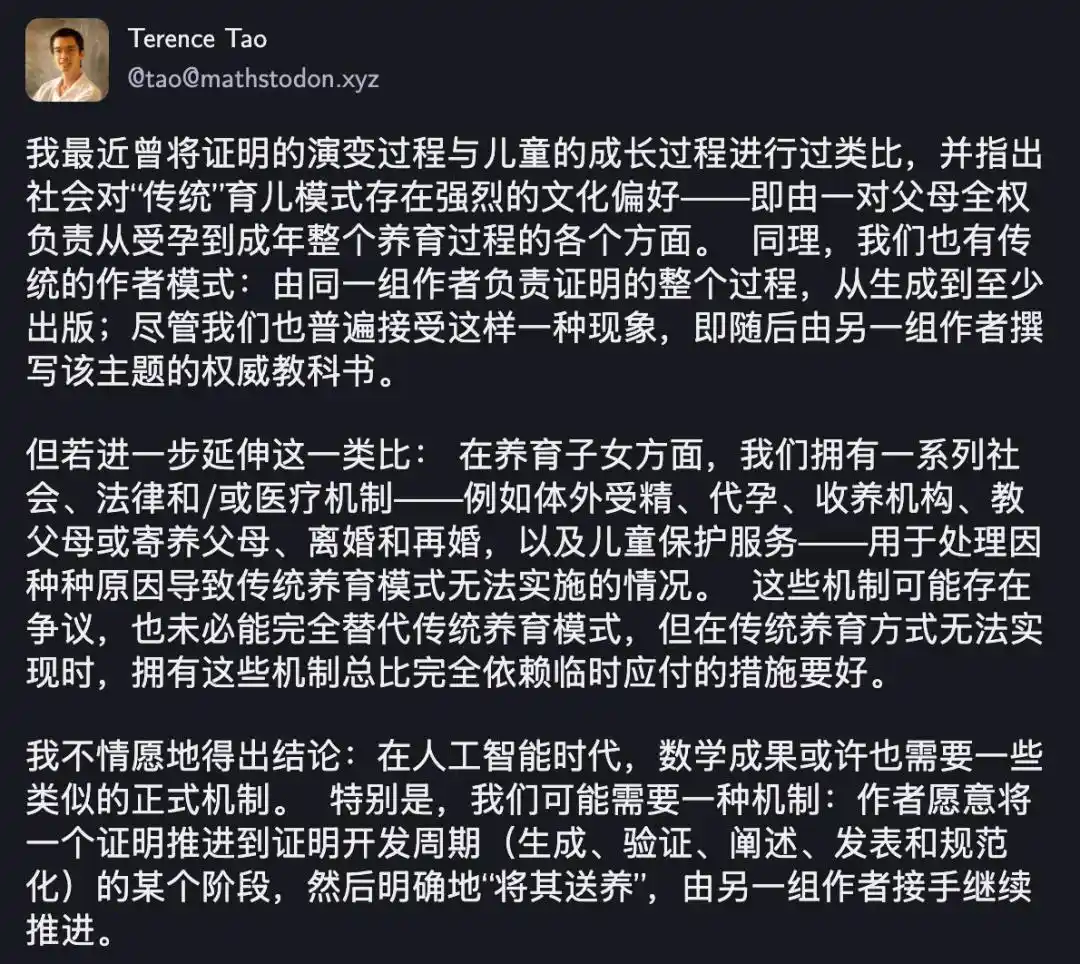
The article cites two examples. One is OpenAI’s new model Astra, which reportedly solved 10 problems in mathematics and theoretical computer science across areas including high-dimensional geometry, coding theory, and group theory. The other is a neurosurgeon without formal higher-mathematics training who let ChatGPT 5.6 run autonomously for about 16 hours and obtained a key proof for the Crouzeix conjecture in numerical linear algebra.
Against that backdrop, Tao breaks a complete mathematical result into five stages:
- generate an argument,
- check that it is correct,
- explain the idea to peers,
- put it through publication and community review,
- reorganize the result, connect it to existing theory, and settle it into standard knowledge that can be reused later.
In his view, AI is strongest at accelerating the first two steps. The later stages depend much more on mathematicians deciding what the core idea is and what the result actually means.
The Sendov conjecture as a full-scale digestion exercise
The Sendov conjecture concerns the distance between the zeros of a polynomial and its critical points. According to the source text, low-degree cases and sufficiently large-degree cases had already been resolved, while the middle range remained open for a long time.
A few days before Tao’s intervention, math enthusiast Lech Mazur used AI to fill that gap and produced a formal proof verified in Lean. At first glance, that could have looked like the end of the story. Tao’s point was that the original proof had not yet been shaped into a mathematical text suitable for human reading and publication, which meant the result was not yet usable in the full professional sense.
He then spent several days, using both ChatGPT and pen-and-paper derivation, carrying out what the report describes as a complete digestion of the result: tracing the literature sources, isolating the identities that actually drive the proof, removing detours, and rewriting the machine-found argument into a version with a visible main line.
That work did more than restate the original. The article says Tao’s reorganized argument not only proved the Sendov conjecture, but also covered the stronger Phelps–Rodriguez conjecture. It also relied on core tools that were far more elementary than the original formal presentation suggested, and reduced the Lean code from about 90,000 lines to 15,000 lines.
In that sense, digestion is not just another round of verification. It can also broaden what a mathematical result becomes.
A challenge to first-to-announce priority
Tao is also using this moment to question the field’s older rules around priority.
The report says mathematical ownership used to be anchored first in journal publication dates, and later in arXiv timestamps. Now that AI-generated proofs can appear much faster, even arXiv is viewed by some as too slow, with some results posted to social platforms as soon as they are generated. In the rush to claim priority, verification and explanation can get skipped, creating extra burden for the rest of the field.
That is why Tao argued in his ICM talk that mathematics should stop focusing so narrowly on the first person to produce a proof. The status of digesting and organizing proofs should be raised as well. Explaining proofs, refereeing them, and turning results into classic theory should count as meaningful work, rather than treating only the production of new theorems as creditworthy.
The source text quotes the idea in stricter terms: if an author cannot personally give an expert-level talk explaining the result clearly, then the work should not be published, even if AI has verified its correctness.
By that standard, a proof that humans cannot understand does not qualify as a complete result. Tao is calling for a deeper discussion across the discipline about AI’s limits and about the values mathematics wants to preserve, while also stressing the parts of mathematical work that machines still do not replace.
Palomar as a bridge between verification and publication
Alongside those arguments, Tao has publicly released Palomar, a registry aimed at Lean-verified results.
According to the report, Palomar records the problem statement, proof code, the form of AI involvement, and version information, then checks the material again through an independent kernel. Its purpose is to gather AI-generated proofs scattered across GitHub, social media, and news coverage into one place.
It is intended to serve as a digestion relay station between verification and publication, so later researchers can see what AI and other mathematicians have already accomplished and what work remains. Teams interested in the same problem can also use Palomar to collaborate.
The report notes that Palomar does not declare how important a result is and does not replace peer review.
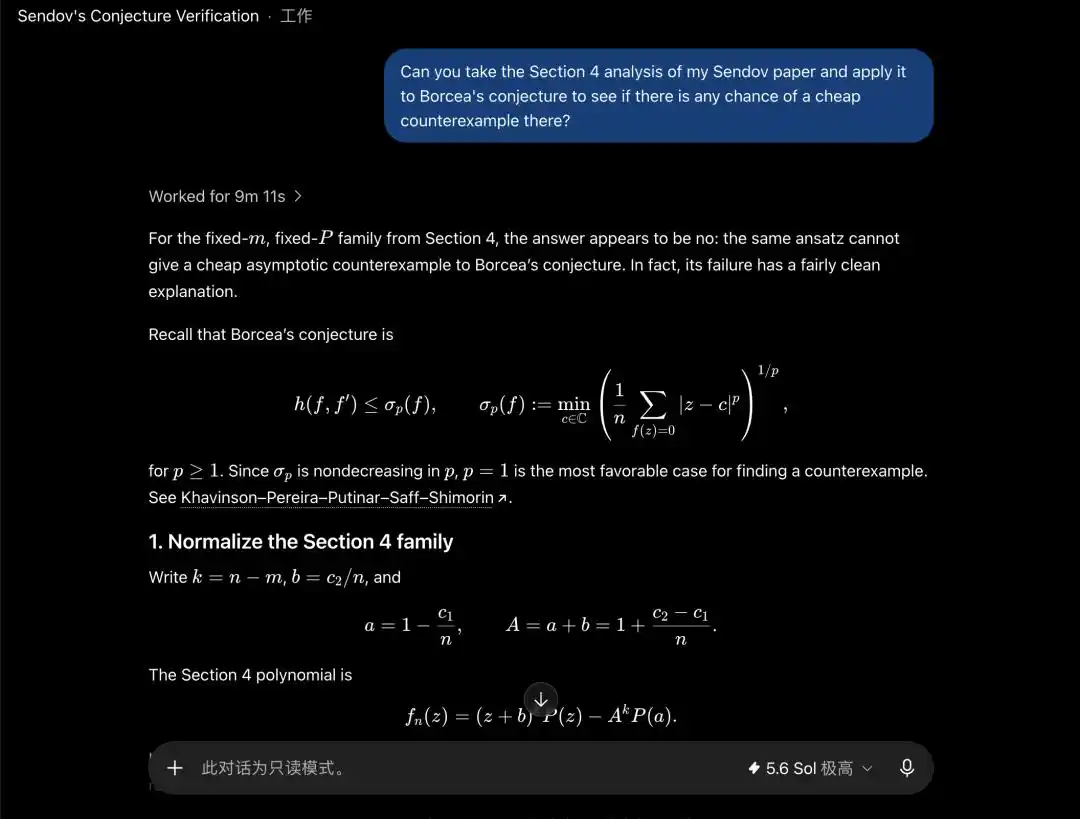
As described in the article, future priority over a result may be determined by the ordering of four timestamps:
- the generative record showing how the proof was produced, such as AI chat logs,
- the verification record confirming logical correctness, such as Lean code,
- the explanatory record that makes the idea clear, such as a public talk,
- the publication record that formally carries the result, such as a paper.
In plain terms, the source text says priority should go to the party that first delivers the full package, not just the first proof fragment.
Tao’s reorganized treatment of the Sendov conjecture has already become one of Palomar’s first archived entries.