


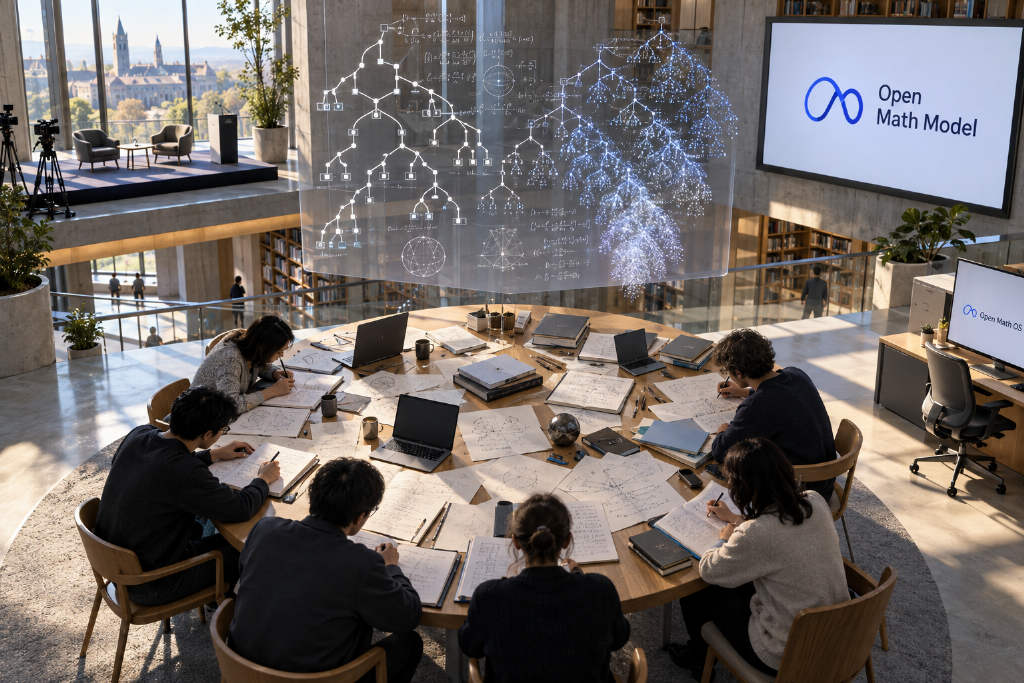
Fields Medalists Terence Tao and Yu Deng used a SAIR interview to make a point that cuts through the recent noise around AI-generated mathematics: a machine producing a proof is not the same thing as humans understanding the problem.
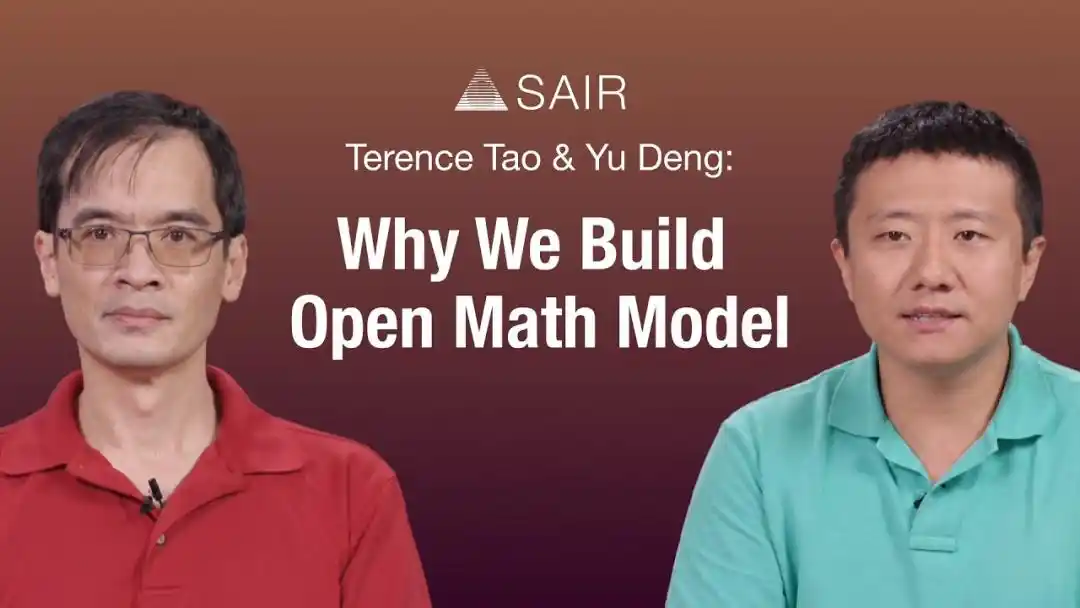
The conversation came after controversy over a leading commercial AI company releasing more than 700 mathematical proofs at once. Tao and Deng said the issue is not simply how many problems AI can solve. What matters is whether those proofs can be understood, whether the derivations can be checked, and whether mathematicians can build on them.
They also discussed how labor should be divided between mathematicians and AI systems. Tedious derivations may be handed to machines, they said, but asking good questions, planning a proof strategy, making judgments, and developing new ideas remain skills researchers need to cultivate themselves.
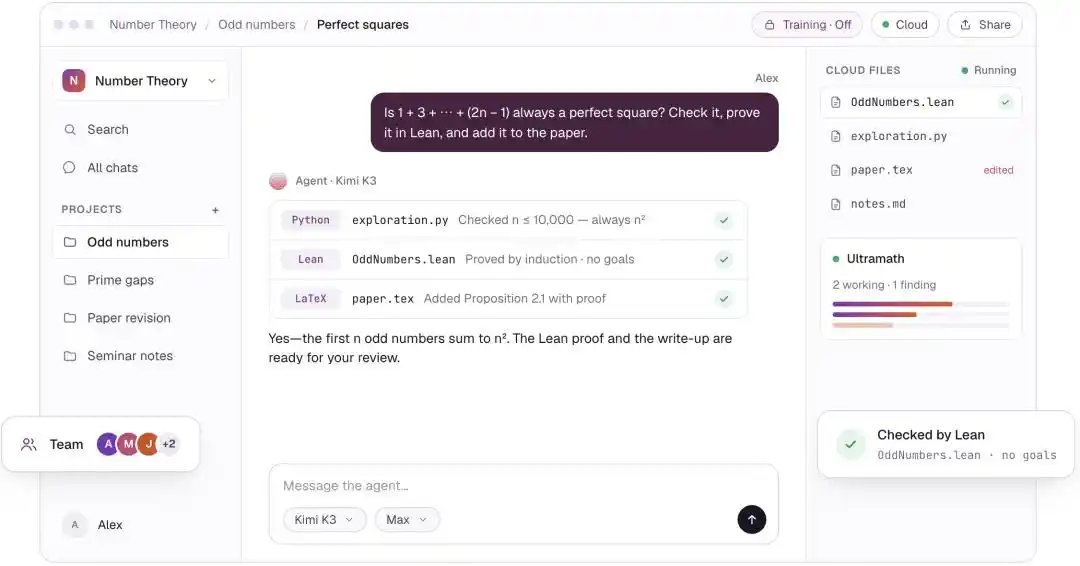
That view also sits behind their involvement in the Open Math Model initiative. The goal, as described in the interview, is to let the mathematics community help shape the tools it uses so AI serves mathematical research rather than treating mathematics only as a benchmark for general-purpose models. At the time of the interview, the team was still preparing its own new model. What has already been launched is Open Math OS, a working platform that combines existing open models, research tools, and collaboration functions.
AI can speed up research, but slower science still matters
The host opened by noting that the release of more than 700 proofs had set off a broad reaction online. The concern, he said, was not only whether AI might replace mathematicians, but also academic integrity, who should receive credit, and what counts as the core of mathematics itself.
Deng said using AI is a good thing and part of the future. In his view, AI can greatly expand the boundaries of mathematics and research, but only if it is used properly. He framed that as a matter of academic norms and, to some extent, ethics.
He also praised the technical quality of some recent AI-generated proofs. Leaving aside the conduct of the company involved, Deng said the proofs themselves contain striking and beautiful new ideas. He described the current moment as one in which AI learns from humans, absorbs human ideas, and develops new ones of its own. Those ideas, he said, can still be understood by people and can become the basis for further human work.
Tao rejected the idea that AI should be treated as a simple pro-or-con question. Technology is never that clean, he said. Cars and the internet both brought gains and trade-offs, and AI is no different.
His concern is that AI gives researchers more power while also displacing slower ways of doing science and mathematics that still carry real value. The aim, he said, should be to keep both sides: preserve the benefits of doing science slowly, including deeper understanding, community building, and maintaining human command of a field, while also using methods that can make work much faster. Speed, in his telling, is not the only thing worth optimizing.
Deng offered a concrete example of where AI fits well. If a researcher already has a roadmap for solving a problem and knows the steps required, but the details are too complicated and time-consuming to carry out by hand, then AI can take over that work. That saves time and energy and lets the researcher focus on more fundamental questions.
Solving a problem and understanding a proof are different boundaries
The host then turned to the recent release itself. After publication, several preprints were withdrawn because of basic notation errors, and observers also pointed to a large gap between the written proofs and the Lean code. That raised a practical question: if major technology companies push immature proofs into public view at this pace, how can the field avoid polluting the literature or turning mathematicians into unpaid debuggers.
Tao said the answer starts with incentives and values. Part of the reason these companies announce that they have solved famous problems so loudly, he said, is that mathematics itself has long placed heavy weight on solved problems.
Historically, though, solving a hard problem usually meant much more than producing a final answer. It meant the researcher understood the problem deeply, could explain the proof clearly, could ask new questions on top of earlier work, and could train students. The field rewarded that whole package, Tao said, even if the easiest part to measure was whether the problem had been solved.
Now, he argued, AI companies are almost solving these problems on the side. For them, mathematical problems are useful benchmarks in training more general models. The solved problems then become a byproduct. Tao said one could even think of them as "toxic waste" that the companies then need to deal with, or that the mathematics community is left to deal with.
That is why he wants the field to say more clearly that solving a problem for its own sake is not the goal. What matters is broader understanding and insight. Ideally, the companies producing these proofs would work with mathematicians to help others understand them, and mathematicians would be involved before the work is dumped on the field afterward.
Tao was also blunt about what may happen in practice. People will probably keep doing this, he said. At some point, the field may simply decide that if a result solves a problem but does not produce the other things mathematics values, then it will not become part of the literature in the usual way.
He added that among the results released by the company are around a dozen problems he personally cares about. He expects to read them eventually, but not as a top priority. As they are currently explained, he said, they do not yet excite him. If the company had worked with mathematicians, the process could have moved much faster.
Deng framed the issue as two separate frontiers. The first is the boundary between problems that have proofs and problems that do not. The second is the boundary, within the set of proved problems, between proofs humans can understand and proofs they cannot.
In the past, he said, the second boundary was not really a problem. If a proof existed, someone had proved it, and someone could understand it. Now, if only AI knows the proof, that second boundary becomes real.
For Deng, the underlying values of mathematics have not changed. People may think the standards are shifting, but he said the goal has always been the same: understanding the world, both the physical world and the abstract mathematical one. What has changed is the technical environment, not the purpose.
Attribution and the chain of ideas need to remain traceable
The interview then moved to credit and fairness. The host asked, in effect, whose work is being claimed when commercial companies showcase this kind of computational power.
Tao said that in one sense these systems are extracting the work of others by using data from prior research and papers. The key question is how to trace those sources.
For centuries, he said, academia has operated under principles of open science, treating the scientific literature as a shared resource. Papers can be used, but they should be cited properly so the origin of ideas can be followed. That is how science advances.
Current AI systems can absorb the accumulated literature produced by scientists and mathematicians over thousands of years and then turn it into answers through a process that is often opaque. Sometimes a system will tell you it used a specific result from a specific paper. Sometimes it cannot trace the path back to the source, or it does not show where the key ideas came from.
Tao said that breaks the chain of intellectual inheritance. That is a loss because part of solving a problem is learning what influenced it and which crucial ideas already existed in incomplete form in the literature. He allowed that this may be temporary and that future AI systems may become better at tracing their own sources. Right now, he said, the technology performs poorly on that front.
He also said technology companies have an incentive to blur this issue because they want people to feel that AI solved the problem out of nowhere, without relying on prior results. In reality, he said, these systems stand on the same long human foundation that human scientists do. Sometimes they acknowledge contributions and sometimes they do not. That needs to improve.
Deng added a more specific example. In some cases, he said, people directly use ideas that others had previously entered into ChatGPT and then use those ideas to generate proofs.
His view is that the long-term goal should be a system that can genuinely trace where ideas come from. If users could at least see the model's chain of thought, they might have some sense of how it reached a conclusion and what material it consulted. Without even that, he said, the situation becomes absurd. For anyone trying to build tools outside the control of large companies, this is one of the goals that has to be met.
Why Open Math Model is being built with community input
The host then asked Tao about the Open Math Model effort and why he believes open models can help mathematicians in ways closed systems cannot.
Tao said one of the original goals behind SAIR was to provide the mathematics community with tools developed by the community itself and aligned with its values and objectives.
He did not dismiss the tools built by large technology companies. He said he uses proprietary models often, and many of his colleagues do as well. In some cases, those tools line up well with the goals of mathematical work. Literature search is one example. Their retrieval abilities are already strong and useful, and becoming better at finding papers does not damage a researcher's understanding of a field.
But the problem, he said, is that these systems can also produce proofs without producing understanding, and they can do so with incomplete citation, breaking links across the literature. That is why he and others have wanted tools developed independently of large technology companies and with full community participation.
After discussing several options, the group concluded that an open-source model for mathematics, paired with an easy-to-use framework around it, would be valuable. Users would not need to deploy the model themselves or buy their own GPUs. The original plan was to roll this out gradually over time.
Events over the past few months changed the pace. Tao said many mathematicians suddenly became much more interested in AI approaches outside the major frontier companies. That pushed the team to accelerate the release of Open Math OS.
According to Tao, the group does not yet have its own new model. It is starting with existing open models. What it has built already is an operating system around those models, intended to be useful now by integrating models with tools and supporting collaboration.
He said the effort is organizing many teams and bringing together ideas, data, training resources, and compute, with many partners involved. He hopes that within a few months the group will be able to build its own model on top of existing open models. He said he is eager to see how the community develops and what it produces in the coming months.
Deng said his reason for joining was straightforward. Science has always been open, he said, and AI used for science should also be open rather than built on closed-source AI tools.
He said he first connected with people at SAIR during the International Congress of Mathematicians, when they were already discussing concrete projects. Later, after what he referred to as the Navier-Stokes incident in September, the need for an open mathematical model became more urgent.
At the same time, he had been speaking with contacts at the University of Southern California and found they were working on exactly the same thing with the same plan. He said many teams around the world are now moving in this direction. In his view, this will first become a trend in mathematics and then spread across the broader academic world as researchers try to keep mathematics and science open.
He added that support from mathematicians matters. This cannot be done by the AI side alone or by mathematicians alone. It requires input from both.
In the AI era, asking questions and planning still belong to people
Near the end of the interview, the host asked which parts of human creativity will matter most once these models are in place, and how the systems can work with people rather than replace them.
Tao said the key is to make people more capable. Tools should be placed in the hands of scientists, mathematicians, and others in a way that makes them smarter and deepens their understanding, not in a way that trades away their own abilities just to get answers from AI.
He returned to the car analogy. If someone drives everywhere, that person may eventually lose the ability to walk routes or even lose physical fitness. That does not mean cars should be abandoned. It means they should be used deliberately.
Tao also said he has strong hopes for younger researchers. Many old rules in mathematics are changing, and younger people may feel anxious or even hopeless. But once they understand what they can do, especially once the tools are in their own hands, he expects them to rise to the challenge and come up with highly creative methods.
Deng said AI is, first of all, a tool. A tool is not good or bad by itself. What matters is the system built around it. Openness is one of the crucial features because it determines whether AI tools can serve the community in a healthy way and benefit it over the long run.
As for the most important skills in the AI era, he started with the ability to ask questions. Once AI answers one question, he said, it often opens several harder and more interesting ones. Researchers can move along the path AI opens and then push in new directions. That requires asking the right questions and having an overall plan.
He also said that in some cases AI can perform very well when humans already understand the problem deeply and may already have a proof strategy. Deng cited an example shown to him the previous day by his collaborator Björn Bringmann involving a stochastic partial differential equation problem. People broadly knew how it should be done, and after testing it with Astra, the problem was solved in about one or two days.
Even there, Deng said, the human side still has to understand the problem well and prepare the proof strategy. The ability to produce genuinely new ideas also remains essential. In his account, the skills that let people guide AI and the skills that let them work independently of AI point to the same core requirement: understanding.
The interview ended where it began, with a basic question about what mathematics is trying to achieve. Tao and Deng's answer was not anti-AI. AI can accelerate research and take over tedious derivations. But the mathematics community, in their view, still needs to protect the value of slower research and keep explanation, verification, and transmissible understanding at the center.