


Anthropic has published a biology study saying Claude generated 318,484 protein designs in 64 hours to search for molecules that can bind scorpion neurotoxins. The team later narrowed that set to 211 candidates for lab testing, and 17 met the preset binding criteria.
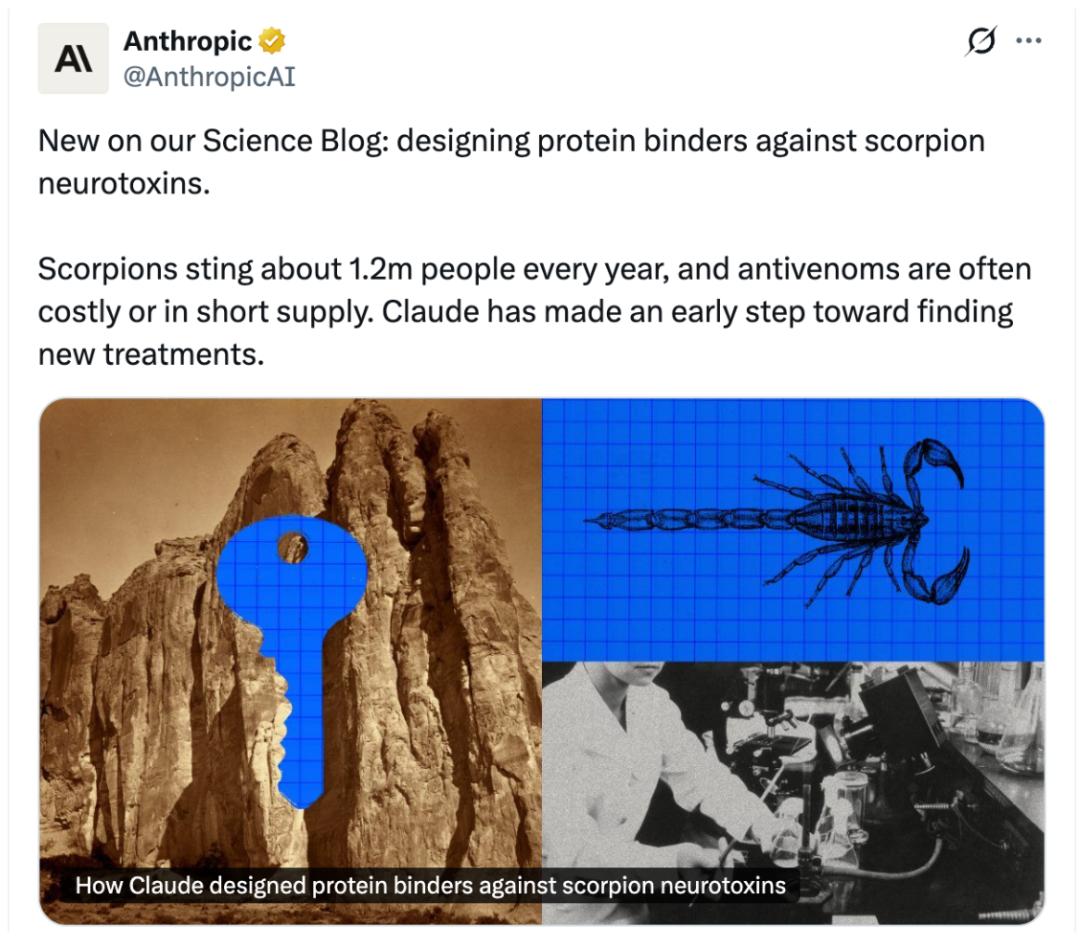
Anthropic said roughly 1.2 million people worldwide are stung by scorpions each year. Traditional antivenom can be expensive and may face supply constraints, and the company described the work as an early step in exploring new treatment approaches through AI-designed proteins that bind scorpion neurotoxins.
Why the study focused on scorpion toxins
The research said more than 1.2 million scorpion stings occur globally each year, causing more than 3,250 deaths. Conventional antivenom is produced through animal immunization, carries high costs, and covers a limited range of toxins, leaving scorpion envenomation as a public-health problem that has seen limited research investment.
Anthropic worked with investment research firm Citrini Research on the project. The goal was to use AI to design small proteins from scratch that can bind scorpion neurotoxins, described in the report as minibinders.
The study said some scorpion neurotoxins bind to sodium ion channels on nerve cell membranes and disrupt neural signaling. In severe cases, that can lead to heart failure or pulmonary edema. The idea behind the project was to design proteins precise enough to occupy the interaction site first and block the toxin from acting on the channel.
Five toxins, 318,484 designs, and 211 lab-tested candidates
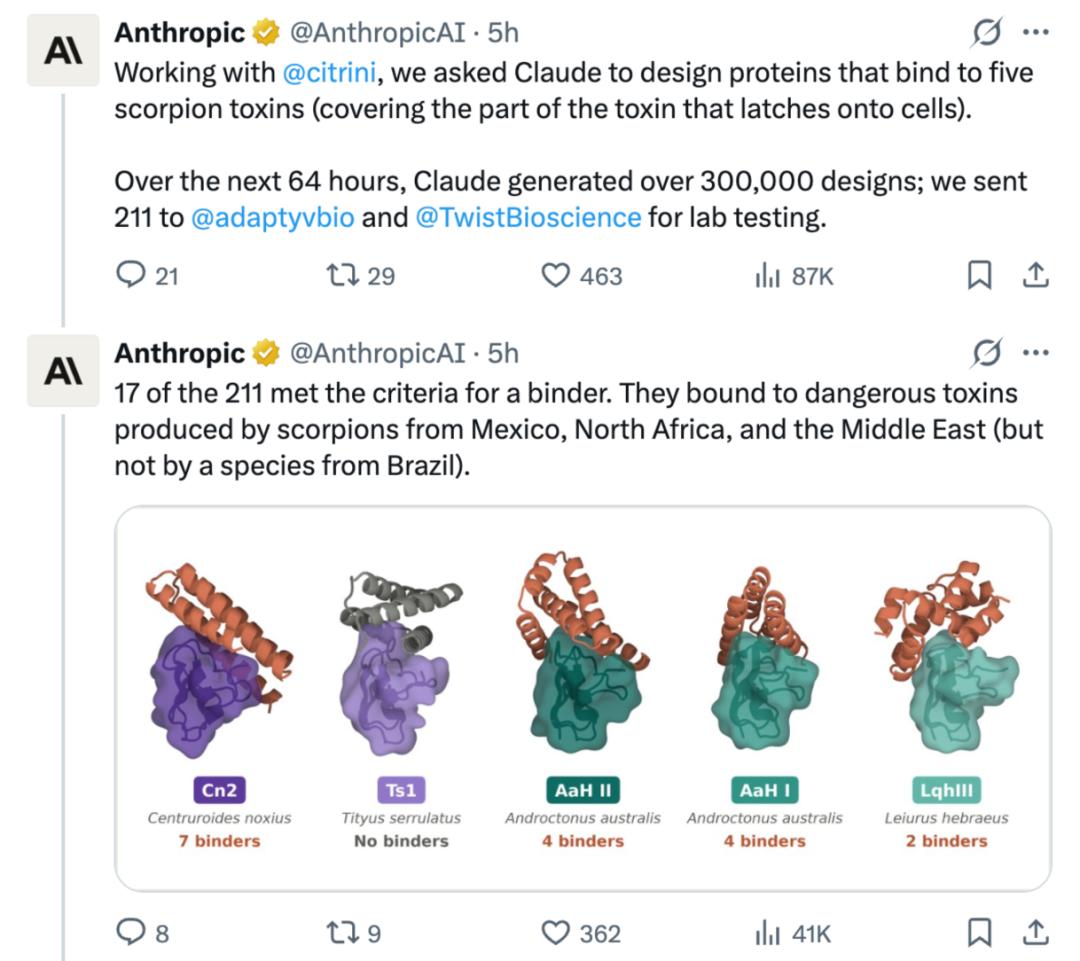
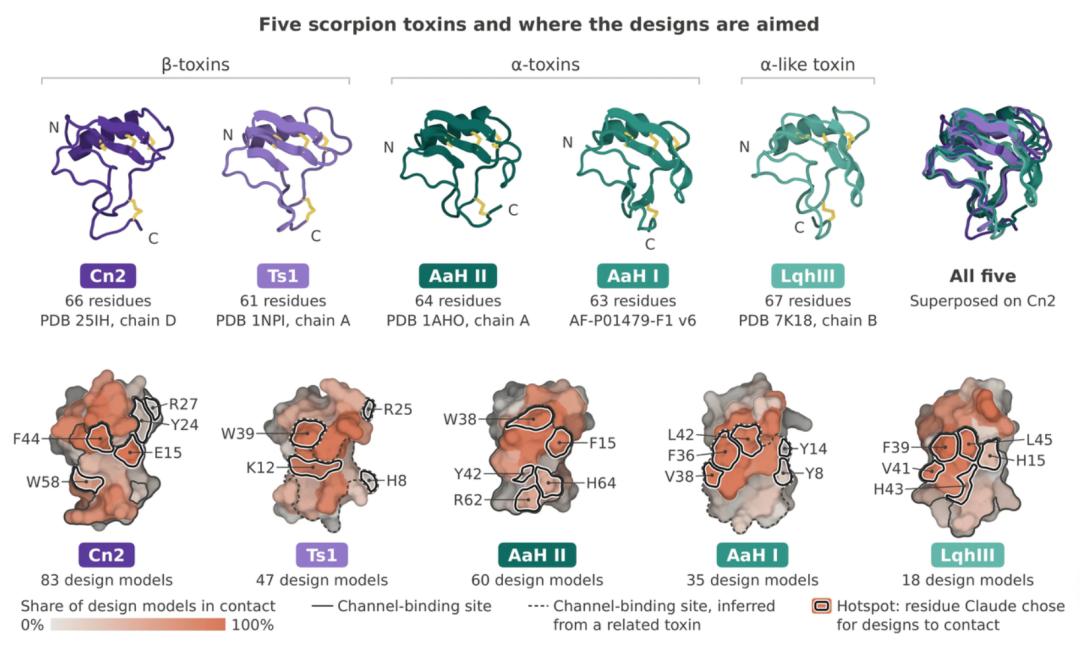
The experiment used five scorpion neurotoxins from Mexico, Brazil, North Africa, and the Middle East: Cn2, Ts1, AaH I, AaH II, and LqhIII.
Claude analyzed the protein structures and key binding sites for the five toxins and designed candidate binders on that basis. The report said the visual materials showed 3D toxin structures and the potential binding regions selected by Claude.
Claude generated 318,484 candidate protein designs and initially selected 180. With Claude's assistance, the research team added 31 more, bringing the total to 211 candidates. Those were sent to Adaptyv Bio and Twist Bioscience for experimental validation.
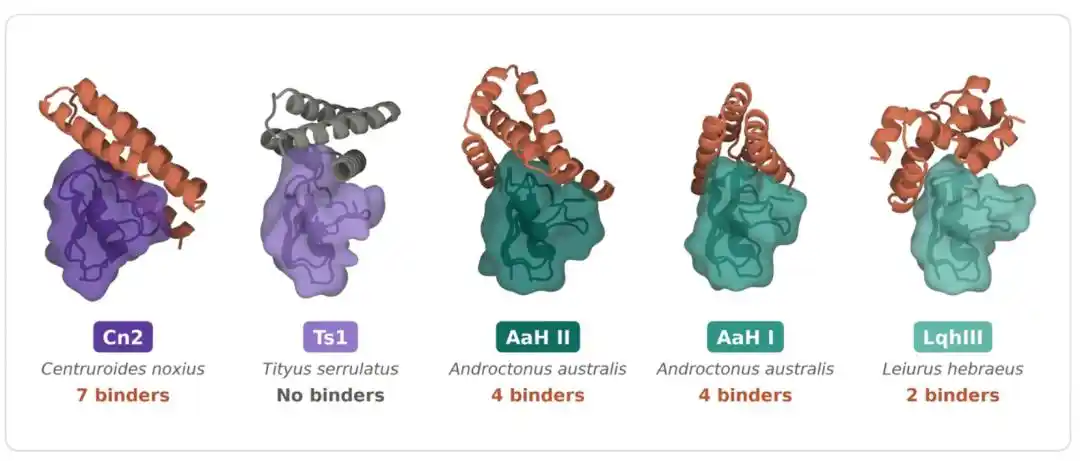
In the end, 17 designs met the team's binding standard. Of those, 7 bound Cn2, 4 bound AaH I, 4 bound AaH II, and 2 bound LqhIII. No design targeting Ts1 passed screening.
The study also said Claude struggled when asked to design proteins that could bind multiple toxins at once. One aim had been to find broader binders that might reduce the number of molecules needed in a future antivenom formulation. But all 17 validated proteins were confirmed to bind only one toxin, and none met the standard for multi-toxin binding.
For single-toxin binders, 11 of 60 specialized candidate designs passed screening, for a success rate of about 18%. Anthropic said that level is broadly in line with typical protein-design studies.
Cn2-B1 and Cn2-B2 drew the most attention
Among the validated molecules, the report highlighted two candidates against Cn2: Cn2-B1 and Cn2-B2.
Both showed strong binding in experiments, with dissociation constants, or KD, in the single-digit nanomolar range. The study noted that lower KD values generally indicate tighter binding between a molecule and its target.
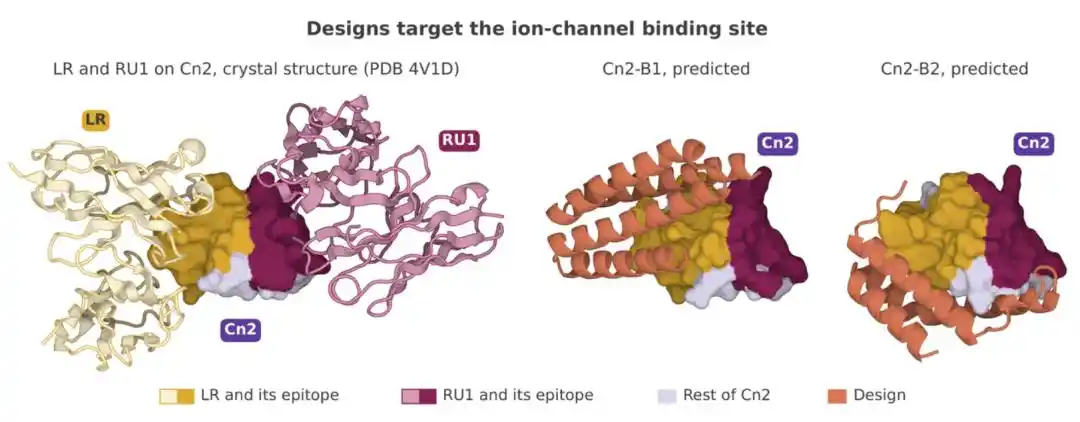
The team also carried out competition-binding experiments. It found that the two proteins may bind at the same or a nearby site as LR, a known neutralizing antibody. Prior research had already shown that LR can neutralize Cn2 toxin in mice.
The report also showed predicted binding structures for Cn2-B1 and Cn2-B2 with the Cn2 toxin and compared them with the binding sites of known antibodies LR and RU1. On that basis, the study said the two candidates may warrant further research.
Still, the current experiments only established binding between the proteins and the toxin. They did not show that the proteins can neutralize scorpion venom. The researchers have not yet run cell-level neutralization tests or animal studies to verify protective effects.
What Claude handled during the 64-hour run
Anthropic said the project was designed to let Claude organize much of the protein-design workflow. In a conventional setup, researchers use multiple tools for structural analysis, candidate generation, binding prediction, and screening. In this study, the team first specified the target toxins, available tools, and screening rules. Claude then retrieved protein structures, chose design tools, set screening criteria, and kept adjusting the design plan.
Across the process, Claude used 12 protein-design tools, generated 318,484 candidate designs, and ran structure predictions on more than 550,000 toxin-protein combinations.
After receiving the initial prompt, Claude ran autonomously for 24 hours. Researchers then added four more prompts to steer further optimization. The full computational design phase lasted 64 hours, and Claude selected 180 candidates by the end of that stage.
The report said Claude also handled the task of sending protein sequences to the labs based on researcher instructions. Anthropic presented that as evidence that Claude can take on planning, analysis, and tool coordination across a larger portion of the research process while adjusting its approach as intermediate results come in.
Human involvement remained part of the workflow. Researchers set the goals, added prompts, and supplemented designs, while protein synthesis and validation were carried out by specialist labs. Anthropic also said the 64 hours covered only the computational design phase and consumed about 10,000 GPU hours.
How this compares with Anthropic's August study
This was not Claude's first protein-design effort. Anthropic said that in August this year it released another study in which Claude worked on 15 protein targets, with 14 yielding experimentally validated binders.
Compared with that earlier work, the new study pushed into a more specific biomedical problem and showed Claude coordinating a more complex research workflow beyond protein design alone. Anthropic has released all 211 candidate designs and the related experimental data for other researchers to examine further.
AI is being applied across more of the biomedicine workflow
The report also pointed to other companies moving into adjacent parts of the field. Radical Numerics released its genomic foundation model Omnii-1 and said an AI-designed bacteriophage had been authorized for compassionate use in a patient with a drug-resistant bacterial infection. The company said the phage had passed laboratory bacterial-killing tests and received authorization for patient treatment.
Bacteriophages are viruses that infect bacteria and, under certain conditions, can be studied as treatments for bacterial infections, especially where standard options are limited, including drug-resistant cases. Compared with designing toxin-binding proteins, the bacteriophage case reaches closer to actual treatment use in a medical setting.
At the same time, OpenAI said it would acquire biopharma AI company Orchestra Bio and integrate its team and technology into Rosalind, OpenAI's life sciences platform.
The report said the acquisition focuses less on protein design itself and more on coordinating and managing research projects in drug development. In April this year, OpenAI launched GPT-Rosalind for life sciences research to help scientists work through complex questions in biology, drug development, and translational medicine. Rosalind Workbench was described as a layer that connects scientific tools and data to help researchers analyze results and plan experiments.
Orchestra Bio's main role, according to the report, is to help biopharma teams coordinate cross-functional R&D work, track experiment progress, and identify dependencies across tasks. One example given was that a failed manufacturing batch in drug development can affect the start date of a later clinical trial. Orchestra's agent can help trace the affected tasks, gather relevant information, and compare response options for researchers and project leads.
From Anthropic's scorpion-toxin binder project, to Radical Numerics using an AI-designed therapeutic candidate in a patient, to OpenAI trying to coordinate drug-development workflows, the report framed the three efforts as covering different parts of biomedical R&D.
For Anthropic's study itself, the result remains at the stage of validating protein-toxin binding. More testing and verification would still be needed before any actual antivenom drug could emerge. As the report put it, finding a potentially useful molecule on a computer is only the start of drug development.